Last updated 2026-08-20
TL;DR
A site services yard is the land base for portable restrooms, roll-offs, fence, and similar site gear. Year one goes zoning first, then entity and a free IRS EIN, then trucks that may need a USDOT number at 10,001 pounds. Environmental paper follows oil tanks and wash water. Confirm every form with the planner and the state board. No honest national approval date exists.
What is a site services yard?
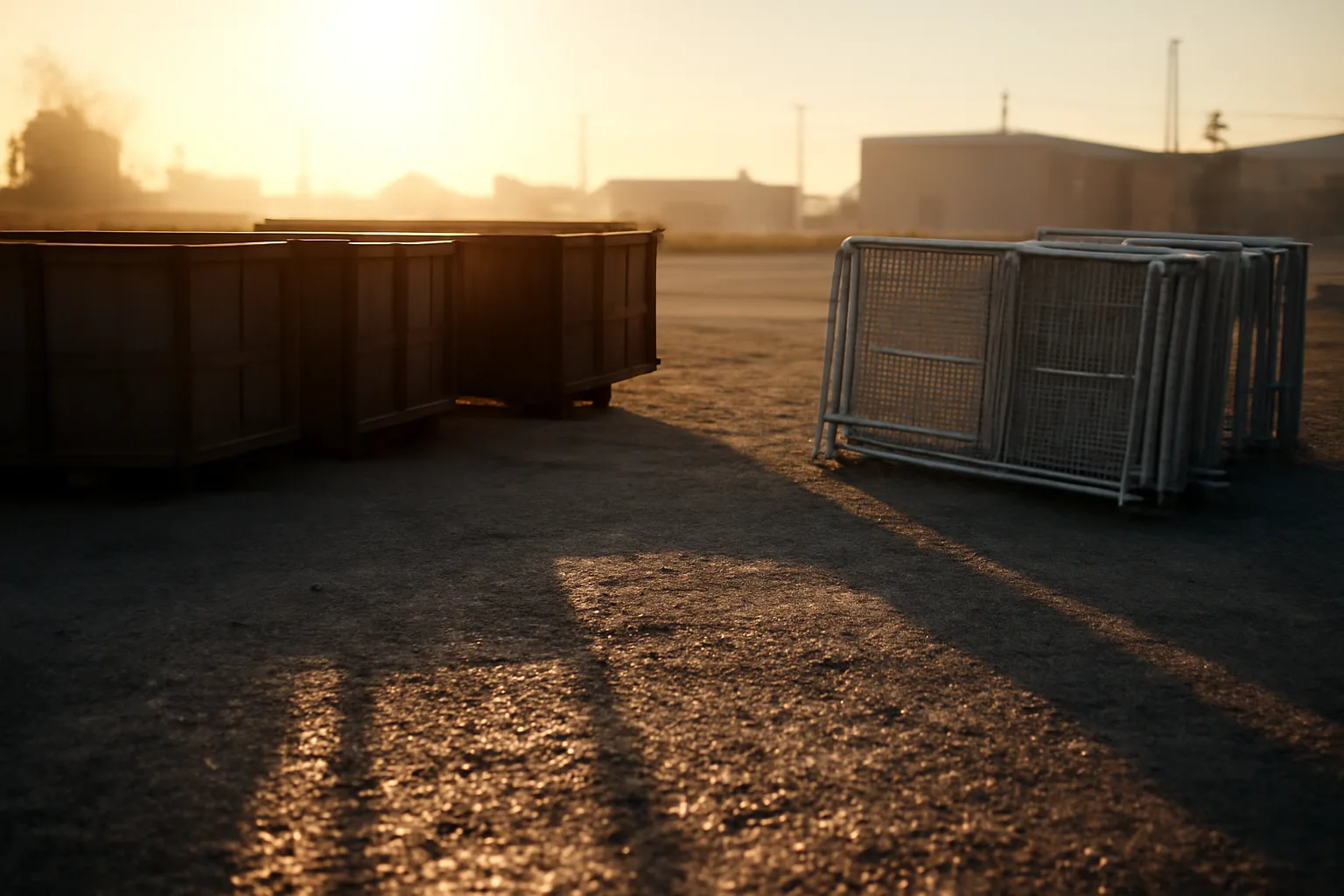
A site services yard is the home base for gear that construction sites, utilities, and events borrow for a while and send back dirty. Portable restrooms. Roll-off boxes. Temporary fence. Storage containers. Water tanks. Light towers. The yard is where that fleet sits, gets washed, gets repaired, and gets dispatched.
There is no single federal license class for it. The Census Bureau splits the work across more than one NAICS code. Portable toilet rental and service sits in 562991 (Septic Tank and Related Services). Roll-off hauling often sits in 562111 (Solid Waste Collection). Your paper stack follows the work you actually do, not a slogan on the truck door. [1][2]
Census describes 562991 as establishments "primarily engaged in (1) pumping septic tanks and cesspools or (2) renting and/or servicing portable toilets." That is the closest official definition if toilets are your core. [1]
People hunt for site services yard advice because the land is the hard part. Units are easy to buy. A legal place to store, wash, and stage them is not. Neighbors complain about trucks and odor. Cities treat outdoor storage as an industrial use. Waste franchises can block roll-offs. Septage rules can block toilet pumping.
If you only rent fence and containers and never haul waste or pump tanks, your paper is lighter. Wash units over bare dirt and it gets heavier fast. The yard is an industrial activity sitting on a parcel. Treat it that way from day one.
Confirm every piece with the city planner and the state board that actually owns that permit. A national checklist cannot see your zoning map.
How do you start a site services yard?
You start a site services yard by locking the land use first, then the entity, then the trucks, then the units. Most people reverse that and pay for it.
The U.S. Small Business Administration still frames a launch as 10 steps: research, plan, fund, pick a location, pick a structure, pick a name, get tax IDs, get licenses, open a bank account, get insurance. That list is generic. For this trade, the location step is the one that kills deals. [5]
Do this, in order. Talk to planning and zoning about outdoor storage, truck traffic, wash water, and hours before you sign a lease. Get the answer in writing if you can. Form the entity your lawyer and CPA actually want. LLC is common. It is not magic. Read the IRS business structures page so you know how the IRS will tax it. [4]
Get a free EIN from IRS.gov. The IRS does not charge for an EIN. Ignore anyone who does. [3]
Open a business bank account. Keep fuel and unit purchases off your personal card. Price insurance (auto liability, general liability, inland marine on the fleet, workers comp if you have W-2s) before you buy the third trailer. Only then buy or lease units.
State paper is not one form. California is not Alabama. If you are actually opening in a named state, use a state guide rather than this national walkthrough. Start with how to start a site services yard in California or how to start a site services yard in Colorado if that is your map. Alabama readers should use how to start a site services yard in Alabama instead of inventing a national form.
I would not buy a turnkey route in year one unless you can read the contracts, the franchise overlay, and the truck titles. A lot of those packages are tired units and a customer list that already called three other yards.
What paper do you need before you move the first unit?
You need proof you can occupy the land, proof the IRS knows you exist, proof a bank will take your deposits, and proof you are allowed to roll the specific units you bought. Everything else can stack in the first quarter. Occupancy cannot.
Here is the minimum pile before dispatch. Entity documents and the EIN confirmation letter. [3] A local business license or tax certificate (city or county, sometimes both). SBA's license step is a pointer, not the permit. Confirm the actual form with the clerk. [5] Zoning clearance, occupancy, or a special use permit if outdoor storage is conditional. A written wash-water plan, even if nobody asked yet. Auto and general liability binders. Inland marine on rented units, because a stolen box is your problem.
Hire anyone and you complete Form I-9 on day one. USCIS requires it for every employee hired in the United States. [13]
Do not wait on a credential named site services yard license. Many states do not issue that named paper. They issue a business tax registration, a waste hauler permit, a septage pumper license, a transporter permit, or nothing extra. Call the board that matches the work. For Alabama paper see site services yard license in Alabama. For Arizona see site services yard license in Arizona.
IRS Publication 334 is the small-business tax guide you should skim before you mix personal and yard money. It is dry. It will save you a messy Schedule C. [14]
I would not spend money on custom software or a leased LED billboard in month one. A numbered unit list, a camera at the gate, and invoices that match the contract will carry you farther.
How does zoning decide if your yard can even open?
Zoning decides whether outdoor storage, truck traffic, and washing are legal on that parcel. If the use is not allowed, you do not have a first year. You have a lawsuit and a pile of unsellable units.
Most first-year yards want cheap land on the edge of town. That land is often agricultural, residential, or a light industrial park that bans outdoor storage and overnight trucks. A handshake with the landlord is not a permit.
Ask planning these questions, out loud. Is outdoor storage of portable sanitation units, containers, or fence a permitted use, a conditional use, or prohibited? Do you need a special use permit or a variance, and what is the hearing calendar? Are there screening, setback, or paving rules? Is a wash pad allowed, and where does the water have to go? What are the truck-route and hours-of-operation limits?
Budget time for a conditional use hearing. I would not budget a made-up fee here, because every planning department prices hearings differently. Confirm with that board. Nobody has good national data on how long those hearings take. The closest honest answer is the published calendar on that city's planning page.
Grade more than an acre to build the yard, or make your pad part of a larger common plan of development, and EPA's 2022 Construction General Permit (or the authorized state CGP) can apply. The CGP is for operators of construction activities disturbing one or more acres. That is dirt work to build the lot, not the rental business itself. [10]
Home driveways are a bad plan. Neighbors will call. Insurers will squirm. A real industrial or heavy commercial parcel costs more per month and costs less in forced moves.
When do trucks trigger USDOT, CDL, and new-entrant rules?
Trucks trigger federal registration when you operate a commercial motor vehicle in interstate commerce at 10,001 pounds GVWR or more. FMCSA says you need a USDOT Number if the vehicle "Is used to transport the types of passengers or property described in interstate commerce AND Has a GVWR or GCWR, or GVW or GCW, of 10,001 pounds or more." [6]
Most roll-off trucks clear that weight in their sleep. Many fence and toilet trailers behind a one-ton do too, once you add the load. Weigh the combination. Do not guess.
Interstate versus intrastate matters. Crossing a state line with a CMV is the clean federal case. Purely in-state work can still pull you into a state DOT number. Confirm with your state motor carrier office. I will not invent their form names or their current fees.
A new interstate motor carrier falls under FMCSA's New Entrant Safety Assurance Program. New entrants get monitored and receive a safety audit. Fail that audit and they can revoke your registration. [15]
CDL rules sit on a different hinge (weight ratings, air brakes, placards). A class of license is not the same as a USDOT number. Your insurance desk will ask for both. Your driver who has run farm trucks for years still needs the right class if the truck requires it.
I would put every truck on a preventive maintenance sheet from week one. FMCSA cares about brakes and inspections. Your insurer does too. Fancy telematics can wait until you have a second truck that actually moves every day.
What environmental paper hits a first-year yard?
Environmental paper hits when you store oil, wash dirty units, disturb an acre of dirt, or discharge industrial stormwater. A clean gravel lot with a few fence panels may trip none of this. A toilet wash bay and two diesel tanks will.
EPA's Spill Prevention, Control, and Countermeasure (SPCC) rule can apply to a non-transportation facility with aggregate aboveground oil storage capacity greater than 1,320 gallons. That is drums and tanks counted together, more than the big tank you remember. Keep bulk diesel for the trucks plus waste oil, and you do the arithmetic. [9]
Industrial stormwater is the sneaky one. EPA's 2021 Multi-Sector General Permit covers stormwater discharges associated with certain industrial activities. Whether your yard is in a regulated sector depends on your SIC or NAICS code and what actually leaves the property in the rain. Confirm with the state NPDES program. Do not assume a gravel lot is just dirt. [11]
Pump toilets or handle septage and you have a different stack. State septage hauler licensing. Approved dump sites. Sometimes county health. That is not optional folklore. It is the board that can park your trucks.
Wash water is wastewater. Running a pressure washer into a ditch is how yards get neighbor complaints and agency letters. I would pour a contained pad that drains to a holding tank or an approved sanitary connection. Cheap now. Expensive later.
Hazardous waste is uncommon if you refuse paint, solvents, and mystery drums in your roll-offs. It is common if you do not train drivers to look. Open-tops are not a free dump.
| Service line | Paper you should assume | Who confirms it |
|---|---|---|
| Portable toilets | Septage or sanitary pumper rules, approved dump site, sales tax on rentals | State health and state revenue |
| Roll-off or open-top | Solid waste, possible city franchise, transporter permit | City solid waste and state environmental |
| Temporary fence or storage boxes | Zoning, business license, often no waste permit | Planning and city clerk |
| Any CMV at 10,001 lbs interstate | USDOT number, new-entrant audit | FMCSA |
| Diesel or oil over 1,320 gallons | SPCC plan | EPA or the authorized state program |
What does the first 90 days of a site services yard look like?
The first 90 days look like paper in the morning and dirty units in the afternoon. You will feel behind. That is normal.
Weeks 1 to 2: entity, EIN, bank, insurance binders, utility starts, lock and camera on the gate. Walk the drainage with a hose. Photograph the empty lot so you have a before picture when someone claims you wrecked the drainage.
Weeks 3 to 4: first units arrive. Number them. Photograph every unit on intake. Write a one-page rental contract with delivery, damage, and pickup terms. You do not need a 19-page masterpiece. You need something a GC's AP desk will sign.
Weeks 5 to 8: first deliveries. First no-shows. First "the gate was locked" texts. Build a same-day note habit. Who took the unit, where it sits, who can sign for damage.
Weeks 9 to 12: the first slow-pay invoice. Construction pays when the draw pays. Your diesel does not wait. This is when people start floating the business on a personal card. Do not.
Hire slow. A second driver before you have a dispatch rhythm just adds a second person sitting in the yard. If those people work in construction settings, OSHA's construction standard still wants you to instruct each employee on hazards. 29 CFR 1926.21(b)(2) says: "The employer shall instruct each employee in the recognition and avoidance of unsafe conditions and the regulations applicable to his work environment to control or eliminate any hazards or other exposure to illness or injury." That sentence applies the day they start, not after you get settled. If they only work inside a general-industry yard, 1910 rules may apply instead. Confirm the setup. [7]
With 10 or fewer employees, OSHA's partial recordkeeping exemption in 29 CFR 1904.1 may apply to injury logs. It does not exempt you from keeping people intact. Confirm whether your industry is on the exemption list. [8]
How does cash actually move in the first year?
Cash in year one moves out faster than it moves in. Units, trucks, deposits on the yard, insurance, fuel, and the first payroll hit before the first net-30 check clears.
I do not have a national average cost to open a site services yard that is honest. Land rent in rural Alabama is not land rent on the edge of Denver. Truck prices move. Used toilet inventories move. Anyone giving you a single startup number is selling something. Confirm local rents, confirm insurance quotes, confirm used-unit prices from more than one seller.
Here is what I would model, on a simple sheet. Utilization: how many of your units are on rent, not owned and idle. Delivery density: two drops in one subdivision beat six drops across a county. Damage and contamination: toilets and open-tops come back worse than the brochure. Seasonality: northern yards slow when dirt freezes, southern yards slow when GCs pause between phases. Deposit versus invoice timing: collect delivery fees up front if the GC will bear it.
Want a prebuilt worksheet for shared-yard math (two operators splitting land, wash, and a gate)? SiteServicesPath sells a $249 one-time Shared-Yard Economics Kit. You can also build the same columns in a blank spreadsheet and skip the kit. The math matters more than the brand.
Do not finance a full fleet on a five-year note against a customer list you have not invoiced. Buy a starter set you can keep full. Add units when you have turned away work twice.
BLS Establishment Age and Survival Data exist because a lot of new establishments do not see year two. Pull the latest table yourself. Do not use a motivational speaker's fail-rate line. The numbers change by birth year. [12]
What insurance and tax deposits show up before you feel ready?
Insurance and tax deposits show up as soon as you have a truck, a unit, or a person. Waiting until you feel real is how people drive uncovered.
Expect quotes (not a price from me) on commercial auto, including hired and non-owned if anyone uses a personal truck. General liability. Inland marine or a floater on units off your lot. Property or inland on units sitting in the yard. Workers compensation once you have employees. Some states require it at the first W-2. Confirm with that state. I will not invent a premium.
The year-one tax calendar runs like this. Federal estimated taxes if you are profitable as a pass-through. IRS Publication 334 walks the small-business side. [14] Employment taxes if you have staff. Deposit schedules are not a vibe. They are IRS rules. State sales or rental tax on portable sanitation and container rentals. This is the one first-year owners miss. Confirm with the state revenue department whether your rental is taxable. Personal property tax on units and trucks in some counties. The assessor will find you.
Sales tax on rentals is not uniform. Some states tax portable toilet rental. Some do not. I will not fake a 50-state matrix. Call revenue.
I would keep a one-page calendar with deposit dates and policy audit months. Missing a payroll deposit costs more than a cheap filing cabinet.
What first-year mistakes burn cash at a site services yard?
Buying too many specialty units. The fancy restroom trailer looks like a profit center until it sits 20 days a month.
Skipping the wash-water plan. A notice of violation costs more than a tank.
Signing a five-year lease on land you have not taken through planning.
Hiring a full-time office person before you have a dispatch problem.
Treating GCs like friends on damage. Photograph, timestamp, bill.
Running without a written contract because everyone around here is handshake. Handshakes disappear when a box takes out a car.
Ignoring franchise hauler rules on roll-offs. Some cities give exclusive rights. You can buy trucks and still be illegal to drop a box.
Copying another state's license checklist. Colorado's board path is not California's license path.
Cheap locks and no camera. Units walk.
I would rather own 40 units that stay rented than 120 that fund a storage business you did not mean to start. Expansion is leftover demand you already turned away, not a personality trait.
How do you confirm facts with the board instead of a national myth?
You confirm facts by calling the agency that can fine you, asking for the form name, and writing down the date and the person's desk. National blogs flatten 50 states into one story. That story is wrong.
Use this call list. City or county planning: use, hearings, wash water, screening. City clerk or tax: business license. State revenue: sales tax on rentals, withholding. State environmental or health: septage, solid waste transporter, stormwater. State motor carrier or DMV: intrastate USDOT equivalent, IRP, IFTA if you fuel across lines. State contractor board: only if you are bidding work that is actually construction. Rental and delivery often is not. Confirm. See site services yard license in Colorado as an example of a state-shaped stack.
Your insurer's loss-control person has seen the fire and the stolen skid steer. Ask them what they would refuse to write.
Ask "What is the form number?" and "What would make this application bounce?" Do not ask if you are good.
Nobody has a clean national dataset on how long these local permits take. Processing time is a local fact. Anyone who guarantees a date is guessing. Confirm with that board. This page is not legal advice and it is not an approval.
What should you revisit at month 12?
At month 12 you revisit utilization, renewals, and whether the land still fits.
Pull 12 months of invoices. What share of revenue came from your top three customers? If it is most of it, you do not have a yard yet. You have a couple of GCs.
Renew whatever local license expires on a calendar year. California renewals are their own path (site services yard renewal in California). Other states differ. Confirm the date and the form with that board. Do not trust a blog anniversary.
Insurance audit. Workers comp will want payroll. Auto will want VINs and radii. Underreport and you will pay.
Tax: depreciation on units, fuel, repairs, and whether you mixed personal miles. Publication 334 again. [14]
Stormwater and SPCC: did you add tanks this year? Recount the gallons against the 1,320 gallon aboveground trigger. [9]
People. Are the I-9s complete? [13] Do training notes exist for the hazards they actually see? [7]
Decide if you expand units, add a second yard, or stay put. Want a structured start checklist after this page? Go to /start. SiteServicesPath is an independent publisher, not a law firm and not a service company. Nothing here is approval, legal advice, or a timing promise.
Frequently asked questions
What is a site services yard?
A site services yard is the land base for portable restrooms, roll-offs, temporary fence, and similar gear that leaves for a job and comes back dirty. It is not one federal license. Census NAICS 562991 covers toilet rental and service. NAICS 562111 often covers roll-off collection. Confirm your actual use with planning and the state board that owns that work.
How do you start a site services yard?
Lock zoning for outdoor storage and wash water before you sign a lease. Then form the entity, get a free IRS EIN, open a business bank account, and bind insurance. Buy units last. Follow SBA's generic 10-step launch, but treat location as the step that fails first. Confirm every local form. Do not copy another state's checklist.
Do I need a contractor license to open a site services yard?
Often no, if you only rent and deliver units. Sometimes yes, if you bid work the state treats as construction. That line is a state contractor board fact, not a national rule. Ask the board what activities require a license. Rental plus drop-off is frequently outside that statute. Confirm before you print the word contractor on a proposal.
How much land does a first-year site services yard need?
Enough paved or well-drained area for the units you own, truck turnaround, a contained wash pad, and screening the city will require. There is no honest national acreage number. A starter toilet and fence mix can fit a small industrial lot. Roll-offs need more turning room. Ask planning about setbacks before you count spaces on a napkin.
What licenses does a site services yard need in year one?
Expect a local business license, zoning or occupancy paper, and then work-specific permits. Toilets can pull septage rules. Roll-offs can pull solid waste or franchise rules. Trucks can pull USDOT or a state carrier number. There is often no credential literally named site services yard. Confirm form names with the clerk, health, environmental, and motor carrier desks.
Do I need a USDOT number for site services trucks?
FMCSA requires a USDOT Number if you operate a CMV in interstate commerce at 10,001 pounds GVWR, GCWR, GVW, or GCW or more. Many roll-off and loaded trailer combinations clear that weight. Purely intrastate work can still need a state number. Weigh the combination and confirm with FMCSA and your state motor carrier office.
Does a site services yard need a stormwater permit?
It might. EPA's industrial stormwater program (the 2021 MSGP or the state permit that replaced it) applies to certain industrial activities that discharge stormwater. Building the yard can also trip the Construction General Permit if you disturb one or more acres. Confirm with the state NPDES program. A gravel lot is not automatically exempt.
Can I run a site services yard from my house?
I would not. Outdoor storage, truck traffic, odor, and wash water are why cities write industrial zoning. Home lots and HOAs blow up fast. Insurers get nervous. If you only keep a laptop at home and stage units on a permitted industrial parcel, that split can work. Confirm home-occupation rules before you park a box in the driveway.
What insurance does a first-year site services yard carry?
Plan on commercial auto, general liability, and inland marine or a floater on units that leave the lot. Add workers comp when you have employees, on the timetable your state requires. Premiums are quotes, not a blog number. Ask the carrier what they exclude for theft, contamination, and on-hook cargo. Bind coverage before the first delivery.
Is portable toilet rental the same paper as roll-off dumpsters?
No. Toilet service often sits in NAICS 562991 and can pull septage hauler rules and approved dump sites. Roll-offs often sit in NAICS 562111 and can hit solid waste transporter rules and city franchise grants. Fence and storage boxes are usually lighter. Mix the lines and you inherit both stacks. Confirm each line with the matching board.
How much does the first year of a site services yard cost?
There is no honest single number. Land rent, used units, truck notes, and insurance quotes vary by market and by what you haul. Model utilization, delivery density, and invoice lag instead of chasing a national average. Confirm rents and premiums locally. Anyone selling one startup price is not pricing your parcel.
When does EPA SPCC apply to a yard?
EPA's SPCC rule can apply to a non-transportation facility once aggregate aboveground oil storage capacity exceeds 1,320 gallons. Count diesel tanks, waste oil, and drums together. If you are over the threshold, you need a plan that matches 40 CFR 112. Confirm applicability and any state overlay before you add the next tank.
Do I need CDL drivers in year one?
You need the class of license the truck and load require, which may be a CDL. That is separate from a USDOT number. Weight ratings, air brakes, and combinations decide it. A farm-truck habit is not a license. Check the actual GVWR and GCWR on the door sticker and confirm with your state driver license office.
Who do I call to confirm my site services yard paper?
Call planning first, then the city clerk, state revenue, state health or environmental, and the state motor carrier desk. Ask for form numbers and bounce reasons. Processing times are local. This site is an independent publisher, not a law firm and not a service company. Confirm fees and dates with the board that can fine you.
Sources
- U.S. Census Bureau, NAICS 562991 Septic Tank and Related Services (2022): NAICS 562991 covers establishments primarily engaged in pumping septic tanks and cesspools or renting and/or servicing portable toilets.
- U.S. Census Bureau, NAICS 562111 Solid Waste Collection (2022): Roll-off and similar collection activity is classified under NAICS 562111 Solid Waste Collection.
- IRS, Apply for an Employer Identification Number (EIN) Online: Businesses can apply for an EIN online through IRS.gov, and the IRS application itself is the official no-charge path.
- IRS, Business Structures: The IRS explains how sole proprietorships, partnerships, corporations, S corporations, and LLCs are taxed.
- U.S. Small Business Administration, 10 steps to start your business: SBA frames startup as 10 steps including location, structure, tax IDs, licenses, banking, and insurance.
- FMCSA, Do I need a USDOT number?: A USDOT Number is required for a CMV used in interstate commerce at 10,001 pounds GVWR, GCWR, GVW, or GCW or more.
- OSHA, 29 CFR 1926.21 Safety training and education: 29 CFR 1926.21(b)(2) requires employers to instruct each employee in recognizing and avoiding unsafe conditions.
- OSHA, 29 CFR 1904.1 Partial exemption for employers with 10 or fewer employees: OSHA provides a partial injury-and-illness recordkeeping exemption for certain employers with 10 or fewer employees.
- EPA, Spill Prevention, Control, and Countermeasure (SPCC) rule: The SPCC rule can apply when aggregate aboveground oil storage capacity exceeds 1,320 gallons.
- EPA, 2022 Construction General Permit (CGP): The CGP covers operators of construction activities disturbing one or more acres, or smaller sites in a larger common plan.
- EPA, Stormwater Discharges from Industrial Activities: EPA's 2021 MSGP: EPA's 2021 Multi-Sector General Permit covers stormwater discharges associated with certain industrial activities.
- U.S. Bureau of Labor Statistics, Establishment Age and Survival Data: BLS Business Employment Dynamics publishes establishment age and survival tables, including first-year survival by opening year.
- USCIS, Form I-9, Employment Eligibility Verification: U.S. employers must complete Form I-9 for each individual they hire for employment in the United States.
- IRS, Publication 334, Tax Guide for Small Business: Publication 334 is the IRS tax guide for small businesses, including recordkeeping and common deductions.
- FMCSA, New Entrant Safety Assurance Program: New interstate motor carriers are subject to FMCSA's New Entrant Safety Assurance Program, including a safety audit.