Last updated 2026-08-21
TL;DR
A site services yard is the fenced depot where you stage roll-offs, toilets, fence, and small gear between jobs. Start with an entity and EIN, then a parcel your zoning office actually allows. Match federal triggers next: 1 acre of disturbance, 1,320 gallons of oil, or 10,001-pound interstate trucks. Confirm every local license with the board that issues it. There is no national yard license.
What is a site services yard?
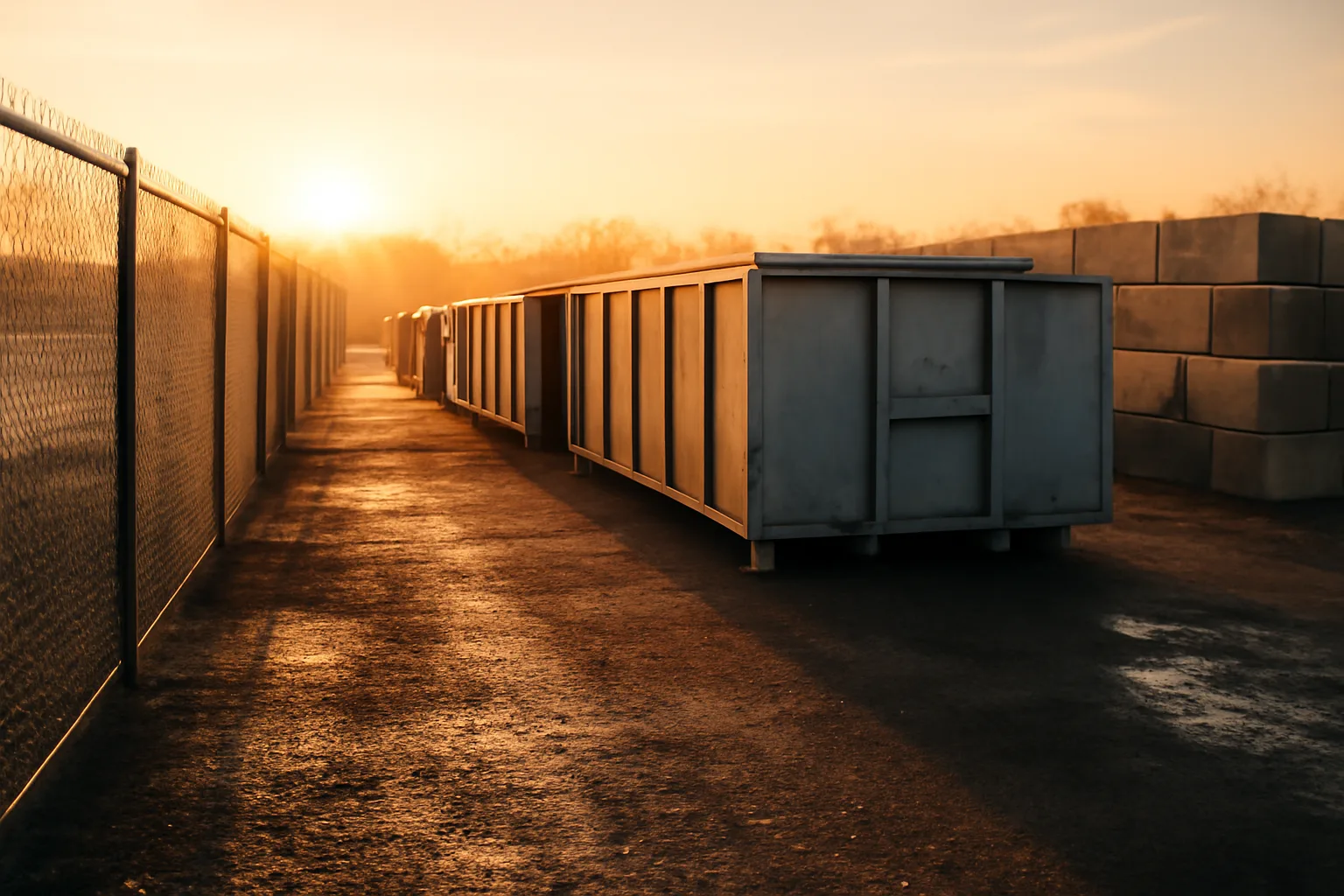
A site services yard is the private depot where a site-services operator stages roll-offs, portable toilets, temporary fence, tanks, and the trucks that move them between jobs. It is not a landfill. It is not a public transfer station unless you take other people's waste and a state program says it is.
The yard is land plus the paper that land creates. The service is what you invoice. You can sell site services from a rented corner of someone else's lot. Once you control the parcel, zoning, drainage, oil storage, and truck rules attach to you.
Most yards sit on industrial or heavy commercial ground. You park assets, do light repair, and build morning loads. Some add a small office. Some share a fence line.
I do not treat a site services yard as one federal license class. The United States does not issue a site services yard license. Your stack comes from what you store, what you spill, what you haul, and what your zoning table calls the use.
Empty boxes and fence look like contractor storage. On-site fueling, toilet pumping, or inbound waste makes the paper thicker. Get that split right before you print cards.
People want a single building type and a single permit name. They will not find one national name. Cities use contractor's yard, outdoor storage, equipment storage, or a special use. Those labels are not interchangeable. Ask planning which row of the use table they will apply to your mix.
If customers never enter, you still have inspectors. Fire, zoning, and stormwater staff will. Plan the lot for them.
How do you start a site services yard?
You start on paper, not on gravel. Form an entity your state recognizes, get a free EIN from the IRS, then get a written zoning determination for a specific parcel before you sign a long lease.[1][2]
SBA puts the entity choice in plain language: "Your business structure affects how much you pay in taxes, your ability to raise money, the paperwork you need to file, and your personal liability."[1] I use an LLC or a corporation for any yard with trucks and public visitors. A sole prop is a bad fit once someone can get hurt on your lot.
After the entity, walk the real triggers. Will you disturb one or more acres when you build the lot? That can pull in construction stormwater coverage under EPA's 2022 Construction General Permit, or your state's version of that permit.[5] Will you store more than 1,320 gallons of oil or fuel aboveground? That is the SPCC line.[3] Will any truck run interstate at 10,001 pounds GVWR or more? That is USDOT number territory.[8] Will the shop make more than 100 kilograms of hazardous waste in a month? That changes your generator class.[9]
Then you do local paper. Business tax receipt, occupancy, fire inspection, maybe a conditional use permit. Those names and amounts change by city. Confirm them with the clerk and the planning counter. I would not order a fleet of boxes or pour a pad until planning has the use in writing.
Hiring comes after the lot is legal to occupy. Federal minimum wage is $7.25 an hour and has been since July 24, 2009, per the U.S. Department of Labor, though your state floor is often higher.[13] Nonexempt staff get overtime after 40 hours in a workweek under the FLSA.[12] You complete Form I-9 for each hire.[15]
That is the start path. It is boring. It is also how you avoid a stop-work tag on week three.
What paper do you file before you lease the lot?
Get four documents in your hands before you wire a deposit you cannot stand to lose.
First, articles or a certificate of organization from your state, plus an EIN confirmation from IRS. The EIN application is free on IRS.gov.[2] Anyone charging you a government-looking fee for that number is running a sideline you do not need.
Second, a zoning letter or stamped pre-app notes that name your use. Ask planning to say, in writing, whether outdoor storage of roll-offs, toilets, and fence is allowed, conditional, or banned. Industrial on a listing flyer is not a determination.
Third, a site plan you can actually build. Show parking, pile limits, wash area, fuel, and drainage. Fire and public works will argue about those later. Better to argue on a PDF than on poured concrete.
Fourth, a lease that lets you do the use and hold the permits. If the landlord forbids outdoor storage or liquid waste, you do not have a yard. You have a fight.
I skip glossy broker packets. I walk the drainage. If the lot sheets to a ditch, assume someone will ask about industrial stormwater.[6][7]
Do you need a special license to run a site services yard?
No single federal license exists for a site services yard. You collect activity licenses that match the work, then you confirm each one with the board that issues it.
Hauling waste often needs a local or state hauler registration. Pumping portable toilets often needs a septage or wastewater hauler credential from the state health or environmental agency. Renting gear may need a sales tax permit and, in some cities, a rental license. None of those is the yard license. They attach to the route.
Contractor licenses are a separate trap. If you only store and deliver your own assets, many states do not treat you as a construction contractor. If you install fence, set tanks, or disturb land for a customer, you may cross into licensed contracting. Confirm with your state contractor board. I would not take a we-will-license-you-later job on the first route.
If you handle other people's waste on the lot, you may have walked into solid waste facility rules. A transfer station is not a parking lot. States care about that line. Ask the solid waste program, not a comment thread.
Insurance is not a license, but many cities will not issue occupancy without a certificate. I cover the buy list in Site services yard insurance you actually need to buy and related certificate notes in site services yard guide 11.
What zoning and land-use rules actually apply?
Zoning is local. The same pile of boxes can be fine in one county and a code case next door.
Typical fights are outdoor storage, screening, hours, truck routes, and how the code defines a contractor's yard. Some codes lump toilets and dumpsters with junk yards. Some allow them in an industrial district with a fence. You will not know until you read the use table and talk to the planner assigned to your parcel.
Conditional use permits take hearings. I cannot quote a national timeline or fee because there is not one. Anyone who gives you a standard six weeks number is guessing. Confirm process and current charges with the planning board that will vote.
I would spend money on a land-use lawyer or a planner who has sat in that city's hearings. I would not spend money on a national license package that prints generic forms.
Watch deed restrictions and industrial park covenants. They can ban portable toilets or overnight trucks even when the city would allow them. Read the recorded docs.
If neighbors can see the lot from a collector road, budget for slats or a wall. That is aesthetics. It is also how you keep the CUP.
Which environmental permits hit a typical yard?
Match the activity, not the vibe. A quiet gravel lot can still trip federal paper.
Construction stormwater comes first if you build the yard. EPA's 2022 Construction General Permit applies to operators of construction activities that disturb one or more acres, or less than one acre if the work is part of a larger common plan of development or sale, in areas where EPA is the permitting authority.[5] Many states run their own CGP. If you grade a two-acre lot, this is real. If you lease a paved site and change nothing, it may not apply. Confirm with the state NPDES desk.
Industrial stormwater is the one operating yards miss. 40 CFR 122.26 sets up permitting for stormwater discharges associated with industrial activity.[7] EPA's 2021 Multi-Sector General Permit is the federal version.[6] Yards with vehicle maintenance, fueling, or certain waste and transportation classifications often fall in. Some sites file a no-exposure certification instead of a full SWPPP. I would rather keep materials under roof and file no-exposure than write a plan I will not follow.
Oil storage has a hard number. EPA states: "A facility is covered by the SPCC rule if it has an aggregate aboveground oil storage capacity greater than 1,320 U.S. gallons or a completely buried storage capacity greater than 42,000 U.S. gallons and there is a reasonable expectation of an oil discharge to navigable waters or adjoining shorelines."[3][4] Count totes, drums of 55 gallons and up, and tanks. Diesel for the fleet counts. A 1,000-gallon tank plus a few drums can put you over. SPCC is a plan you keep on site.
Used oil from the shop has its own management rules under EPA's used-oil program.[14] Do not dump it in a roll-off.
Hazardous waste is the shop surprise. Solvents, some paints, and certain residues can make you a generator. VSQGs stay at 100 kilograms or less per month of hazardous waste, or one kilogram or less of acutely hazardous waste.[9] Cross the line and the record rules jump. I keep a simple waste log from week one.
Wash water is the sleeper. If you wash toilets or trucks and the water hits a storm drain, you have a discharge problem. I plumb wash pads to sanitary sewer only with written permission from the utility, or I use a closed system.
Trigger | Threshold | Typical paper | Confirm with Aboveground oil | 1,320 U.S. gallons | SPCC plan | EPA and your state oil program Land disturbance | 1 acre (or part of a larger plan) | CGP or state CGP | State NPDES authority Industrial runoff | listed industrial activity | MSGP, state ISW, or no-exposure | State NPDES authority Hazardous waste | 100 kg per month | generator class rules | State RCRA program
When do trucks force USDOT and CDL paper?
Read FMCSA's own test against your actual trucks, not against a forum post. Interstate commerce plus a GVWR, GCWR, or actual weight of 10,001 pounds or more is the common cargo trigger for a USDOT number.[8] Hazardous materials and passenger rules are separate and stricter.
Intrastate-only fleets still often need a state DOT number. Confirm with your state patrol or motor carrier office. I would not assume we never cross a state line saves you from all truck paper. Weight stations inside your state still exist.
CDL rules attach to the vehicle class and the cargo, not to your trade name. A roll-off truck is often a Class B. Combination units can be Class A. Tank and hazmat endorsements show up if you haul liquids or placarded loads. Training and testing are state-run. I do not quote wait times because they move.
IFTA and IRP matter when you run interstate fuel and plates. That is a different desk from the yard CUP. Keep them in different folders so a city inspector is not staring at a cab card you handed over by mistake.
Medical cards, drug and alcohol testing, and ELD rules follow the commercial motor vehicle definition. If you are in, you are in. Half-compliance is how you buy a long roadside day.
What insurance should you buy first?
Buy what the lease, the city, and the trucks force, then buy what a burned box or a hurt visitor would actually cost you.
General liability and commercial auto sit at the base. Inland marine or a scheduled equipment floater covers boxes and toilets off the lot. If you have employees, workers' compensation is a state statute, not a nice-to-have. Pollution coverage is the policy people skip until a sheen leaves the yard.
I would not buy a fancy cyber package before I have a fence and a lock. I would not underinsure the fleet to save a few hundred and then argue actual cash value after a fire.
Limits belong in a conversation with a broker who has written this class. I laid out the stack in Site services yard insurance you actually need to buy, and I go deeper on certificates and additional insured language in site services yard guide 17 and site services yard guide 29.
Confirm every required limit with the landlord and the city risk manager. Their numbers beat my preferences.
How much cash does the first year really take?
Nobody publishes a clean national cost series for opening a site services yard. I will not invent one.
Your big checks are land (lease or buy), grading and rock, fence and gates, used boxes or toilets, one reliable truck, insurance, and idle time while paper clears. Those line items move with metro area and with how picky the fire marshal is about surfacing.
A waste of money I see often: a new heavy wrecker you do not need, an office nicer than your first contracts, and a software stack with six logins. Used fence panels and a steel container office work.
If you will share the lot, do the split on paper. Who holds the CUP. Who is the SWPPP operator. Who is additional insured. The $249 one-time Shared-Yard Economics Kit from SiteServicesPath is a worksheet set for that split, not a permit. You can do the same math in a notebook.
Keep several months of lot cost in cash if you can. First-year revenue is lumpy. I would rather open thin on assets than thin on rent.
Variable fees (occupancy, CUP, hauler registration) are board-specific. Confirm current amounts with the issuer. I will not quote a number I cannot point to on a live fee schedule for your city.
What records keep you board-confirmable?
Boards believe folders. Keep these from day one.
Entity and EIN papers. Zoning letter and approved site plan. Occupancy and fire sign-off. Lease and insurance certificates. SWPPP or no-exposure, plus inspection logs if you have a permit. SPCC plan if you trip 1,320 gallons.[3] Waste paperwork and a monthly kilogram tally.[9] Driver qualification files if you are in FMCSA. I-9s in a separate binder.[15] An SDS set under OSHA HazCom, 29 CFR 1910.1200.[10]
OSHA injury logs have a size break. 29 CFR 1904.1 gives a partial exemption from routinely keeping OSHA injury records if you had 10 or fewer employees at all times during the last calendar year, with listed exceptions and with separate duties to report severe injuries.[11] Count heads honestly.
I photograph the lot monthly. Same corners. When someone claims you piled boxes on the setback in March, you have March.
Keep training sign-ins. HazCom and equipment walk-around sheets are enough to start. A paid learning platform can wait.
If a state inspector asks for a document you cannot name, write down the citation they want and get that document. Do not argue from memory.
What is a waste of money in year one?
A brand-new shop building before you know your mix. You may end up toilet-heavy with almost no welding. A huge shop is then a heated museum.
National licensing consultants who sell a binder of generic forms. Your city will not stamp those.
Paying for expedited EIN help. IRS runs that application at no charge.[2]
Overbuilding the wash rack before the sewer utility agrees to take the water.
Buying every attachment for a skid steer because the dealer had a package price.
I would spend instead on survey and drainage, a decent used truck with service records, and a lawyer to read the CUP and the lease. That is not glamorous. It keeps the gate open.
More policy detail lives in site services yard guide 35 and site services yard guide 41 if your broker starts stacking endorsements you do not understand.
Can two operators share one site services yard?
Yes, and it is common. It is also how people inherit the other company's spill.
Write who is the operator of record on every permit. Industrial stormwater and SPCC want a named operator. If both of you fuel and both of you wash, a handshake is not a plan.
Split the fence if you can. Separate locks, separate waste drums, separate additional-insureds. Shared gates need a written access rule.
City occupancy may list one tenant. Get both names on something the fire department will honor, or accept that the named tenant owns every violation.
I like a simple cost-share: lot rent by square feet, utilities by submeter if you can get one, insurance by each party's broker. I do not like we'll settle up later.
Check site services yard guide 47 when both parties want to be named on the same general liability policy. That request gets messy.
How do you confirm facts with the right agency?
Pick the desk that can say no.
Zoning and occupancy go to city or county planning and building. Stormwater goes to the state NPDES authority, or to EPA in a few states and on some tribal and federal lands.[5][6] SPCC is a plan you implement. EPA and some states inspect it.[3][4] Hazardous waste goes to the state environmental agency that implements RCRA.[9] Trucks go to FMCSA for interstate work and to the state motor carrier office for in-state work.[8] Wage and hour goes to U.S. DOL and your state labor department.[12] Contractor status goes to the state licensing board. Septage goes to the state health or environmental program. Tax goes to the state revenue department and the IRS.
Call with the parcel number and the work you will actually do. Ask them to email the form name and the current fee. Save the email.
SiteServicesPath is an independent publisher, not a law firm and not a service company. Nothing here is a permit, an approval, or a timing promise. If you want the shared-yard worksheets, they live at /start. Read the statute anyway.
Frequently asked questions
What is site services yard?
A site services yard is the fenced depot behind a site-services business. You stage roll-offs, portable toilets, temporary fence, tanks, and trucks there between jobs. It is a land use and a records problem, not a single federal license. If you take other people's waste onto the lot, state solid waste rules can reclassify you. Confirm the use name with local planning.
How do you start site services yard?
Form a state entity, get a free IRS EIN, then lock a written zoning determination on a real parcel before you sign a long lease. Next, check federal triggers: 1 acre of disturbance, 1,320 gallons of aboveground oil, 10,001-pound interstate trucks, and 100 kg of hazardous waste per month. File only the local licenses that match your actual routes. Confirm fees with each issuing board.
Can I run a site services yard from my house?
Usually no, not if you mean outdoor storage of boxes, toilets, fence, or commercial trucks. Most residential zones ban that mix, and HOA rules can ban it even when zoning is fuzzy. A home office for dispatch is a different question. Ask planning about the parcel, not about your kitchen table. Get the answer in writing before neighbors call code.
Do I need a contractor license just to have a yard?
Often no, if you only store and deliver your own assets. You can still need a contractor license if you install fence, set tanks, or disturb land for a customer. That line is state law, not internet consensus. Confirm with your state contractor board using a description of the work, not the word yard. Do not take install jobs until that board answers.
Is a stormwater permit always required?
No. Construction stormwater paper usually starts at one acre of disturbance, or less if you are part of a larger common plan, under EPA's 2022 CGP or the state clone. Operating industrial stormwater depends on your activity and exposure. Some lots qualify for a no-exposure filing instead. Paved storage with no maintenance and no exposed materials is a different case. Confirm with the state NPDES authority.
What if I only store empty dumpsters?
You still have zoning, occupancy, and often screening rules. Empty boxes can look like a junk yard to a use table. Industrial stormwater may still apply if you do vehicle maintenance or fueling on the same lot. SPCC still counts diesel you keep for the truck. Ask planning and the state stormwater desk using empty outdoor storage as the description.
Do portable toilet yards need a wastewater hauler license?
Pumping and hauling septage is usually a state health or environmental credential, separate from the land-use permit for the yard. Parking empty units may only be a zoning issue. Washing units can create a sewer or discharge problem. Confirm hauler licensing with the state program that regulates septage, and confirm wash-water disposal with the local utility in writing.
Can two companies share one yard?
Yes. Put operator-of-record names on every permit, split waste drums, and write who pays which claim. Shared fuel and shared wash pads are how one spill becomes everyone's problem. City occupancy may list only one tenant. Get both names on fire and insurance paper, or accept that the named tenant owns the violations.
Do I need a USDOT number for local deliveries only?
Interstate commerce plus a 10,001-pound GVWR, GCWR, or actual weight is the common FMCSA cargo trigger. Purely in-state fleets often still need a state DOT number. Crossing a state line with a heavy truck is the easy yes. Confirm with FMCSA's USDOT guidance and your state motor carrier office using the truck's rating plate, not a guess.
How soon can I open after I apply?
There is no honest national processing time. Zoning hearings, fire inspections, and state hauler credentials each run on local calendars. Anyone who sells you a guaranteed open date cannot bind those boards. File the entity and EIN first, then ask each issuer for current steps. Do not schedule customer deliveries until occupancy and the use approval are in hand.
Do I need a solid waste facility permit for the lot?
Not if you only park your own empty containers and do not accept other people's waste. If inbound waste is dumped, sorted, or transferred on the lot, many states treat that as a facility. That is a different program from a hauler registration. Ask the state solid waste desk with a blunt description of what crosses the gate.
What about fire department approval for fuel?
On-site diesel or gasoline usually needs fire review, tank listing, and spill control even before you hit the federal 1,320-gallon SPCC threshold. Local fire codes can restrict tank size and setbacks on a small lot. I would take the fire marshal the tank spec before I buy it. Confirm required inspections with that fire prevention office.
Are employees required to have OSHA 10 cards?
Federal OSHA does not impose a blanket OSHA 10 card rule on every private site services yard. Host contractors and some public owners still demand the card in contracts. You do have HazCom duties under 29 CFR 1910.1200, and you may have construction standards if your people work on jobsites. Train to the hazard. Do not confuse a jobsite badge with a yard license.
Sources
- U.S. Small Business Administration, Choose a business structure: Business structure affects taxes, fundraising, paperwork, and personal liability.
- Internal Revenue Service, Apply for an Employer Identification Number (EIN) online: Businesses apply for an EIN online through IRS, with no IRS charge for the number itself.
- U.S. EPA, SPCC Overview for oil storage facilities: A facility is covered by the SPCC rule if aggregate aboveground oil storage capacity is greater than 1,320 U.S. gallons or completely buried capacity is greater than 42,000 U.S. gallons, with a reasonable expectation of discharge to navigable waters.
- eCFR, 40 CFR 112.1 General applicability: 40 CFR part 112 sets the federal SPCC applicability rules for oil storage facilities.
- U.S. EPA, 2022 Construction General Permit (CGP): EPA's 2022 CGP covers construction operators that disturb one or more acres, or less than one acre as part of a larger common plan, where EPA is the permitting authority.
- U.S. EPA, Stormwater Discharges from Industrial Activities, EPA's 2021 MSGP: EPA's 2021 Multi-Sector General Permit is the federal industrial stormwater permit for listed industrial activities.
- eCFR, 40 CFR 122.26 Storm water discharges: 40 CFR 122.26 establishes NPDES permitting for stormwater discharges associated with industrial activity and large construction activity.
- FMCSA, Do I Need a USDOT Number?: A USDOT number is required for specified commercial motor vehicles in interstate commerce, including many cargo vehicles at 10,001 pounds GVWR or more.
- U.S. EPA, Categories of Hazardous Waste Generators: VSQGs generate 100 kilograms or less per month of hazardous waste or 1 kilogram or less per month of acutely hazardous waste; SQG and LQG categories start above those amounts.
- OSHA, 29 CFR 1910.1200 Hazard Communication: OSHA HazCom requires chemical classification, labels, safety data sheets, and employee information and training.
- OSHA, 29 CFR 1904.1 Partial exemption for employers with 10 or fewer employees: Employers with 10 or fewer employees at all times during the last calendar year are partially exempt from routinely keeping OSHA injury and illness records, with stated exceptions.
- U.S. Department of Labor, Wage and Hour Division, Fair Labor Standards Act: The FLSA sets federal minimum wage, overtime for nonexempt employees after 40 hours in a workweek, and related recordkeeping rules.
- U.S. Department of Labor, Federal Minimum Wage: The federal minimum wage is $7.25 per hour and has been in effect since July 24, 2009.
- U.S. EPA, Managing Used Oil: Answers to Frequent Questions for Businesses: Used oil from businesses is subject to EPA used-oil management standards rather than casual disposal.
- U.S. Citizenship and Immigration Services, Form I-9, Employment Eligibility Verification: Employers must complete Form I-9 to verify identity and employment authorization for each hire.