Last updated 2026-08-18
TL;DR
Colorado has no single statewide "site services yard" license. You need a stack: state entity registration, local business licensing, county or city zoning approval, and sometimes a DORA contractor license or a CDPHE liquid waste hauler permit. Government fees run $500 to $10,000 in year one. Plan on 3 to 6 months if your property is already zoned right. Confirm every fee locally.
What is a site services yard in Colorado?
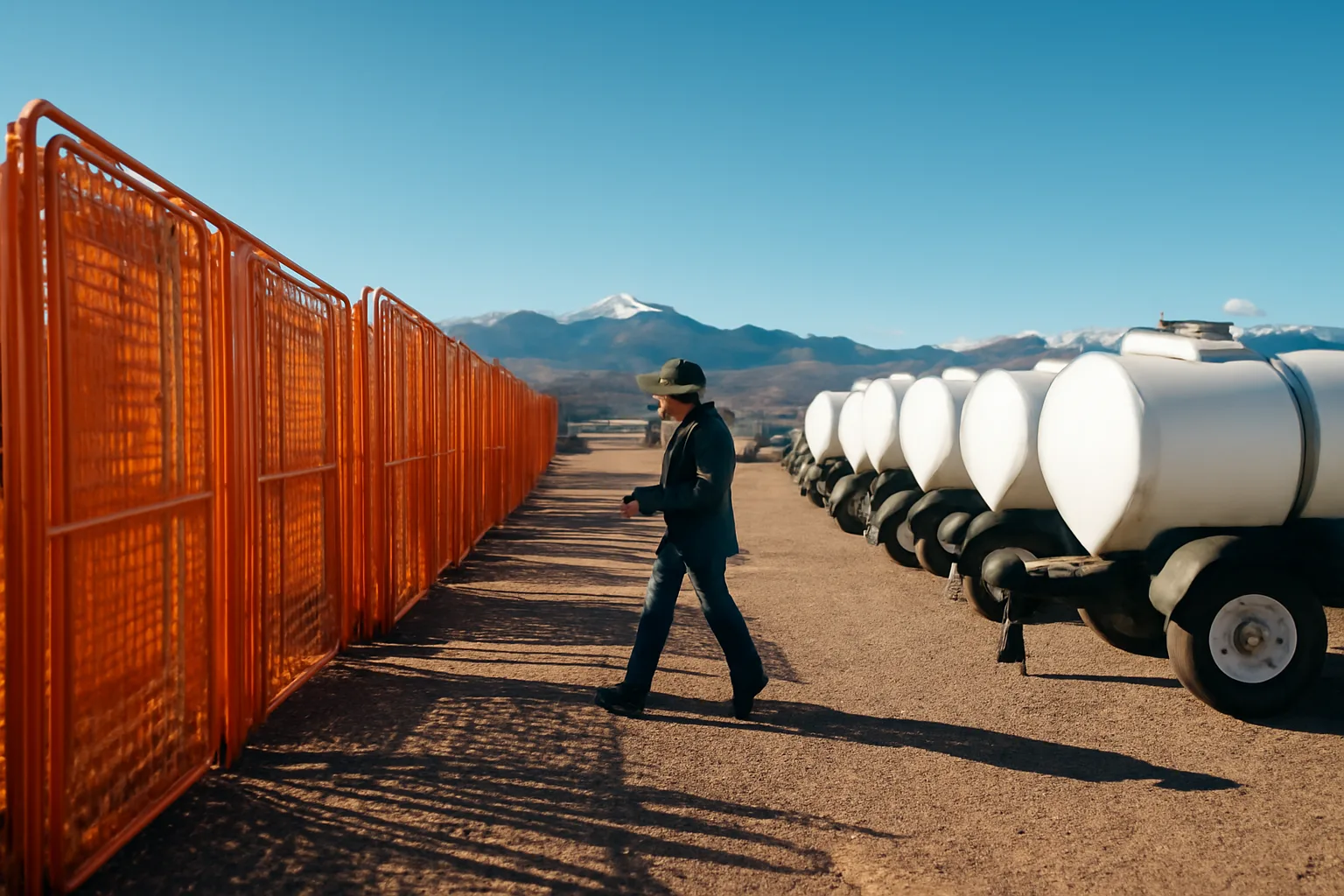
A site services yard stores, maintains, and dispatches equipment or materials for construction, civil, or utility work. Portable toilets, fencing panels, temporary power units, water trailers, staged at a fixed location before they head out to a job.
Colorado has no state agency that licenses "site services yards" as a category. That's common nationwide. What exists instead is a stack: local business licensing, county zoning and land-use approval, state contractor licensing for regulated trades performed out of the yard, and environmental permits if the yard touches waste or hazardous materials.
Getting a yard open in Jefferson County feels different from doing it in El Paso County or inside Denver city limits. Same state, very different paper paths. Most people searching for a state-level answer miss this. The controlling authority is almost always the local one.
Do you need a license for a site services yard in Colorado?
Yes, and the answer comes in layers. Here's what actually applies.
Every business operating in Colorado registers with the Colorado Secretary of State if it's a legal entity (LLC, corporation, partnership). A sole proprietor using a trade name files a Statement of Trade Name. The Secretary of State charges $50 to form a Colorado LLC as of 2024, and $20 for trade name registration [1]. Baseline, not optional.
Many Colorado municipalities require a general business license on top of that. Denver requires a Business License through the Denver Department of Excise and Licenses [2]. Colorado Springs runs its own licensing structure. Smaller towns vary hard: some want nothing beyond the state registration, others want an annual renewal plus an inspection. Ask your city or county clerk.
Here's where it gets trade-specific. If your yard dispatches workers who do electrical, plumbing, mechanical, or general contracting work on client sites, those workers and sometimes the company itself need a state contractor license through the Colorado Department of Regulatory Agencies (DORA) [3]. A yard that only stores and hauls gear without performing licensed trades on-site may not trigger state contractor licensing. The line blurs fast.
One more. If the yard handles portable restroom waste, liquid waste, or septage, the Colorado Department of Public Health and Environment (CDPHE) has permitting authority. Vehicles transporting that material need a liquid waste hauler license [4].
So the honest answer: you almost certainly need two or three authorizations, and whether a state contractor license is one of them depends on what you actually do from the yard.
What zoning and land-use approvals does Colorado require for a site services yard?
Zoning is usually the longest and most expensive part of the process. Site services yards need commercial or industrial zoning, and many counties file outdoor storage yards under use categories that require a special use permit or a conditional use review.
In unincorporated areas, county planning departments control this. Denver and other home-rule cities handle it under their own municipal codes. The Colorado Land Use Act (C.R.S. Title 29, Article 20) sets the framework counties build on, but the actual zoning call is local [5].
A conditional use permit application usually means a site plan, neighbor notification, a planning commission hearing, and sometimes a board of county commissioners vote. That runs 60 to 180 days depending on the county's meeting calendar and whether anyone shows up to fight it. Application fees swing wildly: some rural counties charge a few hundred dollars, larger counties charge $1,500 to $5,000 or more for the application plus any required traffic or environmental studies.
Find a property that's already zoned right. If the current zoning doesn't allow outdoor storage or light industrial use, a rezoning is longer and far less predictable. Most operators buy or lease into correct zoning rather than fight for a change.
Neighboring states run on similar local-first frameworks. The site services yard board in Arizona and site services yard board in California guides walk through comparable zoning structures.
How much does a site services yard cost in Colorado?
There's no single number, because costs stack from separate sources. Here's the realistic breakdown of what you actually pay.
State entity registration and trade name: $50 for an LLC with the Colorado Secretary of State, $20 for a trade name if you need one [1].
Local business license: Free to around $500 annually depending on the municipality. Denver's fees vary by license type and revenue tier [2]. Plenty of smaller towns charge $50 to $150 flat.
Zoning or conditional use permit: The variable that can dwarf everything else. Expect $300 to $5,000 for the application fee alone, plus $500 to $5,000 or more for required professional reports (traffic, drainage, environmental). Confirm current fees with the specific county planning department.
State contractor license (if applicable): DORA fees depend on classification. A general contractor license runs several hundred dollars at the application stage [3]. Confirm the current schedule with DORA directly.
CDPHE liquid waste hauler permit (if applicable): CDPHE fees track the number of vehicles and the type of waste [4]. These are board-confirmable and shift with regulatory updates.
Insurance: A yard typically carries commercial general liability (at minimum $1 million per occurrence is common), commercial auto on the fleet, and sometimes garage keepers or inland marine for equipment in your care. Figure $3,000 to $15,000 annually for a small-to-mid yard depending on fleet size and services.
Physical plant: Lease or purchase of the zoned property, site prep, fencing, utilities. This dwarfs the licensing costs for most operators.
Licensing and registration alone, taken by itself, realistically runs $500 to $10,000 in first-year government fees depending on location and which trades you run. The zoning process is the wildcard that can double or triple that.
How long does it take to set up a site services yard in Colorado?
The fastest path assumes a compliant property, no conditional use permit, and no state contractor license. In that case, state entity registration processes in 1 to 2 business days online through the Secretary of State [1]. A local business license takes a few days to a few weeks.
Reality is slower. Zoning is the rate-limiting step. A conditional use permit hearing in Colorado requires public notice, usually 10 to 30 days before the hearing depending on the county, then the hearing, then any appeal period (often 30 days after the decision becomes final). Total: 60 to 180 days is a realistic planning number for a conditional use process.
If a state contractor license is required, DORA's processing time depends on application volume and whether your application is complete. Plan for 4 to 12 weeks on a new contractor license. DORA posts current estimates on its licensing portal [3].
CDPHE liquid waste hauler permits have their own review queue. Confirm current timelines directly with CDPHE.
Add it up. A well-prepared operator in a cooperative jurisdiction can open in 3 to 6 months. A messy zoning situation or a slow county planning cycle can push past a year. Nobody has authoritative statewide data on average site services yard startup timelines in Colorado; the closest proxy is general contractor licensing and county zoning permit data, which vary too much to average meaningfully.
What environmental permits might a Colorado site services yard need?
It depends entirely on what the yard handles. A pure equipment storage yard with no waste, no fuel above threshold, and no vehicle washing that generates runoff may have almost nothing beyond standard stormwater rules.
Stormwater is the most common trigger. If your yard disturbs one acre or more during construction, you need a stormwater discharge permit from CDPHE under the Colorado Discharge Permit System (CDPS) [6]. Even after construction, some industrial yard operations need an ongoing industrial stormwater permit.
Store diesel, gasoline, or other regulated substances above certain quantities and EPA Spill Prevention, Control, and Countermeasure (SPCC) rules may apply. The federal SPCC threshold is 1,320 gallons of aboveground oil storage in aggregate, or 660 gallons in a single container, at a non-transportation facility [7].
Portable restroom waste is domestic septage. Vehicles hauling it need a CDPHE liquid waste hauler license, and the yard itself may need approval as a storage or transfer point depending on how the operation is structured [4].
Waste tires, batteries, and other solid waste categories carry their own CDPHE rules. If your yard piles these up as a byproduct of equipment maintenance, check the applicable handling requirements before it becomes a problem.
How does Colorado handle contractor licensing for yard-based service companies?
Colorado licenses electrical, plumbing, and mechanical trades at the state level through DORA. General contracting runs through DORA's Division of Professions and Occupations, with requirements that depend on the work classification [3].
Here's what trips up yard operators. If your crew goes to a job site and does work that qualifies as a regulated trade, you need the license, period. Whether the work originates from a yard or a truck changes nothing. The yard's physical location neither creates nor eliminates the requirement.
Colorado Revised Statutes Title 12, Article 155 governs electrical contractors [8]. Plumbing contractor licensing sits under C.R.S. Title 12, Article 58 [9]. If either trade touches your service menu, your license holder needs to be on file with DORA before you send anyone out.
For general labor (flagging, site cleanup, fencing that doesn't involve a regulated trade), Colorado has no state-level general contractor license for residential work below a certain threshold. Check your specific services with a Colorado-licensed attorney or directly with DORA, because the boundaries have moved over the years and the penalty for unlicensed contractor work in Colorado can reach $1,000 per violation [3].
See how neighbors structure the same requirements in the site services yard board in Arizona and site services yard board in Idaho guides.
What insurance does a Colorado site services yard actually need?
Insurance requirements come from three directions: state law, your lease or lender, and your clients' contracts.
Colorado requires workers' compensation for any business with one or more employees, under C.R.S. Title 8, Articles 40-47 [10]. Not optional. The state sets no mandatory minimum for commercial general liability on businesses generally, but specific contractor license categories require proof of liability insurance as a condition of licensure [3].
Most site services yards carry:
- Commercial general liability at $1 million per occurrence / $2 million aggregate minimum. Client contracts often demand it.
- Commercial auto on every vehicle in the fleet. Colorado's minimum auto liability is $25,000 per person / $50,000 per accident / $15,000 property damage for registered vehicles, well below what a commercial operation should carry [11].
- Inland marine or an equipment floater if you store high-value client equipment or rent gear out.
- An umbrella policy, usually $1 million to $5 million, once the operation reaches any real scale.
Workers' comp, CGL, and commercial auto together for a small yard might run $8,000 to $20,000 annually. Fleet size, payroll, and claims history drive the actual number. Get quotes from carriers who know contractor operations rather than standard commercial lines.
How does the Colorado site services yard paper path compare to neighboring states?
Colorado sits in the middle of the complexity range among western states. It's less centralized than California, which oversees contractor licensing, waste handling, and yard operations at the state level through CSLB and CalRecycle. It's more structured than some rural Mountain West states.
The table below compares first-year licensing elements across a few states for context. Confirm every figure with the relevant state board before you rely on it.
| State | Entity registration fee (LLC) | State contractor license required? | Zoning authority | Liquid waste hauler permit |
|---|---|---|---|---|
| Colorado | $50 [1] | Yes, for regulated trades [3] | County / municipal | CDPHE [4] |
| Arizona | $50 | ROC license required | County / municipal | ADEQ |
| California | $70 | CSLB license required | Local | CalRecycle / RWQCB |
| Idaho | $100 | Idaho Contractor Board | County / municipal | DEQ |
The big differentiator in Colorado is local zoning. Counties like Weld, Adams, and El Paso have large amounts of industrially zoned land and relatively quick conditional use processes for yard operations. Denver and Boulder are tighter on industrial land use and slower to permit. Where you site your yard matters as much as what your yard does.
For a fuller look at how other states handle this, the site services yard board in California and site services yard board in Florida guides cover two high-volume states with very different approaches.
What's the right order of operations for starting a site services yard in Colorado?
Order matters, because spending money on a lease before you know the zoning works is an expensive mistake. Here's the sequence that makes sense.
Start with zoning research before you sign anything. Confirm with the county or city planning department that your target property allows outdoor storage and light industrial operations, and ask specifically whether a conditional use permit is required. This is a phone call and a look at the county's GIS or zoning map. It costs nothing.
Once you've confirmed a viable property, form your legal entity with the Colorado Secretary of State [1]. Takes less than a day online and locks in your official business name.
Apply for local business licensing at the same time if your municipality requires it [2]. Start early, because some jurisdictions require a physical inspection before they issue the license.
If your services include regulated trades, contact DORA and open the contractor license application before you plan to open [3]. Licensing takes weeks to months, and you can't legally operate without it.
If you'll handle liquid waste, apply for the CDPHE liquid waste hauler license in parallel [4].
Secure insurance before the yard goes operational. Your lease, your contractor license application, and your first client contracts will all likely demand proof of coverage.
Register for Colorado state sales tax through the Colorado Department of Revenue if you'll make taxable sales (equipment rental often triggers this) [12].
If you're mapping this with actual state documents in hand, SiteServicesPath's Shared-Yard Economics Kit ($249, one-time) at /start compiles the paper path for operators who want to work through the documents systematically. Useful if you're doing multiple states or building a template for a franchise-style operation. The government sources linked here are the primary reference regardless.
Where do you register a site services yard business in Colorado?
The Colorado Secretary of State handles all entity registrations and trade name filings online at sos.state.co.us [1]. The system works: you can form an LLC in one session. You'll file your annual Periodic Report through the same portal to keep the entity in good standing. That Periodic Report costs $10 for a Colorado LLC as of 2024.
State contractor license applications go through DORA's online licensing portal [3]. DORA posts current fee schedules there, and those schedules update, so don't trust any number in a guide (including this one) without checking the live schedule.
CDPHE runs an online submission system for many permit types, including liquid waste hauler applications [4].
Local business licenses register with the city or county clerk, or in Denver's case the Department of Excise and Licenses [2]. Not centralized. Each jurisdiction runs its own process.
Colorado sales tax registration goes through the Colorado Department of Revenue's Revenue Online portal [12].
See the site services yard board in Georgia and site services yard board in Illinois guides for how other states centralize or fragment the same registration points.
Frequently asked questions
Do you need a license for a site services yard in Colorado?
Yes, and in practice you need several authorizations rather than one. At minimum: state entity registration with the Colorado Secretary of State, a local business license from your city or county, and possibly a DORA contractor license if your yard dispatches workers who perform regulated trades. A CDPHE liquid waste hauler permit is required if your yard handles portable restroom waste or septage. Confirm specifics with each agency.
How much does a site services yard cost to start in Colorado?
Government filing fees alone typically run $500 to $10,000 in the first year, depending on location and which permits apply. The $50 LLC formation fee is the floor. Zoning or conditional use permits can cost $300 to $5,000 or more in application fees plus study costs. Add insurance ($8,000 to $20,000 annually for a small yard), property, and equipment. Licensing is rarely the biggest cost.
How long does it take to open a site services yard in Colorado?
State entity registration takes 1 to 2 business days online. A local business license takes a few days to a few weeks. The conditional use zoning process, if required, typically takes 60 to 180 days including public notice and hearing periods. A DORA contractor license application takes 4 to 12 weeks depending on completeness and queue. Plan for 3 to 6 months minimum if your property is already zoned correctly.
Does Colorado have a statewide site services yard license?
No. Colorado has no single statewide license category for site services yards. Operators instead need a combination of state entity registration, local business licensing, county or municipal zoning approval, and in many cases a trade-specific contractor license through DORA. The controlling authority for most yard-specific approvals is local, not state.
What zoning does a site services yard need in Colorado?
Site services yards typically require commercial or light industrial zoning with allowance for outdoor storage. Many Colorado counties require a conditional use permit or special use permit even within an otherwise eligible zone. The Colorado Land Use Act (C.R.S. Title 29, Article 20) provides the county framework, but zoning decisions are made locally. Check with the county planning department for the specific property before signing a lease.
Does a Colorado site services yard need a contractor license?
If the yard dispatches workers who perform licensed trades (electrical, plumbing, mechanical, or certain general contracting work), the company and relevant license holders need a Colorado contractor license through DORA. A yard that only stores and hauls equipment without performing regulated trade work on client sites may not trigger state contractor licensing, but the line depends on what you actually do. Confirm with DORA directly.
What environmental permits does a Colorado site services yard need?
It depends on operations. Stormwater discharge permits are required through CDPHE if your site disturbs one acre or more during construction, and some ongoing industrial operations also need a CDPS permit. Federal SPCC rules apply if you store more than 1,320 gallons of oil aggregate aboveground. Portable restroom waste hauling requires a CDPHE liquid waste hauler license. A clean storage yard with no waste or significant fuel may have minimal environmental obligations.
How much is the LLC registration fee for a site services yard in Colorado?
As of 2024, Colorado charges $50 to form an LLC through the Secretary of State's online portal. A trade name (DBA) filing is $20. The annual Periodic Report that keeps the entity in good standing costs $10. These are among the lowest entity formation fees in the Mountain West. Confirm current fees at sos.state.co.us before filing.
Does Colorado require workers' compensation for site services yard employees?
Yes. Colorado requires workers' compensation coverage for any employer with one or more employees, under C.R.S. Title 8, Articles 40-47. This is not industry-specific: it applies to site services yards the same as any other business. Coverage must be in place before any employee begins work. Self-insurance is available for qualifying large employers but isn't practical for most new yard operations.
What is a Colorado CDPHE liquid waste hauler license and does a site services yard need one?
The CDPHE liquid waste hauler license authorizes vehicles to transport domestic septage, portable restroom waste, and similar liquid waste in Colorado. If your yard operates or services portable restrooms and hauls the waste to a disposal facility, you need this license for each hauling vehicle. The application goes through CDPHE's online permit portal. Confirm current fees and required documentation directly with CDPHE, as schedules update.
Where do I register a site services yard business in Colorado?
Entity formation goes through the Colorado Secretary of State online at sos.state.co.us. State contractor licenses apply through DORA's online licensing portal. CDPHE permits are submitted through the agency's online system. Local business licenses register with your city or county clerk. Colorado sales tax registration goes through the Department of Revenue's Revenue Online portal. These are four separate systems with no single intake point.
How does Colorado's site services yard setup compare to Arizona or California?
Colorado's LLC formation fee ($50) is on par with Arizona ($50) and below California ($70). All three require state contractor licensing for regulated trades. California has the most centralized and burdensome oversight through CSLB and CalRecycle. Arizona's ROC licensing process is somewhat similar to Colorado's DORA. Colorado's local zoning variation is significant: rural counties are generally more permissive and faster than Front Range urban counties.
Sources
- Colorado DORA, Division of Professions and Occupations, Contractor Licensing: Colorado requires state contractor licenses through DORA for regulated trades; penalties for unlicensed contractor work can reach $1,000 per violation
- Colorado CDPHE, Liquid Waste Hauler Licensing: Colorado requires a CDPHE liquid waste hauler license for vehicles transporting domestic septage and portable restroom waste
- Colorado Revised Statutes, Title 29 Article 20, Local Government Land Use Control Enabling Act: C.R.S. Title 29, Article 20 is the Colorado Land Use Act that sets the framework counties use for zoning and land-use decisions
- Colorado CDPHE, Colorado Discharge Permit System (CDPS) Stormwater: Land disturbance of one acre or more during construction requires a CDPS stormwater discharge permit from CDPHE
- U.S. EPA, Spill Prevention, Control, and Countermeasure (SPCC) Rule: The federal SPCC threshold is 1,320 gallons of aboveground oil storage in aggregate, or 660 gallons in a single container, at a non-transportation facility
- Colorado Revised Statutes, Title 12 Article 155, Electrical Contractors: C.R.S. Title 12, Article 155 governs electrical contractor licensing in Colorado
- Colorado Revised Statutes, Title 12 Article 58, Plumbing Contractors: C.R.S. Title 12, Article 58 governs plumbing contractor licensing in Colorado
- Colorado Revised Statutes, Title 8 Articles 40-47, Workers' Compensation: Colorado requires workers' compensation coverage for any employer with one or more employees under C.R.S. Title 8, Articles 40-47
- Colorado Department of Regulatory Agencies, Division of Insurance, Auto Insurance: Colorado minimum auto liability is $25,000 per person / $50,000 per accident / $15,000 property damage for registered vehicles
- Colorado Department of Revenue, Revenue Online Sales Tax Registration: Colorado businesses making taxable sales including equipment rental register for sales tax through the Department of Revenue's Revenue Online portal
- Denver Department of Excise and Licenses, Business Licensing: Denver requires a business license through the Department of Excise and Licenses, with fees that vary by license type and revenue tier