Last updated 2026-08-21
TL;DR
A site services yard is a fenced lot and shop that stages and services portable toilets, dumpsters, temporary fence, and construction support gear. You start by locking zoning and a legal disposal outlet, then forming an entity, pulling a free EIN, and adding only the hauler, septage, and FMCSA credentials your mix triggers. Confirm every local fee with the issuing board. Skip the big fleet until the wash pad and the paper exist.
What is a site services yard?
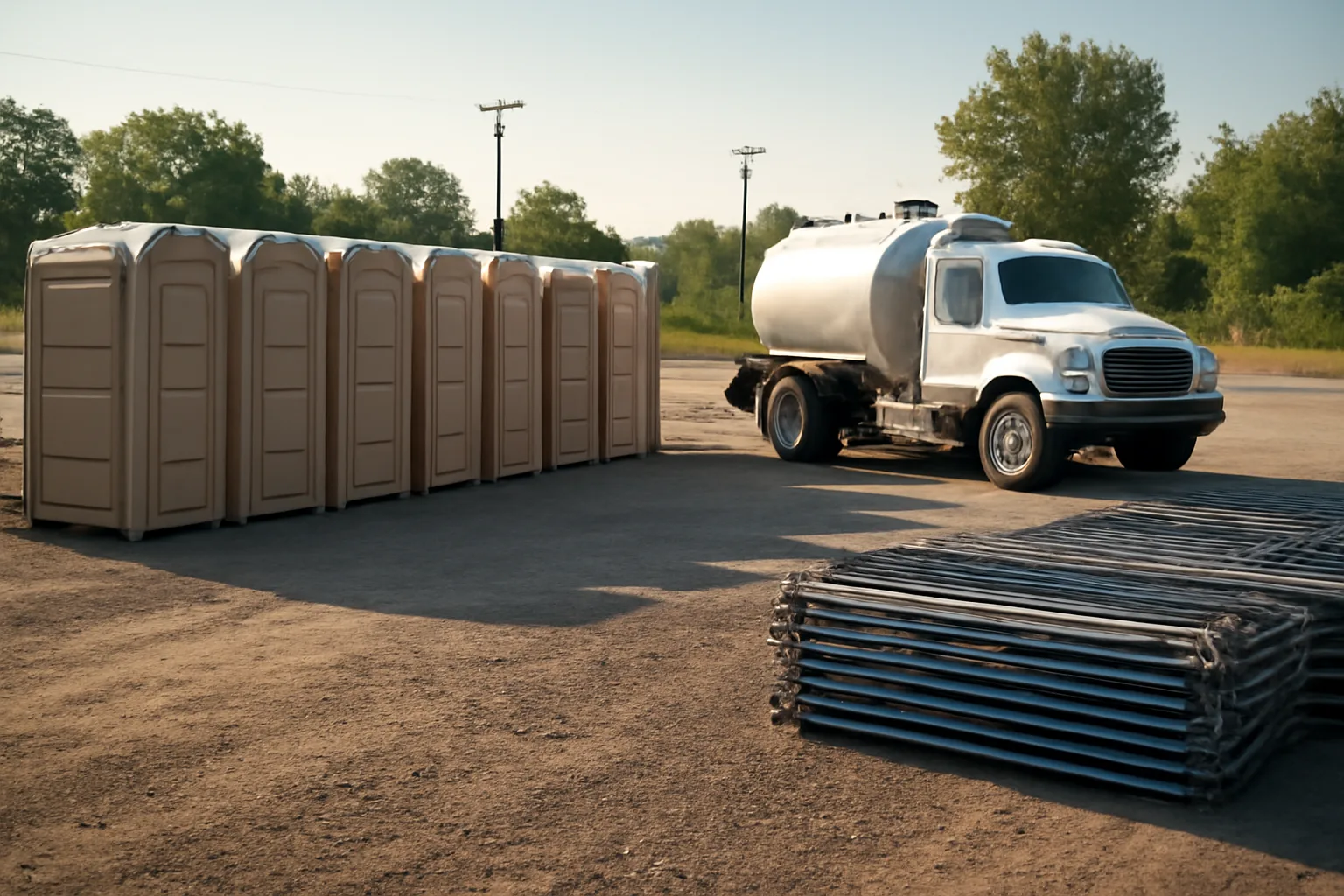
A site services yard is a fenced industrial lot, shop, and dispatch point for temporary construction support. Typical inventory is portable toilets, roll-off dumpsters, temporary fence, and storage containers, plus the trucks that move them. It is a logistics and sanitation business. It is not a general contractor, and it is not a landfill.
People mix the phrase up with a contractor laydown yard. A contractor yard holds that one builder's own steel and forms. A site services yard rents units to many jobs and brings them home dirty. The dirty part is the business.
The Census Bureau files the toilet side under NAICS 562991, Septic Tank and Related Services. The 2022 code covers establishments that pump septic tanks and cesspools and that rent or service portable toilets [7]. Dumpster-heavy shops often sit in solid waste collection instead. Rental-heavy shops sit in construction machinery rental. Use the line that produces the revenue. Your accountant should read the NAICS text, not a blog post.
The yard itself is boring on purpose. Gravel or recycled concrete. A wash pad that drains to a tank, not the ditch. A small office. Racks or rows for units. Fuel or waste-oil tanks if you maintain trucks. Neighbors notice odor, backup beepers, and Saturday traffic. That is why zoning fights start before the first invoice.
You can run a thin mix or a fat mix. Toilets plus a vacuum truck is one business. Roll-offs plus a landfill account is another. Fence and containers are lighter on environmental paper and heavier on labor and loss. Mixing all three under one lease is common. It is also how people trip over a permit they never called about.
Want a blunt test? Ask what leaves the gate every morning and what comes back wet. If the answer is empty, you do not have a site services yard yet. You have a parking lot.
How do you start a site services yard?
You start a site services yard by locking zoning and a written disposal outlet, then forming an entity and pulling a free EIN. Add only the hauler, septage, and FMCSA credentials your mix triggers. Keep the first fleet small. Confirm every local license and fee with the board that issues it.
I would not spend a dollar on units until two pieces of paper exist. One is a zoning or use confirmation for that exact address. The other is a written acceptance letter from a wastewater plant or licensed septage facility, or a landfill and transfer account if you are in roll-offs. Trucks without a legal dump point are lawn ornaments.
The U.S. Small Business Administration still frames the generic sequence as plan, legal structure, tax IDs, licenses, then banking and insurance [5]. That sequence is right. The myth is that a single national site-services license sits at the end of it. It does not.
Form the entity your lawyer actually uses in that state. Pull the EIN on the IRS site. The IRS charges nothing for an EIN when you apply on its own page [6]. Open a bank account in the entity name before you take a deposit. Then call the boards that match your mix, not a random contractor board.
Hire later than your pride wants. One trained driver and a clean used vacuum truck or roll-off truck will teach you more than a branded fleet. Write the service ticket so it names the waste stream, the dump site, and who pays contamination fees. Customers will put paint, tires, and food grease in anything with a lid.
Do not promise a city a start date you cannot control. Boards do not publish a universal clock, and I will not invent one. Ask the clerk for the current checklist and the current fee schedule. If they will not put the use in writing, walk.
What licenses does a site services yard need?
A site services yard needs a local business license, land-use approval, and then only the hauler, septage, health, and motor-carrier credentials that match the inventory you actually roll. There is no single federal site-services license. Confirm each item and each fee with the board that issues it.
Start with the city or county business license and the planning file on that parcel. If the use list says waste-related, sanitation, or outdoor storage, read the conditions. Hours, screening, stacking height, and truck routing show up here. Fire departments care about tanks and wash water.
Then match the mix to the board.
| Mix | Federal hooks you should read | Boards to call before you buy trucks |
|---|---|---|
| Portable toilets and vacuum | EPA 40 CFR 503 septage rules [2] | County health, state septage, receiving WWTP |
| Roll-off dumpsters | RCRA hazardous-waste basics if loads are mixed [10] | State or city solid-waste hauler licensing |
| Temp fence and containers | FMCSA if trucks meet the weight test [3] | Zoning, right-of-way, sometimes a rental license |
| Mixed yard | All of the above, plus stormwater and SPCC if you store oil [4] | Planning, fire, health, DOT, environmental |
Skip a general contractor license unless you are actually building. Paying for a ticket you will not use does not impress a dumpsite clerk.
If you hire anyone, most states require workers' compensation. Texas is the loud exception. Texas Labor Code 406.002 says, "Except for public employers and as otherwise provided by law, an employer may elect to obtain workers' compensation insurance coverage" [12]. That sentence is Texas law, not a national rule. Confirm with your state board.
Keep a folder with the entity papers, EIN letter, use approval, disposal acceptance, hauler or septage credential, and insurance certificates. Inspectors ask for that stack. They do not ask for your logo.
Do site services yard trucks need a CDL or USDOT number?
Many site services yard trucks need a CDL, and many need a USDOT number, but the trigger is weight, cargo, and interstate work, not the phrase site services. A pickup towing a light fence trailer may stay under the line. A vacuum truck or loaded roll-off truck usually does not. Confirm the current test with FMCSA and your state DMV.
FMCSA's USDOT page is the one to print. It says you need a USDOT number if you operate a vehicle in interstate commerce that meets the listed weight or passenger tests, including a GVWR, GCWR, GVW, or GCW of 10,001 pounds or more [3]. Intrastate rules are a state overlay. Ask the state carrier desk, not a truck dealer.
A CDL is a separate ticket. FMCSA's CDL page covers Class A, B, and C and the endorsements [9]. Most vacuum trucks land in Class B. If you haul liquid waste in a tank, ask about the tanker endorsement before you bid night service. I would not put a new driver in a loaded tanker on a verbal "you will be fine."
Local-only work does not erase inspection risk. Troopers still weigh trucks. A roll-off with a heavy C&D load will surprise you on a scale.
If you stay interstate with qualifying trucks, budget time for the USDOT number, medical cards, and a drug-testing program that actually runs. If you stay truly local and light, get that in writing from the state. Guessing here is how people buy a truck they cannot legally dispatch.
What zoning stops a site services yard before you open?
Zoning stops a site services yard when the parcel is residential, light commercial, or silent on outdoor storage, trucking, and waste-related uses. The fight is almost always odor, hours, and truck routing, not your business plan. Get a written determination on the exact address before you sign a lease.
Call planning with the NAICS description in your hand and a plain list of units, tank sizes, and daily truck counts. Ask whether the use is permitted, conditional, or forbidden. Ask about wash-water discharge, screening, and stacking height in the same call. If they send you to environmental health, go that week.
A farm or home lot is a bad first site in most counties. Even where agricultural zoning looks loose, portable-toilet washing and dumpster storage draw complaints. I have seen operators try to hide the wash hose behind a barn. It does not stay hidden.
Industrial parks are easier on paper and harder on rent. Shared lots can work if the lease names who owns the tanks, who files stormwater paper, and who is on the insurance. Midway through year-one planning, the $249 one-time Shared-Yard Economics Kit from SiteServicesPath at /start is the only paid worksheet I would bother with for split-lot math. You can still do that math on a pad if you are cheap.
Do not take a landlord's "everyone stores trucks here" as approval. Landlords do not issue certificates of occupancy. The city does.
What first-year paper actually matters?
First-year paper for a site services yard is the entity file, the EIN, the land-use approval, written disposal acceptance, the hauler or septage credential if required, insurance certificates, and clean tickets that name the waste. That stack beats a brand book. Confirm forms and fees with each issuer. Nobody can honestly publish a national processing time.
The SBA start guide still puts registration and tax IDs before you chase customers [5]. Do that. Then write three operating documents you will actually use. A service agreement with contamination language. A driver checklist for leaks and overweight. A disposal log that ties ticket, truck, and dump site.
If you hire, complete Form I-9 and keep it. That is federal employment paper, not a branding task. For tax mechanics, IRS Publication 334 is the small-business tax guide you can hand an accountant without embarrassment [6].
Customer paper is where yards leak money. Require a signed ticket before the truck leaves. Photograph overloaded or painted-up roll-offs. Put the landfill's prohibited-waste list in the quote. When a load gets rejected, you need a document, not a memory.
I would skip fancy SOPs in month one if they will sit in a drawer. Write the five pages drivers will keep on the clipboard. Update them after the first failed inspection, not before you have had one.
How much money do you need to start a site services yard?
There is no honest national starter budget for a site services yard because land, trucks, and local fees move by county and by mix. The only federal money fact I will treat as firm is that an EIN is free on the IRS site [6]. Everything else is a quote you collect, not a number I should invent.
Think in five buckets. Land and yard buildout (fence, rock, wash pad, lighting). Rolling stock (service truck or roll-off truck, plus trailers). Units (toilets, dumpsters, fence, containers). Compliance (licenses, insurance, possible SPCC or stormwater work). Cash to survive slow winter invoices.
Unit prices move with resin, steel, and freight. I have not seen a clean public time series that a first-year operator can bank on, so get three written quotes and assume freight will annoy you. A wash pad with a legal drain path is a better first spend than another row of toilets you cannot clean.
Tanks create a hard federal line. EPA's SPCC rule can require a written plan once aggregate aboveground oil storage passes 1,320 gallons in containers of 55 gallons or more [4]. That is a real threshold. Count waste oil, diesel, and hydraulic totes, more than the pretty tank.
I would not finance a new boom truck in month one. I would not pre-buy 300 toilets before a plant will take your septage. And I would not treat a cheap rural lease as cheap if the use is illegal. Re-reading site services yard guide 12 is useful if you are still choosing mix before you spend.
What insurance should a site services yard carry?
A site services yard should carry commercial auto, general liability, inland marine or equivalent on rented units, workers' compensation where the state requires it, and pollution coverage if you haul waste or wash units. I will not quote premiums. They are not national, and a made-up number would be a lie.
Auto is the claim that arrives first. Backing into a parked car on a muddy site is not rare. Name additional insureds the way GCs ask, then read the endorsement so you know what you actually bought.
Inland marine (or a floater that acts like it) is how lost or crushed rental units get paid. Fence panels walk. Containers get hit by other contractors. If the policy only covers units on your lot, you have a hole.
Pollution is the policy people skip because it feels abstract. Vacuum-truck spills and a dumpster full of unknown drums are not abstract. A surplus-lines broker who already writes sanitation or waste will waste less of your time than a personal-lines shop that "can probably add a truck."
Workers' compensation follows the state rule, with Texas as the elective outlier noted above [12]. If you use owner-operators, do not assume their policy covers your dispatch. Read the certificates.
Confirm every form and limit with the carrier. Do not take my list as a bind order. I am not your broker.
Which OSHA and EPA rules apply to toilets and dumpsters?
OSHA's construction sanitation rule sets jobsite toilet counts, and EPA rules govern septage and any load that is actually hazardous waste. Your yard is not the jobsite, but your customers buy toilets because 29 CFR 1926.51 exists. Read that text before you write a rental pitch.
OSHA says, "Toilets shall be provided for employees according to the following table" [1]. Table D-1 is the part salespeople mangle.
| Number of employees | Minimum number of facilities |
|---|---|
| 20 or less | 1 |
| 20 or more | 1 toilet seat and 1 urinal per 40 workers |
| 200 or more | 1 toilet seat and 1 urinal per 50 workers |
That table is why a 40-person crew is not a one-toilet job. Quote the table. Do not invent a "standard trailer."
On the waste side, EPA defines domestic septage in 40 CFR 503.9(f) as "the liquid or solid material removed from a septic tank, cesspool, portable toilet, Type III marine sanitation device, or similar treatment works that receives only domestic sewage" [2]. Portable-toilet pump-out is in that world when it is domestic. Land-application and plant-acceptance rules still apply. Confirm with the receiving facility and the state septage desk.
Dumpsters are not a free-for-all. EPA's hazardous-waste basics page is the right first read if a load might contain listed or characteristic waste [10]. A contractor tossing solvent drums in a C&D box can hand you a problem you did not price. Your ticket should shift that cost back.
If the yard itself stores oil above the SPCC line, write the plan [4]. If industrial stormwater rules attach to your SIC or activity, talk to the state NPDES desk before the first rain after you scrape the lot [4]. Forklifts on the yard pull in OSHA 1910.178 training duties [11]. None of this is optional because you are "just renting boxes."
What equipment should you buy first (and what is a waste)?
Buy a legal disposal path, a wash pad, and one truck you can keep on the road before you buy a pretty fleet. Extra units without a way to clean and dump them are a waste of money. I would rather open short on inventory than short on compliance.
For a toilet-led yard, that means a used vacuum truck that will pass inspection, a wash setup that does not drain to the ditch, and only as many units as you can turn in a week. For a dumpster-led yard, that means a roll-off truck, a landfill or transfer account, and boxes you can afford to have sitting dirty. Fence can start with a flatbed and panels if zoning allows outdoor storage.
A forklift helps. If you get one, train operators under 29 CFR 1910.178 instead of handing over keys [11]. A brand-new service body with lights you do not need is a vanity buy. So is custom wrap in month one.
Shared equipment with another operator can work. Put hours, fuel, wrecks, and insurance in writing. If that split is the only way the lot cash-flows, compare notes with site services yard guide 24 and site services yard guide 30 before you shake on a handshake.
I would not buy light towers and water buffaloes on day one unless a signed job needs them. Accessory toys hide in the weeds and die.
How does pay compare with a nearby W-2 job?
A site services yard can beat nearby W-2 pay after the trucks are working, and it can pay worse than a driving job in year one while you eat lease and insurance. Public wage data is about employees, not owners. Use it as a floor, not a promise.
The median annual wage for refuse and recyclable material collectors was $45,760 in May 2023, according to the Bureau of Labor Statistics [8]. The median annual wage for heavy and tractor-trailer truck drivers was $54,320 in May 2023 [13]. Those are employee medians. They are still the cleanest national numbers you can put next to a first-year owner draw.
If your yard cannot cover a driver at those levels plus truck cost, you do not have a business yet. You have a hobby with a vacuum pump.
Owner draw is lumpy. Construction pauses. Event work spikes. Winter in the north is quiet unless you have a municipal or plant account. I would keep a W-2 or a second trucking account longer than Twitter advice suggests.
For a direct side-by-side on first-year pay versus staying employed, read site services yard vs nearby career. For states that make the paper path ugly, use the hardest states for a site services yard.
What do first-year operators get wrong?
First-year operators buy units before they have a dump point, sign a pretty lease on the wrong zoning, and skip pollution coverage. The rest of the mistakes are ego. A site services yard is a paper-and-trucks business. Act like it.
They also under-ticket contamination and then argue with landfills in the rain. Write the rule while everyone is still polite. They hire a second driver before the first truck has a spare tire program. They treat OSHA's toilet table as marketing fluff instead of the reason the customer called [1].
Another miss is assuming portable-toilet waste is "not regulated" because it is not a lab chemical. EPA's septage definition names portable toilets [2]. Plants still say no. States still license pumpers. Ask.
I would run the first six months on a short fleet, a mean ticket, and a weekly habit of calling the boards that already have your file. Confirm fees whenever a clerk says the schedule changed. No article can freeze a local fee.
SiteServicesPath is an independent publisher, not a law firm and not a service company. If you want the shared-lot worksheet after you have read this, it lives at /start. If you want more mix comparisons, keep going through site services yard guide 36 and site services yard guide 42.
Frequently asked questions
What is site services yard?
A site services yard is a fenced industrial lot, shop, and dispatch point that stages portable toilets, dumpsters, temporary fence, storage containers, and the trucks that move them for construction and events. It is sanitation and logistics, not general contracting. The Census NAICS 562991 description covers portable-toilet rental and septic pumping. Confirm your own code with the definition that matches revenue.
How do you start site services yard?
Lock zoning and a written disposal outlet first. Form an entity, pull a free EIN from the IRS, and open a bank account in the company name. Add only the hauler, septage, health, and FMCSA credentials your mix triggers. Buy a small fleet you can wash. Confirm every local fee and form with the issuing board. Do not invent a national timeline.
Is a site services yard the same as a dumpster company?
No. A dumpster company is one common mix inside a site services yard. Many yards also run portable toilets, temporary fence, and containers from the same lot. Dumpster-only shops live closer to solid-waste hauler rules. Toilet-led shops live closer to septage and health rules. The lot looks similar. The boards you call are not.
Do I need a contractor license to open a site services yard?
Usually no, if you are renting and servicing units rather than building. Some cities still want a business license or a waste-hauler license. That is not the same ticket as a general contractor license. Confirm with the local licensing desk and do not buy a GC card you will not use. Waste of money.
Can I run a site services yard from a farm or house lot?
Sometimes on paper, rarely without pain. Wash water, odor, and truck traffic draw complaints even where agricultural zoning looks loose. Get a written zoning determination on that exact parcel before you set a toilet on it. I would not start on a home lot if an industrial pinch of gravel is available.
How many portable toilets do I need to start?
Nobody publishes a clean national starter count. Trade groups do not release a census of first-year fleets that I would trust. Size the stack to the wash pad and the dump point, not to a number you saw online. I would rather turn 40 clean units than watch 200 sit dirty. Get quotes. Confirm plant capacity in writing.
Do vacuum trucks need a CDL?
Often yes. Weight and tank cargo usually put a vacuum truck in Class B, and a tanker endorsement may apply. FMCSA sets the CDL framework. Your state DMV issues the card. Confirm before you bid work that requires a loaded tank on public roads. A pickup with a small trailer is a different test.
Is portable toilet waste hazardous waste?
Domestic portable-toilet pump-out is treated as domestic septage under EPA 40 CFR 503.9 when it is only domestic sewage. That is not the same as saying unregulated. Receiving plants and state septage desks still set the rules. Solvents, fuels, or unknown chemicals mixed in can push a load toward hazardous-waste rules. Confirm with the facility.
Do I need a stormwater permit for the yard?
Maybe. If you scrape an acre or more, construction stormwater rules can attach. If the industrial activity and SIC land in a regulated sector, industrial stormwater (MSGP or a state analog) can attach. Oil tanks can also pull SPCC duties at 1,320 gallons. Ask the state NPDES authority about your exact activities. Do not guess from a map.
What NAICS code does a site services yard use?
Toilet and septic work often files as 562991, Septic Tank and Related Services, per the Census 2022 NAICS text. Roll-off collection often sits in solid waste collection. Construction-gear rental sits in machinery rental. Use the code for the activity that produces the most revenue. Have your accountant read the Census language.
Can I start a site services yard with no employees?
Yes. Plenty of first yards are one owner and one truck. You still need the land-use, disposal, and vehicle credentials that match the work. Hiring later adds I-9, workers' compensation in most states, and a real drug-testing program if FMCSA applies. Solo does not erase overweight or septage rules.
What happens if a customer puts paint or drums in a roll-off?
The landfill can reject the load and you own the truck hours until someone pays. EPA hazardous-waste basics apply if the material is listed or characteristic waste. Your ticket should name prohibited items and a contamination fee. Photograph the box. Do not pretend a painted-over drum is C&D because the contractor is in a hurry.
How long does licensing take for a site services yard?
There is no honest national clock. Local planning, health, and state hauler desks run their own queues and fee schedules. Anyone publishing a guaranteed week count is guessing. Ask each board for the current checklist and do not take deposits you cannot serve if the use file stalls.
Do I need a special license for a temporary fence trailer?
Often you need the right combination of vehicle class, trailer brakes, and, if you cross the FMCSA weight test in interstate commerce, a USDOT number. A light trailer behind a pickup may stay under the line. A stacked, wet, overloaded trailer will not. Confirm weight ratings and state towing rules before you dispatch.
Sources
- OSHA 29 CFR 1926.51 Sanitation: OSHA requires toilets at construction jobsites per Table D-1, including 1 facility for 20 or fewer employees and 1 seat plus 1 urinal per 40 workers at 20 or more employees.
- EPA 40 CFR 503.9 General definitions: Domestic septage includes liquid or solid material removed from a portable toilet that receives only domestic sewage.
- FMCSA Do I Need a USDOT Number: A USDOT number is required for qualifying interstate commercial vehicles, including those at 10,001 pounds GVWR/GCWR/GVW/GCW or more.
- EPA Spill Prevention, Control, and Countermeasure (SPCC): SPCC requirements can apply when aggregate aboveground oil storage exceeds 1,320 gallons in qualifying containers.
- U.S. Small Business Administration 10 steps to start your business: SBA sequences starting a business through planning, legal structure, tax IDs, and licenses before full operations.
- IRS Apply for an Employer Identification Number (EIN) Online: Businesses apply for an EIN online through the IRS at no charge on the agency's application page.
- U.S. Census Bureau NAICS 2022 code 562991: NAICS 562991 covers establishments that pump septic tanks and cesspools and that rent and/or service portable toilets.
- BLS Occupational Outlook Handbook, Refuse and Recyclable Material Collectors: The median annual wage for refuse and recyclable material collectors was $45,760 in May 2023.
- FMCSA Commercial Driver's License: FMCSA sets the CDL class and endorsement framework that states use for trucks such as vacuum and roll-off units.
- EPA Learn the Basics of Hazardous Waste: Loads that meet listed or characteristic hazardous-waste definitions are regulated under RCRA, which matters when dumpsters are contaminated.
- OSHA 29 CFR 1910.178 Powered industrial trucks: Employers must train and evaluate forklift operators before they run powered industrial trucks on the yard.
- Texas Labor Code Chapter 406 Workers' Compensation Coverage: Texas private employers may elect workers' compensation coverage, unlike the mandatory systems in most other states.
- BLS Occupational Outlook Handbook, Heavy and Tractor-trailer Truck Drivers: The median annual wage for heavy and tractor-trailer truck drivers was $54,320 in May 2023.