Last updated 2026-08-18
TL;DR
Starting a site services yard in Colorado means registering your business with the Secretary of State, securing local zoning approval and a business license, meeting CDPHE environmental permit requirements if you handle waste or hazardous materials, and carrying appropriate insurance. Startup costs typically run $5,000 to $50,000+ depending on scale. Plan for 60 to 180 days from first filing to operational.
What exactly is a site services yard and what does Colorado regulate?
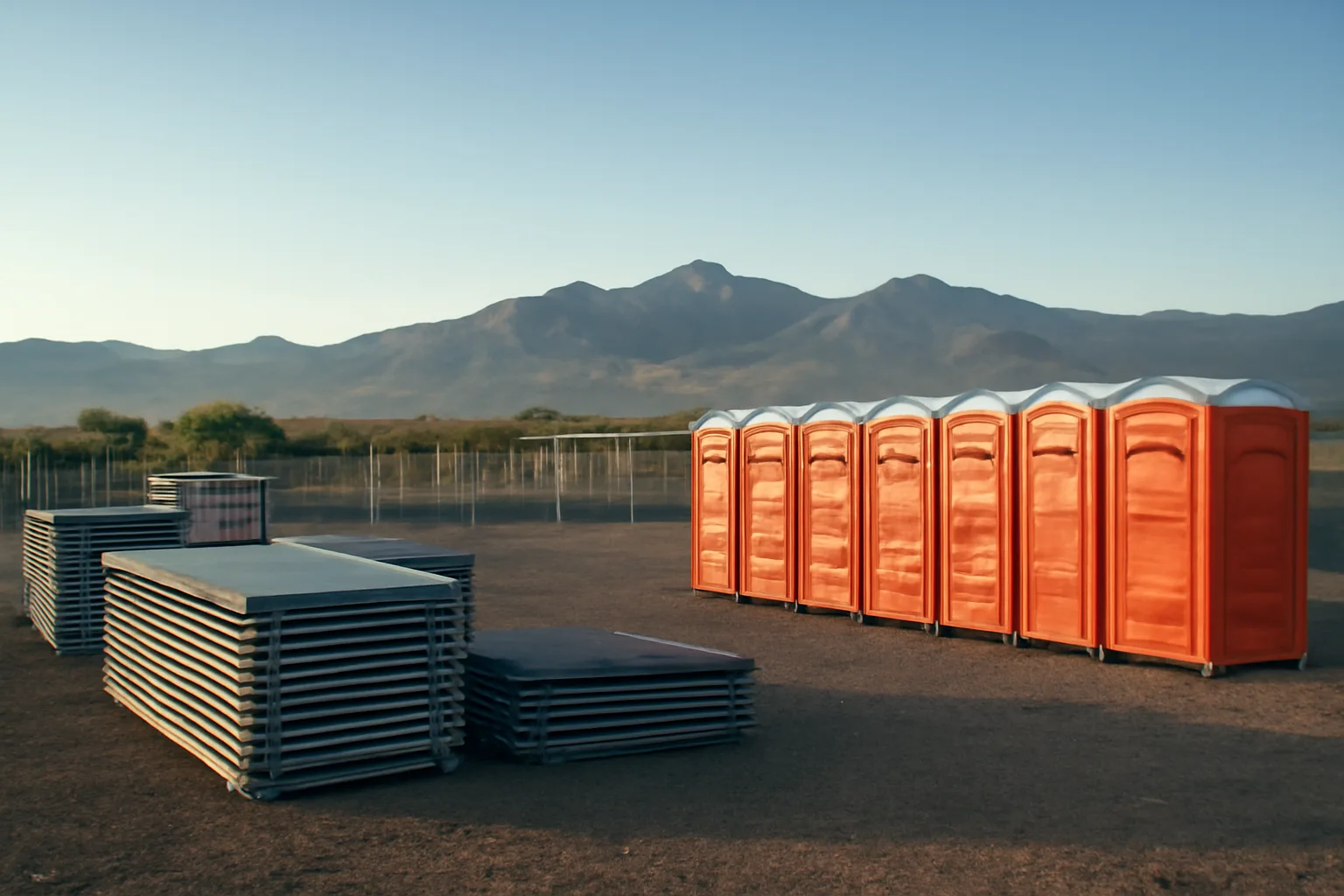
A site services yard is a physical staging or storage facility that supports construction, civil engineering, or infrastructure projects. Portable toilets, temporary fencing, site trailers, generators, welfare units, fuel tanks, and similar equipment live there between deployments. Colorado doesn't have a single "site services yard license" at the state level. What it has is a layered set of obligations, and which ones apply to you depend on what you store, handle, and discharge.
If you're storing only clean equipment, your main regulatory touchpoints are business registration, local zoning, and a local business license. If you're washing down equipment, holding waste tanks, or storing petroleum products, you pick up CDPHE (Colorado Department of Public Health and Environment) oversight. That distinction drives the whole paper path, so be clear about your operational scope before you file anything.
Colorado also has specific rules for solid waste facilities and infectious waste, both of which matter if your yard accepts waste from portable sanitation units [1]. The CDPHE Hazardous Materials and Waste Management Division administers those rules under 6 CCR 1007-2 [2]. Know which side of that line you sit on.
Do you need a license for a site services yard in Colorado?
There's no single "site services yard license" you apply for with Colorado's Secretary of State. What you actually need is a stack of approvals, and each one comes from a different agency.
First, every Colorado business must register with the Secretary of State. LLCs pay a $50 filing fee and file Articles of Organization online [3]. Corporations file Articles of Incorporation at the same office. That registration is the foundation. Without it, you can't open a business bank account or sign contracts under a legal entity name.
Second, you need a local business license from the city or county where the yard sits. Colorado has no statewide business license, so this comes entirely from your municipality. Denver, Colorado Springs, Aurora, and other major jurisdictions all run their own licensing portals with their own fees (confirm current fees with the relevant local clerk).
Third, zoning. A site services yard is an industrial use in essentially every Colorado municipality. You'll need to confirm the parcel is zoned I-1, I-2, or equivalent heavy commercial before you sign a lease. If it isn't, you're looking at a rezoning or a special use permit, both of which can add months and uncertainty.
Fourth, if your yard handles portable toilet waste, wastewater, or petroleum products, CDPHE requires specific permits. A solid waste facility permit is required for any facility that accepts, stores, treats, or disposes of solid waste, which includes portable sanitation waste under Colorado's definition [1]. CDPHE's Solid Waste Program administers applications under the Colorado Solid Waste Act (C.R.S. 30-20-100.5 et seq.) [1].
The site services yard license in Colorado guide on this site breaks down the license stack in more detail if you want to go deeper on any single permit layer.
How much does starting a site services yard cost in Colorado?
Costs break into four buckets: entity formation, permits and licenses, physical infrastructure, and insurance. The table below shows the state-level fees you can pin down from public sources. Local fees vary and should be confirmed directly.
| Cost Item | Typical Range | Source |
|---|---|---|
| LLC Articles of Organization (state) | $50 | CO Secretary of State [3] |
| Registered agent (annual) | $50, $300 | Market rate |
| Local business license | $50, $500+ | Varies by municipality |
| CDPHE solid waste facility permit (if applicable) | $1,000, $10,000+ | CDPHE fee schedule [2] |
| Stormwater (CDPHE NPDES/CDPS permit) | $0, $500 filing | CDPHE [4] |
| Zoning/land use application | $200, $2,000+ | Local jurisdiction |
| General liability insurance (annual) | $2,000, $8,000+ | Insurance market |
| Equipment (starter fleet) | $20,000, $200,000+ | Equipment market |
| Yard improvements (fencing, hard stand, utilities) | $5,000, $50,000+ | Contractor quotes |
Here's the honest answer. A bare-bones Colorado site services yard, running a modest fleet on a leased industrial parcel, can be capitalized for $30,000 to $80,000 if you buy used equipment carefully and the site already has a concrete or compacted gravel surface. A purpose-built yard with new equipment and owned land is a different conversation entirely.
Permit fees are the part most operators underestimate. CDPHE solid waste facility permit fees are tiered by facility type and throughput. Confirm exact figures with CDPHE's Hazardous Materials and Waste Management Division because the schedule is updated periodically [2]. A stormwater Construction Permit or an industrial stormwater permit under the CDPS program may also apply if you're disturbing over one acre or discharging industrial process water [4].
SiteServicesPath publishes a Shared-Yard Economics Kit ($249, one-time) at /start that models the permit-stack cost structure for first-year Colorado operations, but the figures above from public sources are enough to build an initial budget.
How long does it take to open a site services yard in Colorado?
If your yard stores only clean equipment on a properly zoned parcel, you can be operational in 60 to 90 days. That assumes your LLC files quickly (online filing through the Secretary of State's SCORE system processes in 1 to 3 business days [3]), your municipality has a fast business license process, and you're not doing any construction that triggers a building permit.
The realistic path for most operators is 90 to 180 days. Here's where time actually goes:
Zoning confirmation or variance: 2 to 8 weeks depending on the municipality and whether you need a public hearing.
CDPHE solid waste facility permit: CDPHE's own guidance says to expect several months for permit review on new solid waste facilities. There's no fixed statutory clock on approval, and no agency will hand you a firm date up front. Confirm current processing times directly with CDPHE's Solid Waste Program [1].
Stormwater permitting: Colorado's CDPS stormwater permits can take 4 to 6 weeks for industrial permits if there are no public comment issues [4].
Local business license: In most Colorado cities, 2 to 4 weeks after you submit a complete application.
Insurance: A week if your broker is responsive.
The thing that wrecks timelines is discovering a zoning problem after you've already signed a lease. Before you commit to any parcel, pull the zoning map and call the local planning department to confirm that a site services yard is a permitted use at that address. That one phone call is the highest-leverage hour you'll spend in the startup phase.
What Colorado entity structure works best for a site services yard?
Most small to mid-size site services yards in Colorado form as LLCs. The LLC structure gives you liability separation between your personal assets and the business, pass-through taxation, and minimal ongoing compliance burden compared to a corporation. Colorado LLCs file a Periodic Report annually (currently $10 per year [3]) to stay in good standing.
If you have multiple investors or plan to raise outside capital, a Colorado C-corp or S-corp may make more sense, but that's a conversation for a CPA and an attorney, not a startup guide.
One practical note: if you're operating the yard alongside a portable sanitation business or a fencing company, consider whether those should be separate LLCs or operate under one entity. Separate entities add administrative cost but provide cleaner liability separation if one operation generates a claim.
What Colorado environmental permits apply to a site services yard?
This is where Colorado gets specific and where most guides gloss over the details.
Solid waste: If your yard accepts, consolidates, or temporarily stores portable toilet waste, you're operating a solid waste facility under C.R.S. 30-20-100.5 [1]. That triggers a CDPHE permit requirement. The Colorado Solid Waste Regulations (6 CCR 1007-2) define facility types, design standards, and operating requirements [2]. A transfer station handling portable sanitation waste is treated differently from an end-disposal facility, but both require permits.
Stormwater: If your yard is an industrial facility (Standard Industrial Classification code applies), you likely need a Colorado Discharge Permit System (CDPS) industrial stormwater permit. CDPHE's Water Quality Control Division administers these [4]. The permit requires you to develop a Stormwater Management Plan (SWMP) and conduct regular site inspections.
Hazardous materials storage: If you store diesel, gasoline, or other petroleum products above certain thresholds, you may need an Aboveground Storage Tank (AST) registration with CDPHE or local fire authority requirements under NFPA 30. Thresholds and requirements vary. Confirm with your local fire marshal and CDPHE.
The Colorado Department of Labor and Employment (CDLE) also sets workplace safety standards under its Division of Labor Standards and Statistics, which apply to any yard with employees [5]. Federal OSHA requirements apply too, specifically 29 CFR 1910 for general industry operations at the yard [6].
Colorado's environmental permit stack is not trivial. Budget time to read 6 CCR 1007-2 or hire an environmental consultant for an hour to scope your specific obligations before you file anything with CDPHE.
What local zoning requirements apply to site services yards in Colorado?
Zoning in Colorado is entirely a local government function. The state doesn't set industrial zone definitions. Every municipality and county does its own. That means a parcel in unincorporated Jefferson County and a parcel in Denver can have dramatically different requirements even if they're two miles apart.
Site services yards are typically classified as outdoor storage, equipment rental yards, contractor yards, or industrial uses. In most Colorado jurisdictions, these require an industrial zone designation (often I-1 light industrial or I-2 general industrial). Some jurisdictions allow contractor yards in heavy commercial zones with a conditional use permit.
Specific things local planners will look at: lot coverage limits, setback requirements from residential zones, screening requirements (fences and landscaping), lighting restrictions, access road width and paving requirements, and noise ordinance compliance.
Colorado counties with significant construction activity (El Paso, Adams, Weld, Larimer, Arapahoe) all have active planning departments that process industrial zoning applications regularly. Processing time for a standard land use application at most Colorado counties runs 4 to 10 weeks if you don't need a variance or special use permit.
Get a pre-application meeting with the local planning department. Most jurisdictions offer these at no charge or low cost, and they'll tell you exactly what they need before you invest in a full application. Skipping this step is how operators end up with a lease on a parcel that can't be permitted.
What insurance does a Colorado site services yard need?
Colorado doesn't mandate a specific insurance program for site services yards at the state level, but several coverage types are practically non-negotiable.
General liability: Most commercial landlords require a minimum of $1 million per occurrence / $2 million aggregate. Your customers (construction companies, contractors) will often require proof of $2 million or more before they'll hire you.
Commercial auto: Any vehicle used for hauling equipment on public roads needs commercial auto coverage. A personal auto policy doesn't cover commercial hauling.
Garage keepers or inland marine: Covers equipment in your care that belongs to customers. Relevant if you're storing or servicing third-party equipment.
Workers' compensation: Colorado requires workers' compensation insurance for any business with one or more employees under C.R.S. 8-40-202 [7]. There's no exception for small employers. The Colorado Division of Workers' Compensation administers this requirement.
Environmental liability: If you're handling portable sanitation waste or petroleum products, your general liability policy almost certainly excludes pollution claims. A standalone environmental liability or contractors pollution liability policy is worth pricing.
Expect to pay $3,000 to $10,000 per year in combined general liability and commercial auto premiums for a small operation. Workers' comp rates vary by classification code. Confirm current rates with your broker and the Colorado NCCI classification schedule.
What's the realistic first-year operations picture for a Colorado site services yard?
The first year is slower than you think and more expensive than the startup costs suggest. Equipment maintenance, unexpected permit delays, fuel costs, and the time it takes to build a customer base all compress margins.
Colorado's construction market is active. ENR (Engineering News-Record) consistently ranks Denver among the top U.S. metro areas for construction spending, which means demand for portable sanitation, temporary fencing, and site services equipment is real. The competitive field, though, has national players (United Site Services, ZTERS, Honey Bucket) operating across the Front Range alongside regional independents.
Your differentiation in year one is almost always response time and relationship. Large nationals can't move as fast on a small job. Building relationships with small to mid-size general contractors is more tractable than trying to compete for large account bids.
On the revenue side, portable toilet rentals in Colorado typically run $100 to $200 per month per unit for standard construction toilets (market rates; confirm with local competitors). A 50-unit fleet generating average revenue of $125/unit/month produces $75,000 in annual gross revenue before costs. That's a thin year. A 200-unit fleet at similar pricing starts to look like a real business.
Keep your overhead structure lean in year one. A leased yard rather than owned real estate keeps capital deployed in billable equipment. Hire your first employee only when your schedule requires it. Colorado's administrative burden for even one W-2 employee (unemployment insurance registration with CDLE [5], workers' comp, payroll taxes) adds meaningful overhead.
If you want a modeled view of the economics, the SiteServicesPath Shared-Yard Economics Kit at /start covers the cost structure in detail specific to first-year Colorado operations.
How does Colorado compare to neighboring states for site services yard startup?
Colorado sits in a middle tier for startup regulatory burden compared to its neighbors.
| State | LLC Filing Fee | Statewide Business License? | Solid Waste Permit Required for PS Waste? | Notes |
|---|---|---|---|---|
| Colorado | $50 [3] | No | Yes (CDPHE) [1] | Strong local zoning variance |
| Arizona | $50 | No | Yes (ADEQ) | Similar local zoning structure |
| California | $70 | No | Yes (CalRecycle) | Much higher overall regulatory burden |
| Arkansas | $45 | No | Yes (ADEQ) | Lower overall cost environment |
| Alaska | $250 | No | Yes (ADEC) | Remote logistics add real cost |
Colorado's $50 LLC fee is competitive. Its real friction points are CDPHE's solid waste permitting process (expect months, not weeks, for a new facility [1]) and the strength of local zoning controls in high-growth Front Range counties. Arizona's permitting process is generally considered faster by operators who work both markets, though neither state publishes an official processing time you can bank on.
For comparison guides on other states, the how to start a site services yard in Arizona and how to start a site services yard in California articles cover those state-specific paper paths.
What's the step-by-step paper path for opening a Colorado site services yard?
Here's the sequence that minimizes wasted motion.
Step 1: Define your operational scope. Will you handle waste or only clean equipment? This single question determines whether CDPHE enters your permit stack.
Step 2: Identify and confirm your parcel. Pull the zoning map, call the planning department, and confirm the use is permitted or conditionally permitted before signing anything.
Step 3: Form your LLC or corporation with the Colorado Secretary of State. File online through SCORE (sos.colorado.gov). Processing is typically 1 to 3 business days for online filings [3].
Step 4: Obtain an EIN (Employer Identification Number) from the IRS. Free, online, immediate [8].
Step 5: Apply for a local business license with the city or county. Submit immediately after entity formation. Don't wait.
Step 6: File for any CDPHE permits required by your operations. This is the long pole. File as early as possible. CDPHE's solid waste program application materials are available through their online portal [1].
Step 7: Apply for any stormwater permits from CDPHE's Water Quality Control Division if your yard generates industrial stormwater discharge [4].
Step 8: Register for Colorado state taxes with the Department of Revenue if you're selling taxable products or services [9].
Step 9: Register with the Colorado Department of Labor and Employment for unemployment insurance if you'll have employees [5]. Get workers' compensation coverage before your first hire.
Step 10: Secure your insurance stack (general liability, commercial auto, workers' comp).
Step 11: Execute your lease, improve the yard, and take delivery of equipment.
Step 12: Begin operations. Keep your permit documents physically on-site. Inspectors from CDPHE, the fire marshal, and local code enforcement can and do conduct site visits.
Frequently asked questions
Do you need a license for a site services yard in Colorado?
There's no single state-issued "site services yard license" in Colorado. What you need is a stack: an LLC or corporation registered with the Secretary of State ($50 filing fee), a local business license from your municipality, zoning confirmation, and, if you handle portable sanitation waste or petroleum products, permits from CDPHE. Confirm current local requirements directly with your city or county clerk.
How much does it cost to start a site services yard in Colorado?
State-level entity formation costs $50 for an LLC. Add local business license fees ($50 to $500+), CDPHE solid waste permit fees ($1,000 to $10,000+ if applicable), insurance ($3,000 to $10,000+ annually), and equipment and yard improvements ($25,000 to $200,000+ depending on scale). A realistic bare-bones first-year budget runs $30,000 to $80,000 before equipment. Confirm permit fees directly with CDPHE.
How long does it take to open a site services yard in Colorado?
Plan 60 to 180 days from first filing to operational. LLC registration processes in 1 to 3 business days online. Local zoning confirmation or a special use permit can take 4 to 10 weeks. A CDPHE solid waste facility permit for a new facility typically takes several months. Industrial stormwater permits run 4 to 6 weeks. The most common timeline killer is discovering a zoning problem after signing a lease.
What environmental permits does CDPHE require for a site services yard?
If you accept, store, or transfer portable sanitation waste, CDPHE requires a solid waste facility permit under C.R.S. 30-20-100.5 and 6 CCR 1007-2. If your yard generates industrial stormwater discharge, a CDPS industrial stormwater permit from CDPHE's Water Quality Control Division applies. Petroleum storage above certain thresholds may trigger additional requirements. Contact CDPHE directly to scope your specific obligations before filing.
What zoning do you need for a site services yard in Colorado?
Zoning is set entirely at the local level in Colorado. Site services yards are typically classified as contractor yards, outdoor storage, or industrial uses and require I-1 or I-2 industrial zoning in most jurisdictions. Some municipalities allow them in heavy commercial zones with a conditional use permit. Confirm the zoning designation and permitted uses with the local planning department before committing to a lease.
Is workers' compensation required for a Colorado site services yard?
Yes. Colorado requires workers' compensation insurance for any business with one or more employees under C.R.S. 8-40-202. There's no small-employer exemption. The Colorado Division of Workers' Compensation administers the requirement. Coverage must be in place before your first employee starts work. Premiums vary by job classification; confirm current rates with your broker.
Do I need to register for Colorado state sales tax?
If you sell or rent taxable goods or services in Colorado, yes. Equipment rental is generally taxable in Colorado. You register with the Colorado Department of Revenue through the MyLicense Office portal. The state sales tax rate is 2.9%, but local jurisdictions add their own rates, so effective rates vary by location. Confirm your specific taxability obligations with a Colorado CPA or the Department of Revenue.
Can I run a site services yard from a rural or unincorporated Colorado county?
Yes, and rural unincorporated county parcels often have more permissive zoning than incorporated cities. You'd apply to the county planning department rather than a city. You still need Secretary of State registration and any applicable CDPHE permits. Some rural counties in Colorado allow contractor yards in agricultural-commercial transition zones; confirm with your specific county's zoning code before assuming any parcel works.
What is the Colorado LLC annual report fee?
Colorado LLCs file a Periodic Report annually with the Secretary of State. The filing fee is currently $10 per year. Filing is done online through the Secretary of State's SCORE system. Missing the filing deadline can result in delinquent status and eventually administrative dissolution, so calendar the due date. Confirm the current fee at the Secretary of State's website as fee schedules can change.
How do portable sanitation companies in Colorado handle waste disposal compliance?
Colorado classifies portable sanitation waste as solid waste under C.R.S. 30-20-100.5. Pumper trucks must transport waste to an approved disposal site, typically a wastewater treatment plant that has agreed to accept septage. If your yard operates as a transfer point, CDPHE requires a solid waste facility permit. Operators should have signed disposal agreements with an approved receiving facility before they accept their first customer job.
What insurance limits do Colorado construction clients typically require from site services vendors?
Most general contractors and construction managers in Colorado require a minimum of $1 million per occurrence and $2 million aggregate in general liability coverage, with some larger clients requiring $2 million per occurrence. They also typically require commercial auto coverage and, if you have employees, workers' compensation. You'll likely need to add them as additional insureds on your policy. Confirm specific requirements in each customer contract.
Is there a state licensing exam for site services yard operators in Colorado?
No. Colorado has no state licensing exam or certification specific to site services yard operators. Your regulatory obligations come from entity registration, local licensing, and environmental permits, not a professional license. Individual employees who operate certain equipment (commercial drivers, hazmat handlers) may need their own federal or state credentials, but the yard itself has no exam-based licensing requirement.
How does starting a site services yard in Colorado compare to Arizona?
Both states share a similar structure: no statewide business license, local zoning controls, and environmental permits for waste handling. Colorado's LLC formation fee ($50) matches Arizona's ($50). Arizona's permitting process through ADEQ is generally considered faster than CDPHE's for new solid waste facilities, though neither state publishes a firm processing time. The Arizona guide at this site covers that state's specific paper path in detail.
Sources
- Colorado Department of Public Health and Environment, Solid Waste Program: Colorado requires a CDPHE solid waste facility permit for facilities that accept, store, treat, or dispose of solid waste, including portable sanitation waste, under C.R.S. 30-20-100.5.
- Colorado Secretary of State, 6 CCR 1007-2 Solid Waste Regulations: 6 CCR 1007-2 defines Colorado's solid waste facility types, design standards, and operating requirements enforced by CDPHE.
- Colorado Department of Public Health and Environment, Water Quality Control Division, Industrial Stormwater Program: Industrial facilities in Colorado generating stormwater discharge must obtain a CDPS industrial stormwater permit from CDPHE's Water Quality Control Division.
- Colorado Department of Labor and Employment, Division of Unemployment Insurance: Colorado employers must register with CDLE for unemployment insurance when they have employees; CDLE administers employer registration.
- U.S. Occupational Safety and Health Administration, 29 CFR 1910 General Industry Standards: Federal OSHA 29 CFR 1910 sets general industry workplace safety standards applicable to site services yard operations.
- Colorado Revised Statutes, C.R.S. 8-40-202, Workers' Compensation: C.R.S. 8-40-202 requires Colorado employers with one or more employees to carry workers' compensation insurance with no small-employer exemption.
- Internal Revenue Service, Apply for an Employer Identification Number Online: The IRS issues EINs online at no cost with immediate issuance for qualifying entities.
- Colorado Department of Revenue, MyLicense Office Sales Tax Registration: Colorado businesses that sell or rent taxable goods register for a sales tax license through the Colorado Department of Revenue; the state sales tax rate is 2.9%.