Last updated 2026-08-20
TL;DR
A site services yard is a depot that rents and hauls portable toilets, dumpsters, temp fence, and related kit to jobsites. A nearby career is the W-2 work you would take instead, often labor, refuse, or trucking. Year one, the job usually wins on cash, benefits, and sleep. The yard can win later if you already control land, a truck, and a paying account. Confirm every license with your state board. Nobody publishes clean owner-income data.
What is a site services yard?
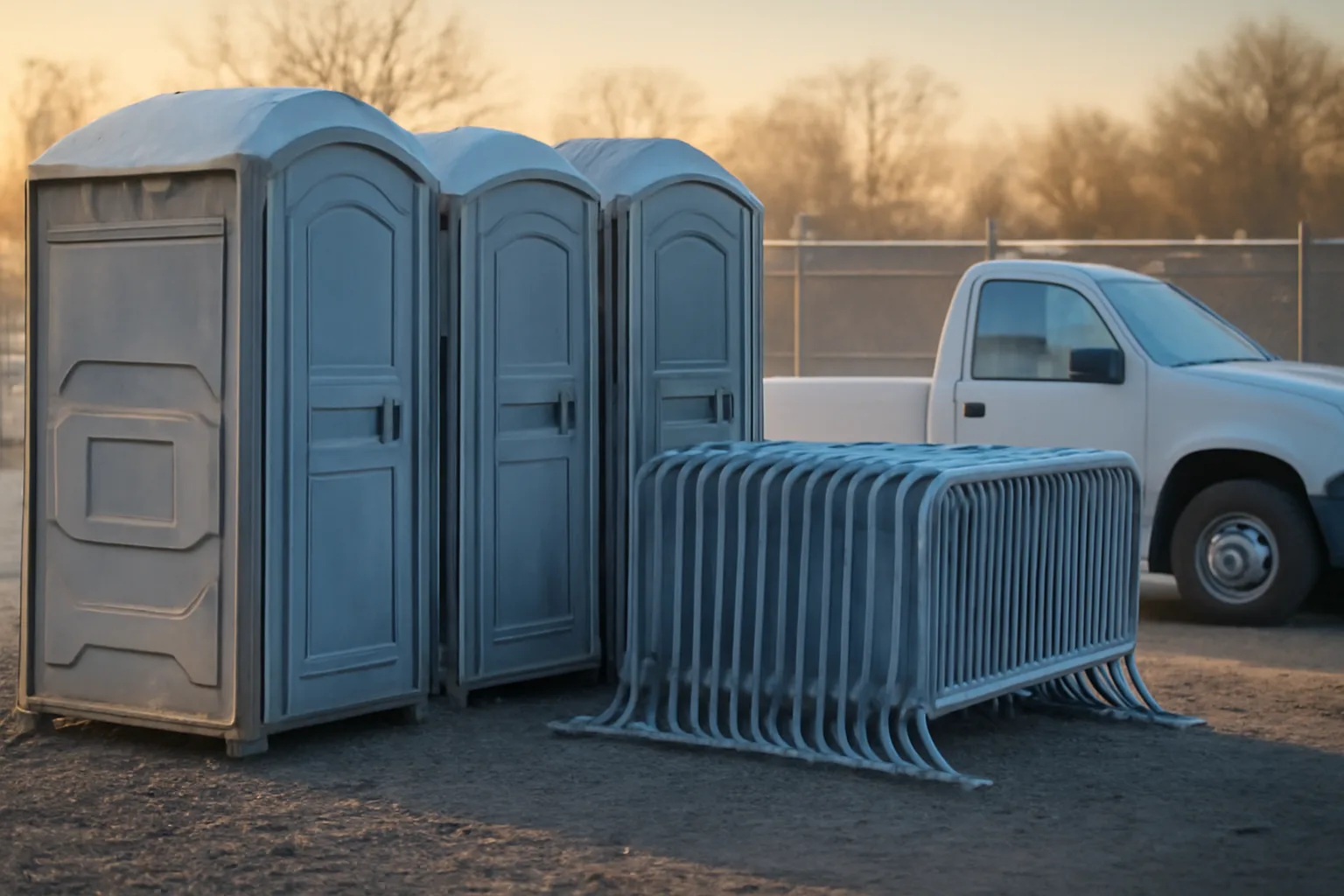
A site services yard is a fenced depot that stores, dispatches, and services rental gear for jobsites. You park portable toilets, roll-off boxes, temporary fence, water tanks, or small generators, then you haul them, service them, and pull them when the superintendent calls. You are in the rental-and-haul business. You are not the general contractor.
A nearby career, in this comparison, is the W-2 job you would actually take if you did not open that lot. Around most yards that means construction labor, refuse collection, truck driving, equipment operation, or a municipal public-works seat. Same dirt. Different name on the paycheck.
People mix the yard up with a GC shop. They are not the same. A general contractor bids scope and carries project liability. A site services operator drops a unit or a box on a ticket, runs a route, and invoices. Some states still pull you into contractor licensing if you install fence as a fixture or if you do excavation. That is a board question, not a vibe.
The physical plant is usually ugly and that is fine. Gravel, a wash pad, a hose bib, a used box truck or a flatbed, and enough room to turn a trailer. Neighbors will care about odor, truck traffic, and stormwater long before they care about your brand. Zoning staff will care more than your first customer will.
If you want a longer map of how yards differ by service mix, read the site services yard guide 12 next. It stays on paper, not slogans.
What does a nearby career pay next to a yard?
Nearby W-2 work has published medians. Yard owner draw does not. In the May 2023 Occupational Employment and Wage Statistics, construction laborers (SOC 47-2061) had a median annual wage of $45,770. [1] Heavy and tractor-trailer truck drivers sat higher. The Occupational Outlook Handbook reported a $54,320 median annual wage for that occupation using May 2023 data. [2] Across every occupation, BLS put the May 2023 median annual wage at $48,060. [3]
Those figures are wages, not total compensation. BLS measured private-industry benefit costs at $13.70 per hour worked in March 2024, against $30.11 in wages and salaries. [4] That benefits slice is paid leave, insurance, retirement, and legally required taxes. You do not see it in the job posting. You feel it when you leave.
Owner income is a residual. Fuel, tires, dump fees, chemical, lease, insurance, and debt service come out first. Then you pay yourself. I have not found a federal series that isolates site services yard proprietor pay. Treat any social post that names a clean monthly net as marketing.
Here is the honest comparison: cash you can miss for 90 days. The job keeps sending a check if you show up. The yard can post a profitable month on paper and still bounce the chemical invoice because three supers did not pay.
| Nearby benchmark (May 2023) | Annual figure | Source |
|---|---|---|
| All occupations median wage | $48,060 | BLS OEWS news release |
| Construction laborers median wage | $45,770 | BLS OEWS 47-2061 |
| Heavy truck drivers median wage | $54,320 | BLS OOH |
For a side-by-side on route mix versus wage work, the site services yard guide 18 is the next click.
Does the yard beat the job in year one?
Usually no. Not on cash, and not on sleep. Year one you are buying a fleet, teaching a route, and waiting on net-30 accounts that behave like net-60. The nearby career pays in week two.
I would not quit a job in the mid $40,000s or mid $50,000s for a yard unless I already controlled land and had at least one signed account that covered the truck note. Used kit helps. Hope does not. BLS reports a May 2023 median annual wage of $45,770 for construction laborers, and that check does not care whether your wash pad is finished. [1]
SBA tells you to split one-time startup costs from monthly operating costs before you open. [5] Do that on paper. Land control (lease or buy), a service truck, tanks or toilets or boxes, an insurance down payment, and a cash buffer for 90 days of fuel and dump tickets. I will not invent a national total. Lots and trucks move with local industrial rent and diesel. Confirm asking rents with local listings, not a blog.
If the job offers overtime, run the real number. DOL requires one and one-half times the regular rate after 40 hours for most nonexempt employees. [6] Plenty of nearby careers clear well above the median with Saturday work and no personal guarantee on a truck note.
The yard can beat that later. Year one it rarely does unless you start half-built.
How do you start a site services yard?
You start with land you can legally use, an entity, an EIN, and a written list from the local planning desk and the state board that touches your waste stream. You do not start with a logo. IRS lets you apply for an EIN online at no charge. [7] SBA walks through entity choice (sole prop, partnership, LLC, corporation) and the tax and liability tradeoffs. [8] Confirm current filing steps with your state business filing office. I will not quote a state fee here because those change.
Then you match the fleet to a permit path. Portable sanitation often runs through the state health or environmental board as a pumper or septage hauler. Roll-off dumpsters often need a local hauler franchise or a solid-waste permit. Temporary fence may be just a rental, or it may trip a contractor license if you install it as a site improvement. That split is why people get surprised. Ask the board in writing.
Trucks can pull you into FMCSA rules. A commercial driver's license is required to operate a vehicle with a GVWR of 26,001 pounds or more, most combination vehicles in that class, placarded hazmat, or a vehicle designed to transport 16 or more passengers (including the driver). [9] Interstate hauling at 10,001 pounds GVWR is the usual USDOT-number tripwire. Confirm your exact vehicle and whether your runs cross a state line.
If you hire anyone, OSHA says it is your job to keep a safety program that meets Part 1926. The text is blunt: "It shall be the responsibility of the employer to initiate and maintain such programs as may be necessary to comply with this part." [10]
Stormwater and oil storage come next. EPA's industrial stormwater program can cover material yards and vehicle maintenance under the Multi-Sector General Permit. [11] Diesel or waste-oil tanks that push you over 1,320 gallons of aboveground oil storage can trigger the SPCC rule. [12]
Insurance sits last on this list and first on the landlord's list. Commercial auto, general liability, and inland marine on the rental fleet. Confirm limits with the customer and the lot lease, not with a template. The site services yard guide 24 is a useful companion if you want the paper sequence without the career comparison.
What licenses does a yard need that a W-2 job does not?
The job needs you to show up, and for some seats a CDL or a union book. The yard needs a stack. Local business license. Zoning or a conditional-use permit for outdoor storage and truck traffic. A state hauler or pumper credential if you touch sewage or putrescible waste. Possible solid-waste or franchise authority for roll-offs. Possible contractor license for fence or site work. Employer accounts for withholding if you have staff.
None of those are optional because a blog said so. They are out of scope only if the activity is out of scope. A toilet yard that never pumps and only rents clean units still has wash-water and chemical storage questions. Ask environmental staff.
Here is how I would work it. Walk into planning with a simple site plan: gravel, wash pad, parking count, hours, and truck types. Ask them to name the use category. Write down the ordinance section they cite. Then call the state board that licenses septage or solid waste and ask if your actual work matches a permit. Render every fee and every processing time as confirm with the board. Those numbers move.
Employees at the nearby career do not hold those permits in their own name. That is the whole difference in paper load. See site services yard guide 30 if you want a deeper license map by service line.
How do taxes change if you leave the job for a yard?
You trade withholding for estimates. IRS sets the self-employment tax rate at 15.3 percent. The agency's own page says, "The self-employment tax rate is 15.3%. The rate consists of two parts: 12.4% for social security (old-age, survivors, and disability insurance) and 2.9% for Medicare (hospital insurance)." [13]
On a W-2, you pay 7.65 percent and your employer pays 7.65 percent. The nearby career hides half of it. As a sole proprietor you see the full 15.3 percent on net earnings, with an income-tax deduction for the employer-equivalent piece. An S corp payroll can change the mix. That is CPA work, not a forum thread.
You also lose automatic withholding. Miss quarterly estimates and you get penalties. The job made that boring. Boring was a feature.
Sales tax on rentals, fuel tax, and local business tax depend on the state. Confirm with the state department of revenue. I will not invent a rate.
If you later hire, you become the withholding agent. That is a different IRS relationship than being the employee. The nearby career never asked you to run payroll on yourself.
What benefits disappear when you quit the nearby career?
Paid leave, the employer share of health insurance, a retirement match, and unemployment insurance. That is the $13.70-per-hour BLS benefits bucket in real life. [4] On a $45,770 laborer median, walking away from that package is not a rounding error. [1]
Most wage workers who lose a job can file for unemployment insurance. DOL's UI fact sheet describes a joint federal-state program that pays eligible unemployed workers. [14] Sole proprietors and many partners do not have that backstop. Some S corp owner-employees who paid into the state system can qualify. Confirm with your state UI agency. Do not assume you can file if the yard dies.
Health coverage is the sleeper cost. Leave a job and you are on a marketplace plan, a spouse's plan, or nothing. IRS employer shared responsibility generally starts at 50 full-time employees including full-time equivalents. [15] Your five-person yard will not be an applicable large employer. That means nobody is making you offer coverage, and nobody is buying it for you either.
Price a real marketplace premium for your age and county before you resign. Add it to the yard's monthly nut. A lot of "I will beat my old wage" spreadsheets forget that line.
How do hours and weekend call-outs compare?
The job has a shift. The yard has a phone. Portable toilets overflow on Saturday. A roll-off gets blocked by a concrete truck at 6:10 a.m. Fence panels blow down in a storm. You can hire a second person for that. Then you have payroll and the OSHA program. [10]
Nearby careers in refuse and construction also start early. I am not selling the job as easy. The difference is coverage. Call in sick to a public-works garage and someone else runs the route. Call in sick as a one-truck yard and the account calls your competitor.
Overtime on the job is cash at time and a half after 40 hours for most nonexempt seats. [6] Extra hours on the yard are often unpaid owner labor that your P&L pretends is free. It is not free. It is how yards look profitable while the owner has no days off.
Holiday weeks are worse, not better. Events and pours do not pause because you wanted Christmas Eve. National chains staff that with a bench. You staff it with your cell phone.
If you hate being on call, take the job. I mean that. The site services yard guide 48 goes deeper on route hours if you still want the yard anyway.
What capital does a yard take versus showing up for a paycheck?
The job asks for work boots and, maybe, a CDL you already have. The yard asks for land control and rolling stock. Those two lines dominate. A used service truck and a starter block of toilets or boxes can be bought in pieces. The lot lease with the right use permission is the part people underprice.
SBA's startup-cost guidance is simple and correct. List one-time costs and repeating costs, then decide if you can fund the gap. [5] I would put 90 days of fuel, dump or disposal tickets, insurance, lease, and a repair reserve in the repeating column before I counted a single owner draw.
SiteServicesPath sells a $249 one-time Shared-Yard Economics Kit if you want those lines forced onto one worksheet. It does not replace a CPA or a board conversation.
Do not finance the fleet on a personal credit card because a vendor said the route will cover it. If a customer is not signed, the route does not exist. Collected cash is the only number that pays the note.
The site services yard guide 36 is worth a look for first-year operating line items.
When is the nearby career the smarter move?
Take the job if you need health coverage this quarter, if you have no lot, if you have no CDL and your plan needs one, or if your household cannot miss a paycheck. Take it if the only customers you have are friends who might need a toilet someday.
Take it if you are comparing the yard to a prevailing-wage public job or a union book with a pension. Those packages are hard to beat with ten used toilets and a Facebook page. BLS already puts ordinary construction labor near $45,770 at the median before overtime. [1] Benefits on top of that were $13.70 an hour in the March 2024 private-industry measure. [4]
Take it if you hate collections. Site services invoices get paid after the GC gets paid, and the GC gets paid after the draw. You will spend mornings chasing accounts payable clerks. Some people would rather swing a hammer.
I would also take the job for twelve months if I still needed CDL hours or the local superintendent relationships. Use the job to learn who actually pays. A name in your phone is not an account.
Dual-income households sometimes hide a bad yard. If the other paycheck is carrying rent and health coverage, the yard can look like it works while it is still a hobby with a truck note. Be honest about that before you call it a business.
When does a site services yard actually win?
The yard wins when you already have a place to park dirty equipment, a truck you can insure, and a customer who will sign. It wins in markets where supers cannot get weekend service from the national chains. It wins if you can live on a spouse's coverage for two years and you are honest about owner hours.
It also wins as a second act after a nearby career, not instead of one. People who ran refuse trucks or worked for a rental house already know the unglamorous parts. Wash water. Angry neighbors. Smashed units. Fuel tickets.
Scale helps, but scale is just more paper. More employees means FLSA overtime, workers' comp, and a real safety program. [6] [10] More tanks can mean SPCC once you cross 1,320 gallons of aboveground oil storage. [12] I would rather run a tight toilet route that pays than a sloppy book that does not.
Nobody has good public data on owner returns in this niche. The closest honest comparison is still your own 12-month cash forecast against the BLS wage for the job you would actually take. [1] [2]
The site services yard guide 54 is a decent next read if you are weighing a small fleet against staying employed.
Should you keep the job while you open the yard?
Often yes. Nights and weekends work for fence panels and for buying used kit. They work poorly for toilet service, because the route happens during the same daylight the job wants. A roll-off yard has the same problem if dumps have to happen on weekday scales.
Watch conflicts. Some employers ban moonlighting, especially if you might sell to their customers. Read the handbook. Do not steal a customer list. That is how you start a lawsuit instead of a yard.
Taxes get messy if you are W-2 and buying assets in the same year. File on time. Keep the lot lease in the entity's name once you have the entity. IRS still wants estimates on the self-employment side if that net is real. [13]
I would keep the job until the yard's collected cash (not billed) covers the lease, insurance, and truck for three months. Billed is vanity. Collected is rent.
More on sequencing is in the site services yard guide 42.
What do you confirm with the board before you resign?
Confirm the use category for your address, in writing. Confirm whether your waste stream needs a hauler, pumper, or solid-waste credential. Confirm whether fence installation needs a contractor license in your state. Confirm CDL class for the actual GVWR on the door sticker, not the truck you wish you had. [9] Confirm if the lot needs industrial stormwater coverage. [11] Confirm oil storage against the 1,320-gallon SPCC threshold. [12]
Confirm insurance bind requirements with the landlord and with one real customer. Confirm UI rules with the state if you think owner coverage exists. [14] Confirm estimated-tax mechanics with IRS instructions or a CPA, not a group chat. [13]
Then resign, or do not. The nearby career will still be there if the board says your lot is illegal for outdoor storage. A lot of yards die on zoning, not on toilets.
If you want the worksheet after that board list is in hand, use /start. SiteServicesPath is an independent publisher, not a law firm and not a service company.
Frequently asked questions
What is a site services yard?
A site services yard is a fenced lot plus the trucks and rental fleet you dispatch to construction sites, plants, and events. Typical kit is portable toilets, roll-off dumpsters, temporary fence, and water tanks. You rent, haul, service, and pick up. You are not bidding the building. Confirm local zoning for outdoor storage before you sign a lease.
How do you start a site services yard?
Control land you can legally use, form an entity, get a free EIN from IRS, then ask planning and the state board what permits match your actual work. Match trucks to CDL and USDOT rules. Add insurance the landlord will accept. Do not invent a start date. Confirm every fee and form with the board that issues it.
Can I run a site services yard without a CDL?
Sometimes. FMCSA requires a CDL at 26,001 pounds GVWR, for most combination vehicles in that class, for placarded hazmat, and for vehicles designed for 16 or more passengers. Lighter service trucks can stay under that line. Weigh the actual door-sticker GVWR, not the model name. Confirm with your state driver license agency.
Do I need a contractor license for a site services yard?
Not for pure rental and haul in many states. You may need one if you install fence as a site improvement, do excavation, or hold out as a construction contractor. Portable sanitation and roll-offs more often hit hauler or pumper boards instead. Ask the contractor board and the waste board in writing. Do not guess from a forum.
How much land does a site services yard need?
Enough to store the fleet, turn the longest trailer you will own, and keep wash water on your pad. I have seen tight half-acre lots work for a small toilet route and I have seen two acres feel small once boxes stack up. Zoning setbacks and neighbor complaints matter more than a national acre target. Confirm the use category at planning.
Will I pay self-employment tax on yard profits?
If you are a sole proprietor or a partner, yes, on net earnings. IRS sets the self-employment tax rate at 15.3 percent (12.4 percent Social Security and 2.9 percent Medicare). A W-2 job splits that 15.3 percent with the employer. An S corp payroll can change the mix. That is CPA work. Confirm filing with IRS instructions.
Can I collect unemployment if the yard fails?
Often no, if you were a sole proprietor who never paid into the state UI system as an employee. DOL describes UI as a joint federal-state program for eligible unemployed workers. Some owner-employees on S corp payroll who paid premiums can qualify. Confirm with your state UI agency before you treat UI as a backstop.
Is a site services yard a construction company?
No. It is a rental-and-haul operation that supports construction and events. You can still trip construction rules. OSHA Part 1926 can apply if you have employees on jobsites. A contractor license can apply if you install, more than drop. Keep the scope tight and ask the board if your work crosses the line.
What nearby jobs map closest to yard work?
Construction labor, refuse collection, heavy truck driving, equipment operation, and municipal public works. BLS put construction laborers at a $45,770 May 2023 median and truck drivers at a $54,320 OOH median. Those jobs teach routes, dirt, and early hours. They also come with withholding and, usually, a path to unemployment insurance.
Do I need stormwater coverage for a gravel equipment lot?
Maybe. EPA's industrial stormwater program, including the Multi-Sector General Permit, can cover vehicle maintenance and material storage yards. A clean parking pad with no maintenance may fall out. A wash rack and fueling usually push you in. Ask the state NPDES agency whether your SIC or NAICS and your actual activities need a notice of intent.
Should I form an LLC before I quit the nearby career?
Form the entity before you sign a lot lease or buy a truck in your own name, even if you still have the job. SBA outlines the liability and tax tradeoffs by structure. An EIN from IRS is free. Confirm state filing steps and any local business license with those offices. Quitting can wait until collected cash is real.
Can I start with used portable toilets and one truck?
Yes, if the land is legal and one account will actually pay. Used kit is how most small yards start. The trap is financing a fleet before collections exist. I would keep the nearby career until three months of lease, insurance, and truck are covered by deposited checks, not invoices. Confirm pump-out disposal with the board first.
Why does the job usually beat the yard in year one?
The paycheck lands in week two. The yard waits on net-30 accounts, a finished wash pad, and permits. BLS put construction laborers at a $45,770 median in May 2023, plus $13.70 an hour in private-industry benefits in March 2024. Year one, most owners cannot match wage plus benefits while carrying a truck note and a lease.
How much cash buffer should I hold before opening a yard?
I would fund 90 days of fuel, disposal tickets, insurance, lease, and a repair reserve before I counted any owner draw. SBA guidance says split one-time startup costs from monthly operating costs and fund the gap. Local diesel and industrial rent set the real number, so confirm asking rents with local listings, not a national estimate.
Sources
- U.S. BLS, OEWS May 2023 Construction Laborers (47-2061): May 2023 median annual wage of $45,770 for construction laborers
- U.S. BLS, Occupational Outlook Handbook: Heavy and tractor-trailer truck drivers: May 2023 median annual wage of $54,320 for heavy and tractor-trailer truck drivers
- U.S. BLS, Occupational Employment and Wage Statistics news release, May 2023: Median annual wage for all occupations was $48,060 in May 2023
- U.S. BLS, Employer Costs for Employee Compensation, March 2024: Private industry wages $30.11 and benefits $13.70 per hour worked in March 2024
- U.S. Small Business Administration, Calculate your startup costs: Startup planning should separate one-time startup costs from monthly operating costs
- U.S. Department of Labor, Overtime pay: Most nonexempt employees must receive 1.5 times the regular rate after 40 hours in a workweek
- Internal Revenue Service, Apply for an Employer Identification Number (EIN) online: Businesses can apply for an EIN online at no charge
- U.S. Small Business Administration, Choose a business structure: Sole proprietorship, partnership, LLC, and corporation have different tax and liability tradeoffs
- FMCSA, Commercial Driver's License: A CDL is required at 26,001 pounds GVWR, for specified combination vehicles, placarded hazmat, and 16+ passenger vehicles
- OSHA, 29 CFR 1926.20 General safety and health provisions: Employers must initiate and maintain programs necessary to comply with OSHA construction standards
- U.S. EPA, Stormwater Discharges from Industrial Activities (2021 MSGP): Industrial facilities, including certain material yards and vehicle maintenance, may need MSGP stormwater coverage
- U.S. EPA, Spill Prevention, Control, and Countermeasure (SPCC) Rule: SPCC rule can apply to facilities with more than 1,320 gallons of aboveground oil storage
- Internal Revenue Service, Self-employment tax (Social Security and Medicare taxes): The self-employment tax rate is 15.3 percent (12.4 percent Social Security and 2.9 percent Medicare)
- U.S. DOL Employment and Training Administration, Unemployment Insurance fact sheet: Unemployment insurance is a joint federal-state program that pays eligible unemployed workers
- Internal Revenue Service, Employer Shared Responsibility Provisions: Employer shared responsibility generally applies at 50 or more full-time employees including FTEs