Last updated 2026-08-20
TL;DR
The expensive site services yard mistakes are almost never the trucks. They are opening on the wrong land, skipping industrial stormwater coverage, storing diesel without an SPCC plan, putting non-CDL drivers in heavy roll-off trucks, and keeping no tickets when waste moves. Start with zoning and the state board, then paper the water, fuel, and highway pieces before you buy a fleet. Confirm every fee with the issuing agency.
What is a site services yard?
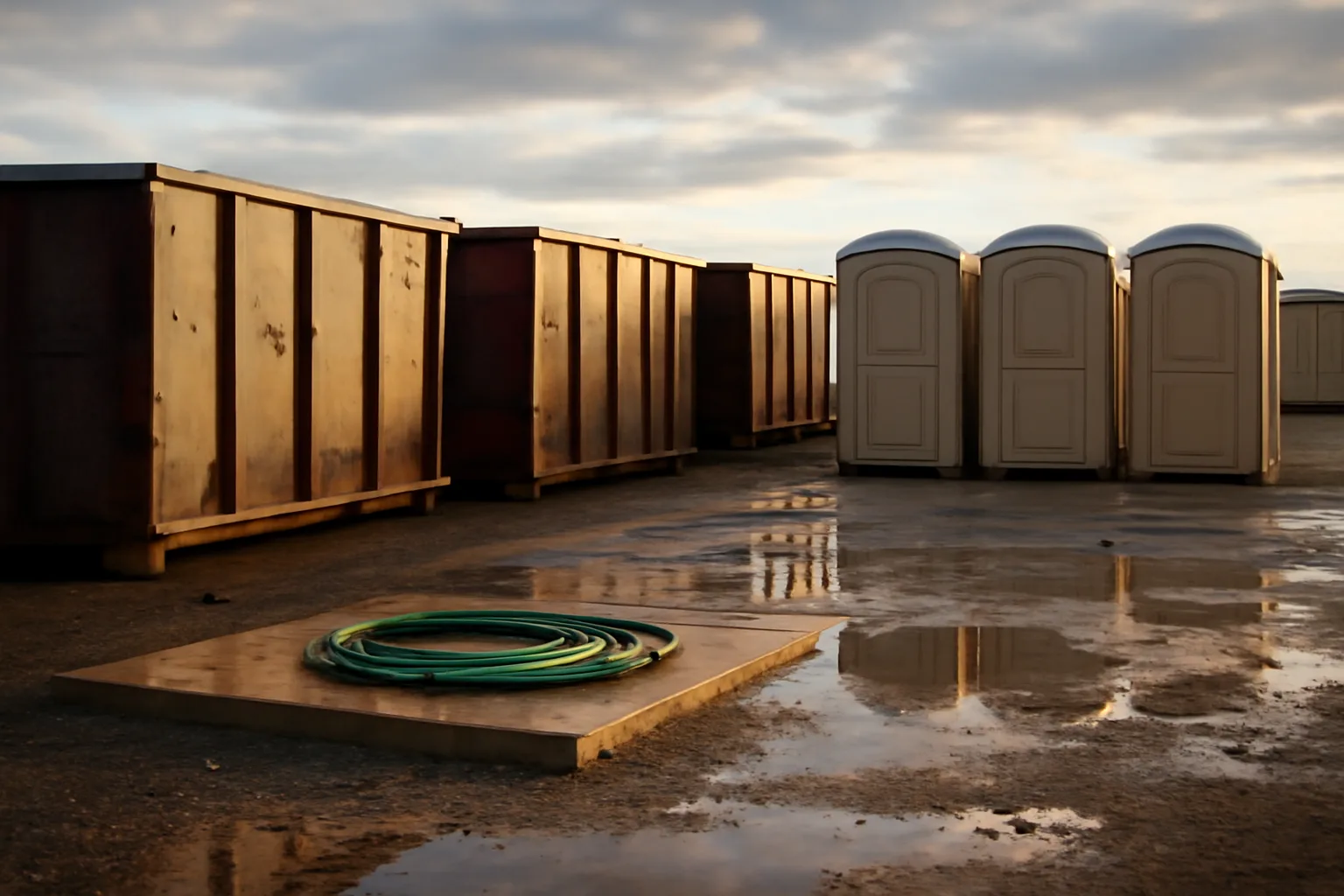
A site services yard is the off-site depot that feeds jobsites. You stage roll-off containers, portable toilets, temporary fence, water tanks, and the trucks that haul them. You wash, repair, and park there. Customers never treat it as the product. Inspectors do.
It is not a landfill. It is not automatically a transfer station. It is also more than parking. Once you store empties, run a wash rack, keep diesel, and send trucks out daily, planning departments and water boards already see an industrial use. That gap between how owners talk and how agencies classify the land is where a lot of first-year pain starts.
Most yards sit at the overlap of four systems. Local zoning and any conditional use permit. State environmental rules for stormwater, septage, and solid waste. Federal and state motor carrier rules if your trucks use public roads. Workplace safety rules in the shop and on the lot. Miss one and you can still operate for a while. Miss two and someone eventually chains a gate.
If you only rent toilets, your state health department may treat you as a septage hauler. If you only rent dumpsters and you never tip on your own land, you may be a transporter, not a facility. If other haulers drop mixed waste on your pad so you can sort it later, you may have built a transfer station without the permit. Confirm that line with your state solid waste program before you say yes to a friend's overflow.
I use a simple test. If a stranger can see stacked inventory, hear backup alarms before 7 a.m., or smell a wash rack from the road, you have a yard. Plan the paper for a yard, not for a truck and a dream.
What site services yard mistakes cost the most in year one?
The most expensive site services yard mistakes are a bad site, missing water and fuel permits, and highway violations that park trucks. Overbuying equipment hurts cash. It rarely produces a stop-work order. Wrong land and wrong paper do.
I have not seen a clean national failure rate for this niche. Nobody has good data on how many yards close in year one. The closest honest picture is the citation stack: planning enforcement, industrial stormwater, spill plans, and motor carrier out-of-service orders. Those are public rules with public penalties. Truck notes are not.
A land fight can burn a year of rent while you wait on a hearing. Confirm timelines with the planning counter. Do not take a broker's should-be-fine as a use determination. Get it in writing.
On the highway side, 49 CFR 387.9 sets public-liability floors that surprise people who bought a cheap garage policy. For-hire property in interstate commerce (nonhazardous) sits at $750,000. Oil and many hazardous materials sit at $1,000,000. Bulk hazardous substances sit at $5,000,000. [4] Your state may demand the same limits even if you never leave the county. Confirm with the state motor carrier desk.
Here is the pattern I would actually budget against. Land and use first. Water and fuel second. Authority, insurance, and drivers third. Boxes and toilets fourth. Reverse that order and you have built a money fire.
| Mistake | What it trips | Who usually shows up |
|---|---|---|
| Wrong zoning or no CUP | Abatement, lost lease | County planning |
| No industrial stormwater coverage | Unpermitted discharge | State water board or EPA |
| Diesel stored with no SPCC plan | 40 CFR 112 gap | EPA or delegated state |
| CDL or medical card missing | Truck placed out of service | State police, FMCSA |
| Third-party waste staged on the lot | Unpermitted transfer station | State solid waste |
How do you start a site services yard without repeating these mistakes?
You start a site services yard by locking the service mix, then the land, then the agency paper, then the people, then the iron. Flip that sequence and you fund a storage lot you cannot legally run.
Write the mix first. Toilets, roll-offs, fence, water, storage boxes, and pump trucks each pull a different license. A toilet-only shop talks to the health department and a wastewater plant. A roll-off shop talks to solid waste and often to the highway patrol. A mixed yard talks to all of them. State walkthroughs differ. The California start path is not the Colorado path, and you should read the state guide before you sign a lease (how to start a site services yard in California, how to start a site services yard in Colorado).
Then form the entity and get an EIN. IRS Publication 535 is the document I actually send people to for how startup and ordinary expenses get treated, not a blog recap of last year's deduction cap. [12] Read the current edition. Tax rules move.
Next, take the mix to planning, fire, and the water board in writing. Ask whether the parcel's use is permitted, conditional, or forbidden. Ask whether a wash rack needs oil-water separation and a sanitary tie-in. Ask whether stacked containers count as outdoor storage with a height cap. If any answer is maybe, stop buying trucks.
After land, pull the operating paper that matches the mix: local business tax, state waste transporter or septage credentials, industrial stormwater coverage if you discharge, and motor carrier credentials if the trucks trigger them. Confirm forms and fees with the board that issues them. I will not quote a processing time. Those change and the board's page wins.
Hire against the highway and the forklift rules, not against a friend who can drive a pickup. Then buy the minimum fleet that covers the first booked routes. Empty iron on a lot you cannot permit is a yard sale, not a business.
Why do zoning mistakes stop a yard before the first truck rolls?
Zoning mistakes stop yards because a site services yard looks like outdoor storage, trucking, and light industry all at once, and many parcels do not allow that combination. A handshake with the landlord does not override the zoning map.
Agricultural land is the trap I see most. People assume farm zoning will accept parked dumpsters because the lot is already messy. Counties often treat commercial container storage and daily truck traffic as a change of use. Residential-edge industrial is the other trap. Backup alarms at 5:30 a.m. create the complaint file that triggers the inspection you were hoping to delay.
Get a written zoning verification or a planner email that names the use. If you need a conditional use permit, budget for neighbor notice, a site plan, screening, hours, and drainage notes. I would rather lose a deposit on a bad parcel than fund a year of rent on land that cannot take the use.
Fire setbacks, stacking height, and drive-aisle width show up on the same site plan. So does employee parking once you have more than a couple of drivers. None of this is glamorous. All of it is cheaper than moving 80 boxes after a denial.
State license pages do not fix local land use. Alabama paper will not save a bad lot in Mobile County. Read the local start notes and the license notes as a pair (how to start a site services yard in Alabama).
What stormwater and wash-rack mistakes do new yards make?
New yards skip industrial stormwater coverage and then wash toilets, trucks, and greasy parts onto bare gravel. That is the fastest way to turn a quiet lot into a water-board file.
Federal rules treat stormwater that is tied to industrial activity as a regulated discharge. 40 CFR 122.26(b)(14) says a storm water discharge associated with industrial activity means "the discharge from any conveyance that is used for collecting and conveying storm water and that is directly related to manufacturing, processing or raw materials storage areas at an industrial plant." [1] A yard that stores equipment, empties, and raw materials, then sheds rain to a ditch, sits in that conversation.
Coverage is usually a Multi-Sector General Permit (the 2021 MSGP in EPA states, or the state clone). [2] You file a notice of intent, write a stormwater pollution prevention plan, train people, and sample if the permit says so. Confirm the sector, the form, and whether your state is authorized. I would not guess the sector from a forum post.
Wash water is not stormwater. Toilet rinse, truck soap, and degreaser belong in a contained pad that drains to a sanitary connection or a permitted tank. Running a hose across gravel is disposal, not cleaning. If the pad overflows in a storm, you just mixed industrial wash water into the storm system. That is the inspection photo.
I would spend money on a sloped pad, a grit and oil separator, and a roof over the worst work before I bought a third roll-off truck. Ugly concrete beats a pretty truck you cannot wash.
Which fuel and SPCC mistakes show up after the first tank?
Fuel mistakes show up when someone drops a cheap 1,000-gallon diesel tank, then adds a second tank, and nobody adds the gallons. EPA's SPCC rule at 40 CFR part 112 is built on aggregate aboveground oil storage. The commonly used trigger is 1,320 U.S. gallons. [3]
Oil here is broader than diesel. Hydraulic oil, used oil, gasoline, and many other oils count. Drums count if they are not motive tanks on vehicles. People forget the drum cage next to the shop. That cage is how a "small" yard crosses the line.
If you are in, you need an SPCC plan, secondary containment that makes sense for the tanks you have, inspections, and a response path. A plan written after the spill is a confession. I would measure every container on day one and keep a one-page tank log on the shop wall.
Used oil from the shop is its own handling problem. So are parts-washer solvents. Those streams can also count toward hazardous waste generator status if they are discarded as hazardous waste. EPA says Very Small Quantity Generators "generate 100 kilograms or less per month of hazardous waste or one kilogram or less per month of acutely hazardous waste." [10] Cross the line without noticing and the paper changes. [11]
Do not bury a tank to dodge the aboveground rules. Buried tanks have their own world, and 40 CFR 112 still looks at buried capacity. Pour a pad. Buy a double-wall tank. Keep the receipt.
What DOT, CDL, and insurance mistakes park your trucks?
The highway mistakes that park trucks are the wrong license class, no medical card, no USDOT number when one is required, and liability limits below the federal floor. A clean truck with a dirty file still sits.
A commercial motor vehicle under the CDL rules generally includes a single vehicle with a GVWR of 26,001 pounds or more, certain combinations, 16 or more passengers, and placarded hazmat. [5] Plenty of roll-off trucks sit over that weight empty or loaded. If the truck needs a CDL, the driver needs the right class and endorsements, plus a valid medical examiner's certificate under 49 CFR 391.41. [6] "He has driven farm trucks for years" is not a certificate.
Interstate commerce usually means a USDOT number. FMCSA's own registration page is the check, not a Facebook group. [13] Intrastate operators often still need a state number. Confirm with the state. IFTA and IRP show up once you cross state lines with qualified vehicles. Crossing once for a favor load still counts.
Insurance is where cheap quotes die. 49 CFR 387.9 is the schedule of public-liability limits for motor carriers. $750,000 is the nonhazardous property floor for covered for-hire interstate operations. $1,000,000 and $5,000,000 apply once oil or other hazardous materials enter the picture. [4] A site services yard that tows a diesel slip tank or hauls contaminated soil can leave the cheap tier without meaning to.
General liability is not auto liability. Pollution is neither. If a tank leaks into a ditch, a garage policy may smile and decline. I buy the highway file and the pollution file before I buy another container.
When does a site services yard become a waste facility by accident?
A site services yard becomes a waste facility when other people's waste sits, gets sorted, or gets transferred on your land. Renting empty boxes is a service. Consolidating full boxes is a facility in a lot of states.
The tell is inbound waste that is not yours, sitting longer than a turn, especially if you open lids and pick metals or cardboard. State solid waste programs wrote transfer-station rules for exactly that picture. Federal RCRA still sits underneath if hazardous waste appears in the mix. [11] Household paint, solvents, and mystery drums show up in construction roll-offs. Your driver did not make them non-hazardous by being in a hurry.
Portable toilet waste is not mixed solid waste. It is septage. If you treat it or land-apply it, 40 CFR part 503 can apply. [14] Most yards should never go there. Haul to a permitted plant and keep the tickets. A field behind the lot is not a plant.
I would write two sentences into every customer and subcontractor agreement. No hazardous waste in the box. No drop-and-leave on my yard. Then enforce it. One free "just overnight" favor is how a clean transporter becomes an unpermitted facility.
License language is state-specific. Arizona's license notes are not California's, and renewal is its own paper path (site services yard license in Arizona, site services yard license in California, site services yard renewal in California).
What first-year equipment and layout mistakes waste cash?
The first-year equipment mistake is buying a full fleet to look busy. The layout mistake is treating the lot like a junk drawer. Both waste cash. Only the layout also wastes inspections.
Buy against booked routes, not against a competitor's Instagram. A second hook-lift truck with no second driver is a depreciating sculpture. Used toilets with cracked tanks cost more in dump fees and complaints than they save at auction. I would rather rent iron for 90 days and learn the real mix.
Layout is drainage, turning radius, and separation. Keep clean empties uphill of the wash pad. Keep diesel and used oil together, bermed, away from the ditch. Keep public pickup (if you even allow it) away from the shop door. Mud rivers toward the gate are how you fail a walking-working-surfaces look under 29 CFR 1910.22, which expects surfaces to be kept clean and, so far as possible, dry. [15]
Shared yards create a special kind of mess. Two operators, one pad, one stormwater plan, and no written split on who files what. If you are modeling that split, SiteServicesPath sells a $249 one-time Shared-Yard Economics Kit. I would still put the same numbers in a plain spreadsheet and make one person the permittee of record.
Do not pave everything on day one. Do pave or concrete the wash pad, the fuel pad, and the first 40 feet inside the gate. Gravel everywhere else is fine until you know traffic paths. Fancy office trailers are a waste. A connex with a heater and a file cabinet is a yard.
Which OSHA and hiring mistakes hit site services yards?
OSHA and hiring mistakes hit yards when owners treat the lot like a farm and the shop like a hobby garage. It is a workplace. The injuries are real even if the national datasets lump you into a broader industry code.
Forklifts and skid steers need trained, evaluated operators under 29 CFR 1910.178. [8] A weekend checkout is not an evaluation. Pinched feet and backed-into toilets are how you learn this. Same for jack stands under a hook-lift hoist. If you cannot name the person who trained the new hire, you did not train the new hire.
Hazard communication still applies to diesel, solvents, acids for toilet rinse, and weld gases. 29 CFR 1910.1200 is the rule. [9] Keep the safety data sheets where people actually work, not in a truck glove box that left for a job at 4 a.m.
Recordkeeping is where small yards look sloppy. OSHA requires each recordable case on the OSHA 300 Log and 301 Incident Report "within seven (7) calendar days after you receive information that a recordable injury or illness has occurred." [7] Seven days. Not when you get around to it. Not after the insurance call.
Hiring off Craigslist without a license check, a medical card check, and a simple road test is how stolen boxes and crashed trucks enter the story. I run the file before the key. I also pay for the physical. Cheap drivers are not cheap.
How do paper and recordkeeping failures get yards cited?
Paper failures get yards cited because inspectors ask for files, not stories. If the ticket, the training card, the stormwater log, or the medical certificate is not in the folder, it did not happen.
Build a boring system. One inbound/outbound ticket per box or toilet with date, customer, driver, and destination. One folder for CDLs and medical cards with expiration dates on a wall calendar. One stormwater inspection log that matches the permit schedule. One SPCC inspection sheet if you have tanks. One OSHA 300 log if you have employees. One file of SDS sheets. That is the whole trick.
Waste destinations need proof. A landfill scale ticket or a plant receipt closes the loop. "We always go to the same dump" is not a receipt. If a load is rejected, keep that paper too. Rejection tickets are how you prove you did not quietly tip on the back lot.
I keep digital photos of every incident, every spill pad, and every stacked row after a wind event. Storage is cheap. Arguments are not. Do not invent fancy software in month one. A numbered receipt book and a shared drive beat an unused app.
Renewal is part of the paper path, not a surprise. California renewal is a different packet than the original license. Read it before the window closes (site services yard license in Colorado if that is your board, and the matching renewal guide for your state).
What should you confirm with the board before you spend?
Confirm the use, the license name, the form numbers, and the current fees with the board that issues them before you spend on iron. Do not confirm them with me, a broker, or a Facebook group.
Ask planning: is this use permitted, conditional, or forbidden on this parcel? Ask the water board: do I need industrial stormwater coverage, and which sector? Ask the solid waste program: does overnight staging of customer waste make me a facility? Ask the health department: what septage credentials apply if I touch toilets? Ask the state motor carrier desk: USDOT, intrastate authority, and insurance minimums? Ask the tax counter: local business license and any vehicle taxes?
Write the answers down with the person's name and the date. Boards change forms. Fees change. I will not print a fee here because a stale number is worse than no number. The agency page and the clerk on the recorded line are the record.
If you want a state-by-state start map after that call, use the state guides and then go back to the board. Arizona's start sequence is a useful comparison if you are shopping states (how to start a site services yard in Arizona).
SiteServicesPath is an independent publisher, not a law firm and not a service company. Nothing here is approval, a timeline promise, or legal advice. If you want the shared-yard worksheet and the start path, use /start. Then confirm every form with the board that stamps it.
Frequently asked questions
What is a site services yard?
A site services yard is the depot that stages and services jobsite rentals such as roll-off dumpsters, portable toilets, temporary fence, and water tanks. It is where you park, wash, repair, and dispatch. It is not the jobsite and it is not automatically a landfill or transfer station. Inspectors still treat it as an industrial use once trucks, tanks, and outdoor storage appear.
How do you start a site services yard?
Lock the service mix, then the land use, then agency paper, then drivers, then equipment. Form an entity, get an EIN, and get written zoning answers. Pull only the licenses that match toilets, waste, stormwater, and highway rules in your state. Confirm every form and fee with the issuing board. Buy the smallest fleet that covers booked routes, not a showroom lot.
Do I need a stormwater permit for a site services yard?
Often yes if rain leaves your lot from industrial areas such as storage, fueling, or a wash pad and reaches a ditch, storm drain, or water. Federal industrial-stormwater rules live in 40 CFR 122.26, and many yards use a Multi-Sector General Permit or the state version. Confirm the sector and the notice-of-intent form with your water board before you wash the first truck.
Can I run a site services yard from agricultural land?
Sometimes, if the county already allows commercial outdoor storage and trucking on that parcel. Often, no. Daily truck traffic, stacked containers, and a wash rack are a change of use on a lot of ag parcels. Get a written zoning verification. A landlord handshake does not beat the zoning map, and a lost growing season of rent is an expensive way to learn that.
Do dumpster trucks need a CDL?
Many do. Under 49 CFR part 383, a single vehicle with a GVWR of 26,001 pounds or more generally needs a CDL, and so do certain combinations, passenger vehicles, and placarded hazmat hauls. Check the door rating, not the nickname of the truck. The driver also needs a current medical examiner's certificate when the CDL rules apply.
What happens if I skip an SPCC plan?
If your aggregate aboveground oil storage is over the 1,320-gallon trigger in 40 CFR part 112 and you have no plan, you are already out of compliance before any diesel hits dirt. After a release, you face cleanup, possible EPA or state enforcement, and a very ugly insurance conversation. Measure every tank and drum on day one and write the plan before the second tank arrives.
Is a site services yard a transfer station?
Not if you only stage your own empty containers and haul customer waste straight to a permitted landfill or plant. It can become one if other people's waste sits, gets sorted, or gets transferred on your lot. That line is state law. Ask the solid waste program in writing before you let a friend drop a full box overnight.
How much insurance does a site services yard need?
There is no single private number. For covered interstate motor carriers, 49 CFR 387.9 sets public-liability floors of $750,000 for nonhazardous property, $1,000,000 for oil and many hazardous materials, and $5,000,000 for certain bulk hazardous substances. States can match or add limits. Buy auto, general liability, and pollution as separate questions, not one cheap garage policy.
Do I need a USDOT number for local hauls only?
Interstate commerce generally requires a USDOT number. Purely in-state work often still needs a state USDOT or equivalent. FMCSA's registration page is the federal check. One out-of-state favor load can change the answer. Confirm with the state motor carrier desk and do not take a shop-talk answer as registration.
Can I wash toilets and trucks on bare ground?
You should not. Wash water carries soap, sewage residue, grease, and diesel film. On bare ground it is disposal, and in a rain it becomes an industrial discharge. Use a sloped, contained pad that drains to a sanitary connection or a permitted tank. I would fund that pad before a third truck.
What records do inspectors actually ask for?
Expect CDLs and medical cards, vehicle files, landfill or plant tickets, stormwater logs, any SPCC inspections, SDS sheets, forklift evaluations, and the OSHA 300 log if you have employees. OSHA requires recordable cases to be entered within seven calendar days. If the folder is empty, the story does not count.
Do I need a hazardous waste ID number?
Not automatically. EPA generator categories start with Very Small Quantity Generators at 100 kilograms or less of hazardous waste per month. Shop solvents, certain used absorbents, and rejected load residues can push you up a tier. Count what you actually discard. Confirm with EPA's generator rules and your state program before you assume household-exempt covers a commercial shop.
Can I share a yard with another operator?
Yes, if one party is clearly the permittee of record for stormwater, tanks, and land use, and the money split is written down. Shared lots fail when two logos share one pad and nobody owns the inspection log. Write who files, who trains, and who pays the spill. A spreadsheet is enough. Fancy joint-venture paper is optional.
Sources
- eCFR, 40 CFR 122.26 Storm water discharges: Defines storm water discharge associated with industrial activity as discharge from conveyances related to manufacturing, processing, or raw materials storage areas.
- U.S. EPA, 2021 Multi-Sector General Permit (MSGP): EPA's 2021 MSGP is the federal industrial stormwater general permit many industrial facilities use for NPDES coverage.
- eCFR, 40 CFR part 112 Oil pollution prevention (SPCC): SPCC requirements apply to facilities with oil storage that can reasonably be expected to discharge to navigable waters, with the commonly applied 1,320-gallon aboveground aggregate threshold.
- eCFR, 49 CFR 387.9 Financial responsibility minimums: Sets motor carrier public-liability minimums at $750,000, $1,000,000, or $5,000,000 depending on cargo type.
- eCFR, 49 CFR part 383 Commercial driver's license standards: CDL rules cover commercial motor vehicles including vehicles with a GVWR of 26,001 pounds or more, certain combinations, passenger vehicles, and placarded hazmat.
- eCFR, 49 CFR 391.41 Physical qualifications for drivers: Interstate CDL drivers must meet physical qualifications and hold a medical examiner's certificate.
- OSHA, 29 CFR 1904.29 Recording criteria forms: Recordable injuries and illnesses must be entered on the OSHA 300 Log and 301 Incident Report within seven calendar days.
- OSHA, 29 CFR 1910.178 Powered industrial trucks: Forklift and other powered industrial truck operators must be trained and evaluated before operating.
- OSHA, 29 CFR 1910.1200 Hazard communication: Employers must communicate chemical hazards, including labels and safety data sheets, for workplace chemicals such as fuels and solvents.
- U.S. EPA, Categories of hazardous waste generators: VSQGs generate 100 kilograms or less per month of hazardous waste or one kilogram or less per month of acutely hazardous waste.
- eCFR, 40 CFR part 262 Hazardous waste generator standards: Federal standards for hazardous waste generators, including counting and paperwork duties that apply once waste is generated.
- IRS, Publication 535 Business Expenses: IRS guidance on deducting and treating ordinary business expenses and startup costs.
- FMCSA, Do I need a USDOT number?: Explains when a motor carrier must obtain a USDOT number for commercial motor vehicle operations.
- eCFR, 40 CFR part 503 Sewage sludge standards: Federal standards can apply to the use or disposal of sewage sludge and related septage if it is treated or land-applied.
- OSHA, 29 CFR 1910.22 Walking-working surfaces: Work surfaces must be kept clean, orderly, and so far as possible dry, which applies to muddy yards and wash areas.