Last updated 2026-08-21
TL;DR
A site services yard is the fenced, zoned base where a site services company parks trucks, stores bins or toilets, stages fence and mats, and runs dispatch. You start by locking land use, then entity and tax IDs, then environmental and vehicle paper that matches what sits on the lot. Federal rules set hard thresholds such as 1,320 gallons for SPCC. Local boards set fees and the land-use call. Confirm every dollar and timeline with that board.
What is a site services yard?
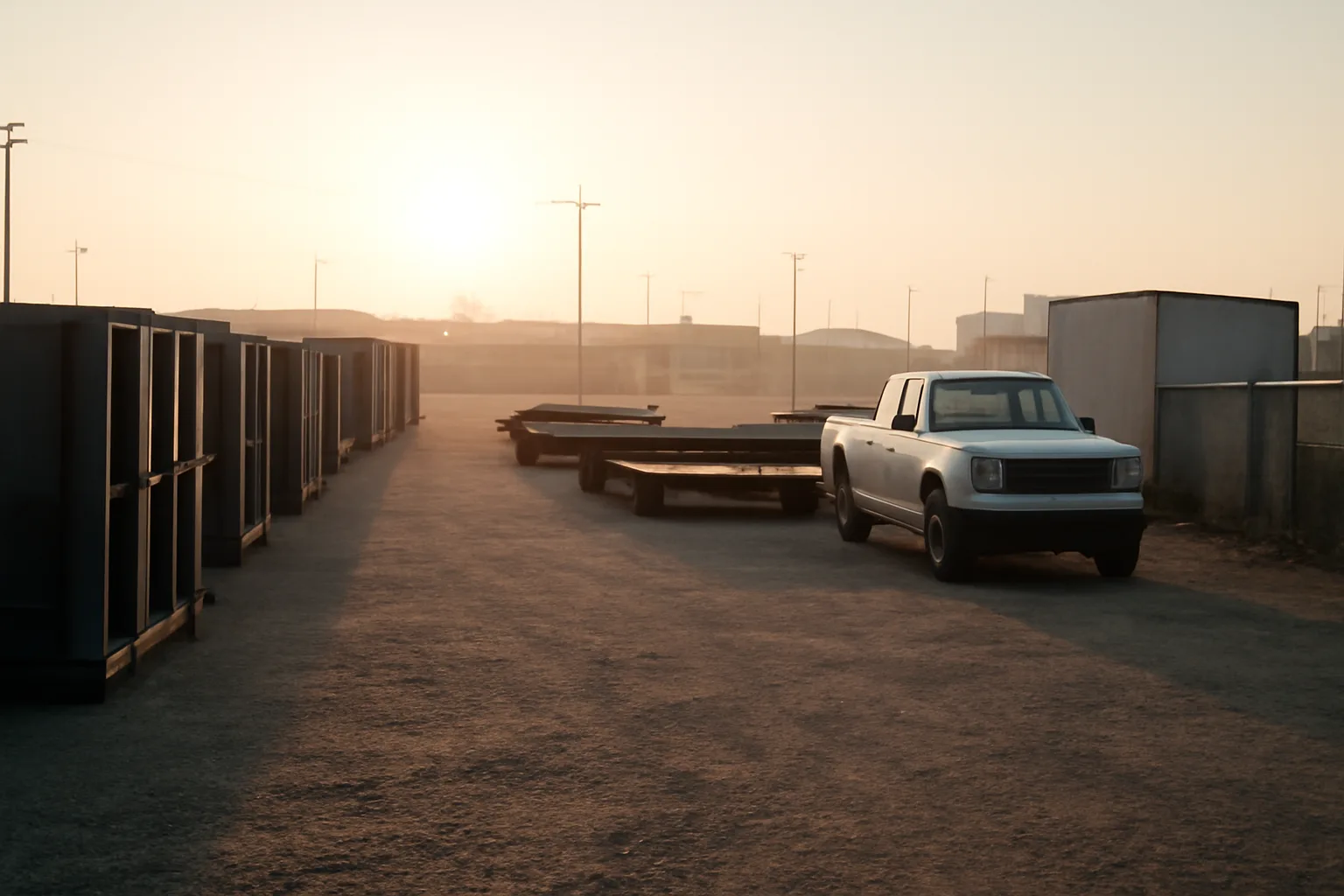
A site services yard is the fenced lot a site services company uses as its base. Crews leave from there. Roll-off boxes, portable toilets, temporary fence, trench plates, water tanks, and mats sit there between jobs. Dispatch, light repair, and container cleaning often happen on the same parcel. It is an operations yard, not a showroom.
People mix the term up with a junkyard or a landfill. Those are different licenses. A site services yard supports construction and event sites. The paper follows what you store and what you haul, not the marketing name on the truck.
There is no single federal site services yard license class. Boards almost never use that exact phrase as the permit title. Planners call it a contractor's yard, outdoor storage, or industrial storage. Health departments talk about septage or portable sanitation if you handle toilets. Solid waste boards talk about roll-off and C&D if you haul containers. DOT talks about motor carriers. You collect several ordinary permissions that add up to a legal yard.
Census folds the work into more than one NAICS code. Site preparation sits in 238910. Solid waste collection sits in 562111. Other support shows up under specialty trade or warehousing. Nobody has a clean national headcount of site services yards as one industry. The closest official boxes are those NAICS lines, and they mix you with firms that never touch a toilet or a bin [15].
If you only rent fence and store panels, your risk and your paper look like a contractor's yard. If you wash tanks or store diesel above 1,320 gallons, the environmental file gets thicker. The lot is the same gravel. The board file is not.
How do you start a site services yard?
You start a site services yard by locking land use first, then forming the entity, then stacking only the permits that match what will sit on the lot. Buy trucks after the planner and the landlord both say yes in writing. I would not order a vacuum truck or a fleet of boxes before the hearing. That is how people get stuck with payments and no place to park.
Get a written zoning determination or a special-use path for the exact address. Ask the planner what they call the use. Bring photos of comparable yards. If the parcel is wrong, every other fee is wasted. Form an LLC or corporation with your secretary of state after you know the site can work. The SBA walks through structure tradeoffs. A sole prop is cheaper on day one and messier when a truck hits a parked car [9]. Get a free EIN from IRS.gov. The IRS treats that application as a free service and warns you about sites that charge for it [7]. Open a business bank account. Put a commercial general liability and auto quote in motion once you can describe the real use. Do not let an agent write landscaping if you haul sewage or 20-yard boxes.
Then map the activity list. Outdoor storage. Vehicle maintenance. Fuel. Container wash. Overnight parking of commercial motor vehicles. Each item triggers different paper. Apply for the local business tax receipt or occupancy certificate. If you disturb an acre or more while building the yard, you may need construction stormwater coverage. If the finished yard has industrial activity and a discharge, you may need industrial stormwater coverage [4]. If trucks are interstate CMVs, get the USDOT number before you run [5]. Hire after the lot is legal to occupy.
Timelines are local. I will not invent a processing time. Confirm with the planning desk, the environmental desk, and the motor carrier desk. Same for every dollar. What a site services yard actually costs in year one is the companion walk-through of the cost stack, without fake national averages.
Shared yards are a real option. A second operator on the same parcel can cut rent and fence cost. It also means two insurance files, a written allocation of diesel and wash water, and a landlord who will sign both names. If you want a worksheet that lines those shared bills against a solo lot, SiteServicesPath publishes a $249 one-time Shared-Yard Economics Kit. This guide still works if you never touch it.
What licenses and permits does a site services yard need?
A site services yard needs a local land-use approval, a local business license or tax receipt, a state entity filing, a federal EIN, and then activity permits that match fuel, waste, sewage, and trucks. There is no master federal yard card.
The SBA's own license guide says the mix depends on your activities and your location [8]. That sentence is the whole game. A fence-only yard in an already industrial park may need little more than occupancy and a business tax receipt. A toilet yard that lands septage usually needs a septage or wastewater hauler credential from the state health or environmental agency. A roll-off yard that accepts C&D from the public can trip solid waste facility rules. Confirm the line with that board before you advertise a public drop-off.
Vehicle paper is separate. Interstate CMVs generally need a USDOT number [5]. Many states want an intrastate DOT number even if you never cross a state line. For-hire hauling of waste or equipment can require operating authority or a state motor carrier permit. CDLs attach to drivers and vehicle class, not to the yard itself.
If you generate hazardous waste (parts washer solvent, leftover paint, spilled fuel debris), you fall under RCRA generator rules. Very Small Quantity Generators sit at 100 kilograms or less of non-acute hazardous waste in a calendar month [10]. Cross that line and the file changes.
I would build a one-page activity list and walk it to planning, environmental health, the fire marshal, and the state motor carrier desk. Ask each desk what they issue for that list. Write down the form names. Ignore any kit that sells you a national site services license. It does not exist.
Once you are open, renewal is a different calendar. Site services yard renewal in California and site services yard renewal in Florida show how that later paper behaves in two large states. Your first-year file is still the one that decides if you can open.
Do you need industrial stormwater coverage for a yard?
You need industrial stormwater coverage if the yard has stormwater discharges associated with industrial activity in a regulated sector and you are not eligible for a no-exposure exclusion. Many equipment and transportation yards fall in. A clean, roofed, no-exposure lot sometimes stays out. Confirm with the state NPDES authority. EPA is the permitting authority only in some states and territories [4][14].
EPA's 2021 Multi-Sector General Permit is the federal template. Most states issue their own MSGP. Sector P (land transportation and warehousing) is the usual bucket when you maintain vehicles on site. Other sectors apply if you recycle scrap or run a waste operation. The permit is not a plaque on the office wall. It is a SWPPP, inspections, and often sampling.
Washing trucks or tanks outside is the fastest way to turn a simple lot into a process-wastewater problem. Process wastewater is not the same as stormwater. I would keep wash water off the dirt and out of the ditch until someone licensed tells you how that water is classified. A cheap pressure washer on bare gravel is a common first-year mistake.
If you are only building the yard and you disturb one acre or more, that is construction stormwater, a different permit. After the lot is stable, you switch the question to industrial activity. Nobody should guess this from a blog. Call the state stormwater program and ask which form they want for your NAICS and your wash setup.
When does oil storage trigger an SPCC plan?
A federal SPCC plan is generally required once aboveground oil storage at the facility exceeds 1,320 gallons under 40 CFR 112.1. Completely buried capacity has a separate 42,000 gallon test. Containers smaller than 55 gallons usually do not count toward the total [3].
40 CFR 112.1 states the aboveground test in plain numbers: "The aggregate aboveground storage capacity of the facility is 1,320 gallons or less of oil." If you are over that, and you are not otherwise exempt, and a discharge could reasonably be expected to reach navigable waters or adjoining shorelines, the rule applies [3]. Motive power (fuel in a truck's own tank) does not count. A 1,000 gallon diesel skid tank plus two 300 gallon totes already puts you in the conversation.
I would add tanks last, not first. A lot of new yards copy a fuel island they do not need. Card-lock off site is boring and it keeps you under the threshold. If you do install tanks, budget a PE-certified plan when the rule requires one, plus secondary containment that actually holds a release. Do not invent a filing fee here. Confirm with EPA Region staff or the state agency that implements SPCC locally.
Used oil and hydraulic totes count. People forget the forklift drum behind the shop.
How do zoning and land use actually work for a yard?
Zoning is the gate. If the parcel is not allowed as a contractor's yard or outdoor storage, you do not have a site services yard. You have a fight. Most codes bury this use in industrial districts or as a special exception in commercial districts. Neighbors complain about backup beepers, dust, and toilets. Plan for that.
I would not buy land, and I would not sign a five-year lease, until planning puts the use in writing. A should-be-fine email from a broker is worthless. Ask for the use table citation and any special-use conditions. Hours. Screening. Stacking height. Idle-truck limits. Whether portable toilets can sit on site overnight.
Home occupations almost never cover this. A residential driveway with two boxes and a trailer will draw a code complaint. Do not test that.
Counties and cities do not share one fee. I will not invent one. Site services yard cost in Connecticut is an example of how one state's local stack shows up on paper. Your town will differ. Bring the activity list to the counter and ask them to name the applications.
Do you need a USDOT number for yard trucks?
You generally need a USDOT number if you operate a commercial motor vehicle in interstate commerce. FMCSA's own registration page is the place to start, not a forum post [5]. Under 49 CFR 390.5, a CMV includes a vehicle used on a highway in interstate commerce to transport property when it has a GVWR, GCWR, GVW, or GCW of 10,001 pounds or more [6]. Plenty of dump trucks, box trucks, and trailers clear that number empty.
Intrastate-only fleets often still need a state DOT number. Some states piggyback on the federal number. Confirm with your state motor carrier office. I would get the number before the first interstate parts run, not after a roadside inspection.
A yard goat that never leaves the lot is a different fact pattern. Once it crosses onto a public highway, the analysis changes. For-hire hauling of someone else's waste can also trigger operating authority questions that a private fleet does not face.
CDLs sit on the driver. If the vehicle needs a CDL, the driver needs the class and endorsements. The yard license does not replace that. Tank and hazmat endorsements show up fast if you haul sewage or fuel. Check the actual vehicle and cargo, not the website slogan.
What OSHA rules hit a site services yard first?
The first OSHA rules that hit a site services yard are storage, walking-working surfaces, hazard communication, sanitation for any field crews you send out, and injury recordkeeping once you are large enough. This is a shop and a lot, not an office.
29 CFR 1926.250 says: "All materials stored in tiers shall be stacked, racked, blocked, interlocked, or otherwise secured to prevent sliding, falling or collapse." [2] That is your bin stacks, fence panels, and trench plates. I have seen more yard injuries from a walking stack than from a highway run. Chock it. Band it. Keep the aisle.
If you send people onto construction sites, 29 CFR 1926.51 requires toilets for employees on those jobs. The table starts at one facility for 20 or fewer employees [1]. If your business is portable sanitation, that rule is also why customers call you. Know the table so you do not undersell a job.
Hazard communication applies when you have chemicals in the shop (1910.1200). You need an SDS set, labels, and a real training session, not a forwarded PDF [12].
Employers with 10 or fewer employees throughout the calendar year are partially exempt from routine OSHA injury and illness recordkeeping under 29 CFR 1904.1 [11]. Partial exemption is not an exemption from reporting a severe injury. Keep that straight.
I would spend money on racking, lighting, and a written hazard communication program before I spent money on branded hoodies. The hoodies do not keep a panel off someone's ankle.
What does first-year operations paper look like?
First-year paper is boring and it is what keeps you open. Entity documents. EIN letter. Lease or deed. Zoning determination. Occupancy. Insurance binders. IFTA and IRP if you run interstate fuel and plates. Driver files if you have CDL people. SWPPP if you have stormwater coverage. SPCC if you crossed 1,320 gallons. Waste determinations if you generate shop waste. A simple mileage and job log the IRS will accept.
IRS Publication 334 is the small-business tax guide you actually open when you do not know whether a repair is an expense [13]. Keep receipts by month. Separate the owner draw from the parts account.
I would run a shared calendar with every renewal date the day the permit arrives. Site services yard renewal in Alabama and site services yard renewal in Colorado are examples of how that calendar looks once you are past opening. Your state will name the forms differently. Put the real form names in the calendar, not the nickname you use in the shop.
Do not promise customers a start date you have not cleared with the fire marshal. Occupancy is the one people forget. A yard can look ready and still be illegal to staff.
Nobody has good public data on how many first-year yards fail on paper versus cash. The closest honest statement is that land use and insurance take longer than entity formation, and entity formation is the part everyone does first because it is online.
What should you skip spending on in year one?
Skip the fuel island if card-lock works. Skip a public debris drop-off if you do not want a solid waste facility file. Skip wrapping every truck before the land-use vote. Skip a national licensing consultant who cannot name your local special-use form.
A second used truck that runs is better than a new truck that advertises. A well-drained gravel pad with a real construction entrance beats decorative rock. Cameras help. A full wash bay can wait until you know the wastewater answer.
Sharing a yard is not skipping. It is a trade. You trade control for rent. Read the shared-yard bill a site services yard actually pays if you want that cost picture without the myth that shared always means cheap.
I would not buy software that promises OSHA compliance as a subscription overlay. You need the written programs and the racks. The app is optional.
Training new drivers on backing and securing loads is not a skip. That is the cheap insurance.
How do you confirm fees and timelines with the right board?
You confirm fees and timelines by calling or walking into the agency that issues the form, asking for the current fee schedule, and writing down the form number and the date they told you. Do not use a blog number. Do not use this article as a fee table. Boards change fees. I will not invent a current fee, quota, or processing time.
Bring the activity list. Ask three questions. What is the application called. What is the fee today. What is the posted or typical clock, and is that clock calendar days or a marketing guess. Then ask what makes them restart the clock. Incomplete site plans restart more files than any statute.
State environmental and motor carrier desks are used to these calls. Planning counters are too. If two desks disagree, get both answers in email. The fire marshal often has a separate occupancy or tank permit that planning forgot to mention.
Site services yard renewal in Arizona is useful later, when you already have a license number and you need the renewal desk, not the new-use desk. Opening and renewing are different counters in a lot of agencies.
If a seller promises a board vote will land by a set date, walk away. Nobody honest promises a date they do not control.
What records prove the yard is real if a board asks?
If a board, an insurer, or a lender asks whether the yard is real, you show the zoning determination, the occupancy or business tax receipt, the lease that names the use, the EIN letter, the insurance binder that matches the operations, and photos of the lot that match the site plan. That packet is the business.
Add the SWPPP and inspection logs if you have stormwater coverage. Add the SPCC plan if you have one. Add medical cards and MVR checks if you run CMVs. Add waste manifests if you ship hazardous waste.
I would keep one binder (physical or a single PDF) that a night supervisor can email at 6 a.m. Boards do not care about your logo. They care that the use on the ground matches the use on the page.
SiteServicesPath is an independent publisher, not a law firm and not a service company. If you want the kit after you have the activity list, the path is /start. Confirm every variable fact with the relevant board. No article can approve your yard.
Frequently asked questions
What is a site services yard?
It is the zoned, fenced base a site services company runs from. Trucks, roll-off boxes, portable toilets, fence, mats, and tanks sit there between jobs. Dispatch and light repair often happen on the same lot. It is not a landfill and not a federal license class. Boards usually call it a contractor's yard or outdoor storage.
How do you start a site services yard?
Lock land use in writing first. Then form the entity, get a free EIN, open a bank account, and quote insurance on the real use. Add stormwater, SPCC, septage, solid waste, and USDOT paper only if your activity list triggers them. Confirm fees and clocks with each board. Hire after occupancy is real.
Is there a federal site services yard license?
No. There is no master federal yard card with that name. You collect ordinary permissions: entity filing, EIN, local occupancy or business tax, plus activity permits for trucks, fuel, wash water, sewage, or waste. Anyone selling a national site services license is selling a label, not a board file.
Can I open a site services yard at my house?
Almost never. Home-occupation rules do not cover outdoor storage of boxes, toilets, or commercial trucks. A residential driveway will draw a code complaint. Get a written zoning determination on an industrial or special-use parcel before you park the first bin. Confirm the use table with planning, not with a broker.
How much does a site services yard cost in year one?
There is no honest national sticker price. Land, rent, screening, trucks, insurance, and local fees move the total more than entity filing. Federal items such as an EIN cost nothing. Confirm every local dollar with the issuing board. Do not use a blog fee table. Year-one cost is a stack, not one license.
Do I need a stormwater permit just to store empty boxes?
Not always. Coverage turns on industrial activity, a discharge, your sector, and whether you qualify for no-exposure. Empty boxes on a clean lot may stay out. Vehicle maintenance or outdoor washing often pulls you in. Ask the state NPDES desk which form matches your NAICS and your wash setup.
When do I need an SPCC plan for diesel on the lot?
Plan on a federal SPCC analysis once aboveground oil capacity exceeds 1,320 gallons and a spill could reach navigable waters or shorelines. Tanks 55 gallons and larger usually count. Truck saddle tanks do not. Used-oil totes count. Confirm applicability with 40 CFR 112 and the agency that implements it locally.
Do my drivers need CDLs to work from the yard?
The yard permit does not answer that. CDLs attach to the vehicle class and the cargo. Many dump trucks, tank units, and combination vehicles need a CDL plus endorsements. Sewage and fuel push tank or hazmat endorsements. Check the actual GVWR and cargo against state and FMCSA rules for each unit.
What OSHA toilet count applies on a construction job we service?
29 CFR 1926.51 requires toilets for employees on construction jobs. The table starts at one facility for 20 or fewer employees, then scales by headcount. If you sell portable sanitation, that table is also your sales sheet. Confirm the current table text before you bid a headcount.
What NAICS code should a site services yard use?
There is no single perfect code. Site preparation work often sits in 238910. Solid waste collection sits in 562111. Fence rental or warehousing may land elsewhere. Pick the code that matches the revenue you actually earn, then tell that same story to insurers and stormwater desks. Census does not keep a separate site services yard count.
Can two companies share one site services yard?
Yes, if zoning, the lease, and both insurance files name the shared use. You still need your own entity, EIN, and activity permits. Write down who owns the diesel, the wash water, and the stormwater inspections. Shared rent can help. Shared liability without a written split is a bad trade.
Who do I call to confirm the local fee?
Call the agency that issues the form and ask for today's fee schedule and the form number. Planning, environmental health, the fire marshal, and the state motor carrier desk are the usual four. Write the date they told you. Do not trust a national checklist or this article for a dollar figure.
Do I need an EIN if I am a single-member LLC?
You will want one in practice. Banks, many boards, and payroll all ask for it. The IRS lets you apply online at no charge and warns that other sites bill for that free filing. Confirm current rules for disregarded entities with the IRS and your state tax desk before you skip it.
What happens if I wash trucks on gravel?
You can turn a simple storage lot into a process-wastewater problem. That water is often not ordinary stormwater. Keep wash water off dirt and out of the ditch until you know how the state classifies it. A pressure washer on bare gravel is a common first-year mistake and a common inspection finding.
Sources
- OSHA 29 CFR 1926.51 Sanitation: Construction employers must provide toilets for employees according to a headcount table that starts at one facility for 20 or fewer employees.
- OSHA 29 CFR 1926.250 General requirements for storage: Materials stored in tiers must be stacked, racked, blocked, interlocked, or otherwise secured to prevent sliding, falling, or collapse.
- eCFR 40 CFR 112.1 SPCC general applicability: SPCC rules generally do not apply when aggregate aboveground oil storage capacity is 1,320 gallons or less; buried capacity has a 42,000 gallon test; small containers are treated separately.
- EPA 2021 Multi-Sector General Permit (MSGP) page: EPA's 2021 MSGP is the federal industrial stormwater permit template for listed sectors in areas where EPA is the permitting authority.
- FMCSA Do I Need a USDOT Number: A USDOT number is required for operations that meet FMCSA's commercial motor vehicle and interstate commerce criteria.
- eCFR 49 CFR 390.5 Definitions: A commercial motor vehicle includes a vehicle used on a highway in interstate commerce to transport property at a GVWR, GCWR, GVW, or GCW of 10,001 pounds or more.
- IRS Apply for an Employer Identification Number (EIN) online: Applying for an EIN on IRS.gov is a free IRS service.
- SBA Apply for licenses and permits: The license and permit mix a business needs depends on its activities and location, per SBA guidance.
- SBA Choose a business structure: Business structure choice (sole prop, LLC, corporation) changes liability and tax treatment and is a first launch step.
- EPA Hazardous Waste Generator Regulatory Summary: Very Small Quantity Generators are generally those generating 100 kilograms or less of non-acute hazardous waste in a calendar month.
- OSHA 29 CFR 1904.1 Partial exemption for employers with 10 or fewer employees: Employers with 10 or fewer employees throughout the calendar year are partially exempt from routine OSHA injury and illness recordkeeping.
- OSHA 29 CFR 1910.1200 Hazard Communication: Workplaces with hazardous chemicals must classify them, label containers, keep safety data sheets, and train employees.
- IRS Publication 334 Tax Guide for Small Business: Publication 334 is the IRS small-business tax guide covering income, expenses, and recordkeeping for sole proprietors and similar filers.
- EPA NPDES Permit Basics: Point-source discharges of pollutants to waters of the United States require NPDES permit coverage, administered by EPA or authorized states.
- U.S. Census Bureau NAICS 238910 Site Preparation Contractors: NAICS 238910 covers site preparation contractors, one of the official industry boxes that can include yard-based site work.