Last updated 2026-08-20
TL;DR
A site services yard has no official national price. You pay for land or a lease, gravel and fence, trucks and boxes, drivers, and permits your city and state set. The only federal dollar floors I can pin are a $750,000 public-liability minimum for many for-hire interstate hauls and a $5,000 first-year startup deduction if total startup costs stay at or below $50,000. Everything else, confirm locally.
What is a site services yard?
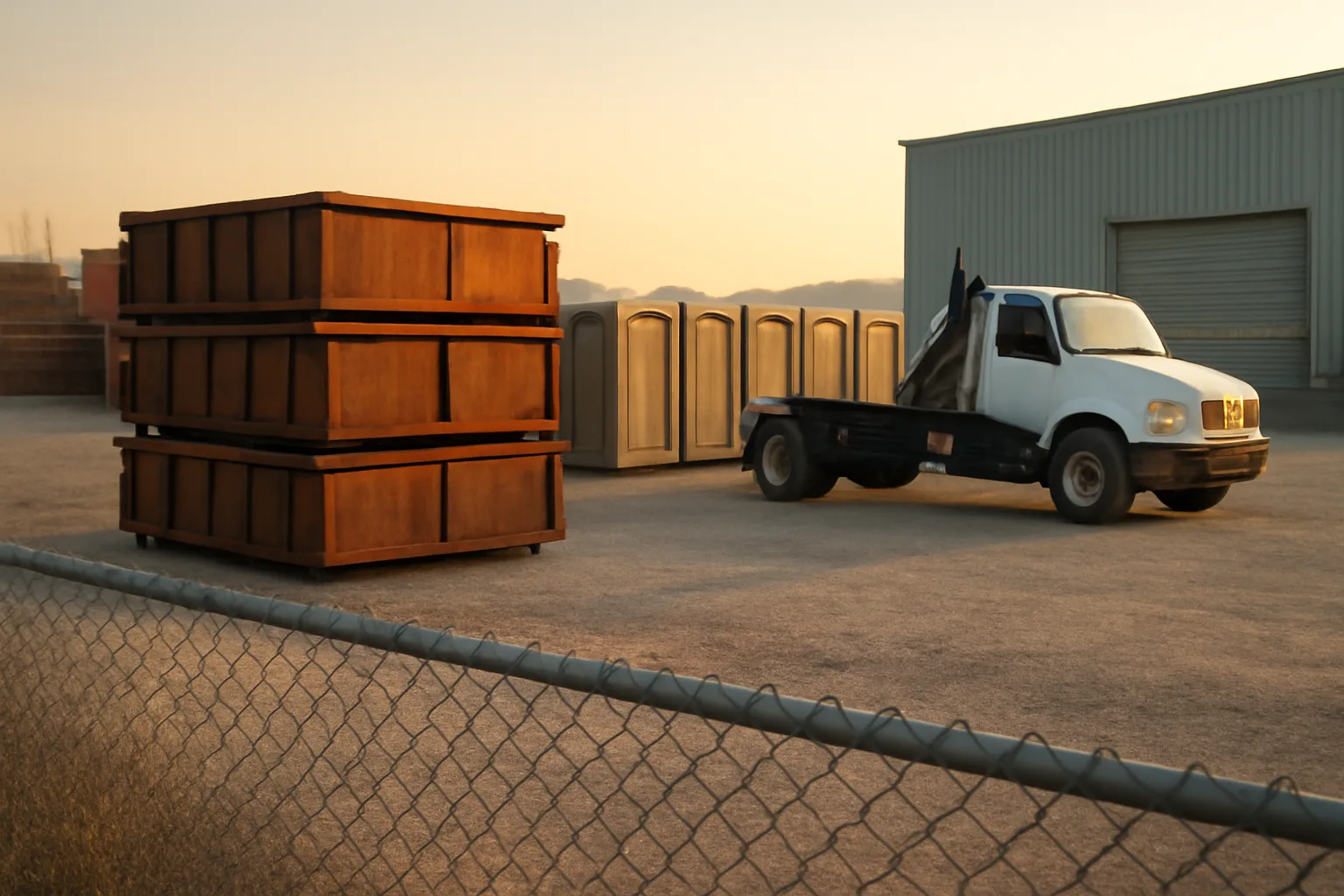
A site services yard is a fenced lot with an office and a small shop where you store and stage the gear construction sites rent. Think roll-off dumpsters, portable toilets, temporary fence, storage containers, water tanks, and the trucks that move them. It is a logistics lot, not a landfill and not a showroom.
People mix this up with a transfer station or a scrap yard. Those are different permits and different neighbors. A clean site services yard turns inventory. Boxes go out full of job-site waste or toilets go out empty and come back to be pumped and washed. The land is a parking and staging problem first.
Demand sits under two boring facts. Construction sites still need toilets. OSHA says toilets at construction jobsites "shall be provided for employees according to" Table D-1, which calls for one toilet seat and one urinal per 40 workers once you pass 20 people [5]. And the country still makes a mountain of construction debris. EPA estimated 600 million tons of C&D debris in 2018 [6]. That volume is why roll-off routes exist. It is not a reason to open a yard tomorrow.
If you cannot picture the lot, you are not ready to price it. Walk three working yards before you call a broker. Watch where the mud goes, where the pump truck parks, and how loud the morning pull is. That walk teaches you more than a national blog post ever will.
How much does a site services yard cost to start?
There is no official national total for site services yard cost. Anyone selling you one number for the whole country is guessing. Your real number is land or a lease, yard build-out, trucks, an inventory of boxes or toilets, insurance that at least meets the federal motor-carrier floor, payroll, and whatever your city and state boards charge.
I will not invent an all-in sticker. No federal series prices this trade as a package. The Small Business Administration tells you to add one-time and monthly costs before you launch, which is the right method and still not a price tag [9]. The only federal dollar figures I can pin without lying are an insurance minimum and a tax rule. For-hire interstate hauling of nonhazardous property sits on a $750,000 public-liability floor under 49 CFR 387.9 [2]. IRC 195 lets many new operators deduct up to $5,000 of startup costs in the year the business begins if total startup costs stay at or below $50,000 [1].
Those two numbers are floors and tax treatment. They are not your checkbook. Land in an industrial park next to a freeway is a different animal than a rural lot with no water. A portable-toilet wash pad is a different animal than a dry fence yard. State boards stack fees on top. Compare a high-regulation market like California with a smaller market like Alabama before you treat a forum range as gospel.
My rule is simple. Build a 12-month cash sheet with a line for every board you can name. Leave blanks for fees you have not confirmed. Do not fill blanks with internet folklore. A blank you must call about is cheaper than a fake number you believe.
What line items make up site services yard cost?
Site services yard cost is a stack of buckets, not one invoice. If a bucket has no primary source, leave it as a bid. Do not average three blog posts.
| Bucket | What you actually pay | How you get a real number |
|---|---|---|
| Land or lease | Rent or purchase, deposit, CAM, taxes | Local industrial broker and assessor |
| Yard build-out | Fence, gravel, lighting, shop, wash pad | Written contractor bids |
| Rolling stock | Roll-off, hooklift, or service truck | Same-week dealer quotes |
| Rental inventory | Dumpsters, toilets, fence, containers | Manufacturer or used-yard quotes |
| Federal carrier paper | USDOT if you meet the interstate 10,001 lb test [4] | FMCSA registration, not a blog fee list |
| Liability floor | At least $750,000 for many for-hire nonhaz hauls [2] | Statute plus your state surplus lines rules |
| Drivers | Pay near the BLS median for heavy truck drivers [7] | Local ads, not a national average alone |
| Stormwater | Possible industrial coverage if you maintain trucks or wash gear [10] | EPA MSGP or your state NPDES office |
| Tax treatment | Up to $5,000 year-one startup deduction if totals stay at or below $50,000 [1] | IRC 195 and your CPA |
SBA's startup worksheet earns its keep here because it forces one-time costs and monthly costs onto separate lines [9]. Use it. Then throw out any line you cannot source.
The bucket that sinks people is working capital. Trucks break. Customers pay in 45 days. Landlords want a deposit. I would rather open thin on inventory and fat on cash than the reverse. Fancy software in month one does not pull a box.
How much do land and yard build-out usually take?
Land is the line nobody can quote from Washington. Industrial acreage, a paved contractor yard, and a rural gravel lot are different products with different price tags. There is no honest national rent I can cite, so I will not fake one. Call two brokers and the planning desk in the same week.
What I would actually do is hunt zoning first, price second. A cheap lot zoned residential or agricultural can cost you a year if the board will not grant a special use for a contractor yard. Ask for the exact use name they use. Some codes say equipment storage. Some say contractor's yard. Some dump you into light industrial only.
Build-out is fence, base rock, drainage, lighting, a lockable shop, and a place for an office that is not your kitchen table. If you wash toilets or trucks, budget a wash pad and a legal way to handle the water. Outdoor industrial activity with vehicle maintenance or equipment cleaning can pull you into industrial stormwater coverage under EPA's Multi-Sector General Permit or a state NPDES permit [10]. Confirm that with the water board before you pour concrete.
Neighbors will care about backup beepers at 5 a.m. more than your business plan. I would spend money on a better fence and a quieter morning routine before I spent it on a pretty facade. Mud control is not glamorous. It keeps you from fighting the city in month four.
What do trucks and rental inventory cost?
I will not invent a sticker price for a roll-off truck or a bank of toilets. Dealers change those quotes by the week, and a made-up national average would be a lie. Get three written quotes dated the same month you price the lease.
What I can pin is the license trigger on the truck. A commercial motor vehicle includes a vehicle with a GVWR or gross weight of 26,001 pounds or more, and that is the classic CDL line [3]. Most roll-off and hooklift chassis sit over that line. If you plan to stay under it with a light service body, confirm the rating on the door card, not the salesman's story.
Interstate work has an earlier trigger. FMCSA says you need a USDOT number if you operate interstate with a GVWR, GCWR, GVW, or GCW of 10,001 pounds or more [4]. Plenty of site services trucks clear 10,001 pounds while empty. Do not wait until the first out-of-state pull to learn that.
Inventory is where operators overspend. New steel boxes look sharp on a website. Used boxes that still cable and still door will earn. Same for toilets. I would buy a small, boring fleet that matches signed work, then add. Empty inventory is a loan with rust on it.
Tax recovery is slow and real. IRS Publication 946 treats trucks as 5-year property under MACRS, which means the cash leaves years before the deduction finishes [11]. Plan cash as cash. Depreciation is not a down payment.
How much do licenses and USDOT paperwork add?
License cost is local plus federal paper, and I will not invent a current fee or a processing time. Confirm every dollar and every clock with the board that charges it. SBA is blunt on this: licenses and permits depend on your business and your location [15].
The federal pieces are at least a USDOT number when you meet the interstate 10,001-pound test, and a CDL for the person behind the wheel of a 26,001-pound CMV [4][3]. For-hire interstate freight also means operating authority, which is a separate FMCSA path from a private fleet that only hauls its own boxes. Know which one you are. Mixing them up is how people buy the wrong insurance filing.
State boards then pile on. Solid waste transporter. Portable sanitation pumper or septage hauler. Business tax certificate. Possible air district rules if you idle a fleet. Possible county health rules for a wash pad. None of those fees are safe to copy from a neighboring state. Florida is not Arizona.
I would sequence paper before iron. Entity and EIN. Zoning and special use. Then USDOT and insurance filings. Then the first truck. Buying a truck while the planning commission is still arguing about your lot is how you pay a note on an asset you cannot park.
If a seller promises a fixed approval window from any board, walk away. No honest broker controls what a planning commission or a state carrier office decides.
What insurance minimums apply to a site services yard?
The federal floor most people miss is public liability for the truck, not the general-liability flyer from a package agent. 49 CFR 387.9 sets $750,000 for for-hire carriage of nonhazardous property in interstate or foreign commerce on vehicles 10,001 pounds or more [2]. The same table jumps to $1,000,000 and $5,000,000 once you touch certain hazardous materials, bulk hazardous substances, or explosives [2]. A normal C&D roll-off is usually the first column. Confirm the cargo. Do not guess.
That $750,000 figure is a limit, not a premium. I do not have a government series for what a site services fleet actually pays a year, so I will not invent a premium range. Your state can also demand more than the federal floor. Ask the insurance desk that files BMC-91X or the state equivalent, not a Facebook group.
The yard itself still needs general liability, and the boxes on a customer's dirt need inland marine or an equivalent scheduled form. If you pump toilets, ask about pollution. A cheap GL policy that excludes what you actually spill is not cheap.
I would not open with a one-truck policy written like a plumber's van. Have the agent read the motor-carrier minimum next to your authority type. If they cannot point at 49 CFR 387.9, get another agent.
What does first-year labor cost?
Labor is the line that repeats every Friday. BLS put the median annual wage for heavy and tractor-trailer truck drivers at $54,320 in May 2023 [7]. Refuse and recyclable material collectors sat at a $45,760 median the same period [8]. Your market may sit above both. Use the medians as a planning floor, then read local ads.
On top of wages you still owe the employer share of Social Security at 6.2 percent and Medicare at 1.45 percent, which IRS Publication 15 treats as the basic FICA split [13]. Workers' compensation is state law. I will not invent a class-code rate.
Overtime math is messy for drivers. DOL Fact Sheet 19 explains the Motor Carrier Act exemption from FLSA overtime for certain employees whose duties affect the safety of operation of motor vehicles in interstate commerce [12]. That exemption is narrow. It is not a free pass to skip overtime for the yard hand who never leaves the county. Have counsel read the duties, not the job title.
I would staff one CDL driver and one yard person before I hired a dispatcher. Early on, you are the dispatcher. A second driver before the route density exists is how a site services yard burns cash while the trucks look busy on paper.
How do you start a site services yard?
You start a site services yard on paper, then on dirt, then with iron. Reverse that order and you will own a truck with nowhere legal to park it.
First, pick the work. Roll-off only. Toilets only. Fence only. Mixed. Mixed sounds safe and is usually just three incomplete inventories. I would pick the work that already has a signed customer or a tight local shortage, then add a second line after the lot is legal.
Second, form the entity and get an EIN. Third, sit with planning and ask whether a site services yard is allowed, allowed with a special use, or not allowed. Get the answer in writing. Fourth, lock insurance and FMCSA filings that match how you actually haul [4][2]. Fifth, buy or lease the smallest legal lot that can turn a truck. Sixth, buy used inventory that matches the first contracts. Seventh, hire the CDL seat.
SBA's license guide is the right attitude even when it is generic: you apply where you operate, and the list is local [15]. The boards that can stop you are zoning, health, waste, and the state motor-carrier office. Call them in that order.
If you want a one-page worksheet that splits a shared lot by stall, truck, and overhead, SiteServicesPath sells a $249 one-time Shared-Yard Economics Kit. Use it or skip it. This page stands without it.
Do not franchise your way out of the paper. A logo does not replace a special use permit.
Which first-year costs are a waste of money?
A brand-new roll-off and a glass office are the two wastes I see most. The truck note starts immediately. The office impresses nobody who just needs a 30-yard box on Thursday.
National brand-building in year one is mostly vanity. Your first fifty customers care about show-up time and whether the door on the box still latches. A wrapped fleet before you have route density is a rolling billboard for a company that cannot answer the phone.
Overbuilding the shop is next. You need a lockable bay and a place to weld a cable. You do not need a dealership service department. Same for software. A shared spreadsheet and a paper ticket will run a ten-box yard. Buy the platform when the paper starts to fail, not because a demo looked slick.
Sharing a yard can be smart if the lease, insurance, and stormwater name every party and split the costs in writing. A handshake on a shared lot is how you inherit someone else's dump. If the other tenant is a welder who paints, you may have just bought their waste stream.
I would also skip any consultant who will not name the statute behind a fee. If they cannot point at a board page, they are selling fog.
How do taxes change the cash you actually need?
Tax treatment changes when you recover cash. It does not change how much cash you must hold on day one. Keep those ideas apart.
IRC 195 is the startup rule people misquote. The statute says the taxpayer is allowed a deduction for start-up expenditures in an amount that "does not exceed $5,000, reduced (but not below zero) by the amount by which such start-up expenditures exceed $50,000" [1]. Cross $50,000 in startup spend and that immediate $5,000 starts to shrink. Cross $55,000 and it is gone, and you amortize instead. Have a CPA apply it to your facts. I am not your CPA.
Trucks then depreciate as 5-year property under the MACRS framework in Publication 946 [11]. That helps taxable income over time. It does not pay the dealer. If you section 179 some of it, you still need the taxable income and the eligible property. Confirm the current year limits with the IRS page or your preparer. I will not invent this year's dollar cap.
Employer FICA still leaves every payday. 6.2 percent Social Security and 1.45 percent Medicare on your side, per Publication 15 [13]. Price labor as loaded labor or you will think you are profitable while the 941 is late.
Keep receipts like you expect an audit. Yard gravel and fence are real costs. A weekend dumpster you "borrowed" from inventory is how books get dirty.
How does site services yard cost change by state?
State and city rules move the number more than any national average. Land, special use hearings, waste-hauler badges, toilet-pumper licenses, and surplus insurance all sit in different buildings. That is why a copied budget from another state fails.
Start with the state pages when you are comparing markets. California stacks air and recycling desks many southern states do not copy. Florida and Georgia look similar on a map and still do not share a fee table. Mountain and desert lots price differently than a coastal industrial park. Read Colorado, Arizona, and Alaska as separate problems. Alabama will not save you if the county still hates contractor yards on that road.
Federal rules travel with you. The $750,000 liability floor, the 10,001-pound USDOT test, the 26,001-pound CDL line, and the IRC 195 deduction do not care which state line you crossed [2][4][3][1]. Everything with a local cashier, confirm.
If you still want that worksheet, it lives at /start. SiteServicesPath is an independent publisher, not a law firm and not a service company. Confirm every fee with the board that charges it.
Frequently asked questions
What is site services yard?
A site services yard is a fenced staging lot plus a small shop and office for construction-site rentals. Typical inventory is roll-off dumpsters, portable toilets, temporary fence, and storage containers, plus the trucks that move them. It is not a landfill. Zoning often calls it a contractor's yard or equipment storage. Confirm the use name with planning before you lease.
How do you start site services yard?
Start on paper. Form the entity, confirm zoning and any special use, then file USDOT and insurance that match how you haul. Buy or lease the smallest legal lot that can turn a truck. Add used inventory against signed work, then hire a CDL driver. Do not buy iron before the lot is legal. Confirm every fee and clock with the board that charges it.
Is there a typical national startup cost I can trust?
No. There is no official national all-in price for a site services yard. SBA tells you to build your own startup list, which is the right method [9]. The only federal dollar floors I can cite without guessing are the $750,000 motor-carrier liability minimum in many for-hire nonhaz cases and the $5,000 IRC 195 startup deduction if totals stay at or below $50,000 [2][1].
Do I need a CDL to run the yard?
You need a CDL to drive a commercial motor vehicle, which includes most trucks with a GVWR or gross weight of 26,001 pounds or more [3]. The person who only runs the office does not. Most roll-off and hooklift chassis sit over that line. Read the door-card rating. Do not take a salesman's word that a heavy chassis is a non-CDL truck.
Do I need a USDOT number for a site services yard?
You need a USDOT number if you operate interstate with a GVWR, GCWR, GVW, or GCW of 10,001 pounds or more, among other FMCSA triggers [4]. Many site services trucks clear that weight empty. Intrastate-only fleets follow state motor-carrier rules instead. Confirm with FMCSA and your state carrier desk. I will not invent a registration fee.
How much insurance is legally required on the trucks?
For-hire interstate carriage of nonhazardous property on vehicles 10,001 pounds or more has a $750,000 public-liability minimum under 49 CFR 387.9 [2]. Certain hazardous cargoes jump to $1,000,000 or $5,000,000. Your state can require more. That figure is a limit, not an annual premium. I do not have a government premium series, so I will not invent one.
Can I deduct site services yard startup costs?
IRC 195 allows a first-year deduction up to $5,000 of startup expenditures, reduced once total startup costs go above $50,000, and gone at $55,000, with the rest amortized [1]. Trucks then follow MACRS, and Publication 946 treats trucks as 5-year property [11]. Have a CPA apply the statutes to your facts. This is not tax advice.
Do I need a stormwater permit for the yard?
Maybe. If you maintain vehicles or wash equipment outdoors, you can fall under industrial stormwater rules. EPA's 2021 Multi-Sector General Permit is the federal template. Many states run their own NPDES industrial permit [10]. A dry fence lot with no washing may be different from a toilet wash pad. Ask the state water board before you build the pad.
Are portable toilets required on construction sites?
OSHA requires toilets at construction jobsites under 29 CFR 1926.51. The table calls for one facility at 20 or fewer employees, and one toilet seat and one urinal per 40 workers above that [5]. That rule is why toilet routes exist. It does not give you a customer. It also does not set what you may charge a general contractor.
Should I buy or lease the land for a site services yard?
Lease first unless you already understand that industrial pocket. A purchase locks you to a use the planning commission may still deny. A short commercial lease with extension options hurts less if the special use fails. I would not sign a long term until zoning is written and stormwater is answered. Buy later with route income, not hope.
Can I run a site services yard from a farm or a house lot?
Usually no, not as a real fleet. Zoning and deed rules typically block commercial truck traffic, outdoor storage, and wash-down on residential or unpermitted agricultural land. Some rural zones allow a home occupation that dies the minute a roll-off shows up. Ask planning for the allowed use list in writing. Parking one box behind a barn is how complaints start.
What NAICS code do people use for this work?
It depends on the mix. Pure roll-off work often sits near solid waste collection. Toilet service often sits near septic tank and related services. Fence and container rental can sit in construction equipment rental. Pick the code that matches the revenue you actually invoice, then confirm with your CPA and any license that asks for NAICS. Do not force one code onto a mixed yard.
Does national C&D debris volume mean I should open a yard?
No. EPA's 600 million tons of C&D debris in 2018 explains why the industry exists. It does not prove your county needs another site services yard [6]. Haulers already sit on that tonnage. Open only if you have a legal lot, a driver, and work you can name. Volume at the national scale is a backdrop, not a business plan.
How do I compare site services yard cost across states?
Hold federal items constant: USDOT and CDL triggers, the 49 CFR 387.9 liability floor, and IRC 195 [4][3][2][1]. Then rebuild land, local permits, and state hauler licenses from each board. Use state-level cost pages for California, Florida, Georgia, and the rest rather than scaling one city's rent. Confirm every fee. Do not copy a neighbor's invoice.
Sources
- Cornell LII, 26 U.S.C. § 195: Startup expenditures are deductible up to $5,000, reduced by the amount by which startup expenditures exceed $50,000
- eCFR, 49 CFR 387.9: For-hire interstate nonhazardous property requires $750,000 public liability; certain hazardous cargoes require $1,000,000 or $5,000,000
- eCFR, 49 CFR 383.5 (commercial motor vehicle): A CMV includes a vehicle with GVWR or gross weight of 26,001 pounds or more, which is the standard CDL threshold
- FMCSA, Do I Need a USDOT Number?: A USDOT number is required for interstate operation at 10,001 pounds GVWR/GCWR/GVW/GCW or more
- OSHA, 29 CFR 1926.51 Sanitation: Toilets at construction jobsites must follow Table D-1, including 1 toilet seat and 1 urinal per 40 workers at 20 or more employees
- EPA, Construction and Demolition Debris: Material-Specific Data: EPA estimated 600 million tons of construction and demolition debris generated in the United States in 2018
- BLS OES, Heavy and Tractor-Trailer Truck Drivers, May 2023: Median annual wage for heavy and tractor-trailer truck drivers was $54,320 in May 2023
- BLS OES, Refuse and Recyclable Material Collectors, May 2023: Median annual wage for refuse and recyclable material collectors was $45,760 in May 2023
- U.S. Small Business Administration, Calculate your startup costs: SBA instructs founders to calculate one-time and monthly startup costs before launch
- EPA, 2021 Multi-Sector General Permit (MSGP) for Industrial Stormwater: Outdoor industrial activity such as vehicle maintenance or equipment cleaning can require industrial stormwater coverage under the MSGP or a state NPDES permit
- IRS Publication 946, How To Depreciate Property: Trucks are listed as 5-year property under the MACRS recovery system
- U.S. DOL WHD, Fact Sheet #19: Motor Carrier Exemption: Certain employees whose duties affect safety of operation of motor vehicles in interstate commerce may be exempt from FLSA overtime
- IRS Publication 15, Circular E, Employer's Tax Guide: Employer FICA is 6.2 percent Social Security plus 1.45 percent Medicare
- FMCSA, Commercial Driver's License: A CDL is required to operate vehicles that meet the federal commercial motor vehicle definition
- U.S. Small Business Administration, Apply for licenses and permits: Required licenses and permits depend on your business activities and location