Last updated 2026-08-20
TL;DR
A site services yard is the lot where you stage toilets, fence, boxes, pumps, and trucks for job sites. Sharing that lot cuts rent. It does not cut stormwater rules, USDOT triggers, or who pays when a stack fails. Start with an entity and EIN, then zoning, then your licensing board. Confirm every fee locally. Write down who owns each risk before you sign.
What is a site services yard?
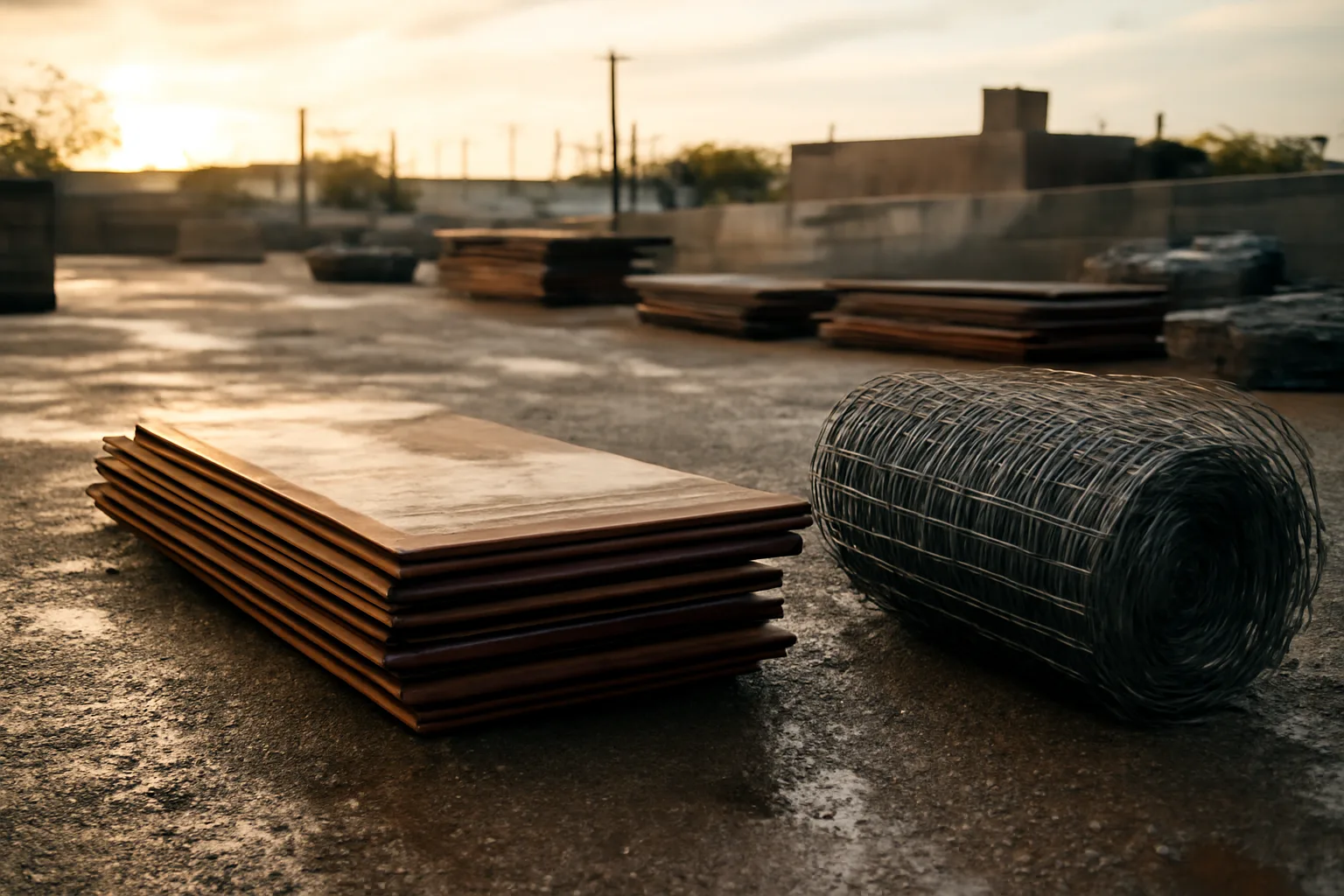
A site services yard is the lot where a company stores, loads, and dispatches the gear that supports construction and industrial sites. Portable toilets, roll-off boxes, temporary fence, trench plates, pumps, generators, and the trucks that move them all live there. It is a place of business. It is not a federal license class.
No U.S. statute defines the phrase. Your planner will call it a contractor yard, outdoor storage, or a truck terminal. Your insurer will call it a premises. Your state contractor board may ignore the lot, then care a great deal the moment you install fence or tie in temp power on someone else's job.
People confuse this with a landfill, a transfer station, or a walk-in rental store. Those carry their own permits. A yard that only stages clean equipment still trips zoning, fire access, stormwater, and vehicle rules. A yard that takes in debris or used oil trips a thicker stack.
If you haul waste, insurers often code you near NAICS 562111 (solid waste collection). If you mostly rent and deliver site gear, you may sit closer to construction equipment rental or specialty trade work. Pick the code that matches what you actually invoice. Banks read that code.
I would not buy land until I can say, in one sentence, what leaves the gate each morning. That sentence drives zoning, CDL needs, and whether the neighbors fight your conditional use. The lot is the factory floor. Revenue happens on other people's sites. That split is why shared-yard deals look cheap on paper and get messy in practice.
How do you start a site services yard?
You start a site services yard by forming a legal entity, getting an EIN, locking a legally zoned lot, then collecting only the licenses that match the work you will invoice. There is no national starter pack. Confirm every fee and form with the city, the county, and the state board that regulates your trade.
Here is the order I would use. Form an LLC or corporation in your state. Apply for an EIN on the IRS site. The IRS says you can apply online and get the number after a completed application [11]. Open a bank account in the entity name. Do not mix personal fuel cards with yard diesel.
Take the address to planning, not to a comment thread. Ask if outdoor storage, contractor-yard use, and heavy truck traffic are allowed by right, by conditional use, or not at all. Floodplain maps matter. FEMA's National Flood Hazard Layer is the federal map set most planners start from [13]. A cheap lot in a floodway is not cheap.
Then list the work as verbs. Delivery only is one stack. Pumping toilets is another. Rolling off debris is another. Installing fence may pull a contractor license. Interstate trucks at 10,001 pounds GVWR or more need a USDOT number [4]. State IRP and IFTA paper shows up once you cross lines on apportioned plates. Confirm plate class with your DMV. Nobody has one clean national table for this trade.
Hire a local land-use lawyer for the hearing if the planner even hints at opposition. Skip the truck wrap until the use is approved. That wrap is a waste of money on a lot you cannot occupy.
State walkthroughs differ. Compare real paper paths such as how to start a site services yard in Alabama or how to start a site services yard in Colorado instead of a national myth.
Employment paper starts the day you have staff. Federal minimum wage is $7.25 an hour under the FLSA [8]. Your state number is often higher. Confirm it. Overtime still applies to most yard hands and drivers unless a real exemption fits [15].
What does shared-yard economics actually mean?
Shared-yard economics means two or more operators split the land cost, then try to split the costs that land creates. Rent is the easy line. Stormwater plans, shared fuel, night access, and who is named as permit operator are the lines that blow up.
A shared yard is joint use of real estate. It is not a partnership unless you sign one. If you only want a parking stall and a loading bay, say that in the lease. If you share customers, fuel, or employees, you have a different animal.
I treat the math as three buckets: occupancy, compliance, operations. Occupancy is base rent, CAM, tax pass-through, the gate, the cameras. Compliance is the SWPPP, spill kits, fire lanes, lighting to code. Operations is fuel, the wash pad, the forklift, after-hours callouts, a bent fence. People love to split occupancy down the middle and forget the other two.
SBA tells new owners to list one-time and monthly costs before they launch, and to keep a cushion [7]. That advice is boring and correct. Shared yards fail when one tenant's peak season becomes everyone's mud and everyone's neighbor complaint.
If you want a worksheet that forces those buckets onto one page, the $249 one-time Shared-Yard Economics Kit on /start is a format that heads off a midnight spreadsheet fight. You can build the same sheet yourself. The kit is optional. The buckets are not.
What costs split when you share a yard?
The costs that actually split are rent, common area maintenance, shared utilities, and sometimes a yard manager. The costs that rarely split cleanly are insurance deductibles, environmental cleanup, damaged customer units, and overtime for the person who unlocks the gate. Put a table in the lease. Not a vibe.
| Line item | Usually split | Usually stays with one tenant | Confirm with |
|---|---|---|---|
| Base lot rent | Yes, by stall or acre | Landlord lease | |
| Water for wash pad | Yes, if metered in common | Utility and lease | |
| Diesel | No | Cardlock per truck | Fuel vendor |
| Stormwater permit fees | Only if you are co-permittee | Lead operator often holds it | State water board |
| USDOT and IRP | No | Each motor carrier | FMCSA and DMV |
| General liability | Each policy, plus additional insured | Your broker | |
| Property tax pass-through | Yes, if the lease is NNN | County assessor | |
| After-hours callout | No | Whoever caused it | House rules |
NNN leases push tax, insurance, and maintenance to tenants. Confirm the current millage with the county assessor. Do not use a blog's average industrial rent. That number is stale the day it posts.
IRS Publication 535 treats ordinary and necessary business expenses as deductible when they are really both [6]. Shared CAM can be ordinary. Paying your co-tenant's wrecked box is a gift unless the lease says otherwise. Keep invoices in the entity's name.
The IRS set the 2025 business standard mileage rate at 70 cents per mile [5]. That rate helps if you run mixed miles on a qualified light truck and you elect the standard rate. It does not replace actual cost tracking on a heavy wrecker you depreciate.
I would meter water if anyone washes tanks. I would not share one diesel tank without SPCC math. EPA's SPCC rule can apply once aggregate aboveground oil storage exceeds 1,320 gallons [10]. Two 1,000-gallon tanks plus drums get you there faster than people expect.
What licenses does a shared site services yard need?
A shared site services yard needs whatever licenses each tenant's work requires, plus land-use approval for the lot itself. Sharing space does not share a contractor license, a waste hauler permit, or a USDOT number. Confirm each credential with the issuing board. Do not assume the landlord's file covers you.
Land use comes first. Conditional use permits, outdoor storage limits, and hours of operation sit with the city or county. Some lots allow parking and forbid maintenance. Some allow maintenance and forbid public retail. Read the resolution, not the listing.
Then trade licenses. Portable sanitation may need a pumper credential in one state and almost nothing in another. Roll-off debris may need a franchise or hauler permit in a city with exclusive waste contracts. Fence installation can be a contractor classification. Temp power can pull electrical licensing. I will not quote a board fee here. Boards change them. Look up the live form.
Vehicle credentials sit with FMCSA and your DMV. FMCSA says you must obtain a USDOT Number if you have a vehicle used in interstate commerce that has a GVWR or GCWR, or GVW or GCW, of 10,001 pounds or more (or that meets the passenger or placarded hazmat tests) [4]. Intrastate-only fleets still often need a state DOT number. Confirm it.
For state license maps, use site services yard license in California or site services yard license in Arizona. Those are paper paths, not promises. The landlord's occupancy certificate is not your hauler permit. Ask to see the CUP and the named SWPPP operators before you wire a deposit.
How much land and stormwater paper does a yard trigger?
A yard triggers stormwater paper when land-disturbing work or industrial activity meets a federal or state threshold, most often 1 acre of construction disturbance or a regulated industrial sector discharge. Sharing the lot does not shrink the acreage. Confirm the permit name with the state water board.
EPA's 2022 Construction General Permit covers stormwater discharges from construction activities. Operators that will disturb one or more acres, or smaller sites that are part of a common plan of development or sale that will ultimately disturb one or more acres, need NPDES coverage unless an exception fits [1]. Grading a shared yard, adding a wash pad, or expanding gravel can be construction activity. People treat gravel as invisible. Inspectors do not.
Operating the yard after it is built can pull industrial stormwater coverage (EPA's Multi-Sector General Permit or a state analog) if your sector is regulated. Land transportation and certain waste activities show up there [12]. Confirm your sector. Do not guess from a forum post.
OSHA still cares how you stack what you store. 29 CFR 1926.250(a)(1) says: "All materials stored in tiers shall be stacked, racked, blocked, interlocked, or otherwise secured to prevent sliding, falling or collapse." [2] That sentence is about people not dying under fence panels. It is also about who pays when a shared stack takes out a neighbor's windshield.
A wash pad without a drain plan is how you buy a soil consultant. Used oil, toilet wash water, and concrete slurry are more than water. RCRA basics apply if you generate hazardous waste [14]. Most small yards stay out of full RCRA permitting when they do not treat or store hazardous waste past generator limits. Confirm your generator category if you have solvents or batteries. I would budget a SWPPP update every time the shared layout changes. Moving the fuel island is not a weekend favor.
What insurance and liability splits go wrong first?
The first split that goes wrong is additional insured language that names the landlord and forgets every other tenant. The second is a shared deductible on a claim nobody wants to own. Buy your own general liability, auto liability, and inland marine on your rolling stock. Ask the broker to endorse the landlord and, if house rules require it, the other tenants. Confirm limits in writing.
A certificate is not a policy. Read the endorsement.
Auto liability follows the truck, not the gravel. If a co-tenant's driver moves your box and clips a sedan, the fight is about permissive use and whose policy pays first. Write a rule: nobody moves another tenant's assets without a signed borrow slip.
Workers' compensation is state law. Sharing a yard hand on a handshake is how you fund someone else's lawyer. If they take your direction, they may be your employee. DOL still expects FLSA wages and overtime for covered employees [8] [15].
OSHA injury recordkeeping applies to most employers with more than 10 employees, with partial exemptions for some low-hazard industries [9]. Construction-related work is not the place to assume you are exempt. Confirm with 29 CFR 1904 and your state plan if you are in one.
Pollution liability is the policy people skip until a tank weeps. If anyone stores diesel above the SPCC trigger, talk to a broker who has actually placed a contractor pollution form [10]. I would not share a tank to save a little monthly fuel hassle.
Is buying your own yard cheaper than sharing?
Buying your own yard is cheaper only if you will fill the land, you can finance it without starving the trucks, and local zoning will let you operate the way you already sell. Sharing wins when you are testing a market or you only need a dozen stalls. Plenty of owners buy too early, then rent stalls to strangers to cover the note. That is how they become accidental landlords.
Run both sides for 36 months, not 12. Purchase carries closing costs, transfer tax, a Phase I environmental site assessment, and old fill dirt. A Phase I is not optional on industrial land if you like sleeping. Sharing has an exit and less control.
SBA's startup-cost worksheet helps here because it separates one-time costs from monthly burn [7]. Land is a one-time or financed hit. A CUP fight can exceed a year of shared rent. I will not invent a CUP fee. Ask the clerk.
Property you own can be depreciated under IRS rules. Shared rent is usually just rent. I am not your tax preparer.
If you buy, walk the flood map [13] and the access route for a long trailer. A cheap parcel on a weight-restricted bridge is a museum of unused inventory. Once you decide, state start paths such as how to start a site services yard in Alaska and how to start a site services yard in Connecticut show how different the paper feels once you leave a national checklist.
What first-year cash does a site services yard usually burn?
First-year cash goes to deposits, trucks, units, insurance down payments, and the months you operate before invoices get paid. Shared rent can cut the deposit. It does not cut the fleet. Nobody has a clean national average for site services yard startup cost, because the term is not a census category. The honest method is to price your actual unit mix and your actual lot.
SBA recommends listing startup costs in detail and adding a cushion [7]. I would hold cash for a few slow receivable cycles. Construction pays slow. Your portable toilet customer is often a GC who pays when the owner pays.
Do not invent a typical franchise fee. This is not a franchise.
Fuel, repairs, and labor outrun rent in most dispatch businesses I have watched. Track miles. The IRS described the 2025 business figure as "70 cents per mile driven for business use, up 3 cents from 2024" [5]. That is a documentation tool for qualified vehicles, not a profit model. Heavy trucks should live on actual expenses.
If you hire, register for employment taxes before the first paycheck. The federal wage floor is $7.25 [8]. State wage boards set the real number. Confirm with that board. I would not hire a helper in cash to dodge this. That savings is fake.
Units themselves (toilets, fence, boxes) are the real capex. Used inventory is fine if you inspect tanks and welds. Cheap cracked poly is a waste of money. Renewal calendars start in year one. California operators should map site services yard renewal in California so a license date does not sneak up during peak season.
Which shared-yard line items are a waste of money?
Shared brand signs, a joint phone number, and a yard membership that does not name permit liability are a waste of money. So is a fancy office trailer you visit twice a week. Spend on drainage, lighting, and a gate that actually logs who entered.
I would not pay extra for a co-op logo. Your customer hires your truck and your invoice terms.
Shared software can wait. A shared spreadsheet of stall assignments is enough until someone double-books the loading aisle. Then buy a cheap reservation tool. Skip the enterprise stack.
Do not prepay a year of CAM until you have seen one winter of invoices. Landlords estimate. Estimates lie.
A joint fuel tank chasing a fleet discount is often a waste once you add SPCC work, leak insurance, and the fight over who left the nozzle in the dirt [10]. Cardlock accounts exist for a reason.
Training that OSHA, DOT, or your insurer does not require can wait. Training they do require cannot. OSHA construction sanitation rules expect toilets on jobs you control, using a headcount table that starts at 1 facility for 20 or fewer employees [3]. Your yard should model the same habit if crews stage there.
How do you confirm numbers with the board, not a blog?
You confirm numbers by calling or filing with the agency that cashes the check. Ask for the form number, the current fee schedule, and the name of the permit as it appears in their regulations. Write down the date of the call. Blogs, including this one, go stale.
For land, the source is the planning counter and the clerk of the permitting board. For contractor work, the state licensing board. For waste, the city franchise office or the state environmental department. For trucks, FMCSA and your DMV. For wages, the state labor department and the federal Wage and Hour Division.
Colorado shows how many desks exist. Use site services yard board in Colorado as a map of desks, then still confirm the live fee. I will not publish a processing time. Boards change staff and queues.
If a seller quotes a standard CUP timeline, smile and ask the planner instead. Print the statute or the fee PDF. If you cannot name the document, you do not have a number yet.
SiteServicesPath is an independent publisher, not a law firm and not a service company. Use us to find the form. File the form with the board.
What paper should you keep before you sign a yard lease?
Keep the CUP or zoning verification letter, the landlord's insurance requirements, a draft house-rules exhibit, the named SWPPP operator, a vehicle list with GVWRs, and a written split of every utility. Add your entity documents and EIN letter. If those are not in a folder, you are not ready to sign.
Ask who is the operator on any NPDES authorization [1] [12]. Operator status is legal exposure, not a courtesy title.
Ask for the last 12 months of CAM reconciliations. One year of actuals beats a pro forma.
Photograph the lot on walkthrough. The stacks, the stains, the wash pad. If a Phase I exists, read it. If the landlord refuses any environmental paper on an old industrial parcel, I would walk.
Write an exit clause that lets you leave if the use gets revoked. Shared yards die when one tenant's violation becomes a notice on the gate.
Then sign. Or don't. The cheap stall is not cheap if it costs you a season.
Frequently asked questions
What is a site services yard?
It is the lot used to store, load, and dispatch site-support gear such as toilets, fence, boxes, pumps, and trucks. It is a land-use and operations setup, not a single federal license. Planners may call it a contractor yard or outdoor storage. Confirm the local use name before you lease or buy.
How do you start a site services yard?
Form an entity, get an EIN from the IRS, then take a real address to planning for outdoor storage and truck use. Add only the trade licenses that match the work you invoice. Interstate trucks at 10,001 pounds GVWR or more need a USDOT number. Confirm every fee with the issuing board. Do not treat a national checklist as approval.
Do I need a federal license just to occupy a site services yard?
No single federal license creates the right to occupy a yard. Federal paper shows up by activity: NPDES stormwater if you hit acreage or sector rules, a USDOT number if you run qualifying interstate CMVs, SPCC if oil storage crosses 1,320 gallons, and FLSA if you have employees. Local zoning still decides whether you can park there.
Does sharing a yard share my USDOT number?
No. A USDOT number belongs to the motor carrier, not the gravel. FMCSA ties the number to vehicles used in interstate commerce that meet the 10,001-pound or passenger or placard tests. Each carrier keeps its own registration, inspections, and accident record. Confirm intrastate numbers with your state DMV.
What stormwater permit does a gravel site services yard need?
If you grade or expand and disturb one or more acres, or you are part of a common plan that will, EPA's Construction General Permit logic (or the state analog) can apply. Day-to-day industrial discharges may need MSGP-style coverage if your sector is regulated. Confirm the permit name with the state water board. Sharing the lot does not cut the acreage.
Can I deduct shared yard rent on my taxes?
IRS Publication 535 allows ordinary and necessary business expenses, and rent for a lot used in the business often fits. Keep the lease and invoices in the entity name. Paying a co-tenant's broken box is not automatically rent. Ask a tax preparer about your facts. This site is not a tax advisor.
What is the 2025 IRS mileage rate for yard trucks?
The IRS set the 2025 business standard mileage rate at 70 cents per mile for cars, vans, pickups, and panel trucks, up 3 cents from 2024. That election does not replace actual-expense tracking on many heavy vocational trucks. Confirm which vehicles qualify before you use the rate in the books.
When does SPCC apply to yard fuel tanks?
EPA's SPCC rule can apply when aggregate aboveground oil storage capacity exceeds 1,320 gallons, counting bulk tanks and many drums. Two modest diesel tanks plus barrels can cross it. Sharing a tank can pull more than one operator into the same plan. Confirm applicability in 40 CFR 112 and with an environmental consultant.
Is federal minimum wage the number I pay yard hands?
Federal minimum wage is $7.25 an hour under the FLSA. Many states and cities set a higher floor, and that higher number is the one you pay. Overtime still applies to most covered yard and driver roles. Confirm the current figure with your state labor department before you make an offer.
Do I need OSHA injury logs at a small shared yard?
OSHA's 29 CFR 1904 recordkeeping generally applies to employers with more than 10 employees, with partial exemptions for some low-hazard industries. Construction-related operations should not assume they are exempt. Confirm headcount, industry, and whether you are in a state-plan state. Sharing a lot does not share someone else's log.
Should I buy land in year one instead of sharing?
Only if zoning already fits, you can fund trucks after closing, and you will actually fill the parcel. Buying too early turns you into a landlord who still has to dispatch. Run 36 months of purchase versus share, include a Phase I on industrial land, and check FEMA flood maps. A CUP fight can erase the rent you hoped to save.
Who is the operator on a shared SWPPP?
The named operator on NPDES coverage is the party the agency can hold to the plan. That is legal exposure, not a courtesy title. Ask to see the current authorization and every named operator before you occupy. If the layout changes, budget a plan update. Do not let a handshake decide who signs the inspection sheet.
Can a landlord's contractor license cover my installs?
Usually no. Contractor licenses follow the qualifying individual and the contracting entity, not the street address. If you install fence, connect temp power, or perform other regulated trade work, confirm your own classification with the state board. The landlord's occupancy certificate and your stall lease do not substitute for that license.
How do I check a city's outdoor storage rules for a site services yard?
Take the parcel number to the planning counter and ask whether contractor yard or outdoor storage use is allowed by right or only by conditional use. Get the answer in writing. Read hours, screening, and truck-route limits in the resolution. Confirm floodplain status on FEMA's National Flood Hazard Layer. Do not trust the listing broker's summary.
Sources
- EPA 2022 Construction General Permit (CGP): Construction stormwater NPDES coverage is required for operators disturbing one or more acres, or smaller sites in a common plan that will ultimately disturb one or more acres.
- OSHA 29 CFR 1926.250 General requirements for storage: Materials stored in tiers must be stacked, racked, blocked, interlocked, or otherwise secured to prevent sliding, falling, or collapse.
- OSHA 29 CFR 1926.51 Sanitation: Table D-1 requires a minimum of 1 toilet facility for 20 or fewer employees, then additional facilities as headcount rises.
- FMCSA Do I need a USDOT number: A USDOT number is required for interstate commercial motor vehicles with a GVWR, GCWR, GVW, or GCW of 10,001 pounds or more, and for certain passenger and placarded hazmat vehicles.
- IRS Publication 535 Business Expenses: Business expenses must be ordinary and necessary to be deductible.
- SBA Calculate your startup costs: SBA instructs founders to list one-time and monthly startup costs and estimate how much money they need to launch.
- U.S. DOL Wage and Hour Division minimum wage: The federal minimum wage is $7.25 per hour.
- OSHA 29 CFR 1904.1 Partial exemption for employers with 10 or fewer employees: OSHA injury and illness recordkeeping generally applies once an employer has more than 10 employees, subject to listed exemptions.
- eCFR 40 CFR 112.1 SPCC general applicability: SPCC applicability includes facilities with aggregate aboveground oil storage capacity greater than 1,320 gallons.
- IRS Apply for an Employer Identification Number (EIN) online: Businesses can apply online for an EIN on the IRS website.
- EPA 2021 Multi-Sector General Permit (MSGP) for industrial stormwater: Certain industrial sectors must obtain NPDES industrial stormwater coverage under the MSGP or a state analog.
- FEMA National Flood Hazard Layer: The National Flood Hazard Layer is the FEMA map set used to identify flood hazard areas for a parcel.
- EPA Learn the Basics of Hazardous Waste: RCRA hazardous-waste rules apply to parties that generate hazardous waste, with duties that scale by generator category.
- U.S. DOL overtime pay: The FLSA requires overtime pay for covered nonexempt employees at one and one-half times the regular rate after 40 hours in a workweek.