Last updated 2026-08-21
TL;DR
A site services yard is a fenced lot that stages portable toilets, roll-offs, fence, boxes, and the trucks that haul them. You start by locking industrially zoned land, then stacking local business paper, waste or sanitation credentials if you haul, USDOT rules above 10,001 pounds, and stormwater coverage if the lot exposes industrial activity. Confirm every form with the issuing board. There is no single national license.
What is a site services yard?
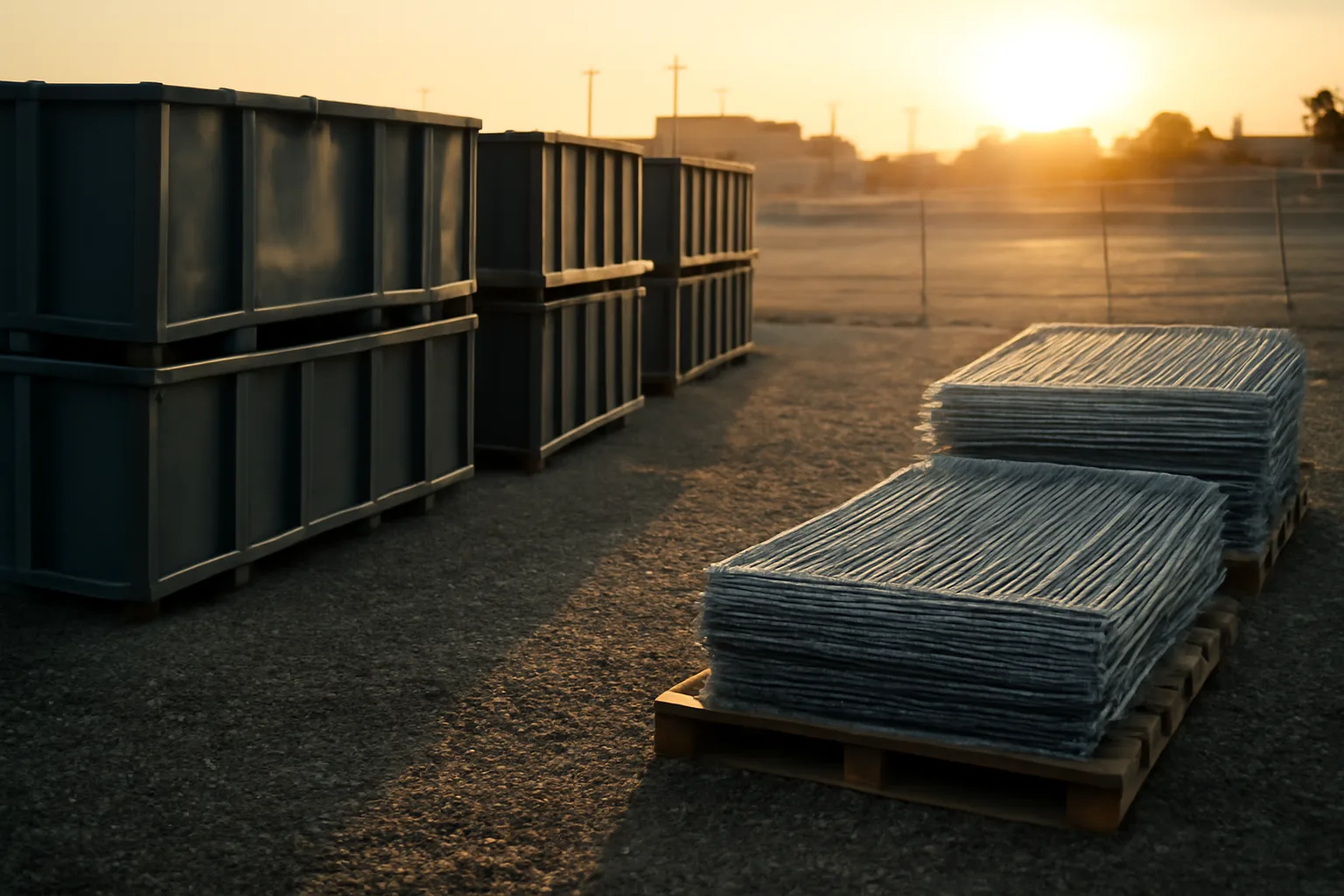
A site services yard is a fenced outdoor lot that stores, stages, cleans, and dispatches the support gear a construction site or event runs on. Portable toilets live there. So do roll-off boxes, temporary fence panels, storage containers, water tanks, and the trucks that move them. It is a logistics base. It is not a showroom.
Most operators sit in two Census buckets. NAICS 562991 covers establishments primarily engaged in pumping septic tanks and cesspools and/or "renting and/or servicing portable toilets." [1] NAICS 562111 covers solid waste collection, which is where roll-off dumpster hauling usually lands. [2] A mixed yard often files under the line that matches the bigger revenue stream. Confirm that with your CPA and the tax agency that handles your resale or waste credentials. Nobody keeps good national data on mixed yards. The closest official tool is the NAICS definition, and it was built for census forms, not for your banker.
The yard itself is the constraint. You need a surface that holds trucks, a wash pad that does not dump gray water into a ditch, a lockable gate, and enough throat at the entrance for a hoist truck and a long box. Neighbors care about odor, backup beepers at 5 a.m., and wind-blown trash. Zoning officers care about outdoor storage and truck trips. If you cannot point to the zoning district that allows outdoor storage of waste containers and sanitation units, you do not have a yard. You have a complaint waiting to happen.
People confuse the yard with the jobsite. OSHA 29 CFR 1926.51 governs toilets on the construction site, not your lot. That rule requires one toilet for 20 or fewer construction employees. [3] Your lot still has to meet general industry rules if you have employees, plus local health rules if you wash tanks there. Keep those piles of paper separate or you will file the wrong form.
How do you start a site services yard?
You start a site services yard by locking land that zoning already allows, then stacking the paper that matches what you haul, then buying iron. Reverse that order and you will own toilets you cannot legally park.
Find a parcel whose use table already lists outdoor storage, a contractor yard, or a truck terminal. Call the planning desk and ask for that row in writing. Do not trust a listing that says industrial. Confirm the conditional use, setbacks, screening, and hours. If the planner hedges, walk. A variance is not a business plan.
Form an entity and get a federal EIN. The SBA walk-through on business structure is a decent map of the choices. [9] I would form an LLC in most states because it keeps a truck wreck off the house, but talk to a lawyer licensed where you live. I am not your lawyer. IRS issues the EIN online for eligible entities. [8]
Match operating credentials to the work. Toilets pull health or sanitation paper in some states and almost nothing in others. Roll-offs pull solid waste collector or franchise paper in a lot of cities. Trucks over the federal weight line pull USDOT registration and, if you hire drivers, CDL and drug testing. [4] Stormwater coverage may apply if industrial materials sit in the rain. [7] Bind insurance and write a yard rule set before the first unit hits the gravel. Buy the smallest fleet that can serve one honest route.
There is no federal site services yard license. SBA is clear that licenses and permits follow your activities and your location. [10] Confirm every fee and form with the board that issues it. Processing times move. I will not invent them.
What licenses does a site services yard actually need?
A site services yard needs a local business license, land-use approval for outdoor storage, and then activity licenses that follow what you actually haul. Toilet routes can trigger health or sanitation permits. Dumpster routes can trigger solid waste collector or city franchise paper. Interstate trucks at 10,001 pounds or more need a USDOT number. [4] Confirm each item with the issuing board.
Start with the city or county business license and the zoning approval. Those two sit under everything else. Skip them and the activity permits will not save you when a code officer shows up. If you pump or wash toilets on the lot, ask the health department and the sewer utility. Some states fold portable sanitation into onsite sewage contractor rules. Some do not. Do not import another state's checklist.
For a state-by-state read, start with site services yard board in California and site services yard board in Florida. Those pages track board-confirmable paper, not rumors.
Waste collection franchises are the silent killer in many cities. The city may have handed exclusive roll-off rights to one hauler. You can own the yard and still be barred from dropping boxes inside city limits. Ask for the franchise ordinance before you buy the first hoist truck.
Federal paper is thinner than people think. There is no federal yard card. IRS wants an EIN if you have employees or you formed an entity. [8] OSHA wants a workplace that meets the standard that applies, which is 1910 in the yard and 1926 if your people work on construction sites. [3] Under 29 CFR 1904.1, employers with 10 or fewer employees are partially exempt from routinely keeping injury logs, though severe-injury reporting still applies. [12] I would not buy a license package from a random consultant before I had the zoning letter. That package is often a reprint of generic checklists.
What zoning and land rules stop most first yards?
Outdoor storage of dumpsters and toilets is what stops most first yards. Planners file that use under contractor yard, truck terminal, heavy commercial, or industrial. A cheap lot on a county road zoned rural residential will not become legal because you built a nice fence.
Ask for the permitted use table row in writing. Ask whether a conditional use permit is required. Ask the screening and setback rules, and the hours you may run trucks. If the parcel sits in an MS4 city, ask stormwater staff how they treat wash-down and dumpster drip. Local illicit-discharge rules can shut a wash pad even when the state never issued an industrial permit. [5]
I would walk any lot that needs a variance, a conditional use, and a neighborhood meeting stacked together. That path is how projects die in public. Lease with a zoning-contingency clause. If the landlord will not give you that clause, the landlord knows something.
Home driveways are not yards. HOA covenants and residential zoning both fail this use. A farm parcel can work if the county allows it and you can build a real entrance. Gravel tracking onto a public road is how you meet your first inspector.
Screening is not decoration. Many codes want a solid fence on the street face and a setback for stacked boxes. Height limits on outdoor storage are real. A 30-yard box sitting on legs already looks like a building to a neighbor. Photograph the lot empty and again with a truck template before you sign.
Do you need a USDOT number and CDLs for the trucks?
You need a USDOT number if you run interstate commerce in a vehicle that, in FMCSA's words, "has a gross vehicle weight rating or gross combination weight rating, or gross vehicle weight or gross combination weight, of 4,536 kg (10,001 pounds) or more." [4] A loaded roll-off truck clears that line. Many empty toilet trailers behind a one-ton also clear it once you count the combination.
FMCSA's test is use plus weight (or placarded hazmat), not your opinion of being just local. Intrastate rules sit in your state DOT. Some states issue a state number at the same weight. Confirm with that office. I will not invent their current fee.
CDLs follow the vehicle. A single-unit truck at 26,001 pounds GVWR generally needs a Class B. A combination at 26,001 with a towed unit over 10,000 generally needs a Class A. Tank endorsements appear if you haul tanks that meet the liquid definition. [14] If you hire drivers, you inherit drug and alcohol testing and a driver qualification file. Owner-operators still need the license that matches the truck.
Run a forklift in the yard and OSHA 1910.178 requires training and evaluation on that truck. [11] I would budget for the compliance file before the second highway truck. The first truck can be owner-driven. The second truck is when people get sloppy.
What environmental paper hits a yard in year one?
Year-one environmental paper is mostly stormwater, wash water, and oil. Construction stormwater hits you if you disturb one or more acres while you build the yard, or if you are part of a common plan that does. EPA states that stormwater discharges from construction activities that disturb one or more acres are regulated under the NPDES stormwater program. [5][6] That is a build-out issue, not always a forever operating permit.
Industrial stormwater is a different stack. EPA's 2021 Multi-Sector General Permit covers listed industrial sectors. [7] A pure portable-toilet lot often sits outside those sectors. A yard that looks like a transportation facility or that handles scrap and waste in the rain can get pulled in. Do not self-diagnose from a blog. Ask the state NPDES program which sector, if any, matches your NAICS and your exposed materials.
Wash water is the citation that actually shows up. Rinsing toilets or dumpsters onto gravel that drains to a ditch is a Clean Water Act problem in real life. Tie the pad to sanitary sewer with the utility's written approval, or capture it and have a licensed hauler pull the tank. Local MS4 inspectors care about this more than your paint color.
Oil storage trips SPCC when aggregate aboveground capacity exceeds 1,320 gallons and a discharge could reasonably reach waters. That threshold lives in 40 CFR 112.1. [13] Add drums, cubes, and tanks together. If you are close, measure. If you are over, you need a plan that matches Part 112. A copied plan from someone who never walked your lot is a waste of money.
How much does a first-year site services yard cost?
Nobody publishes an honest national first-year total for a site services yard. Land rent, franchise barriers, and used-iron prices move too hard by metro. Treat any nationwide average startup cost you see in a listicle as fiction.
The real pile is land and yard build (gate, rock, pad, power, camera), then trucks, then units, then insurance, then six months of operating cash while GC invoices sit unpaid. Units are the part people overbuy. I would start a toilet route with a used vacuum truck that actually pumps and a tight set of units you can keep clean. I would start roll-offs with one hoist and a handful of boxes, not a fleet photo.
Confirm current application fees with each board. I will not print a fee that might have changed last Tuesday. Steel boxes follow scrap and freight. Get three dealer quotes the week you buy.
If cash is tight, share a conforming yard rather than taking a cheap illegal lot. The illegal lot costs more after the first stop-work order. Used trucks with a documented pump or hoist beat pretty trucks with a mystery gearbox. Do not finance wrap. Do not finance a custom shop building in month one. Power, rock, and a legal wash pad return more than a break room.
What insurance do yards carry, and what is a waste?
Most yards carry commercial auto, general liability, inland marine on the units once they leave the lot, and workers comp once you have employees. Pollution coverage is the policy people skip until a leak. Auto is the claim that actually happens.
I would not cheap out on auto liability or on hired and non-owned if employees run personal trucks. I would not buy a fancy cyber package in year one unless you actually store card data. That is a waste for a small yard with paper tickets.
Ask the carrier whether dumpsters in the street and toilets on a job are scheduled correctly. Inland marine wording matters when a box gets hit at 2 a.m. Confirm limits with the GCs you want to work for. Their vendor packet is the real spec.
No public federal fee schedule exists for these premiums. Quotes are underwriting, not a posted tariff. If a GC wants higher limits than your broker calls plenty, believe the GC or do not bid that job. I have no study that names an average premium, and I will not invent one. Certificates get requested weekly. Issue them the same day or you will lose the pour.
Should you start with toilets, dumpsters, or a mixed yard?
A toilet-only yard follows health rules, wash-water rules, and a service route that looks like janitorial work with a truck. A dumpster-only yard follows waste-collector rules, landfill accounts, overweight tickets, and city franchises. A mixed yard inherits both stacks and saves on land.
I would mix only after one side already pays the rent. Mixing on day one doubles the paper and splits your attention.
NAICS follows the larger share. Portable toilet rental and servicing sits in 562991. [1] Solid waste collection sits in 562111. [2] Your banker and your workers-comp class code may argue about that. Let them argue after you pick the work. Temporary fence and storage containers are lighter on environmental paper and heavier on theft and delivery damage. They still need the same zoning for outdoor storage.
| Line | Census code | Paper that usually shows up | Common trap |
|---|---|---|---|
| Portable toilets | 562991 | Health rules, wash-water disposal | Gray water in a ditch |
| Roll-off dumpsters | 562111 | Collector license, city franchise, landfill account | Exclusive franchise |
| Mixed yard | Larger share | Both stacks | Two inspectors, one pad |
Read the table as a warning, not as a permit. Your city can be stricter than the code column.
What should you confirm with the board before you lease?
Before you lease, confirm use permission, wash-water disposal, waste-collector or franchise status, and the name of every bond or insurance certificate the city wants. Get it in email or on letterhead. A verbal should-be-fine is not confirmable.
Ask the planning desk for the use table. Ask public works or the franchise office who may set roll-offs in the right-of-way. Ask the sewer utility if they will accept wash water and what pretreatment they want. Ask the fire marshal about diesel cubes and spacing. Ask the state environmental desk whether your NAICS plus outdoor exposure needs an industrial stormwater notice. [7]
Then read the state board pages for the states you might touch. site services yard board in Alabama is a reminder that some states have no dedicated statewide license for the yard itself. Alaska site services yard board is a different read, with remote logistics and state credentials that do not match the Lower 48. Skim site services yard board in Arizona, site services yard board in Colorado, site services yard board in Georgia, and site services yard board in Idaho if those are your markets.
If two agencies disagree, get both answers in writing and do the stricter one. Fighting them after you pour the pad is how you light money on fire.
What first-year mistakes burn cash?
The expensive mistakes are consistent. People buy iron before zoning. People ignore city roll-off franchises. People wash tanks onto gravel. People hire a second driver with no driver qualification file. People underprice delivery because they forgot landfill fees, dump time, and the Friday afternoon box full of wet drywall.
I would rather lose a bid than take a GC who pays in 90 days and argues every ticket. Cash kills more yards than competition.
Another waste is custom paint and wrap on every unit in month one. Keep them washed and spend the cash on the hoist and the pad. Do not sign a five-year lease on a lot that only works if a variance lands. Do not let a landlord call you a contractor yard in the listing and a storage tenant in the lease. Those two sentences fight in court.
Ticket hygiene matters. If drivers close tickets in the cab with no photo of the box, you will lose every damage dispute. A phone photo costs nothing. A replaced lid does not.
Can two companies share one site services yard?
Yes, two companies can share one site services yard if zoning, the lease, insurance, and waste credentials all allow it. Shared yards fail when one tenant's wash water or overflowing boxes become everyone's violation. Write the operating rules before the second lock goes on the gate. Separate bays. Separate waste accounts. Named insureds that match reality.
This is the one place a simple shared-cost model helps. If you are modeling a shared lot, SiteServicesPath sells a $249 one-time Shared-Yard Economics Kit at /start. You do not need it to follow the paper path in this article.
Shared yards still need one responsible party the city can call. Cities hate a roster where everybody and nobody owns the drip pan. I would put the wash pad on a separate written schedule with hours and a clean-out log. Friendship dies at the grease interceptor.
Where do state site services yard rules actually differ?
State rules differ on waste collector licenses, portable sanitation, vehicle registration, and whether industrial stormwater is state-issued or EPA-issued. They do not differ on the federal weight line for interstate USDOT, and they do not differ on OSHA's construction toilet table if you are on a covered job. [3][4]
Home-rule cities hide exclusive franchises in code chapters nobody sends you until you are already ticketed. Western counties may care more about wellhead protection than about a business license. Some states have almost no dedicated statewide yard credential. Others stack air, water, and waste desks on the same lot.
Read the state page for the state you will dispatch from, then the states your trucks overnight in. Start with site services yard board in California if you touch that market, because the local air, water, and waste desks stack. Pair it with site services yard board in Florida if you work that growth market.
SiteServicesPath is an independent publisher, not a law firm and not a service company. Confirm live forms, fees, and quotas with the board that issues them. No article can promise approval or a timeline.
Frequently asked questions
What is a site services yard?
A site services yard is a fenced outdoor lot that stores and dispatches portable toilets, roll-off dumpsters, temporary fence, storage containers, and the trucks that move them. It is a logistics base for construction and events. Zoning for outdoor storage matters as much as the trucks. Census NAICS 562991 covers portable toilet rental and servicing. NAICS 562111 covers solid waste collection.
How do you start a site services yard?
Lock land whose zoning already allows outdoor storage or a contractor yard. Form an entity and get an EIN. Add the activity licenses that match what you haul, plus USDOT if trucks meet the federal weight test. Set wash-water disposal before the first rinse. Confirm every form with the issuing board. Buy the smallest fleet that can run one honest route.
Is there a national site services yard license?
No. The federal government does not issue a site services yard license. SBA notes that licenses follow your work and location. You may still need local business licenses, state waste or sanitation credentials, and FMCSA registration for qualifying trucks. Confirm the live list with each board. Do not pay anyone who sells a fake national card.
What NAICS code does a site services yard use?
Portable toilet rental and servicing sits in NAICS 562991. Solid waste collection, including many roll-off operations, sits in 562111. A mixed yard usually follows the larger revenue line. Tell your CPA and your insurer the same story. The codes exist for statistical forms. They still show up on tax and workers-comp paperwork.
Do I need a CDL to run a toilet truck?
Maybe. CDL class follows GVWR and combination weight, not the cargo name. A heavy vacuum truck often needs a Class B. A combination that meets the Class A test needs Class A. Tank endorsements can apply to liquid tanks. Confirm the plate weight and the state CDL manual. Owner-operators still need the class that matches the truck.
Can I run a site services yard from my house?
Almost never, not if you mean parking dumpsters and toilets on a residential lot. Residential zoning and HOA covenants block outdoor storage of that gear. Neighbors will call. A farm parcel can work only if the county use table allows it and you can build a real truck entrance. Get the use in writing before you haul anything home.
Does a yard need an EPA stormwater permit?
Building the yard can trigger construction stormwater coverage if you disturb 1 acre or more. Operating the yard may or may not need industrial stormwater coverage. That depends on sector, exposed materials, and your state program. Wash water to a ditch is a separate illegal discharge risk. Ask the state NPDES desk. Do not guess from a forum.
How much land does a site services yard need?
Enough to stage your units, turn a loaded truck, and keep a wash pad off the property line. Tight half-acre lots can work for a small toilet route. Two-acre lots can feel small once boxes stack. The constraint is turning radius and setbacks, not a magic acre number. Measure your longest truck plus hoist overhang before you fall in love with a cheap parcel.
Can I share a yard with another operator?
Yes if the lease, zoning, insurance, and waste accounts allow it. Write rules for wash water, hours, and who talks to the city. Separate bays beat a pile of mixed boxes. Cities want one responsible party. Shared lots fail when one tenant's mess becomes everyone's notice of violation.
Do cities grant exclusive dumpster rights?
Many do. Exclusive or limited franchises for roll-off collection show up in city code and in hauler contracts. You can own a legal yard and still be barred from setting boxes inside that city. Read the franchise ordinance before you buy a hoist. Ask public works who may collect construction debris. Get the answer in writing.
When does SPCC apply to a diesel yard tank?
SPCC applies when aggregate aboveground oil storage exceeds 1,320 gallons and a spill could reasonably reach water, under 40 CFR 112.1. Add every drum, cube, and tank. If you are close, measure rather than round down. A plan copied from another lot is a weak defense. Confirm applicability with someone who walked your containment.
Do OSHA toilet rules apply at the yard itself?
29 CFR 1926.51 is a construction jobsite sanitation rule. It sets toilets for construction employees, including 1 facility for 20 or fewer workers. Your yard is usually general industry (1910) plus local health rules. If your people also work on construction sites, 1926 follows them there. Keep the two rulebooks straight when you write the safety program.
How long does it take to get licensed?
I will not invent a processing time. Boards change queues. Some local business licenses print in days. Conditional use permits and waste franchises can run through hearings. Ask each board for its current posted timeline and treat that as unofficial until you have a receipt. Build the lease contingency around the slowest permit, not the fastest.
Sources
- U.S. Census Bureau, 2022 NAICS 562991 definition: NAICS 562991 includes establishments renting and/or servicing portable toilets
- U.S. Census Bureau, 2022 NAICS 562111 definition: NAICS 562111 covers solid waste collection establishments
- OSHA, 29 CFR 1926.51 Sanitation: Construction jobsites must provide toilets by employee count, including 1 facility for 20 or fewer workers
- FMCSA, Do I need a USDOT Number: A USDOT number is required for interstate vehicles at 10,001 pounds GVWR/GCWR/GVW/GCW or more
- EPA, Stormwater Discharges from Construction Activities: NPDES construction stormwater coverage applies at a land disturbance of one or more acres
- EPA, 2022 Construction General Permit (CGP): EPA issues the 2022 Construction General Permit for eligible construction stormwater discharges
- EPA, 2021 Multi-Sector General Permit (MSGP): EPA's 2021 MSGP covers stormwater discharges from listed industrial sectors
- IRS, Apply for an Employer Identification Number (EIN) Online: Eligible entities can apply online for an IRS employer identification number
- U.S. Small Business Administration, Choose a business structure: SBA outlines legal structure choices for new businesses
- OSHA, 29 CFR 1910.178 Powered industrial trucks: Forklift operators must be trained and evaluated on the truck they use
- OSHA, 29 CFR 1904.1 Partial exemption for employers with 10 or fewer employees: Employers with 10 or fewer employees are partially exempt from routinely keeping OSHA injury logs
- eCFR, 40 CFR 112.1 SPCC general applicability: SPCC applies to qualifying facilities with more than 1,320 gallons aggregate aboveground oil storage
- FMCSA, Commercial Driver's License: CDL class and endorsements follow vehicle weight and cargo type, including tank vehicles