Last updated 2026-08-19
TL;DR
Arizona does not issue a site services yard license. Renewal is a stack: entity annual reports, ADOR transaction privilege tax filings, local zoning and occupancy conditions, and any ROC, ADEQ, or USDOT paper that matches what you store and haul. Confirm every fee and date with the board that collects it. No one can honestly guarantee timing.
What actually renews on a site services yard in Arizona?
A site services yard in Arizona does not have one statewide renewal form. You keep current each piece of paper that matches your entity, your land, your tax accounts, and the work you run out of that fence line.
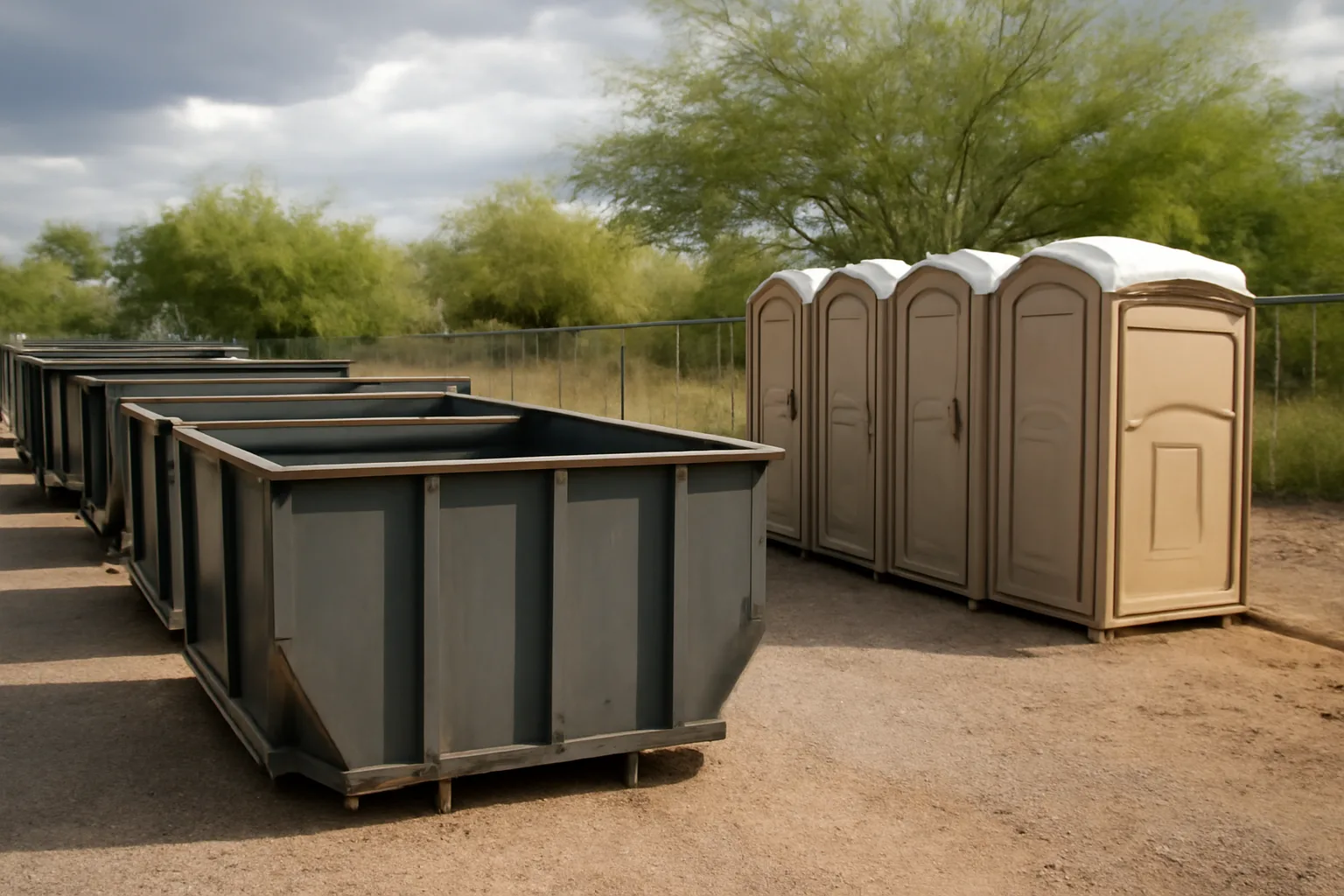
Most operators mean a fenced lot that stages roll-off boxes, portable toilets, fence panels, light towers, or crew trucks. The state does not name that use on a single card. What expires is whatever you actually hold.
If you formed a corporation, the Arizona Corporation Commission wants an annual report under ARS 10-1622. [14] LLCs file on the Commission's current schedule. Confirm the form and fee in the Commission's portal. Do not copy a fee from a blog.
Sell taxable site services or rent tangible property, and you already opened a transaction privilege tax account with the Arizona Department of Revenue. That account is not a diner permit you rebuy once a year and forget. You file returns on the schedule ADOR assigned. [3]
Land use is local. A use permit or occupancy approval can carry conditions that get reviewed. Some cities want fire inspections on their own calendar. Some leases demand insurance proof on a date that has nothing to do with the state.
If the company bids contracting work, the Registrar of Contractors license runs on a two-year statutory term. [2] If you hold a USDOT number, the MCS-150 update is biennial. [11] Diesel tanks can pull you into a federal SPCC plan at 1,320 gallons aboveground. [6]
That is renewal. A pile of calendars, not a mythic yard license.
Do you need a license for a site services yard in Arizona?
Yes, you need licenses and approvals, but not a card printed site services yard. Arizona licenses the work and taxes the receipts. Cities and counties control the land use. The mix depends on the parcel and the contracts.
Store your own empty containers on land zoned for outdoor storage, and the hard paper is often zoning, occupancy, stormwater, and tax accounts. Collect waste, pump toilets, or bid construction, and more boards show up.
ARS 32-1151 makes unlicensed contracting unlawful. The statute says it is "unlawful for any person... to engage in the business of... a contractor without having a contractor's license in good standing." [1] Renting a toilet is not automatically contracting. Installing work or bidding construction can be. If you are not sure, ask the Registrar of Contractors for a classification read on your actual contracts.
You need a privilege license before you take taxable gross income covered by the TPT statutes. ARS 42-5005 puts that duty on the person receiving the income. [3] File the Joint Tax Application (JT-1) with ADOR. [4]
Local registrations exist in some cities. Phoenix runs privilege license tax paper on top of the state TPT structure. Confirm with the city finance shop that matches the yard address. County islands inside metro Phoenix surprise people. Check the parcel.
I would not open a yard on a handshake in a neighborhood commercial district and hope. Outdoor storage and contractor yards are industrial-flavored uses. Phoenix puts light industrial rules in Zoning Ordinance section 627. [10] Other cities use different section numbers. Same idea.
No license is not an option if you are open for business. The wrong license is the usual mistake.
How much does a site services yard cost in Arizona?
The paper is the cheap line. Land, fencing, grading, drainage, trucks, and insurance dominate. Arizona does not publish a statewide site services yard permit fee, so I will not invent one.
State and city filing fees change. Confirm each current fee with the board that invoices it. Corporation Commission annual reports, ADOR licensing, ROC renewal, and city occupancy each post their own schedules. Anyone quoting a single Arizona number for the license is selling a myth.
The real first-year cash is site work. A usable yard needs an all-weather surface or graded gravel that does not sheet mud into the street, a legal driveway apron, screening if zoning required it, lighting the neighbors will not fight, and a fuel or wash spot that does not become an ADEQ problem. Those invoices vary by county and by whether you lease a built pad or raw dirt. Nobody has a clean public dataset of Arizona site services yard buildout costs. Brokers quote asking rents. Treat those as asks.
After opening, the burn is labor, truck debt, container debt, disposal or pumping contracts, fuel, and insurance. Workers compensation is not optional for most Arizona employers. ARS 23-902 is the coverage duty statute. [12] Confirm class codes with a licensed producer. Rates move.
Hold an ROC license, and you budget the renewal fee the Registrar currently posts plus the cost of keeping the bond in force. Bond rules live in the Registrar's statutes and current instructions. Read those. Do not reuse a 2018 dollar figure.
Shared pads change the math. You may pay rent instead of building a lot. You still owe your own tax accounts and activity licenses. SiteServicesPath publishes a $249 one-time Shared-Yard Economics Kit that maps shared-pad rent against this paper stack. It does not file renewals.
Compared with site services yard renewal in California, Arizona state paper is usually thinner. The land fight can still get expensive in Maricopa infill.
How long does a site services yard take in Arizona?
Opening time is not the same as renewal time. A TPT account can be a short ADOR process if the application is clean. A zoning use permit can take several public hearing cycles. I will not quote a week count. Boards change queues. Confirm the current calendar with the planner assigned to the parcel.
Renewal of an already approved yard is faster when the use did not change. On-time ROC renewals are administrative. Late ones get uglier. Entity annual reports are a filing, not a construction project.
Start from dirt, and the long pole is almost always land use plus civil work, not the state tax license. Design review, neighborhood meetings, drainage reports, and fire access chew months in the big cities. County industrial land can be faster and still surprise you with floodplain or dust rules.
USDOT registration and MCS-150 updates are measured in days once you have the facts. [11] SPCC plans take as long as your engineer takes. ADEQ MSGP coverage, if you need it, follows ADEQ's current notice of intent process. [8] Confirm that process on the ADEQ MSGP page before you promise a customer a start date.
Nobody should guarantee you a certificate by Friday. If a consultant does, find another consultant.
For a clean renewal year with the same use, the same qualifying party, and no enforcement file, you are looking at calendar work and inspections. Change the use (add waste transfer, add fueling, add overnight trucking) and you may be back in planning.
Idaho and Colorado operators ask the same timing question. The honest answer is local there too. See site services yard renewal in Idaho and site services yard renewal in Colorado if you run yards in more than one state.
Which Arizona boards do you call before a renewal date?
Call the board that issued the paper, not a general business license hotline, unless your city still runs one.
Start with the Arizona Corporation Commission if you are a corporation or LLC. Confirm the annual report window and the current fee in the Commission's filing system. ARS 10-1622 is the corporate annual report duty. [14]
Call ADOR for the TPT account. Ask whether your filing frequency changed and whether any city privilege account is separate. Use the rate lookup for the yard site, not the owner's house. [5]
Call the planning or development services department that has jurisdiction over the parcel. Ask if the use permit has an expiration, a review clause, or a condition you have been quietly violating (stored height, screening, hours). Phoenix industrial text lives in Zoning Ordinance section 627. [10] Other cities will point you to their equivalent.
Call the fire department that inspects the yard. Some inspections are annual. Some only happen when you add tanks.
Call the Registrar of Contractors only if you hold a license. Ask about the expiration month and whether the qualifying party is still attached. ARS 32-1125 sets the two-year term and ties renewal to the application and fee the Registrar receives. [2]
Call ADEQ if you store waste, used oil, or have industrial stormwater exposure. The MSGP page is the start for stormwater. [8] Solid waste facility plan duties sit in ARS 49-762 when you cross into facility territory. [9]
Call county environmental services if you pump onsite wastewater. Maricopa and Pima run their own pumper licensing. Confirm with the county where the trucks are based and where they discharge.
Call your insurance producer and your surety. A lapsed bond can kill an ROC license even if you paid the renewal fee.
I would keep those names on one sheet with login IDs. That is boring. It is also how yards stay legal.
How do you renew an Arizona contractor license tied to the yard?
Only if you have one. Many site services companies never need ROC paper. If you do, treat the expiration month as a hard date.
ARS 32-1125 sets a two-year license term and renews the license when the Registrar receives the renewal application and the renewal fee. [2] Confirm the current fee and the online steps with the Registrar. Arizona uses a statewide eLicensing portal for a lot of this. Do not mail a guess.
Keep the qualifying party in place. If that person left, you have a qualifying party problem, not a forgotten password problem. Fix that before expiration.
Keep the bond in force without a gap. Read the Registrar's current bond instructions in AAC Title 4, Chapter 9 and its statutes. The rule controls the requirement. The Registrar tells you what they will accept this week.
Arizona Administrative Code Title 4, Chapter 9 holds the ROC rules, including process details the statute does not spell out. [13] Skim the chapter once. Then follow the current online checklist, because rule text and portal buttons are not always in the same order.
I would not pay a recovery service a cut to save a license you can still renew on time yourself. If it already expired, read the reinstatement path on the Registrar's site and confirm whether you are in late renewal, expired, or revoked territory. Those are different.
If your yard work is purely rental and hauling, double-check you even need this license before you keep paying for it. Paying for the wrong classification for a decade is a real hobby in this trade.
What local zoning and occupancy paper comes due?
Zoning is where Arizona site services yards actually live or die. The state will take your TPT filing while the city is writing a violation for outdoor storage.
Ask for the approved site plan and the use permit conditions. If you cannot find them, the planning counter can. Conditions often limit stack height, hours, idling, customer pickup, and screening. Renewal, in practice, means you still match those conditions.
Some approvals expire if the use stops. Some run with the land. Some require a review after a set period. Nobody has good public data on how often Arizona cities put a sunset on a contractor yard use. Ask the planner.
Occupancy certificates and fire inspections can be annual or event driven. Adding a modular office, a welding bay, or a fuel island is a new permit, not a renewal of the old one.
Phoenix industrial districts (Zoning Ordinance section 627) are the usual home for this use inside the city. [10] Unincorporated county land uses the county ordinance. Do not assume a use that was fine in a Phoenix industrial district is fine on a similarly nicknamed district in a suburb. The names rhyme. The tables differ.
Dust control in Maricopa and Pinal is not optional folklore. Earth moving and large disturbed yards can need a dust permit from the county air quality shop. Confirm thresholds with that department. I will not invent acreage cutoffs because they get amended.
Comparing Sun Belt cities? Site services yard renewal in Florida and site services yard renewal in Georgia have the same pattern. Local land use is the long pole. State tax paper is not.
What environmental and stormwater paper can come due?
Empty, clean containers on gravel are not automatically a solid waste facility. Stored waste, transfer, processing, or a working dumpster that is not empty can change that. ARS 49-762 is the solid waste facility plan statute. [9] If your operation starts to look like a transfer site, call ADEQ before a neighbor does.
Industrial stormwater is the permit operators forget. ADEQ administers an AZPDES Multi-Sector General Permit for industrial activities. [8] Whether your yard needs coverage depends on your sector, exposure of materials to stormwater, and current ADEQ rules. Confirm on the ADEQ MSGP page. I will not certify your sector for you.
Store diesel or other oils, and you count the gallons. 40 CFR 112.1 is the federal SPCC applicability rule. [6] The aboveground aggregate threshold is 1,320 gallons, and containers smaller than 55 gallons generally do not count toward that total. Completely buried storage has a 42,000 gallon threshold in the same section. If you are over, you need a plan that matches the rule, not a sticky note on the tank.
Used oil from truck service has its own ADEQ expectations. Do not pour it on the yard to control dust. That sentence should not be necessary. It is.
OSHA still applies to how you stack. 1926.250(a)(1) says: "All materials stored in tiers shall be stacked, racked, blocked, interlocked, or otherwise secured to prevent sliding, falling or collapse." [7] Inspectors still use that language in a yard that supports construction.
Renewal here means the plan is current, the inspections happened, and the spill kit is not a trash bag. A binder from 2014 with a dead engineer's name is not a plan.
What tax accounts stay open after the yard is built?
Your ADOR TPT license is the state tax account most site services firms hold. ARS 42-5005 requires the privilege license for persons who receive taxable gross income under that article. [3] The JT-1 is the application. [4]
Filing frequency can be monthly or less often based on ADOR's rules and your volume. Confirm yours in the ADOR account. Combined rates include state, county, and city pieces. Use ADOR's tax rate lookup for the business location. [5] Do not copy a rate from a Mesa job onto a Flagstaff invoice.
Some cities still want their own privilege license paperwork even when ADOR collects. Phoenix is the example people hit first. Confirm with city finance. I would not assume Tucson, Mesa, or a town in Yavapai does it the same way.
Close a yard, and you close the accounts on purpose. An open TPT account with zero activity can still want returns. An abandoned city account can grow notices.
Sales of tangible personal property, certain rentals, and prime contracting are different TPT classifications. Site services firms sometimes sit in more than one. Misclassification is how you fund an audit. Ask ADOR or an Arizona licensed tax person who does TPT, not a generalist who does W-2s.
Site services yard cost in Connecticut is a different tax world. Do not import New England rate logic into Maricopa County.
What insurance, bonds, and truck filings stay current?
Insurance renews every year because insurers like years. Required coverage is a mix of statute, contract, and landlord rules.
Workers compensation: most Arizona employers must have it. ARS 23-902 is the starting statute. [12] Confirm with the Industrial Commission or a producer if you think you are exempt. Wishful thinking is not an exemption.
Auto and general liability limits are usually set by customers and by the lease, not by a single Arizona yard insurance statute. Construction GC contracts will dictate additional insured language that your yard policy may not automatically include.
ROC bond: keep it continuous if you hold the license. A cancellation notice is an emergency.
Trucks: if you have a USDOT number, FMCSA wants a biennial MCS-150 update. [11] Intrastate-only fleets can still have Arizona credential duties. IRP and IFTA apply when you cross state lines the way those programs define it. Confirm with ADOT, not with a truck stop rumor.
I would not buy a cyber policy before I bought the auto coverage the lease names. I would not assume a personal pickup policy covers a service body and a trailer of toilets. Ask in writing.
Alabama and Alaska operators deal with the same insurance stack with different state workers comp twists. See site services yard renewal in Alabama and site services yard renewal in Alaska if you need those paths.
What would I actually do 90 days before anything expires?
I would print one page with every account number, expiration, login, and board phone number. Then I would work it in this order.
First, land use. Confirm the use permit is still valid and that the yard still matches the site plan. Fix screening and stack height before you invite a fire inspector.
Second, ROC and any county pumper or waste credentials. Those can stop you from bidding or pumping. Confirm the qualifying party and the bond.
Third, tax accounts. Log into ADOR. Look for notices. Check city privilege accounts.
Fourth, entity report. File the Corporation Commission report in the window they publish. Confirm the fee in the portal.
Fifth, environmental. Walk the yard. Count oil gallons against 40 CFR 112.1. [6] Check whether MSGP inspections were done. [8] Replace the spill kit that someone used as a trash can.
Sixth, trucks and USDOT. Do the MCS-150 if it is due. [11]
Seventh, insurance certificates the landlord and top customers will ask for next month.
I would not hire a license expediter for a simple on-time ROC renewal. I would hire a land-use person if a neighbor complaint is already in the file. I would not spend money on a new logo while the bond is cancelling.
The worksheet is at /start if you want the shared-pad version of this list. Confirm every fee with the board that collects it.
What is a waste of money at Arizona yard renewal?
Paying anyone to obtain a statewide site services yard renewal license is a waste, because that license is not a thing.
Buying a new software stack to track one expiration date is a waste. A calendar and a folder work.
Paying old fee amounts a forum posted is how you bounce a filing. Confirm the current fee.
Ignoring zoning because your TPT account is current is how you meet a code officer. The tax department does not control outdoor storage.
Overbuilding the environmental binder for a yard that only stores clean empties, while you skip the dust permit you actually need, is backwards. Match the paper to the dirt.
Renewing an ROC classification you do not use, year after year, is optional charity to the surety.
Comparing your Maricopa use-permit fight to site services yard renewal in Hawaii for timing folklore is entertainment, not planning.
Do the boring calls. Pay the real invoices. Leave the mythic statewide yard card alone.
Frequently asked questions
Do you need a license for site services yard in Arizona?
You need licenses, but Arizona does not issue a card named site services yard. Expect an entity filing, an ADOR TPT account if you have taxable receipts, local zoning and occupancy approval for outdoor storage, and any ROC, ADEQ, county pumper, or USDOT paper that matches the work. Confirm the mix with the board that has the parcel and the contracts.
How much does site services yard cost in Arizona?
State filing fees are the small line and they change, so confirm each current fee with the board that invoices it. The real cost is land or pad rent, fencing, grading, drainage, trucks, containers, and insurance. Nobody publishes a clean statewide buildout number. Workers compensation applies to most Arizona employers under ARS 23-902. Shared pads trade capex for rent.
How long does site services yard take in Arizona?
A clean TPT account can move quickly. A new zoning use permit can take several hearing cycles. On-time renewals of an already approved yard are mostly calendar work. I will not quote a week count because queues change. Confirm the current planner calendar and the Registrar's current renewal window. No one can honestly guarantee an approval date.
Does a dumpster and toilet yard need an Arizona ROC license?
Not automatically. ROC paper is for contracting. Pure rental and hauling of containers or toilets may sit outside that. Bidding construction, installing work, or holding yourself out as a contractor can pull you under ARS 32-1151. Ask the Registrar for a classification read on your actual contracts. Do not guess from a forum thread.
When does an Arizona contractor license expire?
ARS 32-1125 sets a two-year term and renews the license when the Registrar receives the application and fee. Confirm your exact expiration month in the eLicensing account. Keep the qualifying party and the bond in force. Late, expired, and revoked are different statuses. Read the Registrar's current path before you pay anyone to save it.
Do I need ADEQ if I only store empty containers?
Empty, clean containers on a lawful lot are not automatically a solid waste facility under ARS 49-762. Stored waste, transfer, or processing can change that. Stormwater coverage under ADEQ's MSGP depends on sector and exposure. Confirm with ADEQ rather than assuming a gravel lot is invisible. Used oil and fuel tanks are a separate conversation.
How do I renew a Phoenix occupancy or use permit?
Start with the approved site plan and written conditions, not a new application you invent. Ask Phoenix Planning and Development whether the approval expires, needs review, or is tied to a still-true site plan. Section 627 is the usual industrial home for this use inside the city. Adding fueling, welding, or a new office is often a new permit.
Does Arizona charge a statewide yard permit fee?
No. There is no statewide site services yard permit and no single statewide yard fee. You will see separate invoices from the Corporation Commission, ADOR, a city or county, and any activity board you actually hold. Confirm each current fee on that board's fee page. A bundled quote from a random website is not a fee schedule.
What happens if the ROC license lapses?
You can lose the right to bid and perform licensed contracting until the Registrar restores the license. Bond gaps and a missing qualifying party make it worse. Confirm whether you are in late renewal, expiration, or revocation. Those paths differ. I would not keep bidding while you sort it out. Read ARS 32-1151 before you send another proposal.
Do I need a USDOT number for local Arizona hauls only?
Interstate commerce and certain vehicle weights pull you into FMCSA registration. Intrastate-only fleets can still have Arizona credential duties. If you already have a USDOT number, the MCS-150 update is biennial. Confirm with FMCSA and ADOT using your actual truck weights and lanes. A truck-stop rumor is not a determination.
Is stormwater permitting required for a gravel equipment yard?
Sometimes. ADEQ's Multi-Sector General Permit covers certain industrial activities with stormwater exposure. A clean-empty storage lot may or may not fit. Materials, fueling, and maintenance change the answer. Confirm on the ADEQ MSGP page. I will not certify your sector from a description in an email. Dust permits are a separate county issue.
Can I renew everything online in Arizona?
A lot of it, not all of it. ROC renewals and Corporation Commission reports usually go through state portals. ADOR filings are online for most accounts. Zoning condition reviews and fire inspections still involve people and a site. County pumper credentials vary. Confirm the current portal and whether your file has a hold that blocks online renewal.
Does Arizona require continuing education for contractor renewal?
Confirm with the Registrar for your classification and the current rules in AAC Title 4, Chapter 9. Do not assume another state's CE hours transfer, and do not assume Arizona copied Nevada or California. If CE is not on the Registrar's current renewal checklist for your class, do not buy a random 16-hour course to feel busy.
Sources
- Arizona Legislature, ARS 32-1151: Arizona law makes it unlawful to engage in the contracting business without a contractor license in good standing.
- Arizona Legislature, ARS 32-1125: An Arizona contractor license issued under Title 32, Chapter 10 is on a two-year term and renews when the Registrar receives the application and fee.
- Arizona Legislature, ARS 42-5005: Persons receiving taxable gross income under the TPT article must obtain a privilege license from the Department of Revenue.
- Arizona Department of Revenue, Joint Tax Application (JT-1): Arizona businesses apply for a transaction privilege tax license through the Joint Tax Application (JT-1) filed with ADOR.
- Arizona Department of Revenue, TPT tax rate lookup: Combined TPT rates in Arizona include state, county, and city pieces that vary by business location.
- U.S. eCFR, 40 CFR 112.1: Federal SPCC rules use a 1,320 gallon aboveground aggregate oil threshold, a 42,000 gallon completely buried threshold, and generally exclude containers under 55 gallons from the count.
- OSHA, 29 CFR 1926.250: Construction materials stored in tiers must be stacked, racked, blocked, interlocked, or otherwise secured to prevent sliding, falling, or collapse.
- Arizona Department of Environmental Quality, AZPDES MSGP: ADEQ administers the Multi-Sector General Permit for industrial stormwater discharges in Arizona.
- Arizona Legislature, ARS 49-762: Solid waste facility plan requirements apply when an operation meets Arizona's solid waste facility definitions.
- City of Phoenix Zoning Ordinance § 627: Phoenix Zoning Ordinance section 627 sets light industrial district rules commonly used for outdoor storage and similar yard uses.
- FMCSA, Biennial MCS-150 update: Motor carriers with a USDOT number must file a biennial MCS-150 update.
- Arizona Legislature, ARS 23-902: Arizona employers generally have a statutory workers compensation coverage duty.
- Arizona Secretary of State, AAC Title 4 Chapter 9 (Registrar of Contractors): Arizona Administrative Code Title 4, Chapter 9 contains the Registrar of Contractors rules that fill in licensing process details.
- Arizona Legislature, ARS 10-1622: Domestic and authorized foreign corporations must deliver an annual report to the Arizona Corporation Commission.