Last updated 2026-08-20
TL;DR
California, New Jersey, New York, and Massachusetts are the hardest states for a site services yard. They stack environmental review, a solid waste or integrity license, and local hearings on top of ordinary zoning. Hawaii is hard because of land. Nobody publishes a real national ranking. Stay on empty-equipment storage, confirm every form with the board, and take no inbound waste in year one.
What is a site services yard?
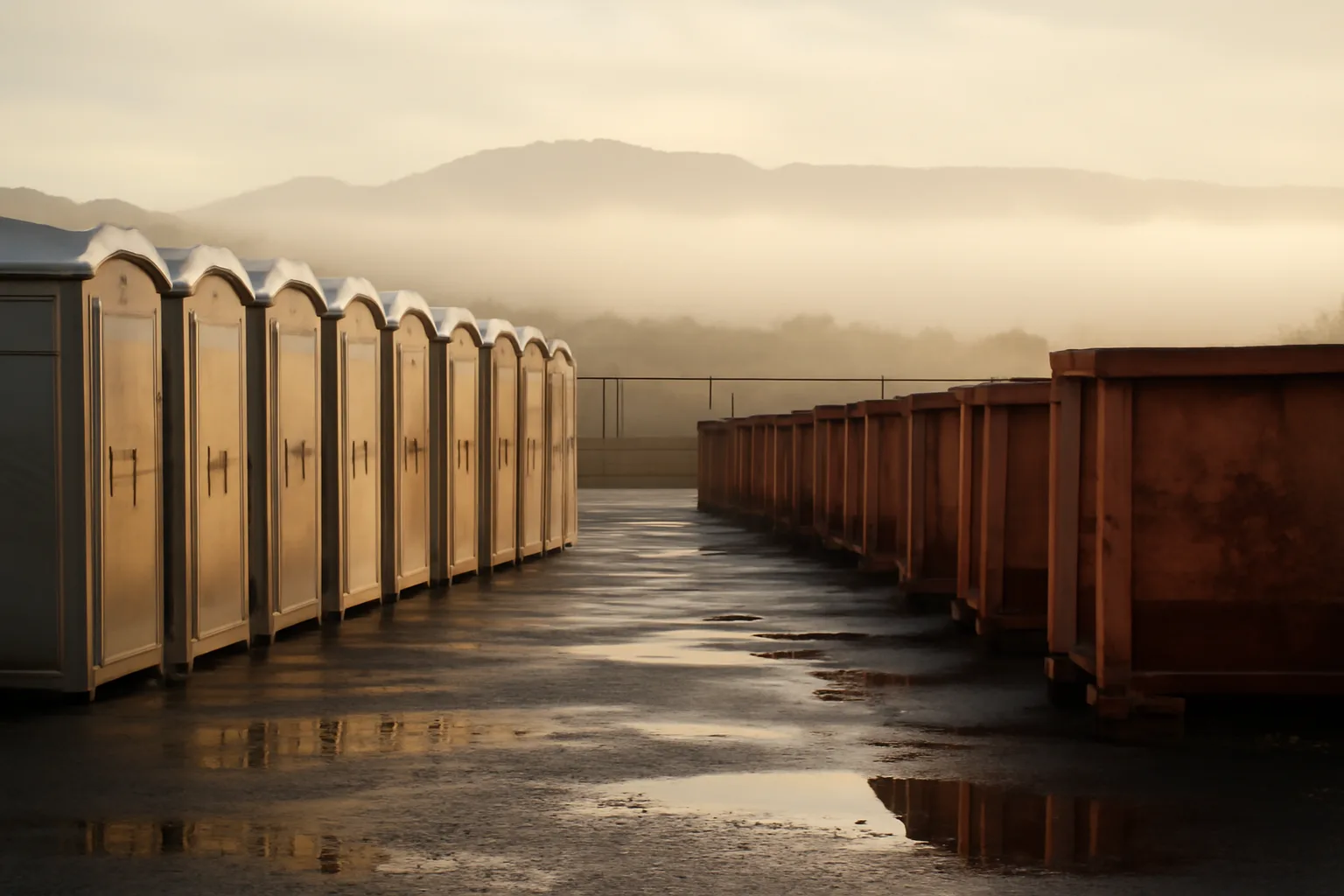
A site services yard is a fenced lot where you stage the gear construction sites rent. Portable toilets, roll-off boxes, temporary fence, light towers, and the trucks that move them. Some yards add a wash pad and a small shop. Some stay gravel and a conex.
It is a logistics pad. It is not a landfill. Empty boxes and clean toilets sit in a different legal box than mixed debris or septage. Cross that line and you inherit solid waste facility rules. Stay on empty equipment and you still face zoning, stormwater, and truck rules. You just skip the worst chapter of the code.
People confuse this with a transfer station. A transfer station takes waste from off site and consolidates it. Your yard should not do that in year one. I would not take inbound debris. The permit load on that one choice can eat your first two years of profit.
If you wash tanks or wrench on trucks, industrial stormwater under 40 CFR 122.26 is the federal hook. [10] States add their own general permits on top. California uses State Water Board Order 2014-0057-DWQ. [12] Confirm enrollment with that board. Do not guess your industrial classification and hope.
What makes a state hard for a site services yard?
Hard is stacked paper, not rude counters. A hard state makes you clear zoning, a state environmental review, a solid waste or transporter license, industrial stormwater, and sometimes an integrity investigation before you park the first box.
The stack starts with local zoning and often a conditional use permit. Then a state EIS or negative declaration if that CUP is discretionary. Then a solid waste facility permit if anyone decides you handle waste. Then a transporter or hauler registration for the trucks. Then stormwater. Then a USDOT number once a truck used in interstate commerce hits 10,001 pounds GVWR. [11]
Nobody publishes a clean national ranking of site services yards. The closest honest method is counting the statutes that fire on a typical yard. California, New Jersey, New York, and Massachusetts light up the most. Hawaii is hard for land. Alabama and Arizona still make you zone the lot. They just do not staple a novel-length EIS to a gravel pad.
If your plan includes inbound waste or a septage dock, every state gets harder. If you only store empty equipment, hardness tracks CEQA-style review plus local politics. That is the whole game.
Which states are the hardest for a site services yard?
California, New Jersey, New York, and Massachusetts. That is the working order for most empty-equipment yards. Hawaii and Connecticut sit right behind them. Washington and Oregon get close inside an urban growth boundary.
This is not a peer-reviewed index. It comes from the statutes cited on this page. Your county can flip it. A calm inland county in California can be easier than a coastal New England town. A transfer station in Alabama can be harder than empty-box storage in San Bernardino.
| State | Extra review | Waste / integrity overlay | First tripwire |
|---|---|---|---|
| California | CEQA, PRC 21080 | CalRecycle SWFP if you handle waste | Discretionary CUP |
| New Jersey | Local plus DEP | A-901 and N.J.A.C. 7:26 | Integrity license if you are solid waste |
| New York | SEQRA | 6 NYCRR Parts 360 and 364 | Waste transporter permit |
| Massachusetts | MEPA | M.G.L. c.111 §150A | Board of health assignment |
| Hawaii | HEPA, coastal SMA | HRS 342H | Land and special management areas |
| Connecticut | CEPA | CGS 22a-208a | Solid waste facility permit |
| Washington | SEPA | RCW 70A.205 | Local health plus Ecology |
| Oregon | Statewide land-use goals | ORS chapter 459 | DEQ disposal-site questions |
Read the table as risk, not destiny. Confirm each cell with the current board.
For the actual California forms, use the site services yard license in California page. For a lighter state path, read how to start a site services yard in Alabama.
Why is California so hard for a site services yard?
A conditional use permit is usually a discretionary project, and CEQA attaches to discretionary projects. That single fact explains most of the pain. Public Resources Code section 21080 states, "Except as otherwise provided in this division, this division shall apply to discretionary projects proposed to be carried out or approved by public agencies." [2]
Once CEQA is open, you run an initial study. Neighbors write letters. You talk dust, truck trips, and runoff. That is not fatal. It is public and it is slow. I would hire the planner before I hire the truck painter. Confirm current filing fees with the county and the state. Those numbers move. I will not print a stale one and call it fact.
If the yard receives solid waste, Public Resources Code section 44001 and the rest of that permit chapter apply. [1] Empty storage usually stays out. A C&D drop-off does not. The local enforcement agency and CalRecycle read the facts on the ground. Do not let a broker tell you it is just storage.
Stormwater sits on top through Order 2014-0057-DWQ. [12] Vehicle maintenance and some recycling activities often need coverage. California splits water regulation across nine Regional Water Quality Control Boards created in Water Code section 13200. [13] Your region handles the messy file.
If I had to open in California, I would go inland, keep the use description boring, and refuse public drop-off. I would not close on land until planning staff put that use in writing. The longer how to start in California walk-through is the next read. Renewal is its own paper path later. See site services yard renewal in California.
Why is New Jersey hard for a site services yard?
New Jersey is hard because of A-901. If DEP treats you as a solid waste business, you disclose owners, funding, and history under N.J.S.A. 13:1E-126 and N.J.A.C. 7:26. [5] That is an integrity investigation, not a zoning stamp.
A toilet lot with nothing but empty units may stay outside that net. A roll-off outfit that parks loaded boxes overnight may not. Write NJDEP and ask whether A-901 applies to empty container storage and to portable sanitation only. Keep the reply in a folder you can hand a lender.
Facility standards live in N.J.A.C. 7:26. Transporters carry a separate license. Pinelands, CAFRA, and the Meadowlands can kill a site even when the solid waste desk is calm. I would not take a first-yard lease inside any of those overlays.
If you can cover the same jobs from Pennsylvania, run the drive-time math before you sign. The North Jersey market is dense, so some operators eat the paper. I would not be the first-time owner who meets A-901 by getting denied.
Is New York harder than California for a site services yard?
New York runs close to California for different reasons. SEQRA is the review statute. Solid waste facilities sit under ECL Article 27 and 6 NYCRR Part 360. ECL 27-0707 is the permit section for solid waste management facilities. [3] Waste transporters sit under Part 364. [4]
The tripwire I see first is the transporter license, not the facility permit. Loaded roll-offs and pump trucks look like waste transport to a regulator. Empty toilet deliveries may not. Confirm with NYSDEC for your exact loads. I will not invent a processing time. Ask the region.
New York City adds the Business Integrity Commission for trade waste. If your plan is the five boroughs, read BIC before you read DEC. I would not make NYC the first yard.
California hits you on land-use discretion. New York hits you on the waste definition. Both can stop a closing cold. Connecticut rhymes with this pattern. See how to start a site services yard in Connecticut.
How do Massachusetts, Connecticut, and Hawaii compare?
Massachusetts puts a local board of health site assignment on solid waste facilities. M.G.L. c.111 §150A keeps a facility from operating unless the board of health has assigned the place as "a site for a facility" after the process that section requires. [6] That hearing is political, and the room fills up fast.
MEPA can stack when state permits trigger it. 310 CMR 19.000 is the solid waste code. Empty storage may stay out. A C&D pad will not. Get a written determination from MassDEP and the local board before you wire a deposit.
Connecticut requires a permit to construct or operate a solid waste facility under CGS 22a-208a. [7] Say empty equipment in every sentence you send them. Do not paste a transfer-station narrative you found online.
Hawaii pairs HRS 342H solid waste authority with scarce industrial land and coastal special management rules. [8] I like the customer market. I do not want it as a first-yard state unless you already control a legal lot.
Washington uses SEPA plus local health permits under RCW 70A.205. [9] Oregon asks disposal-site questions under ORS chapter 459. [15] Both are serious if you handle waste. Both are mostly land-use fights if you do not.
How do you start a site services yard?
You start with the land use, not the LLC. Read the zoning table until you see outdoor storage, contractor's yard, or equipment storage listed as permitted or conditional. If the table says no, walk. Rezoning a first yard is a hobby, not a business plan.
Write a one-page use description. Empty portable sanitation units. Empty roll-off boxes. Temporary fence. Light towers. Company trucks. No public drop-off. No septage. No C&D receiving. Take that page to planning, the local solid waste enforcement desk, the state waste program, and stormwater. Ask each one which permit they want. File what they name. Confirm every fee with that board.
Then form the entity, get an EIN, and pull the local business license. If any truck will run interstate at 10,001 pounds GVWR or more, get the USDOT number. [11] IRP and IFTA show up once you cross state lines often. Insurance is whatever the CUP lists, plus auto and general liability. Add pollution coverage if you wash tanks.
Buy iron last. First-year operations are dispatch and keeping other people's waste off your gravel. Arizona and Colorado are reasonable paper paths if you do not already own a California customer list.
Comparing several states on one worksheet? The $249 one-time Shared-Yard Economics Kit is built for that math. You can ignore it and still use every statute on this page.
What permits actually trip people up first?
Zoning and the waste definition. Everything else follows those two.
People order trucks, then learn the lot is not a permitted use. Or they accept a few contractor drop-offs and become an illegal transfer station. The first error is a dead lease. The second is an enforcement file with your name on it.
Industrial stormwater is the quiet third. 40 CFR 122.26 names the industrial activities that need NPDES stormwater coverage. [10] A shop or a wash pad can pull you in. File the general permit or a no-exposure certification if you qualify. Confirm with the state water program.
USDOT is simple and people still skip it. FMCSA guidance says you must obtain a USDOT Number if you have a vehicle that, among other tests, "Has a gross vehicle weight rating or gross combination weight rating, or gross vehicle weight or gross combination weight, of 4,536 kg (10,001 pounds) or more, whichever is greater" and is used in interstate commerce. [11]
Skip the brand build-out, the custom app, and the second lot until the CUP and the waste determination sit in the file. That spend is a waste of money in year one.
Are red states automatically easier for a site services yard?
No. Texas and Florida still run municipal zoning and stormwater. A loud coastal CUP can outlast a quiet inland California storage use. Alabama is usually lighter at the state level. It is not a blank check. Read the Alabama start guide.
RCRA Subtitle D, 40 CFR part 258, set a federal floor for municipal solid waste landfills. [14] States built facility and transporter programs on top of that floor. Those programs exist in every political direction. Fewer states attach a full EIS statute to a simple CUP. That is the real difference, not the absence of rules.
Arizona is a common easier pick when the zoning fits. Colorado is a middle path: real local process, less novel-length state waste overlay for empty storage. Pick the market, then the paper. The county planning counter is the review that decides your year one.
What should you confirm with the board before you lease land?
Four written answers. Is outdoor storage of empty site-service equipment permitted or conditional at this address. Does the solid waste program treat this use as a facility. Do the trucks need a transporter license for your own empty units versus customer waste. Do you need industrial stormwater coverage or a no-exposure certification.
Ask for form names and the current fee schedule. Boards swap PDFs without warning. I will not invent a fee or a quota. If staff will not email it, send a letter.
Ask whether the CUP is discretionary. Discretionary is the CEQA and SEQRA tripwire. Public Resources Code 21080 is the California version of that split. [2]
If answers conflict, follow the stricter one until a written determination says otherwise. Nobody here can guarantee an approval or a hearing date. Anyone who does is guessing with your money.
How do zoning and neighbors beat state licenses?
A state permit does not rezone the lot. Neighbors do not need a statute number to fill a room. Early trucks, wash-pad odor, and stacked toilets on the fence line are what they talk about at the microphone.
In Massachusetts the site assignment runs through the board of health process in M.G.L. c.111 §150A. [6] In California the CEQA comment period is the same energy. In a small Connecticut town, inland wetlands can add a season if your gravel sits near a mapped stream.
Spend money on a site plan that hides the wash pad and keeps stack height boring. Do not spend it on a showroom. If the parcel needs a variance plus a CUP plus a wetlands permit, walk. One discretionary approval is enough for a first yard.
What would I actually do if I had to pick a first state?
I would pick the state where I already have customers and a legal place to park, unless that state is California, New Jersey, New York, or Massachusetts and I have no local help. Then I would test serving the metro from the next state over, if drive times work. Confirm IRP, fuel tax, and waste-hauler rules before you assume a border save actually saves anything.
If I am footloose, I would open the first pad in Alabama, Arkansas, or Arizona. Lighter statewide overlays. Real volume in Arizona. I would add a hard-state yard only after the first one prints cash.
I would keep the use empty-equipment only. No inbound debris. No septage. Stormwater enrollment the day a shop or wash pad appears on the site plan.
SiteServicesPath is an independent publisher, not a law firm and not a service company. If you want the worksheet bundle after you have read the statutes, it lives at /start. You do not need it to use this page.
Frequently asked questions
What is site services yard?
A site services yard is a fenced logistics lot for portable toilets, roll-off boxes, temporary fence, light towers, and the trucks that move them. It is not a landfill or a transfer station. Empty storage and inbound waste sit under different rules. Keep other people's debris off the gravel unless you want a solid waste facility file with your name on it.
How do you start site services yard?
Lock the land use first. Get written answers on zoning, solid waste status, transporter rules, and stormwater. Form the entity, pull the local business license, and get a USDOT number if you meet the 10,001 pound interstate test. Buy trucks last. Confirm every fee and form with the board that owns it. Nobody can honestly guarantee an approval date.
Is California the hardest state for a site services yard?
For most empty-equipment yards, yes. A discretionary CUP pulls CEQA under Public Resources Code section 21080. Handling waste adds a solid waste facility permit under PRC 44001. Nine Regional Water Quality Control Boards sit on stormwater. An inland storage-only lot can still be workable. Confirm the use in writing before you lease.
Does New Jersey A-901 apply to a portable toilet yard?
Only if NJDEP treats you as a solid waste business under N.J.S.A. 13:1E-126 and N.J.A.C. 7:26. Empty toilets with nothing on the ground may stay out. Loaded roll-offs parked overnight may not. Do not guess. Ask DEP in writing and keep the reply. Pinelands, CAFRA, and Meadowlands overlays can kill a site even when A-901 does not.
Do empty roll-off boxes need a solid waste facility permit?
Usually no, if they are empty, they are yours, and the public cannot drop debris. The minute you accept C&D or leave loaded boxes as a habit, agencies can read the lot as a facility. California uses PRC 44001. New York uses ECL 27-0707 and Part 360. Get a written determination. Do not take inbound waste in year one.
Is Hawaii worth a first site services yard?
Rarely, unless you already control industrially zoned land outside a painful special management area. HRS 342H gives DOH solid waste authority, but the harder problem is parcel scarcity and cost. The customer market is real. The first-yard paper-plus-land combo is a poor classroom. I would not learn the business there.
Can I serve California from Nevada?
Sometimes, if drive times, fuel, IRP, and any waste-hauler rules still work for your loads. A Nevada lot does not erase CEQA if you later open a California yard. It can delay the California land-use fight. Confirm with both states' transporter and stormwater desks before you sell that plan to a lender.
What permit should I pull first for a site services yard?
None, until zoning staff say the use is allowed. Then pull whatever they and the solid waste desk name, in the order they name it. Stormwater enrollment belongs with the shop or wash pad, not with the logo design. USDOT belongs on the truck before the first interstate trip at 10,001 pounds GVWR.
Are Texas and Florida easy for a site services yard?
Easier than California on statewide EIS paper. Not easy. Cities still run CUPs, neighbors still show up, and stormwater still exists. A coastal Florida hearing can outlast a quiet inland California storage use. Judge the county, not the state's political brand. Confirm the zoning table on the actual parcel.
Do I need industrial stormwater coverage?
Maybe. 40 CFR 122.26 is the federal list of industrial activities that need NPDES stormwater coverage. A wash pad or a maintenance shop often pulls you in. A bare gravel storage lot sometimes qualifies for no-exposure. States issue the general permit. Confirm with the state water program. Do not assume outdoor means exempt.
What is the difference between a yard and a transfer station?
A yard stages your empty equipment and dispatches your trucks. A transfer station takes waste from off site and consolidates it. That second use triggers facility permits such as New York Part 360, a CalRecycle SWFP, or a Massachusetts board of health assignment. I would not run both on the same first lot.
Which board should I call first?
City or county planning, with the address and a one-page use description. Then the local solid waste enforcement agency or state waste program. Then the industrial stormwater desk. Then FMCSA or your state truck desk if you cross state lines. Ask for form names and the current fee sheet. Keep every answer in writing.
Is Colorado easier than the Northeast for a site services yard?
Usually, for empty-equipment storage. You still face a real local land-use process. You are less likely to inherit A-901, a board of health site assignment, or CEQA on day one. That is not a promise. Mountain towns and Front Range neighbors can still sink a noisy lot. Confirm the parcel, not the reputation.
How long does CEQA take for a site services yard?
There is no honest single number, and I will not invent one. Time tracks whether the lead agency uses an exemption, a negative declaration, or an EIR, plus how loud the comment file gets. Ask the planning department that will be the lead agency. Anyone who guarantees a hearing date on a blog is guessing.
Sources
- California Public Resources Code §44001 (solid waste facility permits): California requires a solid waste facility permit under PRC 44001 when a site is a solid waste facility.
- California Public Resources Code §21080 (CEQA applicability): CEQA applies to discretionary projects proposed to be carried out or approved by public agencies.
- New York Environmental Conservation Law §27-0707: New York ECL 27-0707 is the permit section for solid waste management facilities.
- NJDEP A-901 background investigations program page: New Jersey requires A-901 integrity disclosure for people in the solid waste business.
- Massachusetts General Laws c.111 §150A: Massachusetts requires board of health site assignment before operating a place as a site for a facility.
- Hawaii Revised Statutes §342H-4: HRS 342H-4 gives the Hawaii Department of Health solid waste powers used to regulate facilities.
- Revised Code of Washington 70A.205.125: Washington requires solid waste permits under RCW 70A.205 for covered handling and disposal sites.
- 40 CFR 122.26 (EPA NPDES stormwater): 40 CFR 122.26 is the federal rule that pulls certain industrial activities into NPDES stormwater coverage.
- FMCSA, Do I Need a USDOT Number?: FMCSA requires a USDOT number for interstate CMVs meeting the 10,001 pound GVWR (and related) tests.
- California State Water Board Order 2014-0057-DWQ (Industrial General Permit): California's industrial stormwater general permit is Order 2014-0057-DWQ.
- California Water Code §13200 (regional boards): Water Code section 13200 establishes California's nine Regional Water Quality Control Boards.
- 40 CFR part 258 (RCRA Subtitle D landfill criteria): 40 CFR part 258 sets federal municipal solid waste landfill criteria that states implement under RCRA Subtitle D.
- Oregon Revised Statutes chapter 459 (solid waste): Oregon solid waste disposal-site and related permit questions sit in ORS chapter 459.