Last updated 2026-08-21
TL;DR
A site services yard is a fenced outdoor lot that stores and dispatches construction-site support: roll-off boxes, portable toilets, temporary fence, and containers. You start by forming an entity, getting a free EIN, locking the right zoning, covering stormwater and oil rules if they apply, and registering heavy trucks. Confirm every state license and fee with the issuing board. No single national license exists.
What is a site services yard?
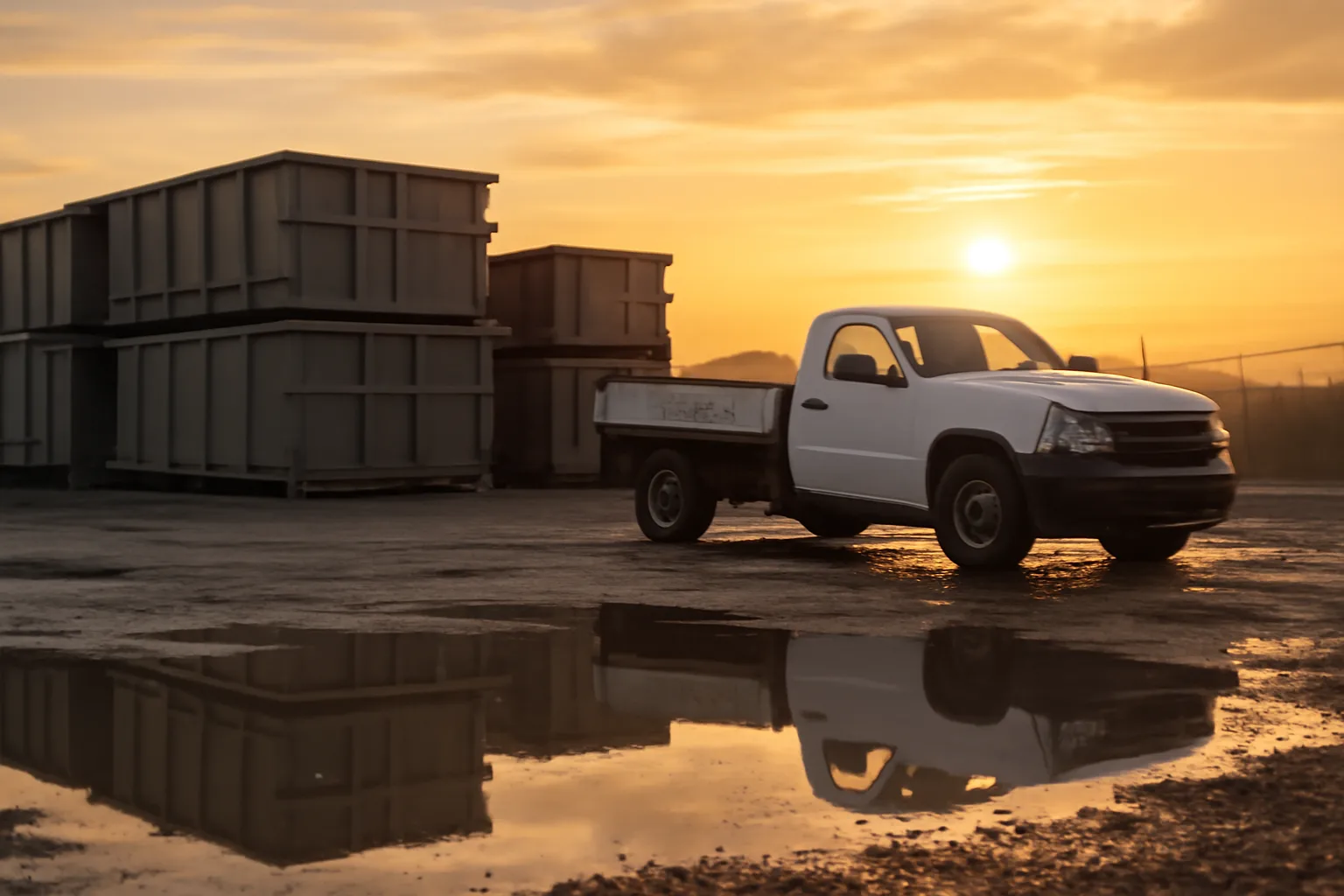
A site services yard is a fenced outdoor lot that stores, stages, and dispatches the gear contractors rent for a jobsite. Roll-off dumpsters. Portable toilets. Temporary fence. Storage containers. Water tanks. The trucks that move all of it.
It is not a landfill. It is not a contractor’s garage with a leftover box. It is the depot. Dirty inventory comes home. Drivers leave before dawn. By mid-morning the gravel looks empty and the phone is already booking the afternoon swaps.
People blur this with a “construction yard” or a “waste facility.” Those words change your paper. If you only rent and haul your own boxes to a permitted landfill or transfer station, you are usually in the rental-and-collection bucket. If you let builders dump mixed debris on your lot, sort it, or hold it overnight like a mini transfer station, your state solid-waste program can treat you as a facility. Confirm that line before you take a favor load. EPA estimates that 600 million tons of C&D debris were generated in the United States in 2018 [1]. Cities watch that stream.
Invoice codes matter to banks and insurers. Construction equipment rental often sits in NAICS 532412. Haul-and-dump work often sits in 562111. Use the code that matches what you actually bill, not the one that sounds nicer.
I would not call two toilets on a cousin’s dirt a site services yard. Once you have returning inventory, a gate a city can inspect, and recurring dispatch, you have a yard.
How do you start a site services yard?
You start a site services yard by locking a legal entity, a tax ID, a legally zoned lot, and the environmental and vehicle paper that matches what you store and drive. In that order. Motivation posters do not open a gate.
File the entity with your state. The U.S. Small Business Administration walks through sole proprietorships, partnerships, LLCs, and corporations in plain language [3]. I would use an LLC unless a CPA gives you a tax reason not to. Then get an EIN. The IRS says, “Applying for an EIN is a free service offered by the Internal Revenue Service,” and you can apply online [2]. Anyone charging you a government fee for the EIN itself is selling a line.
Lease or buy land that already allows outdoor storage and truck traffic. If you wash tanks or boxes, ask where the water goes before you sign. Then map the federal triggers that do not care what you named the company. Aggregate aboveground oil storage over 1,320 gallons can pull you into SPCC rules [6]. Interstate trucks at 10,001 pounds need a USDOT number [7]. Highway vehicles at 55,000 pounds taxable gross weight need Form 2290 [8]. If you grade one acre or more to build the lot, construction stormwater coverage can apply [14].
State contractor cards, waste-hauler permits, and portable-sanitation licenses are local. Confirm each fee and form with the board that prints the card. I will not quote a processing week I cannot defend.
Write a one-page activity list: what sits on the ground, what leaves the gate, where wastewater goes, who you employ. Hand that list to zoning, the fire marshal, and your insurance broker the same week. That sequence saves more cash than a new skid steer.
What licenses does a site services yard actually need?
There is no federal “site services yard license.” You stack ordinary business paper plus the permits that match your inventory and your routes.
The federal layer that is real: an EIN from the IRS, which is free [2]. A USDOT number if you meet FMCSA’s interstate-and-weight test [7]. Heavy Highway Vehicle Use Tax on Form 2290 if a vehicle hits 55,000 pounds taxable gross weight [8]. Form I-9 for every hire [10]. OSHA duties if you have employees [4]. Publication 334 is the IRS small-business tax guide you will actually open [13].
The state and city layer you must confirm, because I will not invent a fee: entity filing with the secretary of state, a sales tax permit if you rent tangible property, a city or county business license, zoning or conditional-use approval, a waste-hauler or roll-off permit in franchise cities, a septage or portable-sanitation license if you pump, and sometimes a contractor license if you install fence or do site work. Exclusive-franchise cities will tag a box you dropped without their blessing. Ask public works.
If you handle other people’s waste at the yard, your state environmental agency may treat you as a solid-waste facility. That is a heavier license. Do not “just accept a few loads” to be helpful.
Insurance certificates are not licenses. Many city permits still will not print without them. Get the certificate wording from the city first, then buy the policy. Doing it backward wastes premium.
Do you need a stormwater permit for a site services yard?
Maybe. Outdoor industrial activity that discharges stormwater to a municipal storm sewer or to waters of the United States is the EPA’s concern. Your self-image as “just a rental lot” is not.
EPA’s industrial stormwater program covers listed sectors under the Multi-Sector General Permit or a state-issued equivalent [5]. Land transportation shops, scrap and waste recycling, and certain treatment works show up on that list. A clean equipment-rental pad with no maintenance, no fueling, and no waste handling may sit outside a sector. A yard that washes trucks, fuels tanks, stores scrap, or stages dirty C&D is a different fact pattern. Ask the state NPDES authority which sector, if any, fits.
Building the yard can trigger a separate construction permit. EPA’s 2022 Construction General Permit applies to operators of construction activities that will disturb one or more acres, or smaller sites that are part of a larger common plan of development that will disturb one or more acres [14]. Grading a 1.2 acre lot for gravel and a shop is not a paperwork-free weekend.
I would still budget for grade, a track-out pad, and a simple SWPPP binder even when counsel says you might be exempt. Mud on the public street is how neighbors get you shut down. Straw-bale theater around a low spot is a waste of money. Get the drainage right.
When do trucks and oil tanks trigger extra federal paper?
Trucks trigger USDOT registration when you operate in interstate commerce and the vehicle hits the 10,001 pound threshold (GVWR, GCWR, GVW, or GCW), or you haul certain hazardous materials [7]. Intrastate-only fleets still often need a state USDOT-style number. Confirm with your state patrol commercial section, not a truck dealer.
IRS Form 2290 is a tax return, not a safety sticker. You file it and pay the tax if you have a highway motor vehicle registered in your name with a taxable gross weight of 55,000 pounds or more [8]. A loaded roll-off truck lives in that neighborhood. A one-ton pickup usually does not.
Oil is the quiet one. 40 CFR 112.1 applies to facilities that, among other tests, have “an aggregate aboveground oil storage capacity greater than 1,320 U.S. gallons” [6]. Count drums and totes 55 gallons and larger. Diesel. Hydraulic oil. Used oil. Crossing that line without an SPCC plan is how a spill becomes a federal file. Hiring an engineer for three tidy totes is usually a waste.
Used oil has its own management standards in 40 CFR 279.22. Keep it in closed containers in good condition, label them, and fix leaks [11]. Do not cut it with solvent so it “goes away.”
How much does it cost to open a site services yard?
Nobody has a clean national number I trust, and I will not invent one. Land, gravel, fencing, a used roll-off truck, toilet inventory, and a shop move with the metro. State filing fees move too. Confirm current amounts with the secretary of state and the licensing board.
What I can pin down is free versus not free. An EIN from the IRS costs nothing [2]. Forming an entity costs whatever your state charges this month. A USDOT number is an FMCSA registration step, not a mystery product someone should mark up for you [7]. Form 2290 is a tax you calculate from the form instructions [8].
State-by-state cost notes beat a coast-to-coast average. If you are pricing dirt and paper in one state, start with the site services yard cost in Alabama, California, Colorado, or Florida writeups rather than a national myth.
Do not spend first-year cash on a new office modular and a lighted monument. Spend it on drainage, one reliable truck, and enough inventory that you can say yes on Tuesday. Pretty yards do not cash flow. Full trucks do.
Insurance deposits and first and last month on industrial land shock people who budgeted like a home garage. Get a written rent quote and a broker indication before you buy a single toilet.
What insurance should a site services yard actually buy?
Buy what the lease, the city permit, and the truck lender name in writing. Then buy the gaps that bankrupt you.
Commercial auto, including hired and non-owned if anyone uses a personal truck. General liability for the lot and for a box that kisses a parked car. An inland marine or scheduled equipment floater for boxes, toilets, and fence that live off-site. Workers’ compensation if you have employees. That is state statute, not a vibe. Pollution or contractors pollution coverage matters if you haul waste or pump toilets. An umbrella once primary limits look thin next to a loaded dumpster on a highway.
I would not buy a cyber package or an employment-practices rider in month one unless a lender forces it. I would not skip auto or the floater. A stolen row of toilets is a cash event.
Ask the broker for the exact additional-insured and waiver-of-subrogation wording the city and the GC will demand. Rewriting certificates every week is how small yards bleed time. Markets move. Get a written indication. I will not invent a premium.
Where can you put a site services yard?
On land the zoning code already allows for outdoor storage, contractor yards, or heavy commercial use, with truck access that does not punch through a school zone at 5:30 a.m.
Residential and light retail will fight you. Neighbors complain about odor from toilets, early trucks, and mud. A conditional-use permit can work. It also gives opponents a hearing. I would rather pay more for a lot that is already industrial than spend a year performing for a planning commission.
Check floodplain maps, wellhead protection, and whether the sewer will take wash water. No sewer means pumpings and wash-rack water become a hauled-waste problem on day one. Fire codes care about diesel and propane. Outdoor-storage setbacks live in the local code.
If you disturb an acre or more to build, construction stormwater coverage is on the table [14]. Wetlands on the back of a cheap lot are not a bargain.
Walk the site after rain. Standing water where you planned to park boxes is a drainage bill.
What does the first year of a site services yard look like?
The first year is dispatch discipline and paper you already promised someone. It is not a brand story.
Mornings go to trucks that did not start. Afternoons go to invoices GCs ignore for 45 days. You will learn which landfills take your waste stream and which cities run exclusive franchises. You will get one surprise inspection. Keep the SWPPP binder, the I-9 file, and the truck registrations in one place.
The longer first year of a site services yard, in real paper walkthrough is the month-by-month version of this.
Cash gets tight when inventory is out and receivables are old. I would rather own fewer toilets and turn them than finance a fleet that sits. Renting extra boxes from a larger operator for a spike job is boring and often smarter.
If you want a worksheet that lines entity, zoning, and truck paper next to cash, SiteServicesPath sells a $249 one-time Shared-Yard Economics Kit. You do not need it to use this guide. Use /start only if that worksheet format helps you.
Confirm tax deposits with a CPA who has filed a 2290. Do not use a relative who “does taxes.”
What mistakes wreck a new site services yard?
Starting on the wrong zoning. Taking third-party waste because a builder asked nicely. Running interstate without checking the 10,001 pound test [7]. Stacking oil drums until you quietly pass 1,320 gallons [6]. Hiring a driver and skipping the I-9 [10]. Promising same-day delivery with one truck.
Vanity spend wrecks people too. New iron, a custom paint scheme, a second location in month eight. Read site services yard mistakes that wreck the first year before you copy a competitor’s yard photo.
A quieter wreck is franchise cities. Dropping a roll-off inside an exclusive hauler’s territory can get the box tagged and you banned. Call the city solid-waste office with the street address before you quote.
Do not sit an exam you do not need. Some states test waste-hauler applicants or contractor classifications. Many do not. Confirm with the board. What the site services yard exam actually requires of you is the note for the states that really test.
How do you hire and pay people at a site services yard?
If they work for you, they are not a handshake. Complete Form I-9 for each employee [10]. Follow the Fair Labor Standards Act. The federal minimum wage for covered nonexempt employees is $7.25 per hour [9]. Many states and cities sit higher. Pay the higher number. Overtime rules still exist when the driver is “part of the family.”
OSHA’s general duty is not optional. Section 5 of the OSH Act requires each employer to furnish a workplace “which are free from recognized hazards that are causing or are likely to cause death or serious physical harm to his employees” [4]. Yards create those hazards. Backing trucks. Unstable box stacks. Sewage. Dust off dirty C&D. Hydraulic lines. Off-site construction work can pull in 29 CFR 1926 [12].
Workers’ compensation is state law. Confirm coverage and class codes with the state fund or your carrier before the first shift. Misclassifying a driver as a 1099 to dodge comp is how you meet a lawyer.
I would hire one reliable driver before I hire a CSR. The phone can go to voicemail. A missed swap cannot.
What oil, waste, and tax paper stays on the lot after you open?
Keep three files current: environmental, vehicle tax, and income tax.
Environmental: an SPCC plan if you are over the 1,320 gallon oil test [6]. Used-oil containers that meet part 279 [11]. Stormwater inspections if you hold a permit [5]. Landfill tickets if you haul waste. That 600 million ton C&D figure is why inspectors ask where the dirty box went [1].
Vehicle: USDOT updates when your fleet changes [7]. Form 2290 on the IRS cycle for 55,000 pound vehicles [8]. State IRP and IFTA if you cross state lines for mileage tax. Confirm those with your state DMV motor-carrier unit.
Income and employment: IRS Publication 334 is the guide you open in March [13]. Payroll deposits. Sales tax on rentals if your state taxes them. Personal property tax on boxes and toilets in states that still assess it.
SiteServicesPath is an independent publisher, not a law firm and not a service company. Nothing here is a permit decision. Confirm variable fees, quotas, and processing times with the board that issues the paper.
Frequently asked questions
What is site services yard?
A site services yard is a fenced outdoor depot that stores and dispatches jobsite support gear such as roll-off dumpsters, portable toilets, temporary fence, and storage containers. It is a staging lot, not a landfill. If you start accepting other people’s mixed debris for sorting or transfer, your state may treat you as a solid-waste facility. Confirm that line with the state program.
How do you start site services yard?
Form a state entity, get a free IRS EIN, lock industrial or heavy-commercial zoning, then add the stormwater, oil, and truck paper that matches your actual activity. Confirm every state hauler, sanitation, or contractor license with the issuing board. Do not quote yourself a processing time. Nobody has one national license for this work.
Do I need a contractor license to rent dumpsters?
Often no, if you only rent and haul containers. Some cities still require a hauler or franchise permit, and some states pull you into a contractor class if you also install fence or do site work. Confirm with the contractor board and the city solid-waste office for the addresses you will serve. Do not trust a national forum answer.
Can I run a site services yard from my house?
Usually no, not as a real yard. Residential zoning rarely allows outdoor storage, early truck traffic, or toilet servicing. Neighbors will call. A home office for invoices is different from parking boxes and tanks. Check the zoning map and the use table before you buy inventory. Industrial land costs more and saves the hearing.
Is a USDOT number required for one roll-off truck?
If you operate in interstate commerce and the truck meets the 10,001 pound GVWR, GCWR, GVW, or GCW test, FMCSA says you need a USDOT number, even with one truck. Intrastate-only fleets often need a state number anyway. Confirm both with FMCSA’s USDOT page and your state commercial vehicle unit.
What is the SPCC 1,320 gallon rule in plain English?
40 CFR 112 looks at aggregate aboveground oil storage capacity greater than 1,320 U.S. gallons. Count tanks, totes, and drums 55 gallons and larger, including diesel and used oil. Cross that line and you need an SPCC plan. Three small totes may not get you there. A fuel tank plus a used-oil tote plus drums often does.
Do portable toilet yards need a special license?
Many states and counties license septage hauling, portable sanitation, or both if you pump and transport waste. A yard that only stores empty units still needs zoning that allows outdoor storage. Confirm the pumping license with the health department or environmental board. I will not invent that fee.
How do franchise cities affect roll-off yards?
Some cities grant exclusive collection rights. Dropping a box there without the franchise or a city permit can get the container tagged and you banned from bidding. Call public works with the job address before you quote. This is a local ordinance issue, not a federal one.
What NAICS code should a site services yard use?
Use the code that matches the invoice. Equipment and container rental often sits in 532412. Solid waste collection often sits in 562111. Mixed yards sometimes need more than one code for insurance and tax filings. Pick based on revenue, not on what sounds cleaner on a website.
Do I need an EIN if I am a single-member LLC?
If you will hire anyone, open a business bank account, or file employment taxes, get an EIN. The IRS offers the application as a free online service. You do not need a third-party “registration” firm. Confirm with your CPA whether your single-member LLC will be disregarded or taxed as a corporation.
Is there a national site services yard exam?
No. There is no federal exam for opening a site services yard. A few states test specific hauler or contractor classes. Many states do not. Confirm with the board that would print your card. Sitting a random practice test you found online is a waste of a Saturday.
Can I accept construction debris at my yard?
Not casually. Accepting, sorting, or storing other people’s C&D can flip you into solid-waste facility rules. EPA estimated 600 million tons of C&D debris in 2018, which is why states regulate that stream. Haul your own boxes to a permitted landfill or transfer station unless your state facility license says otherwise.
Does washing trucks trigger stormwater rules?
Wash water and outdoor maintenance change your fact pattern under industrial stormwater programs. Even if you were outside a listed sector as a clean storage lot, fueling and washing can pull you in. Ask the state NPDES authority. Do not let soapy water sheet into the street and hope.
What should I confirm with the board before I spend money?
Confirm the current license list, fees, bond amounts, and whether your use is allowed at the street address. Confirm franchise status for roll-offs. Confirm whether pumping toilets needs a separate septage credential. Fees and forms change. A blog number, including any older figure you remember, is not the board’s number.
Sources
- U.S. EPA, Construction and Demolition Debris: Material-Specific Data: EPA estimates 600 million tons of C&D debris were generated in the United States in 2018.
- IRS, Apply for an Employer Identification Number (EIN) Online: Applying for an EIN is a free service offered by the Internal Revenue Service.
- U.S. Small Business Administration, Choose a business structure: SBA describes sole proprietorship, partnership, LLC, and corporation options for new firms.
- Occupational Safety and Health Act, Section 5 Duties: Employers must furnish workplaces free from recognized hazards likely to cause death or serious physical harm.
- U.S. EPA, Stormwater Discharges from Industrial Activities: EPA's 2021 MSGP: Listed industrial sectors that discharge stormwater need NPDES industrial stormwater permit coverage under the MSGP or a state equivalent.
- eCFR, 40 CFR 112.1 General applicability: SPCC rules apply when aggregate aboveground oil storage capacity is greater than 1,320 U.S. gallons, among other tests.
- FMCSA, Do I Need a USDOT Number?: A USDOT number is required for interstate commerce vehicles at 10,001 pounds GVWR/GCWR/GVW/GCW, or certain hazardous materials.
- IRS, About Form 2290, Heavy Highway Vehicle Use Tax Return: Form 2290 is required for a highway motor vehicle with taxable gross weight of 55,000 pounds or more.
- U.S. Department of Labor, Wage and Hour Division, Minimum Wage: The federal minimum wage for covered nonexempt employees is $7.25 per hour.
- U.S. Citizenship and Immigration Services, Form I-9, Employment Eligibility Verification: Employers must complete Form I-9 to verify identity and employment authorization of each hire.
- eCFR, 40 CFR 279.22 Used oil storage: Used oil generators must store used oil in containers or tanks in good condition with no severe leaking.
- OSHA, 29 CFR 1926 Safety and Health Regulations for Construction: Off-site construction activity can fall under OSHA construction standards in 29 CFR 1926.
- IRS, Publication 334, Tax Guide for Small Business: Publication 334 is the IRS small-business tax guide covering income, expenses, and employment tax basics.
- U.S. EPA, 2022 Construction General Permit (CGP): Construction activities that disturb one or more acres (or are part of a larger common plan that will) need NPDES construction stormwater coverage.