Last updated 2026-08-21
TL;DR
A site services yard is the lot you use to store and dispatch portable toilets, dumpsters, temporary fence, and the trucks that move them. There is no single national license. You form an entity, confirm zoning, then add the state septage or hauler papers that match your mix, plus DOT credentials if your trucks meet federal weight rules. Confirm every fee and form with the board that issues it. Buy equipment last.
What is a site services yard?
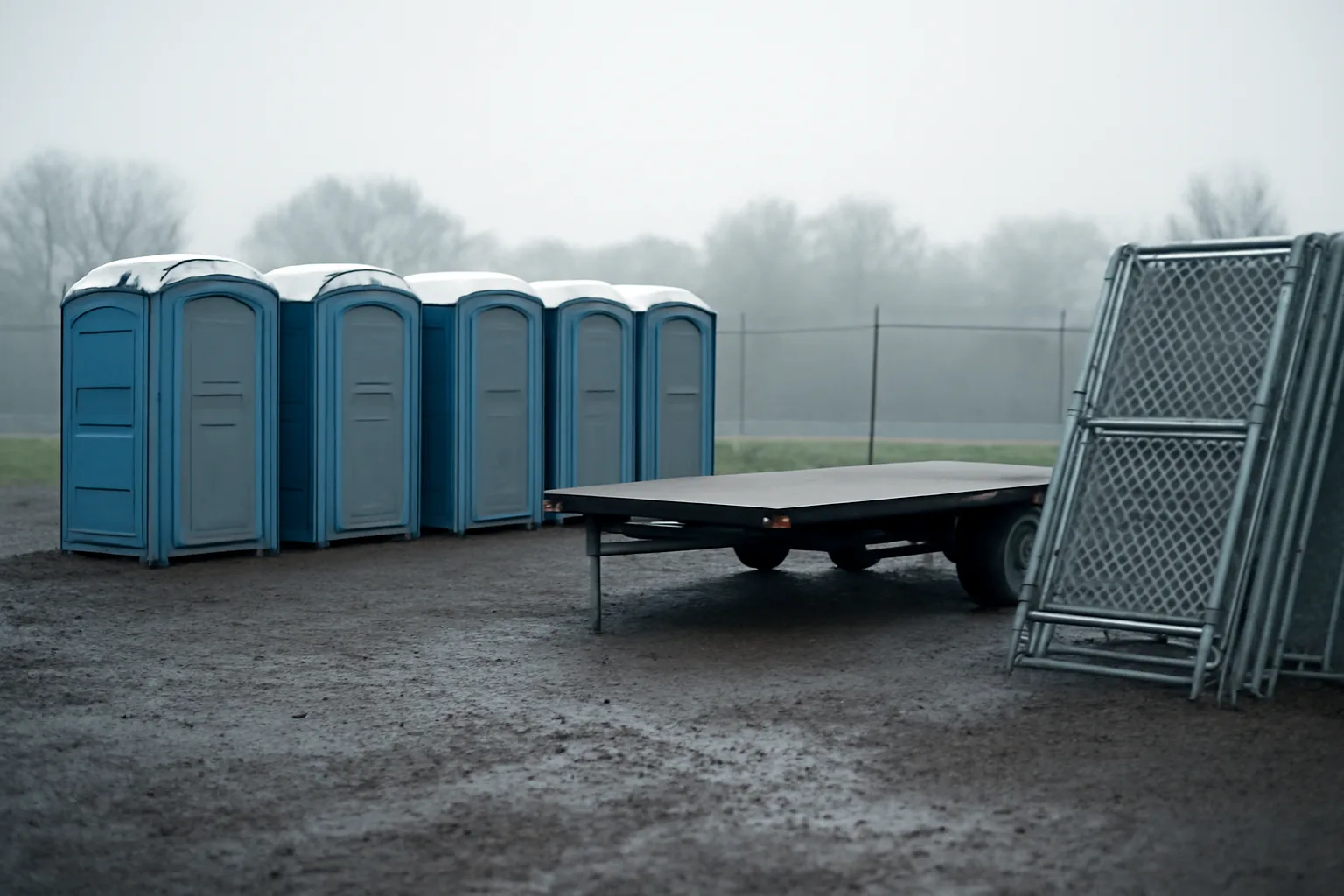
A site services yard is a legally occupied outdoor lot, plus a shop or office, used to store, wash, and dispatch portable toilets, roll-off dumpsters, temporary fence, storage containers, and the trucks that move them. It is a base of operations. It is not a federal license class.
People hear yard and picture a dump. Wrong picture. A landfill or transfer station takes waste for disposal under solid waste facility rules. Your yard is a staging lot. Clean units go out. Dirty units come back. If full boxes sit for weeks, a local inspector can decide you crossed into storage of solid waste. That is a different permit. I would not test that line.
The demand side is simple. Construction sanitation rules require toilets for employees on many jobs. OSHA 1926.51 says, "Toilets shall be provided for employees according to the following table," and then sets headcounts and facility counts. [1] That one sentence is why portable toilets keep showing up on pads with no sewer.
What you pump from those units is usually domestic septage. EPA's definition in 40 CFR 503.9 is blunt: "Domestic septage is either liquid or solid material removed from a septic tank, cesspool, portable toilet, Type III marine sanitation device, or similar treatment works that receives only domestic sewage." [2] If a unit sat on a site that put industrial waste in it, that definition can fail. Ask the plant that receives your load. Do not guess.
Dumpsters are not septage. They are solid waste collection. Fence panels and empty storage boxes sit closer to equipment rental. One lot can run all three. The yard does not merge the licenses. You still hold each stack.
The Census Bureau puts portable toilet rental and servicing in NAICS 562991, Septic Tank and Related Services. [14] Collection of containerized solid waste sits in 562111. Use the code that matches what you invoice. Banks and insurers read that code. So do some local tax clerks.
A working yard has a dirty row, a clean row, a wash pad with a drain that goes somewhere legal, truck parking that does not block a fire lane, a locked place for deodorizer and PPE, and a desk for tickets. Shared lots work. Fancy offices do not make units rent. Gravel is fine if the stormwater story is honest.
How do you start a site services yard?
You start a site services yard by picking the mix you will dispatch, forming an entity, proving the lot is zoned for that use, then stacking only the licenses that match the mix. Equipment comes last. Paper comes first.
I would not buy a wall of toilets on a credit app and hunt for land later. Land with the wrong zoning is a storage bill you cannot operate from. Write a one-page mix: toilets, dumpsters, fence, boxes, or a blend. Each line adds a board.
Form the entity. The SBA guide on business structure walks through sole proprietorship, partnership, LLC, and corporation in plain language. [12] An LLC is what most small operators pick, but that is a tax and liability choice, not a magic shield. Get an EIN if IRS rules say you need one. Corporations, partnerships, and employers generally do. The IRS issues EINs at no charge on its own site and warns that other sites charge for the same free filing. [8]
Next, zoning. Sit with planning staff or their published use table before you sign a lease. Outdoor storage, truck traffic, washing, and chemical storage are the triggers. Some lots need a conditional use permit. Some industrial parks ban tank washing. Confirm with that planning desk. Do not take a landlord's word.
Then state and city paper. For a first look at real stacks, read how to start a site services yard in Alabama and how to start a site services yard in California. Alabama and California do not share forms. Anyone who sells you a single national packet is selling a myth.
If you will run interstate in a commercial motor vehicle, get the USDOT number before you haul for pay. [4] New interstate motor carriers sit in the New Entrant Safety Assurance Program for 18 months. [5] Bind auto and general liability before the first invoice. Open a disposal account. Then buy used units in a count you can place fast, not a count that looks good in photos.
The SBA startup cost page tells you to split one-time costs from monthly costs. [11] Do that. A pretty average from a forum is not a plan.
What licenses does a site services yard need?
There is no federal site services yard license. You hold a stack of ordinary licenses that match what leaves the gate. Confirm names, fees, and forms with the state board and the city that will actually stamp the paper.
Portable toilets usually sit under a septage, pumper, or portable sanitation credential. You also need a legal place to dump. A handshake with a plant is not a record. Get the agreement in writing and keep load tickets.
Roll-off dumpsters usually need a local collection permit. Some cities run exclusive franchises. If the city already gave one hauler the territory, you cannot legally place boxes there. Call the solid waste department before you print door hangers.
The yard itself needs a business license in most cities, plus zoning clearance. Stormwater coverage can be a permit, not a suggestion. Trucks need registration, and interstate CMVs need USDOT credentials. [4] SBA is honest about the rest: licenses and permits depend on your business activity and location. [10] That is the whole national rule. Everything else is local.
| Work mix | Typical paper | Who confirms it |
|---|---|---|
| Portable toilets and pumping | State septage or pumper credential, disposal agreement, load tickets | State health or environmental board, receiving plant |
| Roll-off dumpsters | City or county hauler permit or franchise, landfill account | Municipal solid waste office |
| Temporary fence and empty boxes | City business license, contractor license if your state treats it as contracting | City clerk, state contractor board |
| The lot | Zoning or conditional use, stormwater authorization | Planning department, water board |
| Trucks and drivers | USDOT or state DOT, CDL, medical card when required | FMCSA or state DMV |
I would not pay anyone to package a national license. That product does not exist. Pay a local land-use person for one hour before you lease, and call the boards yourself. For form names, use a state license page such as site services yard license in Alabama or site services yard license in California.
Do you need special zoning for a site services yard?
Yes, in most cities you need a parcel whose zoning already allows outdoor storage and trucking, or a conditional use permit that adds those rights. A general commercial storefront usually fails. Confirm the use table with planning staff before you sign anything.
Clerks look at screening, stacking height, hours, idle trucks, wash water, and neighbor complaints. A lot that is legal for a plumber's van can still be illegal for rows of toilets and a vacuum truck. Industrial and heavy commercial districts are the usual fit. Rural land with no use table can be worse, because the first complaint becomes the rule.
Walk the parcel at dawn and at quitting time. Listen. If houses sit on the fence line, you will spend year one on odor calls. I would rather have a homely lot next to other trucks than a pretty lot next to kitchens.
Ask planning, in writing, about washing. A pad that drains to the street is how you meet a water inspector. Ask about storing full boxes overnight. Ask about fuel. Get the answer in an email you can find later. Landlords sell hope. Boards sell stamps.
What federal rules apply to a site services yard?
Federal rules attach to the waste, the oil, the stormwater, the trucks, and the workers. They do not hand you a yard license. They sit under the state and city paper.
Portable toilet contents that meet the domestic septage definition fall under 40 CFR Part 503 when you land-apply or otherwise dispose under that part. [2] Most small operators never land-apply. They deliver to a treatment plant. The plant's rules then control the load. Keep the tickets anyway. They are how you prove the waste left.
Oil is the quiet trap. 40 CFR 112 requires a Spill Prevention, Control, and Countermeasure plan once aggregate aboveground oil storage capacity exceeds 1,320 U.S. gallons, counting containers of 55 gallons and more. [3] A couple of diesel tanks and a waste-oil tote can put you over. Measure the tanks. Do not estimate from memory.
Industrial stormwater coverage under EPA's Multi-Sector General Permit, or a state NPDES twin, can apply if your lot matches a covered industrial sector or if a state water board says the activity needs a notice of intent. [13] Confirm with the water board that has the lot. EPA's 2021 MSGP page is the federal starting document, not a local approval.
OSHA still applies in the yard. Forklift operators need training and evaluation under 29 CFR 1910.178. [15] Hazard communication applies to deodorizers and cleaners. Construction sanitation rules sit on your customer's job, not on your lease, but they are why the customer calls you. [1]
Do site services yard trucks need a USDOT number or CDL?
Many do. If you use a vehicle on a highway in interstate commerce to haul property, and the GVWR, GCWR, GVW, or GCW is 10,001 pounds or more, FMCSA treats it as a commercial motor vehicle and you generally need a USDOT number. [4][6] Confirm the facts of your runs on FMCSA's USDOT page. Do not guess from a Facebook group.
49 CFR 390.5 states that a commercial motor vehicle includes a self-propelled or towed motor vehicle used on a highway in interstate commerce to transport property when the vehicle "Has a gross vehicle weight rating or gross combination weight rating, or gross vehicle weight or gross combination weight, of 4,536 kg (10,001 pounds) or more, whichever is greater." [6] A heavy pickup plus a loaded toilet trailer can meet that number. Weigh the combination.
Intrastate-only fleets often need a state DOT number instead. States copy federal weight language, then add their own twists. Confirm with your state DMV or state police commercial section. I will not invent your state's threshold.
A CDL is a driver credential, not a company number. FMCSA's CDL rules generally pull in single vehicles with a GVWR of 26,001 pounds or more, and combinations at that level when the towed unit is heavy enough. [7] Placarded hazmat and certain passenger counts also trigger a CDL. New interstate carriers also enter an 18 month New Entrant safety period. [5] If a driver is subject to hours of service, ask FMCSA whether an ELD is required for that operation.
What does first-year site services yard operations look like?
First year is route discipline, dirty versus clean rows, and tickets that match the plant. It is not a brand film. Most new yards lose money by owning more units than they can place, and by running trucks with no same-day wash plan.
Build a dirty row and a clean row on day one. Mix them and you will deliver a filthy unit to a GC who will not call again. Wash water has to go somewhere legal. A hose on gravel that sheets to the ditch is how you meet a water inspector.
Keep utilization in view. Empty toilets earning nothing still need pumping on a cycle, still take yard space, still get stolen. I would rather turn a smaller set every week than watch shiny inventory sit through winter. Fence panels and empty boxes have the same problem, just with less odor.
Disposal is operations, not admin. If the plant is closed on Sunday and you run weekend events, you need a tank plan. If a city franchise blocks your dumpsters, you need a written no from that city so sales stops promising boxes there.
Theft and damage are normal. Lock the lot. Photograph every unit on the way out and back. Drivers need a simple ticket: unit number, site, condition, pump-or-not, customer name. That ticket is also your paper trail when a board asks where the waste went.
Labor is the other first-year shock. One owner-operator can run a tiny toilet route. Dumpsters and long fence jobs need a second body fast. Hire after the route exists, not before. Train forklift work before anyone lifts a unit. [15]
What paper can a board actually confirm?
A board can confirm what it issued, plus the records its rule says you must keep. It cannot confirm a vibe. If you cannot hand over the form, the ticket, or the inspection log, you do not have it.
Keep the entity papers, the EIN letter, the city business license, the zoning or conditional use approval, and the lease. Keep the state septage or pumper credential and the written disposal agreement. Keep every load ticket. Those tickets are how you prove portable toilet waste went to a plant, not a ditch. [2]
For trucks, keep the USDOT registration if you have one, cab cards, inspection reports, and driver qualification files when FMCSA or your state says you are a carrier. [4] Keep medical examiner certificates when a CDL or DOT medical card applies. [7] Keep insurance certificates that name the actual entities on the lease and the titles.
If stormwater coverage applies, keep the notice of intent and the inspection logs your SWPPP requires. [13] If you store enough oil to trip 40 CFR 112, keep the SPCC plan and the inspections that plan requires. [3] Training records for forklifts belong in the same cabinet. [15]
I would run one binder per topic, not one junk drawer. When a clerk asks, you hand them a section. You do not scroll a phone in the lobby.
How much does it cost to open a site services yard?
Nobody publishes a clean national cost to open a site services yard. Land rent near a port and land rent in a rural industrial park are not the same market. Anyone giving you one number is inventing it.
The honest method is the SBA startup cost worksheet: list one-time costs in one column and monthly costs in the other, then add a cushion. [11] One-time usually means deposits, grading, used fence or used toilets, a used truck, a wash pad, tanks, racks, an initial insurance down payment, and whatever application fees the boards actually charge. Monthly means rent, fuel, disposal, labor, insurance, phones, and loan payments.
I will not invent a toilet price, a truck payment, or a board fee here. Those change by region and by month. Confirm every fee with the board that collects it. Confirm truck and unit prices with sellers you can walk up to, not with a national average.
The EIN itself costs nothing if you file on the IRS site. [8] That is one of the few fixed facts. Zoning applications, franchise applications, and dump fees are local. Used equipment beats new equipment in year one. A new vacuum truck is how people run out of cash before the route exists.
Build the sheet with conservative placement rates. If you cannot name who will rent the first twenty units, do not buy forty.
What insurance does a site services yard need?
You need commercial auto, general liability, and, once you have employees, workers compensation. Most yards also need inland marine for units sitting on customer sites, and a pollution or contractors environmental policy if you pump septage or haul waste. Confirm coverages with a licensed agent who has written hauling accounts. I will not invent a premium.
Commercial auto is the policy that sinks people. A personal pickup policy will not like a trailer of toilets or a dumpster delivery. If staff run errands in their own trucks, ask about hired and non-owned auto. Name every entity that is on a title or a lease.
Pollution coverage is easy to skip and painful after a spill on a city street. General liability does not always pick that up. Read the exclusion. Inland marine (the floater for gear off your lot) is what pays when a box disappears from a job.
Do not start routes on a binder you have not read. Have the agent match the operations you described, including washing and overnight storage of full boxes if you do that.
Should you buy land or share a site services yard?
In year one I would lease or share, not buy. Acreage eats cash you need for trucks, units, and a slow winter. A shared lot with a written yard agreement is ugly and useful. Buying land is how a new operator becomes a landlord with no customers.
Sharing has real costs. You will fight over the wash pad. You will argue about whose customer stole a panel. You need written rules on hours, insurance, indemnities, and who talks to the landlord. If you cannot get that on paper, do not share.
If you want a one-time worksheet for shared-lot math, SiteServicesPath sells a $249 Shared-Yard Economics Kit. You can still do the same work in a spreadsheet. The kit is optional. The lease review is not.
Buy land later, after the route exists and you know the radius you actually serve. A pretty parcel twenty miles past your customers is a waste. So is a cheap parcel you cannot wash on.
How do site services yard rules change by state?
They change in the name of the credential, the agency that issues it, the city franchise custom, and whether the state runs its own stormwater permit. The federal truck and septage definitions stay in the background. The clerk in front of you does not.
California cities often run exclusive solid waste franchises, so dumpsters are a local fight even when toilets are a state health paper. Other states lean on county pumper licenses and leave boxes to the city. Colorado splits pieces across more than one desk, which is why a board page helps. Start with how to start a site services yard in Colorado, then site services yard license in Colorado and site services yard board in Colorado. Arizona is a different stack again. Use how to start a site services yard in Arizona rather than copying a coastal checklist.
Confirm every fee, quota, and processing time with the board that collects the money. No article should guarantee an approval date. SiteServicesPath is an independent publisher, not a law firm and not a service company. If you want the optional kit after you have the board list, use /start. The reference above still works if you never do.
Frequently asked questions
What is a site services yard?
A site services yard is the outdoor lot and shop you use to store, wash, and dispatch portable toilets, dumpsters, temporary fence, storage containers, and trucks. It is a staging base, not a landfill and not a federal license name. NAICS 562991 covers portable toilet rental and servicing. Confirm local zoning before you treat any lot as a yard.
How do you start a site services yard?
Pick the mix you will haul, form an entity, get an EIN if IRS rules require one, then confirm zoning. Add the state septage or city hauler papers that match that mix, plus USDOT or state DOT credentials if your trucks meet the weight rules. Bind insurance and a disposal account. Buy used units last. Confirm every form with the issuing board.
Can I run a site services yard from my house?
Usually no, not if you store rows of units, wash tanks, or park commercial trucks. Home occupations rarely allow outdoor storage or septage handling. A first neighbor complaint can end it. Ask planning staff about the actual parcel, not about home offices in general. A small rented industrial lot beats a residential code case.
Is a site services yard a landfill?
No. A landfill or transfer station is a disposal facility with solid waste facility permits. A site services yard is meant to stage clean and dirty units and move waste to a legal plant or landfill the same day or on a short cycle. Let full boxes sit and a local inspector can treat you like a storage facility. Do not blur that line.
Do I need a contractor license to rent fence and toilets?
It depends on the state and on whether you install, haul only, or bid as a contractor. Toilet rental and pumping often sit under a health or environmental credential instead. Fence installation sometimes trips a contractor board. Confirm with the state contractor board and the health board. Do not assume a city business license covers both.
How many acres does a site services yard need?
There is no federal acreage rule. A tiny toilet-only route can live on a fraction of an acre if turning radius, wash space, and fire access work. Dumpsters and long fence inventory need more stacking room. I would size the lot to trucks first, inventory second. Confirm setbacks and screening with planning staff. Unused acres are just rent.
Where does portable toilet waste go?
To a treatment plant, septage receiving station, or other outlet that is allowed to take domestic septage. EPA 40 CFR 503.9 treats material removed from a portable toilet as domestic septage when it is only domestic sewage. Keep the plant agreement and every load ticket. Do not land-apply unless you actually hold that authorization.
Do I need a USDOT number if I never leave my state?
Interstate commerce is what triggers the federal USDOT number, including some loads that cross a state line in the supply chain. Purely intrastate fleets often need a state DOT number instead. Confirm with FMCSA for interstate facts and with your state DMV or state police for in-state trucks. Weight still matters. A 10,001 pound threshold is the usual federal CMV line.
Can I store full dumpsters on the yard overnight?
Sometimes, if zoning and solid waste rules treat it as incidental staging. Leave them long enough and the lot starts to look like a transfer site. That can demand a different permit. Ask the solid waste office and planning staff in writing. I would empty or deliver to the landfill on a short cycle and not build a business on stored trash.
Is a concrete wash pad required?
No single federal rule says every site services yard must pour concrete. Water boards and cities do care where wash water goes. A pad that drains to a legal tank or sanitary connection is the usual safe design. Washing onto gravel that sheets to a ditch is how inspections go badly. Confirm with the local water board before you build.
What NAICS code should I use?
Use NAICS 562991 if portable toilet rental and servicing is the main work. Use 562111 if containerized solid waste collection is the main work. Fence and empty box rental may sit in equipment rental codes instead. Pick the code that matches revenue, not the one that sounds cleaner on a loan form. The Census NAICS definition pages are the source.
Can I start with only temporary fence?
Yes. A fence-only yard skips septage credentials and most dumpster franchises, which is a simpler first year. You still need zoning for outdoor storage, a business license, truck credentials if weights trigger them, and insurance. Some states still treat installation as contracting. Confirm that with the contractor board before you bid install work.
Sources
- OSHA 29 CFR 1926.51 Sanitation: OSHA requires toilets for construction employees and sets counts in a table under 1926.51(c).
- eCFR 40 CFR 503.9 Definitions: Domestic septage includes liquid or solid material removed from a portable toilet that receives only domestic sewage.
- eCFR 40 CFR 112.1 SPCC applicability: SPCC requirements apply when aggregate aboveground oil storage capacity exceeds 1,320 U.S. gallons (containers 55 gallons and larger count).
- FMCSA Do I Need a USDOT Number: A USDOT number is required for many interstate commercial vehicles at 10,001 pounds GVWR/GCWR or more.
- FMCSA New Entrant Safety Assurance Program: New interstate motor carriers are subject to an 18-month new entrant safety monitoring period.
- eCFR 49 CFR 390.5 Definitions: A CMV includes interstate property-hauling vehicles with GVWR, GCWR, GVW, or GCW of 10,001 pounds or more.
- FMCSA Commercial Driver's License: CDL classes are tied to vehicle weight thresholds, generally 26,001 pounds and specified combination rules.
- IRS Apply for an Employer Identification Number (EIN) Online: The IRS issues EINs at no cost through its own online application.
- SBA Apply for licenses and permits: Business licenses and permits depend on the activity and the location.
- SBA Calculate your startup costs: Startup planning should separate one-time costs from monthly costs.
- SBA Choose a business structure: SBA outlines sole proprietorship, partnership, LLC, and corporation as common formation choices.
- EPA 2021 Multi-Sector General Permit (MSGP): EPA's 2021 MSGP is the federal industrial stormwater general permit that covered sectors use when EPA is the permitting authority.
- U.S. Census Bureau NAICS 562991 (2022): NAICS 562991 includes establishments engaged in renting and/or servicing portable toilets.
- OSHA 29 CFR 1910.178 Powered industrial trucks: Forklift operators must be trained and evaluated under OSHA 1910.178.