Last updated 2026-08-21
TL;DR
A site services yard is the fenced lot where you stage dumpsters, fence panels, toilets, trench plates, and the trucks that move them. No national yard license exists. You start by locking land that zoning allows for outdoor storage, forming an entity, getting a free EIN, then stacking only the state and city paper that matches what you actually haul and store. Confirm every fee and form with the board that issues it.
What is a site services yard?
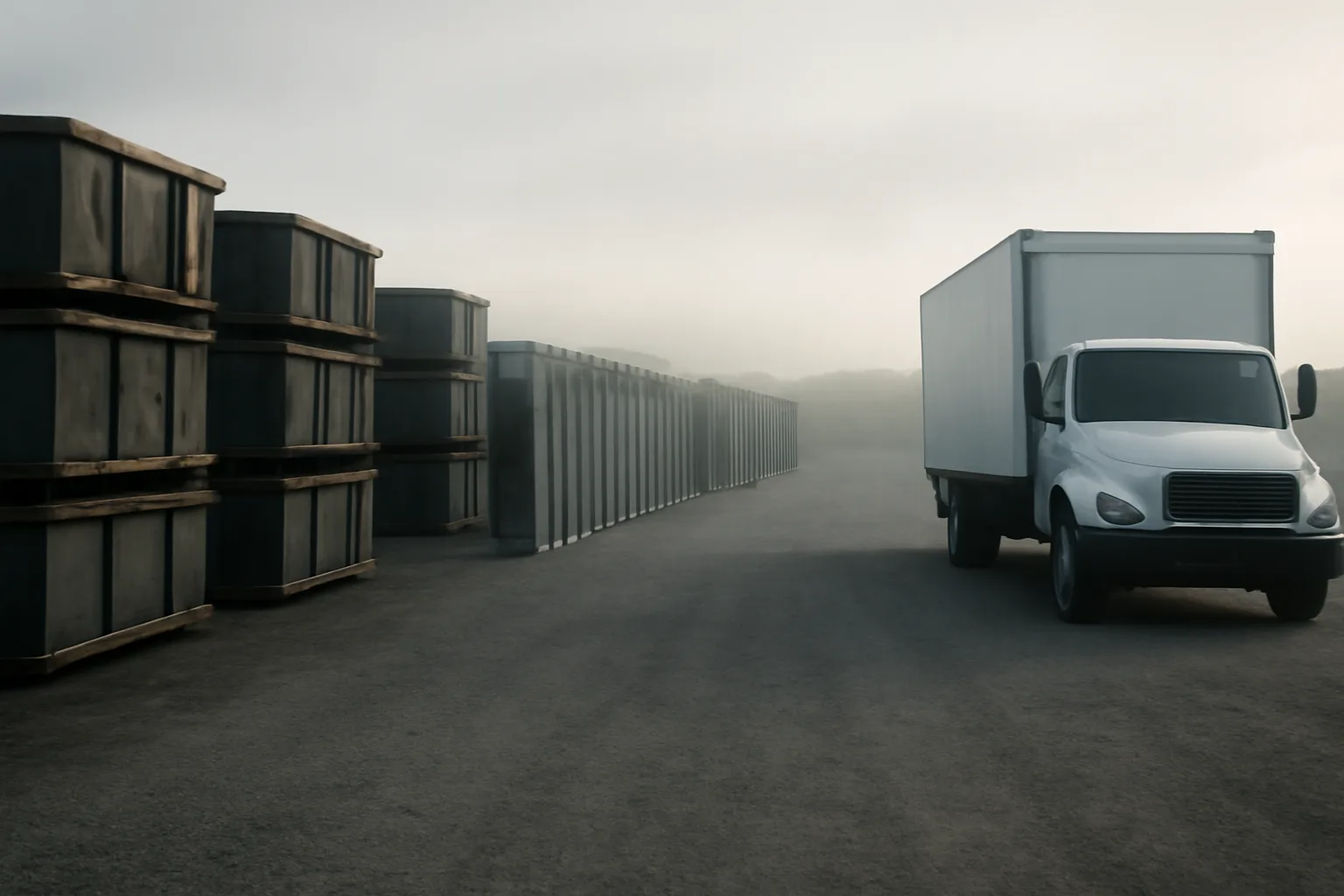
A site services yard is a fenced outdoor lot that stages the gear construction sites burn through. Roll-off boxes. Temporary fence. Portable toilets. Trench plates. Job boxes. The trucks that deliver them. It is a logistics base, not a showroom and not a landfill.
People mash this together with a general contractor shop or a transfer station. Different animal. You store and dispatch site support equipment, and you might do light grade work or final cleanup on the side. The Census Bureau parks a lot of that adjacent work in NAICS 238910, Site Preparation Contractors, which includes excavation, grading, and site cleanup. [10] Dumpster-heavy shops sometimes sit closer to solid waste collection. Equipment rental shops sit in a third bucket. Official codes were not written for your ads, so pick the code that matches most of your revenue and stay consistent on tax and permit forms.
The yard is land plus inventory plus dispatch. Paper follows those three pieces. Land brings zoning and stormwater. Inventory can bring waste-hauler or sanitation rules if you touch dumpsters or toilets. Trucks bring USDOT numbers once you cross the federal commercial motor vehicle line of 10,001 pounds GVWR. [5]
I would not call a driveway with two toilets a yard. A real yard has a gate, a surface that can take truck traffic, a place to park dirty boxes, and an address the city will accept on a business license. If you cannot point to those, you have a side hustle.
Nobody publishes a clean national headcount of these yards. The closest official buckets overlap. Treat any flashy industry-size figure as noise unless it cites Economic Census or QCEW tables you can open yourself.
How do you start a site services yard?
You start by locking legally zoned land, forming an entity, getting a free EIN from the IRS, then adding only the licenses that match your actual work. [1] Skip the national checklist videos. They flatten fifty board systems into one myth.
Here is the order I would actually use.
First, the lot. Call planning and ask if outdoor storage, truck parking, and equipment staging are allowed by right, by conditional use, or not at all. Get it in writing. A cheap industrial lease on land that forbids outdoor storage is a write-off.
Second, the entity. An LLC is what most small operators pick because it is simple and it keeps the lot off your house. The SBA walks through sole proprietorship, partnership, LLC, and corporation choices if you want the official comparison. [7] Confirm formation fees with your secretary of state. I will not quote a number. States change them.
Third, the EIN. The IRS lets you apply online at no cost. [1] An IRS EIN application filed online costs $0. Do this before you open a bank account or run payroll.
Fourth, match work to paper. Hauling roll-offs is often a local waste franchise or a state hauler registration. Portable toilets sit with the health department in a lot of counties. Building temporary fence or cutting grade can trip a contractor license. California Business and Professions Code section 7026 is why site work there is not a handshake trade. [12] Florida puts contractor definitions in section 489.105. [13] Read the board page for the state you will operate in. The California board path and the Florida board path are the right next clicks if those are your states.
Fifth, insurance and a bank account before the first dispatch. A certificate of insurance is how general contractors let you on site. No COI, no gate.
Do not buy a software stack in month one. A shared spreadsheet and a phone will run ten boxes. Software is how people hide from selling.
Do you need a license to run a site services yard?
You need whatever licenses match the work and the land, not a mythical national yard license. Some states license contractors. Some cities franchise waste haulers. Some counties permit sanitation lots. A few states barely touch you at the state level.
If you only store your own equipment and you never construct anything for a customer, you may only need a local business license plus zoning approval. The minute you deliver, install, or haul for a fee, boards start to care.
California is the hard example. CSLB treats a wide band of construction and related improvements as licensed work under BPC 7026. [12] Confirm classification and current fees on the board site. Do not trust a blog fee table. Florida chapter 489 is the other well known contractor statute. [13] The Alabama board note is a different stack, which is why copying a California binder into Birmingham wastes months.
I would pull the statute, then call the board with one sentence. We stage and deliver temporary site equipment from a yard at this address. What license, if any, do you issue for that? Record the name of the person and the date. That note has saved more operators than any checklist.
If two agencies both claim you, get both answers in writing. Do not pick the cheaper one and hope.
| Pattern you are in | What you actually do |
|---|---|
| Contractor-board state | Read the statute, then call the class desk |
| Local-license state | City business tax plus zoning, then stop |
| Exclusive-hauler city | Do not roll a box until the franchise desk says yes |
| Sanitation lot | County health permit before the first toilet lands |
What zoning and land-use paper does a yard need?
A site services yard needs land zoned for outdoor storage, commercial vehicle parking, and often light industrial use. If the zoning map says retail or residential, walk.
Conditional use permits are common. They can add hours limits, screening, noise rules, and a public hearing. Budget time for that hearing. Operators sign a lease, pour gravel, then lose the hearing. That is a bad month.
Ask planning these questions and get the answers emailed. Is outdoor storage allowed. What truck trips per day will they tolerate. What are idling and hours rules. How do they treat stormwater and wash water. Do roll-off boxes count as solid waste handling on this parcel.
Home-based is a fantasy for this trade. A 30-yard box on a cul-de-sac is a code case. Neighbors will call. You will lose.
Surface matters. Bare dirt turns into a mud claim and a stormwater problem. Gravel or recycled concrete is what most small yards use. Paved is nicer and costs more. I would gravel first and pave the gate throat later, after you know the truck path.
A mailing address on a virtual office will not save you if inspectors cannot find the equipment. The lot in the photos should be the lot on the license.
Which environmental permits actually apply to a yard?
Stormwater is the permit new yards miss. If your industrial activity matches a listed category, or if you disturb one acre or more, federal NPDES stormwater rules apply through EPA or your authorized state. [3] [4] [11]
40 CFR 122.26 is the regulation. It pulls in industrial facilities in named categories and construction activity that disturbs one acre or more, including smaller sites that are part of a larger common plan of development. [3] The rule defines small construction activity as "Construction activities including clearing, grading, and excavating that result in land disturbance of equal to or greater than one acre and less than five acres." [3]
EPA's 2022 Construction General Permit is the federal CGP many states still mirror for land-disturbing work. [4] An already-built yard more often sits under a Multi-Sector General Permit or a state industrial stormwater general permit, not the CGP. [11] If you only park trucks on already paved industrial land, you may still need industrial coverage depending on your sector and whether materials sit in the rain. Metal scrap, fuel, and dirty boxes are why inspectors care.
Wash water from toilets or dumpsters is not stormwater. Do not let it hit the drain. That is a different violation.
I would budget a stormwater pollution prevention plan as a real year-one document, not a binder you print and forget. Oil storage can trip separate spill rules. I am not going to pretend every small diesel cube needs the same plan. Ask the state water desk if you store fuel in volume, and confirm rather than guess.
When do trucks force USDOT and CDL paper?
A truck becomes federal paper when it is a commercial motor vehicle in interstate commerce. Under 49 CFR 390.5, that includes a vehicle with a GVWR or actual gross weight of 10,001 pounds or more. [5] Most roll-off trucks and many stake beds clear that line before you leave the lot.
The regulation's own words include a vehicle that "Has a gross vehicle weight rating or gross combination weight rating, or gross vehicle weight or gross combination weight, of 4,536 kg (10,001 pounds) or more, whichever is greater." [5] FMCSA says you need a USDOT number if you operate CMVs in interstate commerce. [6] Intrastate-only operators often still need a state USDOT or equivalent. Confirm with your state DMV or state patrol motor carrier desk.
CDL is separate. Class B is the usual ticket for a straight roll-off. Class A if you pull a trailer combo over the combination weight line. I would hire one CDL driver before I buy the second truck. Owner-operators who drive tired write expensive stories.
If you never leave the state and your trucks stay under 10,001 pounds, you may dodge FMCSA. A loaded dump trailer almost never stays under that. Plan for the number.
Hazmat placards are another fork. Full portable-toilet trucks are usually not hazmat. Fuel trucks are. Do not guess. Read the placard table or ask a compliance shop that already writes motor carrier files.
What insurance should a new site services yard buy?
Buy general liability and commercial auto first. Add inland marine (an equipment floater) for boxes, fence, and plates that leave your lot. Add workers' compensation the day you have an employee, unless you are in a state that lets private employers opt out, and even then general contractors will still demand a certificate.
I will not invent premiums. They swing with claims, garage location, and radius. A broker who already writes roll-off or equipment rental accounts will beat a personal-lines cousin.
Umbrella coverage is what contractors on larger commercial jobs will ask for. If your customers are residential cleanouts, you can wait. If you want commercial sites, price the umbrella early so the bid is not a surprise.
Pollution liability is the policy people skip until a leak. If you wash boxes or store fuel, ask for a quote. It may be a waste of money in year one if you have no tanks and you subcontract dumps. It is not a waste if you handle waste yourself.
Certificates, additional insured endorsements, and waiver of subrogation language are the actual product general contractors want. The policy is just the back end. Get a sample cert in your inbox before you promise a start date.
How do you hire the first crew without making a mess?
Every employee needs a completed Form I-9. USCIS is blunt about that. [8] Nonexempt hourly people get overtime after 40 hours in a workweek under the federal FLSA rule. [9] Your state may be stricter. Follow the stricter one.
I would start with one CDL driver and one yard person, both W-2. 1099 drivers look cheap until a wage claim or an accident. If you do not control their routes and hours, maybe they are contractors. If you do, they are employees. Do not play that game.
Simple written rules beat a fat binder. Gate locked. PPE on the lot. No climbing boxes. Pre-trip the truck. OSHA's construction rules in 29 CFR 1926.20 say, "It shall be the responsibility of the employer to initiate and maintain such programs as may be necessary to comply with this part." [2] A two-page yard sheet that people actually read is the program.
Pay is local. I will not paste a fake national wage. Look at what roll-off outfits in your county actually pay, then add enough to keep people. Cheap labor on a loaded truck is how gates get hit.
Keep I-9s, CDLs, medical cards, and a simple injury log in one folder. If an inspector asks and you rummage through texts, you already lost the room.
What does first-year operations actually look like?
Year one is dispatch, deposits, and damage. It is not a brand story.
You will spend mornings on deliveries and afternoons on pickups that did not happen. Customers will bury boxes. They will lose fence panels. Your contract needs a damage schedule and a photo standard. No photo, no collection.
Cash cycle is ugly. You buy or finance boxes, you deliver, you invoice net 30, you pay the landfill on the spot. That gap is why people blow up. I would rather own twenty boxes free and clear than sixty on a note.
Shared-yard math is real if land is expensive. Some operators split a lot and a gate. If you want a worksheet for that split, SiteServicesPath sells a $249 one-time Shared-Yard Economics Kit. You do not need it to open. A lease, a sketch of stall counts, and honest truck-trip math will do.
Maintenance is a line item, not a surprise. Welds crack. Tires go. Toilets get destroyed. Budget ugly.
I would refuse customers who want you to just leave it with no placement photo and no access plan. That job is how you meet a tow truck.
How much does it cost to open a site services yard?
Nobody has an honest national startup number that survives contact with land prices. A rural gravel lot with ten used boxes is a different species from a fenced acre on the edge of a coastal city.
The only federal number I will put on cost is this. An IRS EIN application filed online costs $0. [1] Everything else is local.
Land is the real check. Confirm rent with landlords who already host outdoor storage. Confirm license and application fees with the board. Confirm dump rates with the landfill. Confirm insurance with a broker who will put a number on paper.
I would not finance the land and the fleet in the same month. Own the relationship with the lot first. Rent boxes if you must. Used steel boxes beat new ones until you know your damage rate.
Beware turnkey yard listings. You are often buying tired boxes and a lease the city already hates.
| Cost block | What is real | What to confirm |
|---|---|---|
| Land and lease | Dominant check you write | Landlord plus planning |
| Entity and EIN | EIN is free from the IRS [1] | State formation fee |
| Board licenses | Varies by state and city | The issuing board |
| Trucks | CMV rules start at 10,001 lb [5] | Dealer plus FMCSA or state desk |
| Inventory | Used versus new steel | Condition and titles |
| Insurance | GL, auto, floater, then workers' comp | Broker quote |
| Stormwater | May need a SWPPP [3] | State water board |
What should you confirm with the state board before you spend money?
Confirm the license class, the application form, the current fee, the exam if any, the experience affidavit, the bond or insurance minimum, and whether a yard address is required. Confirm processing only as a range the board publishes. No one can honestly guarantee a date.
If your state has no contractor board for this work, confirm that in writing too. Alaska's board path and Arizona's are not the same conversation as California. Georgia and Colorado differ again. Bring the statute printout to the call so you are arguing from their words, not a forum post.
Bring a one-page description of services. We store, deliver, and pick up temporary fence and roll-off containers. We do not pour concrete. We do not haul municipal residential routes. Vague pitches get over-licensed.
SiteServicesPath is an independent publisher, not a law firm and not a service company. Use /start if you want the kit. The statutes and the board still win.
What mistakes burn new site services yard operators?
Signing a lease before zoning is confirmed. Buying new boxes before you have recurring routes. Treating 1099 as a personality type. Skipping stormwater because it is just a lot. Letting a customer store their own junk on your yard. That last one turns you into a dump.
Copying another state's license packet. Following a video that got licensed in some unnamed office without naming the board. Paying a consultant who will not show you the statute.
I would rather open narrow, fence and plates only or boxes only, and add a line of business after the first winter. Two half-ready services make one messy yard.
Keep paper in a folder you can email in five minutes. Entity docs. EIN letter. Lease. Zoning email. Insurance cert. Board license or a written no-license-required note. SWPPP if you have one. I-9s. Truck regs. If you cannot find it, you do not have it.
The operators who last are boring on paper and picky about photos. That is the whole job once the gate exists.
Frequently asked questions
What is site services yard?
A site services yard is a fenced lot that stages jobsite support gear such as roll-off boxes, temporary fence, portable toilets, and plates, plus the trucks that move them. It is a logistics base. It is not a landfill and not a general contractor shop. Paper follows the land, the inventory, and the trucks, not a single national yard title.
How do you start site services yard?
Lock land that zoning allows for outdoor storage and truck parking, form an entity, get a free IRS EIN, then add only the city and state licenses that match what you haul or install. Buy general liability and commercial auto before the first dispatch. Confirm every fee with the issuing board. Do not copy another state's packet.
Is a site services yard the same as a contractor yard?
Not always. A contractor yard often supports a licensed builder's own jobs. A site services yard stages rented or dispatched support gear for many jobs. If you construct, alter, or improve property for a fee, a contractor statute such as California BPC 7026 or Florida 489.105 can still apply. Confirm the class with your board.
Do I need an EIN to open a yard?
If you hire anyone, open a business bank account, or form an entity, get an EIN. The IRS issues EINs online at no cost. A sole proprietor with no employees can sometimes use a Social Security number, but most yards outgrow that in a hurry. Apply before payroll, not after the first paycheck bounces.
Does a storage yard need a stormwater permit?
It can. 40 CFR 122.26 pulls in listed industrial categories and construction disturbance of one acre or more (or a smaller piece of a larger common plan). An already-built equipment lot may need industrial stormwater coverage if materials are exposed to rain. Confirm with your state water board, not a forum.
Can I run a site services yard from my house?
Not a real one. Outdoor storage of boxes, toilets, and commercial trucks on a residential lot is a zoning fight you will lose. Neighbors call. Code officers photograph. Use industrially zoned land with a gate and a surface that can take truck traffic. A virtual mailbox does not replace a legal lot.
What NAICS code do site services yards use?
There is no perfect code. Site preparation and grading work often fits NAICS 238910. Heavy dumpster routing can sit nearer solid waste collection. Pure equipment rental sits in rental codes. Pick the code that matches most of your revenue and use it consistently on tax and permit forms. Do not swap codes to dodge a permit.
Do I need a contractor license to rent dumpsters and fence?
Maybe. Pure rental and delivery is local business-license and franchise territory in many cities. Installation, site work, or improvement for a fee can trip a contractor board, especially in states with broad statutes. Call the board with a one-line description of the work. Get the answer in writing before you print invoices.
How long does licensing take?
There is no honest national timeline. Boards publish their own ranges and they change. Anyone promising a fixed number of days without naming the board is selling a story. Ask the issuing office for the current published range, then build your lease start date with slack. No approval date is guaranteed.
What if my state has no yard license?
Then your paper is local: zoning, business tax, possible waste franchise, possible sanitation permit, plus federal items such as EIN, I-9s, and USDOT if your trucks qualify. Get the "no state license" answer in writing. You still need the lot to be legal. Absence of a board is not absence of rules.
Are portable toilets regulated separately from dumpsters?
Often yes. Many counties treat sanitation lots and toilet service as a health-department item, while roll-offs sit with solid waste or a city franchise. Do not assume one city business license covers both. Ask health and public works as two calls. Split answers are normal. Write both down.
Do I need workers' compensation with one employee?
In most states, yes once you have an employee. A few states let private employers opt out, and general contractors will still demand a certificate anyway. Confirm the headcount trigger with your state workers' comp agency. Do not wait for an injury to learn you were supposed to carry it.
Can I start as a sole proprietor?
Yes. The SBA lists sole proprietorship as a real structure. It is simple and it puts the yard's problems on you personally. Most operators move to an LLC once trucks and employees show up. Confirm formation steps and current fees with your secretary of state. Get the EIN either way if you will hire.
What records does OSHA expect on a yard?
If your people do construction-related work, 29 CFR 1926.20 puts the duty on the employer to keep programs that meet that part. In practice that means PPE rules, a simple safety program, and injury records once you are large enough for Part 1904. A two-page yard rule that people follow beats an unread binder.
Sources
- IRS, Apply for an Employer Identification Number (EIN) Online: Businesses can apply online for an EIN at no cost from the IRS.
- OSHA, 29 CFR 1926.20 General safety and health provisions: Employers must initiate and maintain programs necessary to comply with OSHA construction Part 1926.
- eCFR, 40 CFR 122.26 Storm water discharges: NPDES stormwater rules cover listed industrial activity and construction land disturbance of one acre or more (small construction is one to five acres).
- U.S. EPA, 2022 Construction General Permit (CGP): EPA's 2022 CGP is the federal general permit for construction stormwater on qualifying sites.
- eCFR, 49 CFR 390.5 Definitions: A commercial motor vehicle includes a vehicle with GVWR or gross weight of 10,001 pounds or more, and set passenger thresholds.
- FMCSA, Do I need a USDOT number: Operators of commercial motor vehicles in interstate commerce need a USDOT number.
- U.S. Small Business Administration, Choose a business structure: SBA outlines sole proprietorship, partnership, LLC, and corporation options for new firms.
- U.S. Citizenship and Immigration Services, Form I-9: Employers must complete Form I-9 to verify identity and employment authorization for each employee.
- U.S. Department of Labor Wage and Hour Division, Overtime pay: Federal overtime pay is due to nonexempt employees after 40 hours in a workweek.
- U.S. Census Bureau, NAICS 238910 Site Preparation Contractors (2022): NAICS 238910 covers site preparation contractors including excavation, grading, and related site work.
- U.S. EPA, EPA's 2021 Multi-Sector General Permit (MSGP): EPA's MSGP is the federal industrial stormwater general permit for listed industrial sectors.
- California Legislative Information, Business and Professions Code section 7026: California defines contractor to include persons who construct, alter, repair, or improve structures or other improvements for compensation.
- Florida Senate, Statute 489.105 (2023) contractor definitions: Florida statute 489.105 defines contractor classifications used in state construction licensing.