Last updated 2026-08-21
TL;DR
A site services yard is the depot where you stage dumpsters, portable toilets, fence, and the trucks that serve jobsites. You start by forming an entity, getting a free EIN, proving industrial zoning, then adding the hauling and waste permits your state requires. Interstate trucks at 10,001 pounds need a USDOT number. Confirm every fee with the issuing board. No one can promise approval time.
What is a site services yard?
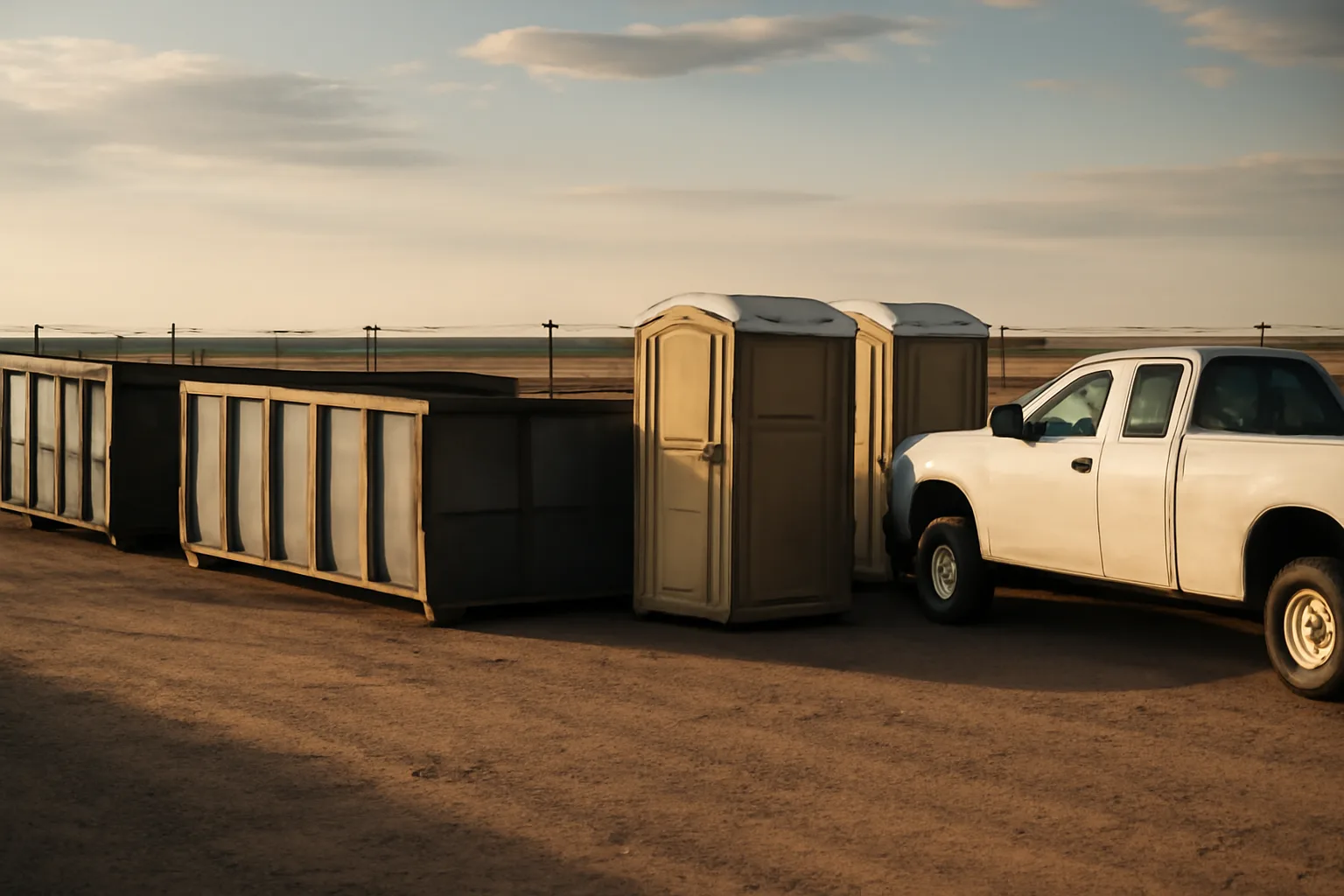
A site services yard is a fenced industrial depot that stores and dispatches temporary jobsite equipment. The usual mix is roll-off dumpsters, portable toilets, temporary fence, storage containers, and the trucks that move them. It is a logistics lot, not a landfill and not a general contractor office.
Most people picture a dumpster company. That is one slice. A working yard also stages restrooms, fence panels, maybe water tanks or light towers. The common thread is short-term rental to builders, plus a place to park dirty boxes between jobs.
Census NAICS 562111 is solid waste collection. A lot of dumpster shops file there. Equipment-heavy shops sometimes sit under commercial machinery rental instead. Pick the code that matches what you actually invoice. The code does not grant a license.[12]
There is no federal license with the name site services yard. The phrase is trade slang. Regulators see a waste transporter, a septage hauler, a motor carrier, or a materials yard. Your paper follows those boxes, not the marketing name.
I would not open a full-mix yard on day one. Pick one revenue line you can permit. Dumpsters only, or toilets only. Mixing waste streams and septage in month one is how people buy the wrong land.
"EPA estimates that 600 million tons of C&D debris were generated in the United States in 2018."[1] That volume is why cities care where your dirty boxes sit. Neighbors smell it. Stormwater off a gravel lot with leaky containers is a real permit trigger.
A yard that only stores empty, rinsed containers is a simpler animal than a yard that accepts construction debris. Taking waste onto your lot can flip you into transfer-station or recycling-facility rules. Confirm that line with the state solid waste program before you advertise that you take C&D.
How do you start a site services yard?
You start a site services yard by forming a legal entity, getting a free EIN, securing industrially zoned land, then adding the vehicle and waste permits your state actually issues. Do the entity and land first. Trucks without a legal lot leave you with nowhere to park dirty boxes.
SBA still frames the opening sequence as a short list: structure, taxes, licenses, then finance.[5] Use that order. Skipping zoning so you can get a truck running is a classic first-year wreck.
Form an LLC or corporation with your secretary of state. IRS explains the tax differences between sole proprietors, partnerships, corporations, and LLCs.[9] I lean LLC for a first yard unless you already have a tax person running S corps. Confirm the filing fee with the state corporations division. I will not quote a number here because those fees move.
Get the EIN yourself on IRS.gov. "Applying for an EIN is a free service offered by the Internal Revenue Service."[3] Anyone selling you an EIN is selling a form you can file in one sitting.
Then lock the lot. You need a use the zoning map already allows, or a conditional use you can actually win. Home driveways fail the moment a roll-off leaks paint onto a residential street. SBA's license guide is clear that most small firms need a stack of local approvals, not one national card.[6]
After land, register the motor carrier side if your trucks hit the federal weight trigger. Then ask the state environmental agency whether dumpsters, septage, or both need a transporter permit. Last, buy insurance your landlord and GC clients will accept. That sequence is boring. It works.
If you want a state-level cost walk-through, start with site services yard cost in California or site services yard cost in Florida and treat every dollar as something to reconfirm.
What licenses and permits does a site services yard actually need?
A site services yard needs a state entity filing, a local business tax or occupancy certificate, zoning approval, and then activity permits for hauling, waste, or septage. There is no single national site services card. The stack is local plus state, with a federal USDOT number if your trucks qualify.
Here is the stack I would map on a whiteboard:
- Articles of organization and a state tax account
- Local business license and certificate of occupancy
- Zoning or conditional use for outdoor storage of containers
- USDOT number and, if needed, state IRP or IFTA plates for interstate work
- State solid waste transporter or roll-off permit
- Septage or portable-toilet waste hauler permit if you pump toilets
- Stormwater coverage if the lot is an industrial discharger
- Driver CDLs if the trucks require them
None of those have a universal price I can honestly print. Processing times are worse. Boards change both. Confirm with the issuing office.
If your state runs a contractor board exam for certain construction trades, ask in writing whether container rental is even in scope. Often it is not. Paying for a contractor license you do not need is a waste of money. If an exam is required where you are, read what the site services yard exam actually requires and then call the board anyway.
Do you need a USDOT number to run site services trucks?
You need a USDOT number when you operate a qualifying commercial vehicle in interstate commerce, including many roll-off trucks over 10,001 pounds. FMCSA sets the weight trigger at 4,536 kg (10,001 pounds) GVWR, GCWR, GVW, or GCW.[2] Intrastate-only rules vary by state. Confirm with your state DOT.
FMCSA says you must obtain a USDOT Number if you have a vehicle used in interstate commerce that "Has a gross vehicle weight rating or gross combination weight rating, or gross vehicle weight or gross combination weight, of 4,536 kg (10,001 pounds) or more."[2]
Almost every loaded roll-off truck clears that weight. A one-ton pickup pulling a small toilet trailer might not. Weigh the actual combination. Do not guess from the sales brochure.
Interstate commerce is broader than people think. Crossing a state line is the clean case. Some movements inside one state still count if the load is part of interstate freight. If you only ever serve in-state jobs with in-state waste, you may fall under a state carrier number instead. Ask FMCSA and the state carrier desk. I would not take a Facebook group's word for it.
CDLs are a separate question. A Class B is common for straight roll-off trucks over 26,001 pounds GVWR. FMCSA publishes the CDL classes and endorsements.[11] Hire at least one driver who already holds the class you need. Training a founder from zero while the truck payment runs is a hard way to learn.
Register through FMCSA, keep the MCS-150 updated, and mark the truck as required. I will not quote a current FMCSA fee. Confirm it on the registration page the week you file.
What zoning and land rules stop most first yards?
Most first yards die on zoning, not on trucks. You need a lot that already allows outdoor storage of containers, truck traffic, and often a waste-related use. Residential and most retail zones will not take a stack of dirty roll-offs. Confirm the use table with planning staff before you sign a lease.
I have seen people fall in love with a cheap two-acre parcel on a county road, then learn it is agricultural with a two-year variance fight. Walk away. Cheap land with the wrong use code is not cheap.
Ask planning four questions in writing. Is outdoor storage of roll-off containers a permitted use? Is a waste transfer or recycling use triggered if boxes come back loaded? What screening, setback, and hours apply? Is a stormwater or grading permit required to gravel the lot?
Bring a simple site sketch. Planners respond better to a drawing than to a vibe.
Lease language matters. You want the right to park waste containers, run early trucks, and install a wash pad if the health department requires one. A landlord who does not want the lot to look messy will push you out after the first complaint.
Floodplain and wellhead protection overlays kill some otherwise fine industrial lots. Check those maps. I would pay a local land-use attorney for two hours before I would pay a broker's full commission on a bad parcel.
State cost pages such as site services yard cost in Alabama and site services yard cost in Colorado talk money. Zoning still comes first. A cheap permit on illegal land is worthless.
What does first-year paper look like for a site services yard?
First-year paper is a thick folder of entity docs, insurance certificates, vehicle files, waste tickets, and driver records. Inspectors ask for those, not for your logo. If you cannot pull a trip ticket and a disposal receipt for last Tuesday, you are not ready.
Build a boring binder. EIN letter and articles. Occupancy and zoning approval. Insurance certificates with the additional insured language GCs demand. Truck registrations, inspections, and the USDOT printout. Driver CDLs, medical cards, and a simple driver qualification file. Disposal contracts and weight tickets. Pumping logs if you run toilets. Stormwater visual-inspection notes if you have coverage.
BLS describes refuse and recyclable material collectors as workers who gather and haul waste, often on a route, with physical and traffic hazards.[14] Your files should match that reality: vehicle condition, lifting injuries, and where the load went.
Spend money on a used shipping container as an office and a lockable file cabinet before you spend money on a wrap for the truck. Paper loses you the account when a GC safety person shows up.
SiteServicesPath publishes a $249 one-time Shared-Yard Economics Kit for people who want the first-year cost lines in one place. Use it as a worksheet, then confirm every line with the board that charges it. The kit does not replace a filing.
For a month-by-month paper walk, read the first year of a site services yard.
How much does a site services yard cost to open?
Opening cost is a wide band because land, boxes, and trucks dwarf the filing fees. Most of the money goes to the lot, a hook-lift or roll-off truck, a starter set of containers, and insurance. State filing fees are noise next to a truck note. I will not invent a national total. Confirm current board fees locally.
People want one number. There is not an honest one. A toilet-only shop with a used trailer and a rented industrial bay is a different business from a 40-box dumpster yard with two new hooklifts.
Waste of money, in my view: brand-new trucks in year one, a retail storefront, and a custom shop building. Buy used iron that a mechanic will touch. Rent the yard if you can get a three-year use that matches zoning.
Compare state writeups rather than averaging them. Site services yard cost in Georgia will not match a cold-weather state. Fuel, disposal tip fees, and winter idle time move the math more than the LLC stamp.
Build a 12-month cash view around empty miles and rental days, more than purchase prices. Boxes sitting unrented still cost you lot rent. That is the part founders skip.
Nobody has a clean national dataset on independent yard startup costs. Trade chatter is not a study. The closest public volume figure is still EPA's C&D tonnage, which tells you demand exists, not what your lease will be.[1]
What insurance and OSHA rules hit a site services yard?
You need commercial auto, general liability, and usually inland marine on the containers, plus workers' comp once you have employees. OSHA construction sanitation rules also shape the toilet side of the business, because jobsites must provide toilets by headcount.[4] Confirm coverages with a broker who already writes waste or equipment rental.
I would not cheap out on auto liability. One unloaded box bouncing on a highway ends the company. Ask the broker for the limits local GCs put in master service agreements. Match those. Excess coverage costs less than losing a hospital job.
OSHA 1926.51 sets toilet counts on construction sites. For 20 or fewer employees, Table D-1 requires 1 toilet.[4] That rule is why portable toilets sell. You are selling compliance, more than plastic.
| Employees on site | Minimum facilities (OSHA Table D-1) |
|---|---|
| 20 or less | 1 toilet |
| 20 or more | 1 toilet seat and 1 urinal per 40 workers |
| 200 or more | 1 toilet seat and 1 urinal per 50 workers |
If your workers service boxes or pump tanks, treat it as construction-adjacent work. OSHA's construction standards in 29 CFR 1926 apply to construction work.[10] Hazard communication, PPE, and lockout on hooklift hydraulics are the unglamorous parts.
Do not store unknown drums a customer left. That is how a simple yard becomes a hazardous waste story. EPA generator categories apply once you create or accumulate hazardous waste.[15]
Workers' comp class codes and rates are state systems. I will not invent a rate. Ask the state fund or your broker.
What waste and stormwater rules apply if you store dumpsters or debris?
If dumpsters come back with debris, or you wash trucks on gravel, you may need solid waste authorization and industrial stormwater coverage. Empty, closed containers on pavement is the lighter case. Accepting C&D on the ground is the heavy case. Confirm with the state solid waste program and the NPDES authority.
EPA regulates stormwater from industrial activity under NPDES.[7] The federal rule lives at 40 CFR 122.26.[8] Many states run the program. A yard with vehicle maintenance, fueling, or scrap-like material storage often fits an industrial category.
Design the lot so loaded boxes go straight to a permitted landfill or transfer station the same day. Do not become an accidental transfer station. That single habit keeps more first-year yards alive than any software.
If you pump portable toilets, you are in residuals and septage territory. 40 CFR Part 503 is the federal sewage sludge rule.[13] States layer hauler licenses and approved disposal sites on top. You do not dump a toilet tank on the yard. Ever.
Hazardous waste mixed into a C&D box is a different statute set. Train drivers to reject paints, solvents, and batteries. One bad box can cost more than a year of rental profit.
What equipment do you actually buy first?
Buy one reliable truck that matches your first product line, a starter set of that product, and a secure lot. That is the whole list. Extra product lines wait until the first line is rented more days than it sits.
Dumpster path: one used hooklift or roll-off truck, 10 to 20 boxes in the sizes your local builders actually order (often 20-yard and 30-yard), and a place to stage them. Toilet path: a service truck with a legal tank, a set of units, and a disposal site that will take your septage under contract.
Waste of money: a vacuum truck and a roll-off truck in the same month if you have never run either route. Also waste: a highway billboard and a dispatcher desk before you have eight daily stops.
Maintenance space matters more than chrome. Hydraulic leaks on a gravel lot become a stormwater problem. Budget a wash pad design your inspector will accept, even if you build it later.
I like buying boxes from a fabricator who will still answer the phone when a door warps. Cheap no-name boxes that will not latch cost you a driver hour every drop.
What mistakes wreck the first year of a site services yard?
The mistakes that wreck a first year are signing the wrong land, mixing waste you are not permitted to touch, and running trucks before insurance and driver files exist. Those three beat a bad logo. See site services yard mistakes for the longer list.
Other expensive errors I would avoid. Advertising that you accept all C&D when the lot is only zoned for vehicle storage. Paying a website to file your EIN. Hiring a driver with a CDL you never copied into a file. Pricing below the landfill tip fee plus fuel plus empty miles. Buying new iron to impress a banker.
Underpricing is quiet and fatal. Tip fees move. If you quoted a builder a flat month and the landfill raised the per-ton rate, you eat it. Write disposal as a pass-through plus a haul.
Keep one product line until the paper is boring. Boring paper is the goal.
Where should you confirm fees before you spend money?
Confirm every fee with the office that deposits the check: the secretary of state, the city or county business desk, the planning counter, the state environmental permit unit, the state DOT carrier desk, and FMCSA for the federal piece. If a blog (including this one) prints a dollar figure, treat it as stale until the board repeats it.
SBA's starting guide is a decent checklist of the categories.[5] It will not name your county's occupancy fee. Call. Get an email. Save the email.
I do not promise approval times. Anyone who does is guessing. Boards get backed up. Incomplete site plans sit.
If you want a worksheet that lists the cost lines without pretending they are current invoices, the Shared-Yard Economics Kit is on /start. SiteServicesPath is an independent publisher, not a law firm and not a service company. Read the kit, then file with the real agencies.
Print the use table page from your zoning code and the FMCSA USDOT threshold page. Those two sheets answer half the panicked questions founders send at night.
Frequently asked questions
What is site services yard?
A site services yard is the industrial depot behind dumpsters, portable toilets, temporary fence, and the trucks that serve jobsites. It is a staging lot, not a landfill. Regulators treat it as a mix of motor carrier, waste transporter, and outdoor storage, depending on what you park and what comes back loaded. Confirm the use with local planning before you lease.
How do you start site services yard?
Form an entity with your secretary of state, get a free EIN from IRS.gov, lock industrially zoned land, then add USDOT, waste, and septage paper your state actually issues. Buy one truck line and insurance GCs will accept. Do not start with a mixed dumpster-and-toilet shop on a residential driveway. Confirm every fee with the issuing board.
Do I need a contractor license to rent dumpsters or toilets?
Often no, because you are renting equipment and hauling, not building the structure. Some states still pull rental into a contractor board if you set fence or perform site work. Ask the contractor board in writing whether your NAICS and invoice language are in scope. Paying for an exam you do not need is a waste of money.
Can I run a site services yard from my house?
Almost never, once boxes are dirty or trucks idle overnight. Residential zoning rarely allows outdoor storage of waste containers or commercial truck traffic. A leaky roll-off on a home driveway is how you meet code enforcement. Lease an industrial or heavy-commercial lot whose use table already lists outdoor storage.
How many trucks do I need on day one?
One reliable truck that matches the first product line. A second truck is downtime cover, not a launch requirement. Founders who buy a roll-off and a vacuum truck in the same month usually underuse one of them. Get the first route rented most weekdays before you add iron.
Do portable toilets change the permit stack?
Yes. Pumping toilets puts you into septage hauling and approved disposal, more than outdoor storage. 40 CFR Part 503 is the federal sewage sludge rule, and states add hauler licenses on top. You need a legal tank, a disposal contract, and pumping logs. Never empty a toilet tank on the yard.
What is a solid waste transporter permit?
It is the state (sometimes county) credential that lets you haul other people's waste, including C&D in roll-off boxes. Names vary: waste transporter, roll-off permit, collector registration. It is separate from your LLC and from a USDOT number. Ask the state environmental agency which form applies to dumpsters. Confirm the current fee there.
Will I need a CDL driver?
If the truck's GVWR is over 26,001 pounds, you usually need a Class B CDL for a straight roll-off. Lighter toilet trailers behind a pickup may fall under a regular license. FMCSA publishes the class rules. Copy the CDL and medical card into a driver file before the first paid load.
How do I price dumpster rental without losing money?
Start from today's landfill tip fee, then add haul time, empty miles, fuel, rental days, and a margin. Do not quote a flat month that ignores tons. Write disposal as a pass-through. Nobody has a clean national price study for independent yards, so pull your local tip sheet every time the landfill changes rates.
What records do inspectors ask for first?
They ask for proof the lot is a legal use, insurance, truck registration, the USDOT printout if you have one, driver credentials, and where last week's loads were disposed. Keep weight tickets with the trip. If you pump toilets, keep the pumping log and the disposal-site receipt. A logo on the door does not substitute.
Can I accept C&D debris at the yard?
Only if zoning and the state solid waste program treat your lot as a transfer, recycling, or processing site. Parking empty boxes is not the same as tipping debris on the ground. Accepting C&D on-site is how a simple depot becomes a facility. Get that answer in writing before you advertise it.
Is the EIN really free?
Yes. Applying for an EIN is a free service offered by the Internal Revenue Service. File on IRS.gov. Websites that charge for the same form are a waste of money. Save the CP 575 letter or the online confirmation in your binder. You will need it for the bank and for most permit applications.
What if I only operate in one state?
You still need the entity, EIN, zoning, insurance, and whatever waste or septage permit that state issues. You may avoid some interstate fuel and plate programs. You may still need a state USDOT or intrastate carrier number. FMCSA's 10,001 pound interstate trigger is the federal line. Ask both FMCSA and your state DOT.
How long does licensing take?
There is no honest national timeline. Entity filings can be fast. Zoning and solid waste reviews can sit for months if the site plan is thin. I will not invent a processing time. Ask each board for its current queue and get the answer in email. Incomplete applications reset the clock.
Sources
- U.S. EPA, Construction and Demolition Debris: Material-Specific Data: EPA estimates that 600 million tons of C&D debris were generated in the United States in 2018.
- FMCSA, Do I Need a USDOT Number?: A USDOT number is required for qualifying interstate commercial vehicles at 4,536 kg (10,001 pounds) or more GVWR/GCWR/GVW/GCW.
- IRS, Employer ID Numbers: Applying for an EIN is a free service offered by the Internal Revenue Service.
- OSHA, 29 CFR 1926.51 Sanitation: Table D-1 requires 1 toilet for 20 or fewer employees on a construction site, with higher ratios above that.
- U.S. Small Business Administration, 10 steps to start your business: SBA sequences starting a business through structure, tax ID, licenses, and financing steps.
- U.S. Small Business Administration, Apply for licenses and permits: Most small firms need a stack of local, state, and sometimes federal approvals rather than one national license.
- U.S. EPA, Stormwater Discharges from Industrial Activities: Facilities with stormwater discharges associated with industrial activity may need NPDES industrial stormwater coverage.
- eCFR, 40 CFR 122.26 Storm water discharges: 40 CFR 122.26 is the federal NPDES storm water discharge regulation, including industrial activity categories.
- IRS, Business Structures: IRS distinguishes tax treatment of sole proprietorships, partnerships, corporations, and LLCs.
- OSHA, 29 CFR 1926.20 General safety and health provisions: 29 CFR 1926 construction safety standards include general safety and health provisions that apply to construction work.
- FMCSA, Commercial Driver's License: FMCSA sets CDL classes and endorsements for commercial motor vehicles, including heavier straight trucks.
- U.S. Census Bureau, NAICS 562111 Solid Waste Collection: NAICS 562111 is the classification for solid waste collection establishments.
- eCFR, 40 CFR Part 503 Standards for the Use or Disposal of Sewage Sludge: 40 CFR Part 503 is the federal rule governing sewage sludge use and disposal, which frames septage handling.
- U.S. Bureau of Labor Statistics, Occupational Outlook Handbook: Refuse and Recyclable Material Collectors: BLS describes refuse and recyclable material collectors as workers who collect and haul waste, with physical and traffic hazards.
- U.S. EPA, Categories of Hazardous Waste Generators: EPA hazardous waste generator categories apply based on the amount of hazardous waste generated or accumulated.