Last updated 2026-08-20
TL;DR
A site services yard is a zoned parcel where you store, service, and dispatch jobsite support gear like roll-offs, toilets, fence, and tanks. There is no national license. Start with an entity and a free IRS EIN, then zoning, then only the environmental and carrier paper that matches what you store and haul. Confirm every form and fee with your local board. State paths differ.
What is a site services yard?
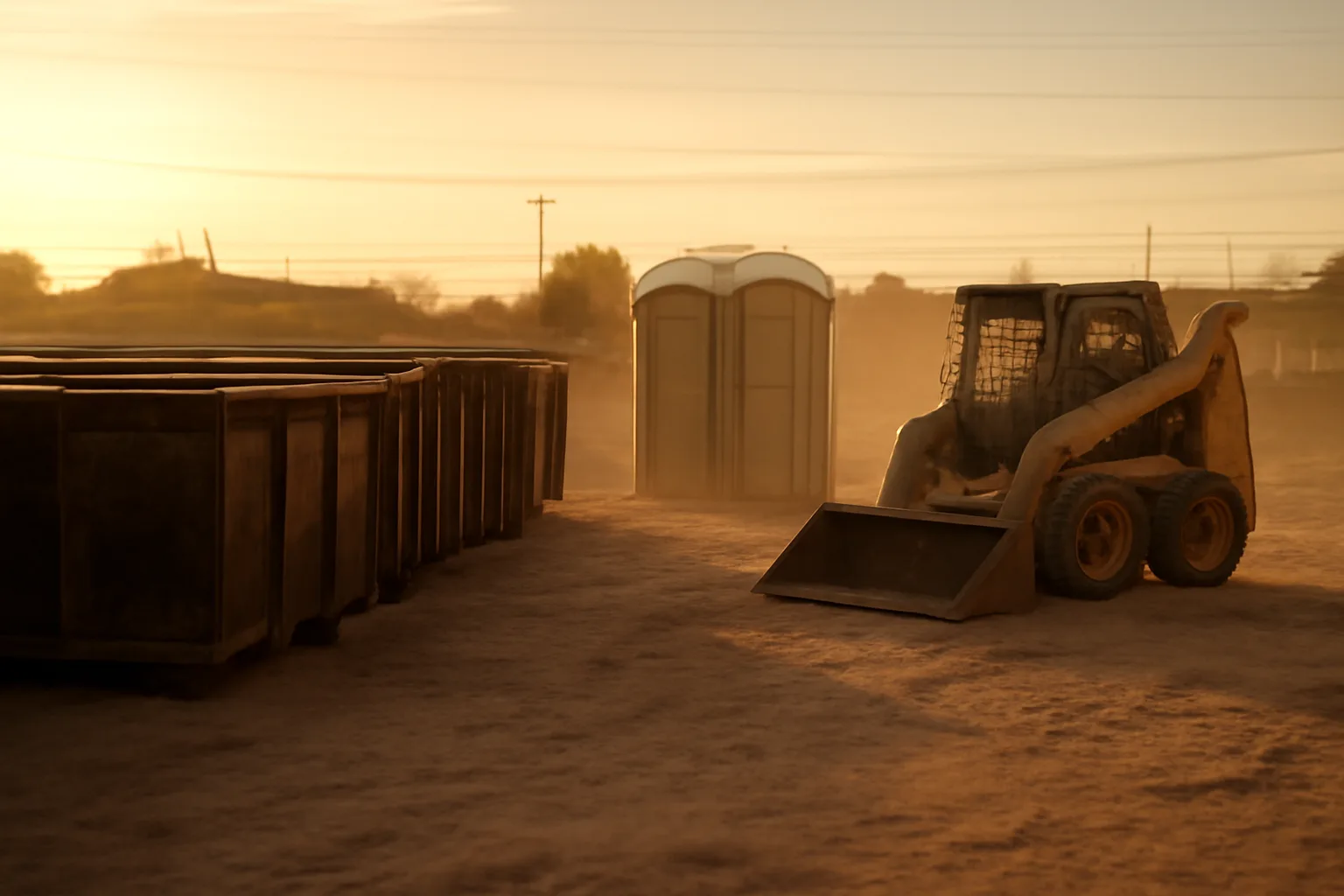
A site services yard is a fenced, zoned parcel you run as the home base for jobsite support gear. You store, service, and dispatch roll-off containers, portable toilets, temporary fence, water tanks, connex boxes, and the small machines that move them. The yard is the depot. The construction site is the customer.
It is not a city dump. It is not automatically a transfer station. Those are different legal boxes. Let outside trucks drop mixed construction debris, or charge the public to tip material, and many states treat you as a solid waste facility. Confirm that line with your environmental board before the first outside load comes through the gate.
The national myth is that this is one license. It is a stack of activity papers instead. Entity filings. A local land-use approval. Stormwater coverage if you qualify as an industrial operator. An oil-spill plan if your tanks add up. Motor-carrier registration if you haul. Health or septage paper if you handle toilets. The mix follows what sits on the gravel, not a slogan.
Treat the yard as a logistics asset. Drainage and truck turning radius beat a pretty office. A lot that cannot swing a 40-yard box will cost you more than any filing.
Census NAICS is a labeling tool, not a permit. A rental-heavy shop often sits in 532412, the Census class for renting or leasing heavy construction and related machinery without operators. [13] A hauling-heavy shop may sit in waste collection instead. Pick the box that matches primary revenue. Do not pick the one that sounds nicer on a bank form.
EPA estimated 600 million tons of C&D debris in the United States in 2018, more than twice the municipal solid waste that same year. [7][8] That volume is why boards watch drop yards so closely. Empty boxes you own are equipment. Other people's debris accepted for a fee is waste. Keep those two ideas apart on paper and on the ground.
How do you start a site services yard?
You start a site services yard by forming an entity, getting a free IRS EIN, locking land whose zoning allows outdoor storage and heavy trucks, then adding only the environmental and carrier filings that match what you store and haul. There is no single federal yard license.
Here is the order I would actually use.
Pick a structure first. The U.S. Small Business Administration lays out sole proprietorships, partnerships, LLCs, and corporations, and the liability difference is real. [2] Most small operators use an LLC. Skip the C-corp on day one unless a tax person asks for it.
Get an EIN next. The IRS says, "Applying for an EIN is a free service offered by the Internal Revenue Service." [1] Use IRS.gov. Do not pay a reseller.
Register the entity with your state and pull the local business tax certificate. SBA's register-your-business page is the clean federal-to-state map. [3] A sales tax permit shows up if you rent or sell tangible goods. Confirm the form name with your state revenue department. I will not invent that fee.
Control the land before you buy iron. Write outdoor storage, after-hours trucking, and wash-water rules into the lease. Zoning is the real gate. A tidy industrial park that bans outdoor storage will end the business.
Then match permits to activity. Disturb one or more acres building the lot and Construction General Permit coverage may apply. [4] Store more than 1,320 gallons of oil aboveground in 55-gallon or larger containers and the SPCC rule is in play. [5] Run interstate in a vehicle at 10,001 pounds or more and FMCSA wants a USDOT number. [9]
Hire like you already have a claim on the books. Powered industrial trucks sit under OSHA 29 CFR 1910.178. [10] Material stacking sits under 1910.176. [11]
State paths are not copies of each other. Read how to start a site services yard in California or how to start a site services yard in Colorado if that is your map. Confirm every fee with the board that collects it. Nobody can honestly promise you an approval date.
Do you need a federal site services yard license?
No. The United States does not issue a license called site services yard. Anyone selling you that as a national product is selling a myth.
What exists are activity triggers. The IRS cares that you have an EIN if you hire, you are a partnership or multi-member LLC, or you need the number for banking and tax filings. [1] EPA cares about stormwater, oil, and waste if your operations hit those statutes. [4][5][12] FMCSA cares about interstate commercial vehicles. [9] OSHA cares about how you store material and run forklifts. [10][11] Your city cares about zoning and the business tax certificate.
That split is why a California packet and an Alabama packet do not look alike. Compare site services yard license in California with how to start a site services yard in Alabama and you will see different boards, different land-use words, and different waste definitions. Confirm form names locally. Do not photocopy another state's checklist and mail it in.
Build a one-page activity list before you talk to any clerk. Write down outdoor storage of empty boxes, diesel tank size, used oil drums, toilet pumping, whether the public can tip debris, number of CDL trucks, and interstate or in-state only. Hand that list to planning, the fire marshal, the water board, and the waste board. Ask each one what they regulate on that list. Take notes. Get names.
What paper should you file before you lease the land?
Before you sign a lease, get a written zoning confirmation that outdoor storage, tractor-trailer circulation, and after-hours dispatch are allowed on that parcel, either by right or by a conditional use you are willing to pursue. If the planner will not put it in writing, walk.
Ask for the use category in the ordinance. Words that often work: contractor's yard, equipment storage, outdoor storage, industrial general. Words that often fail: retail, office, light flex that bans outside storage. A conditional use permit can work. It also invites neighbor hearings. Budget calendar time, more than cash. I will not quote a processing time. Boards do not run on your closing date.
Pull floodplain and wetland screens. A cheap lot in the flood fringe will cost you in fill and insurance. Check truck routes and bridge postings between the yard and your jobs. A 10-minute detour on every pull adds up.
Title and access matter. Shared driveways get ugly when two fleets peak at 6 a.m. If you are looking at a shared lot, read the easement. SiteServicesPath publishes a $249 one-time Shared-Yard Economics Kit for people running the shared-lot numbers. The lease still has to say who owns a spill and who can lock the gate.
Get the landlord to state, in the lease, who holds stormwater coverage and who files the SPCC plan if tanks sit on site. Silence on that point is how you inherit someone else's oil. I would lose a deal before I inherit a tank farm with no paper.
What environmental permits actually show up at a yard?
The environmental paper that shows up is the paper that matches your dirt, your oil, and your waste. It is not a starter pack you buy.
Disturb one or more acres building the lot (grading, gravel, buildings) and EPA's 2022 Construction General Permit is the federal model, with most states running their own NPDES construction permit. [4] Under an acre you may still have local grading or erosion rules. Confirm with the municipal engineer.
Operate vehicle maintenance, fueling, or certain industrial sectors and industrial stormwater (the Multi-Sector General Permit or a state twin) enters the picture. [6] A quiet storage lot with no maintenance may fall outside. A shop that changes oil and washes trucks usually does not. Nobody has a clean national map of gravel-only yards. Ask the state water board, with your activity list in hand.
Oil is a brighter line. The SPCC rule uses a 1,320 U.S. gallon aboveground aggregate threshold under 40 CFR 112.1, and containers under 55 gallons do not count toward that math. [5] A 1,000-gallon diesel tank plus four 55-gallon drums of hydraulic oil is already a conversation. Used oil counts. The SPCC plan is a facility document, not a postcard you file and forget.
Hazardous waste is a monthly weight test. EPA's very small quantity generator category is 100 kilograms or less of hazardous waste per month, about 220 pounds. [12] Shop solvents and some paint wastes can push you over if you are sloppy. Do not guess. Weigh it or stay out of those waste streams.
Accept C&D from off site and you stop and call the solid waste board. That is the transfer-station line.
| Trigger | Usual paper | Who confirms it |
|---|---|---|
| Soil disturbance of 1 acre or more | Construction stormwater (CGP or state twin) | State water board or EPA |
| Vehicle maintenance or listed industrial activity | Industrial stormwater (MSGP or state twin) | State water board |
| Aboveground oil over 1,320 gal in 55-gal+ containers | SPCC plan (40 CFR 112) | EPA or delegated state |
| Hazardous waste over 100 kg in a month | Generator category change | EPA or state hazardous waste |
| Off-site C&D accepted for a fee | Solid waste facility or transfer rules | State solid waste board |
What vehicle and DOT rules apply if you haul?
Haul interstate with a vehicle rated at 10,001 pounds or more (GVWR, GCWR, GVW, or GCW) and FMCSA says you must get a USDOT number. The agency's page states you need the number when the vehicle "Has a gross vehicle weight rating or gross combination weight rating, or gross vehicle weight or gross combination weight, of 4,536 kg (10,001 pounds) or more" and is used in interstate commerce. [9]
In-state-only fleets often still need a state USDOT or intrastate motor carrier number. Confirm with your state patrol or DMV motor-carrier desk. I will not invent that fee.
CDL rules follow the vehicle, not your business card. A combination over 26,001 pounds towing a trailer over 10,000 pounds is the classic Class A trigger. A straight truck can still be Class B. Your state CDL manual is the document, not a forum post.
Interstate fuel and plates (IFTA and IRP) show up when you cross state lines as an apportioned carrier. Confirm thresholds with your state revenue department. Unified Carrier Registration is a separate annual filing for many interstate carriers. Fees vary. Confirm.
Never haul, and let vendors pull every box, and your DOT stack shrinks. Plenty of first-year operators still buy one used roll-off truck. Budget the carrier paper the week you buy it, not the week you get stopped.
Arizona and Connecticut operators should start with those state guides rather than this federal sketch. See how to start a site services yard in Arizona and how to start a site services yard in Connecticut.
What does first-year operations paper look like?
First-year paper is the stuff that keeps you legal after you open the gate. Training records. Inspection logs. Spill kit photos. Scale tickets if you handle waste. A binder the inspector can actually find.
OSHA 29 CFR 1910.176 says storage "shall not create a hazard" and that stacked materials must be stable and secure against sliding or collapse. [11] That is the rule hiding behind the leaning tower of fence panels. 1910.178 is the forklift standard. Formal evaluation of each operator is not optional if you have a lift. [10]
With 10 or more employees, OSHA injury logging (Forms 300, 300A, and 301) is the default federal pattern, with size and industry exceptions. Confirm your exemption before you skip the log.
SPCC plans need review on the schedule in the rule. Do not write it and bury it. Walk the tanks after any modification. A new tote farm can flip you across the 1,320-gallon line before anyone notices, usually the day of a spill.
Pump toilets and septage hauling and disposal paper becomes a state and county health stack. Disposal site contracts matter. "My cousin's farm" is not a plan.
Renewals have their own calendar. California operators should read Site services yard renewal in California rather than assume a license just rolls.
Keep a one-page calendar: insurance renewal, UCR, local business tax, stormwater annual report, fire inspection, driver MVR checks. Put one name on it. If everyone owns the binder, nobody owns the binder.
How much does it cost to open a site services yard?
Nobody publishes a trustworthy national average for opening a site services yard. Land, gravel or pavement, drainage, and the first truck dominate, and those numbers are local. Anyone quoting you a single U.S. startup price is guessing.
What I can say without lying: the IRS EIN is free. [1] Many FMCSA USDOT number filings are not a federal application-fee event, but state plate, fuel, and UCR charges exist and you must confirm them. Local conditional use permits, impact fees, and utility taps vary by city. Confirm with the board that invoices you. I will not invent a CUP price.
Cash typically goes to lease deposit and months of rent, fence, rock or recycle base, used boxes or toilets, one truck or a lease-on-truck deal, insurance down payment, and a boring reserve for the first slow winter. Rent iron before you buy a fleet. New containers look nice in photos and wreck a balance sheet.
Shared yards cut the land bill and create spill-liability messes. Price the mess. If the shared-lot math is the whole business, run it on paper before you split a gate code.
A wash rack is a common money pit. Some cities treat it as industrial wastewater and want a pretreatment permit. Ask public works before you pour the slab.
Insurance is not optional. General liability, auto, inland marine on the rented fleet, and workers' compensation if you have employees. Bind coverage before the first box leaves. Premiums are market quotes, not a number I should invent. Cheap out on lobby furniture. Do not cheap out on auto and inland marine.
What zoning and land-use fights should you expect?
Expect a fight about outdoor storage, truck noise, and what the neighbors think you are. Planning staff will ask if you are a dump. Your job is to show you are a depot.
Bring a site plan. Show setbacks, pile heights, screening, hours, and where a 70-foot combination turns without backing onto the county road. Show oil containment. Show that public tipping is not part of the use (unless it is, in which case you are in a different permit world).
Conditional use hearings go sideways when you hide the toilets. Portable sanitation looks ugly in a rendering and ordinary on a job. Put it on the drawing. Offer hours that match the ordinance. Do not promise no Saturday dispatch if your customers pour concrete on Saturday.
Lighting and idling draw conditions. Live with reasonable ones. Fight the ones that make the yard unusable, like a ban on early staging.
If the parcel is wrong, leave. Rezoning a retail strip to a contractor's yard is a year you will not get back, and I will not promise an outcome.
Colorado's local land-use layer sits on top of any state license conversation. Read site services yard license in Colorado for that stack, then still call the county planner. The planner's letter is worth more than a blog post.
What insurance and OSHA items actually shut a yard down?
A yard gets shut down for a fire-code oil mess, an unpermitted waste pile, a forklift incident, or a stop-work from the city. Not for a missing poster in the break room.
OSHA will care about the lift, the racks, the fuel, and whether anyone trained the new kid. 29 CFR 1910.178 is specific about truck operations and operator training. [10] 1910.176 is specific about storage stability. [11] Those are inspectable. An inspector does not need a long speech. They need to see the evaluation form and a stack that does not lean.
Insurance will care about the same things after a claim. Inland marine covers the boxes and toilets off site. Auto covers the truck that hits a civic. General liability covers the customer who trips on your gravel. Workers' compensation is a state system if you have employees. Confirm residual market options with your state if a standard carrier declines you. I will not invent a premium.
Store more than trivial diesel and the fire marshal becomes a regular. Keep the SDS binder, the extinguishers, and the spill kit where a stranger can find them at 2 a.m.
Write incident reporting into the first employee packet. A late report turns a small claim into a coverage fight. That is a worse outcome than a scratched box.
How is a site services yard different from a dump or transfer station?
A site services yard stages equipment you own or lease out. A dump or transfer station takes other people's waste for disposal or reload. The legal difference is who generated the material and whether you are in the disposal chain.
Empty boxes coming home dirty are still your containers. A contractor dropping mixed debris for a tip fee is a waste customer. That second fact is what pulls in solid waste facility rules in a lot of states. Confirm the definition of transfer station and solid waste processing with your state environmental agency before you advertise debris accepted.
C&D is a huge stream. EPA estimates that 600 million tons of C&D debris were generated in the United States in 2018. [7] Municipal solid waste that same year was 292.4 million tons. [8] Boards wrote rules because of that volume, not because they dislike small operators.
Some yards legally store their own job spoils or separated concrete for reuse. That can still need a beneficial-use determination or a processing registration. Do not assume "it's my dirt" wins. Ask.
If your business plan needs public tipping to work, you are not opening a simple site services yard. You are opening a waste facility that also has a yard. Price that paper honestly or drop the tipping line.
What should you confirm with the board in your state?
Confirm the use name in the zoning code, the solid waste definition that would make you a facility, the stormwater contact for your county, the septage or portable-sanitation registration if you handle toilets, and the motor-carrier desk if you haul. Confirm fees, form names, and whether a public hearing is required. Nobody on the internet can do that last mile for you.
Ask the waste board this exact question: "If I store empty containers and I do not accept off-site waste for a fee, am I a solid waste facility under your statute?" Get the answer in writing.
Ask the water board: "Here is my activity list. Do I need industrial stormwater coverage, only a construction permit during buildout, or neither?"
Ask the fire marshal about diesel, used oil, and propane if you heat with it.
State start pages on this site exist so you can see the board names. They are still not a substitute for the board. If you are early in California licensing, use site services yard license in California. For a different map, how to start a site services yard in Alabama shows how far the paper drifts once you change states.
SiteServicesPath is an independent publisher, not a law firm and not a service company. If you want the kit and the start page, they live at /start. This guide still works if you never click that.
Frequently asked questions
What is site services yard?
A site services yard is a zoned, usually fenced parcel used to store, service, and dispatch jobsite support gear such as roll-off boxes, portable toilets, temporary fence, tanks, and small yard machines. It is a depot, not a municipal dump. Start taking other people's debris for a fee and many states treat that as a waste facility. Confirm that line with your environmental board.
How do you start site services yard?
Form an entity, get a free IRS EIN, and lock land whose zoning allows outdoor storage and heavy trucks. Then add only the stormwater, oil, waste, health, and motor-carrier filings that match what you store and haul. There is no federal yard license. Confirm every form and fee with the local or state board that collects it. State packets are not interchangeable.
Is there one national site services yard license?
No. The United States does not issue a license by that name. You collect activity papers: entity and tax filings, local land use, then environmental and carrier authorizations if your tanks, dirt, waste, or trucks hit those statutes. A California packet and an Alabama packet will not match. Anyone selling a single national yard license is selling a myth.
Is the IRS EIN really free?
Yes. The IRS states that applying for an EIN is a free service. File on IRS.gov. Ignore websites that charge for the same number. You still need state entity registration and a local business tax certificate in most cities. Those are separate filings with their own rules and fees, which you confirm with the state and city that collect them.
When do I need an SPCC plan at a site services yard?
The federal SPCC rule uses a 1,320 U.S. gallon aboveground aggregate oil threshold under 40 CFR 112.1. Containers smaller than 55 gallons do not count in that math. Diesel tanks, hydraulic drums, and used oil totes all count if they are 55 gallons or larger. Confirm applicability and any state overlay with EPA or the delegated state oil program.
Do I need a USDOT number for one dump truck?
If that truck runs in interstate commerce and has a GVWR, GCWR, GVW, or GCW of 10,001 pounds or more, FMCSA says you must get a USDOT number. In-state-only trucks often still need a state motor-carrier number. Confirm with FMCSA for interstate use and with your state patrol or DMV for intrastate use. Do not invent the state fee from a forum post.
Can I let the public dump C&D at my yard?
Often no, not without solid waste facility or transfer-station paper. A site services yard stages your equipment. Public tipping puts you in the disposal chain. EPA estimated 600 million tons of U.S. C&D debris in 2018, which is why boards watch drop sites. Ask your state waste board, in writing, before you advertise debris accepted.
What zoning do I need for a site services yard?
You need a parcel that allows outdoor storage, truck circulation, and after-hours dispatch, either by right or by a conditional use you will actually pursue. Common ordinance words are contractor's yard, equipment storage, or general industrial. Retail and office parks usually fail. Get the planner's confirmation in writing before you sign a lease. I will not promise a hearing outcome.
Can portable toilets and roll-offs share the same lot?
Often yes, if zoning allows both outdoor storage uses and you hold the health or septage paper for toilets plus any waste and carrier paper for the boxes. The lot still has to handle wash water, odor, and truck geometry. Some leases and some neighbors treat toilets as a different fight. Put both uses on the site plan. Confirm with planning and the health board.
How much money do I need to open a site services yard?
There is no honest national average. Land, rock or pavement, fence, the first truck, used boxes or toilets, insurance, and a cash reserve dominate, and they are local. The IRS EIN is free. Permit and plate fees vary. Confirm those with the boards that invoice you. Rent iron before you buy a fleet, and do not pour a wash rack until public works says what they require.
Do I need industrial stormwater coverage for a gravel yard?
Maybe. Building the lot and disturbing one or more acres can trigger construction stormwater coverage under EPA's 2022 CGP or a state twin. Ongoing industrial coverage is more likely if you run vehicle maintenance, fueling, or a listed industrial sector. A quiet storage lot may fall outside. Ask the state water board with a written activity list. Do not guess from a neighboring county.
What is the 100 kilogram hazardous waste line?
EPA's very small quantity generator category is 100 kilograms or less of hazardous waste per month, about 220 pounds. Go over that and your generator duties change. Shop solvents and some paints can get you there if you are sloppy. Weigh what you produce or keep those wastes off the yard. Confirm category and any state-stricter rule with your hazardous waste board.
Should I buy land or lease the first site services yard?
Lease first unless you already understand that parcel's zoning, drainage, and truck access. Buying a cheap lot that cannot turn a 40-yard box, or that sits in a flood fringe, is a slow way to lose capital. Write outdoor storage, hours, wash water, and spill responsibility into the lease. Shared lots can cut rent and create liability fights. Price both sides on paper.
Who confirms fees, quotas, and processing times?
The board that collects the money or issues the paper. That may be city planning, the state water board, the solid waste program, the health department, DMV or state patrol, and FMCSA for interstate carriers. This site does not invent current fees, quotas, or wait times, and it does not guarantee approval. Ask for the form name and the fee schedule in writing.
Sources
- IRS, Apply for an Employer Identification Number (EIN) Online: The IRS states that applying for an EIN is a free service offered by the Internal Revenue Service.
- U.S. Small Business Administration, Choose a business structure: SBA describes sole proprietorship, partnership, LLC, and corporation options and their liability and tax differences for new firms.
- U.S. Small Business Administration, Register your business: New businesses register with the state and obtain local licenses and tax IDs after choosing a structure.
- U.S. EPA, 2022 Construction General Permit (CGP): Federal construction stormwater permitting under the 2022 CGP covers construction activities that disturb one or more acres (states often issue a twin permit).
- eCFR, 40 CFR 112.1 SPCC general applicability: SPCC exemption math uses 1,320 U.S. gallons aggregate aboveground oil storage and excludes containers under 55 gallons.
- U.S. EPA, Stormwater Discharges from Industrial Activities: EPA's 2021 MSGP: Operators of listed industrial activities may need Multi-Sector General Permit or equivalent state industrial stormwater coverage.
- U.S. EPA, Construction and Demolition Debris: Material-Specific Data: EPA estimates that 600 million tons of C&D debris were generated in the United States in 2018.
- U.S. EPA, National Overview: Facts and Figures on Materials, Wastes and Recycling: Total U.S. municipal solid waste generation in 2018 was 292.4 million tons.
- FMCSA, Do I Need a USDOT Number?: A USDOT number is required for many interstate vehicles with GVWR, GCWR, GVW, or GCW of 10,001 pounds or more.
- OSHA, 29 CFR 1910.178 Powered industrial trucks: OSHA requires operator training and evaluation for powered industrial trucks used in general industry.
- OSHA, 29 CFR 1910.176 Handling materials - storage: Storage of material shall not create a hazard; stacked materials must be stable and secure against sliding or collapse.
- U.S. EPA, Categories of Hazardous Waste Generators: Very small quantity generators generate 100 kilograms or less of hazardous waste per month.
- U.S. Census Bureau, 2022 NAICS 532412 detail: NAICS 532412 covers establishments primarily engaged in renting or leasing heavy construction, transportation, mining, or forestry machinery without operators.