Last updated 2026-08-21
TL;DR
A site services yard is a fenced lot where you store and dispatch jobsite gear such as toilets, roll-offs, fence, and tanks. No single federal license covers it. Start by confirming zoning, form an entity, get a free EIN, then add only the waste, hauling, and stormwater paper your inventory triggers. Confirm every current form and fee with the issuing board. Year one is land rules, neighbors, and cash discipline.
What is a site services yard?
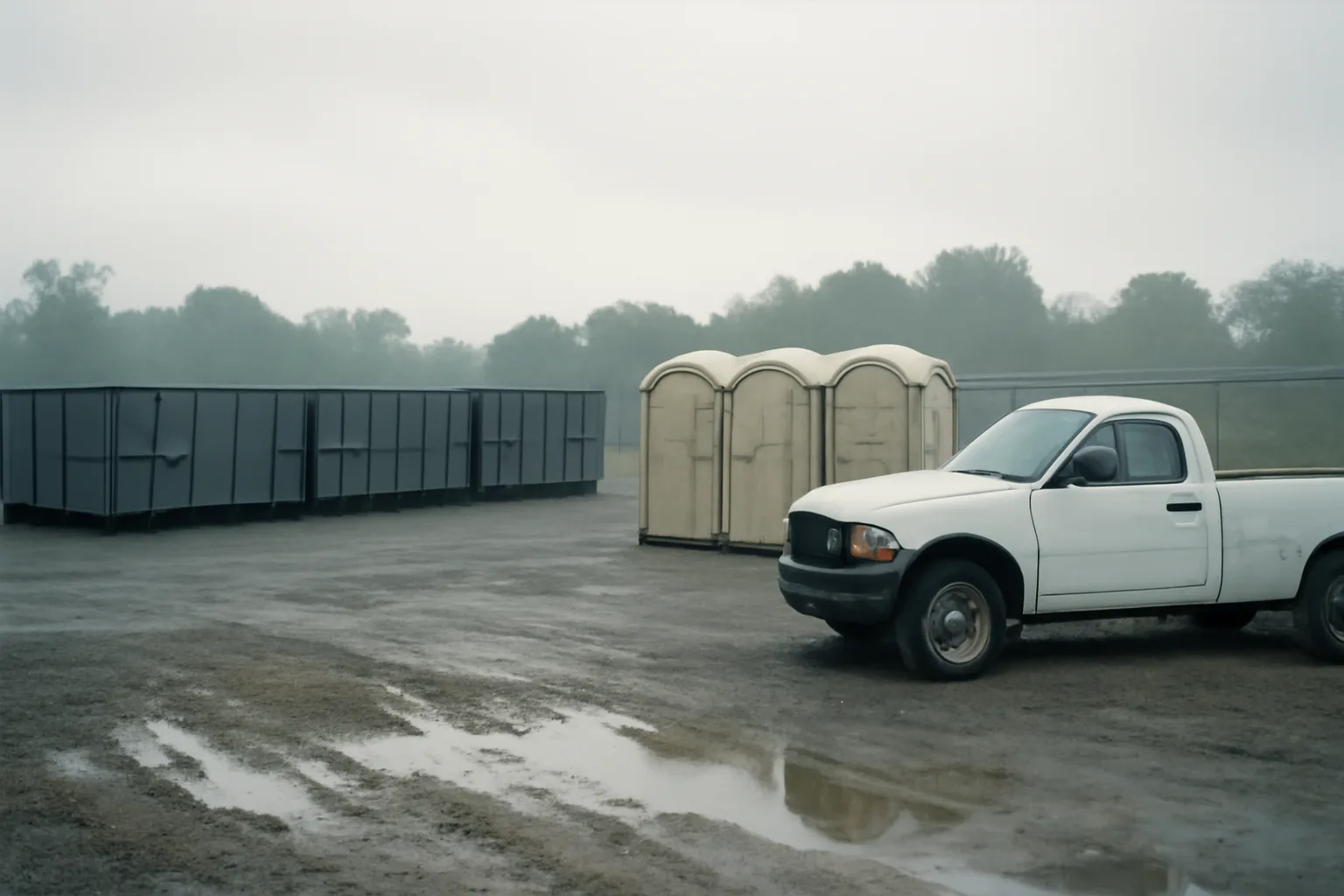
A site services yard is a fenced industrial or heavy commercial lot where you store, maintain, and dispatch jobsite support gear. Portable toilets, roll-off boxes, temporary fence panels, water tanks, and light plants all count. The yard is the land plus the inventory that sits there overnight. The routes are a separate job that happens to start at that gate.
It is not a federal license class. It is not a protected trade name. If someone tells you there is one national site services yard card, they are reciting a myth.
The line that matters is overnight storage on land you control. A contractor who parks one truck at a house is not running a yard. A lot with stacked boxes, a pump pad, and morning dispatch is a yard. Cities read that second picture as outdoor storage, trucking, and sometimes solid waste. Those are land use words. They decide whether you open.
Census does not print an industry line called site services yard. The closest official boxes are construction machinery and equipment rental and leasing (NAICS 532412) and solid waste collection (NAICS 562111), based on where the receipts actually come from [13]. Use the code that matches the money. Do not pick a code because it looks cleaner on a bank form.
Split the business in your head even when it shares one checking account. Land is one problem. Trucks are another. Waste or septage is a third. If you hold construction debris longer than a short transfer, some states treat you as a solid waste facility. California is the clear example, and CalRecycle runs that permitting path [14]. That stack is heavier than a clean toilet depot. Be honest about what will sit on the gravel.
How do you start a site services yard?
You start a site services yard by locking the land use first, then forming the entity, then stacking only the permits that match what you store and haul. Do not buy a fleet first. Do not pour gravel first. A denied conditional use permit after you signed a lease is an expensive hobby.
Walk into planning with a plain site plan. Show the driveway, truck turn, outdoor storage, office or conex, and any wash or pump pad. Ask in writing whether outdoor storage of containers and toilets is allowed by right or only by conditional use. Ask about hours, idling, screening, lighting, and which desk reviews stormwater. A verbal "should be fine" is not a permit.
Then register the business with your state and get a free EIN from the IRS [8][9]. The SBA's guidance on this is blunt: you still have to match licenses to "your business activities, location, and government rules" [7]. After the entity comes the local business tax certificate, a sales or rental tax account if you rent tangible goods, and the activity overlays. Waste facility or transfer paper if you hold debris. Septage or pumper registration if you service toilets. A USDOT number if you run interstate at 10,001 pounds or more [6]. A contractor license only if you install or construct rather than rent and haul. Confirm every current form and fee with the board that issues it. I will not quote a board fee here because those numbers move.
Bind insurance before the first loaded trip. Open a dedicated bank account before you mix personal fuel receipts with yard diesel.
If you want a state packet instead of this shared path, use a real state walkthrough such as how to start a site services yard in Colorado or how to start a site services yard in Alabama. Those pages track board paper. This page tracks the order of work that does not change much by state.
What licenses does a site services yard need?
You need a local business license plus the activity overlays that match your inventory. There is no federal site services yard license. Confirm each current form with the issuing board. Do not copy a fee off a blog.
Think in layers, not in one magic card. Federal paper is narrow: an EIN, a USDOT number when the trucking test is met, and EPA or authorized-state filings if you trigger stormwater, oil storage, or hazardous waste rules [6][8]. State paper is the entity, tax accounts, and any waste, septage, motor carrier, or contractor credential. Local paper is the business tax certificate, zoning or conditional use, building and fire, and sometimes a well or septic sign-off. The SBA states the obvious that people skip: licenses depend on activity and location, not on what you wish the business was called [7].
| Layer | Typical paper | Who to ask |
|---|---|---|
| Federal | EIN; USDOT if interstate at 10,001 lb; EPA or state NPDES, SPCC, RCRA if triggered | IRS, FMCSA, EPA or authorized state |
| State | Entity, tax account, waste or septage, sometimes contractor or carrier | Secretary of state, revenue, environment, DMV or PSC |
| Local | Business tax, zoning or CUP, building, fire | City or county clerk and planning |
If the yard only stores clean rental units and the trucks are local, your stack stays shorter. The minute you accept mixed debris, pump tanks, or store diesel in bulk, another desk gets a vote. California operators who actually construct or install may also hit the Contractors State License Board. Operators who only rent and haul often do not. Confirm that split with the board, not with a Facebook group. For a state example of the license pile, read site services yard license in California or site services yard license in Colorado.
I would not pay a consultant to "package a national license." That product does not exist. Pay a local land use attorney or a civil engineer for the site plan if the city wants stamped drawings. That money buys a yes or a no. Brochure kits do not.
What zoning do you need for a site services yard?
Most site services yards only work in industrial or heavy commercial districts, and many cities still want a conditional use permit for outdoor storage. Residential, mixed use, and pretty retail corridors are usually a hard no once units sit outside overnight.
Zoning is the first filter because it is the one you cannot paper over later. A perfect LLC in the wrong district still cannot stack boxes. Bring the planner a site plan that shows setbacks, a truck turning template, screening, outdoor storage limits, and where stormwater goes. Ask how they classify portable toilets versus roll-off boxes. Some codes treat toilets as outdoor storage. Some treat roll-offs as a junkyard. Those two words produce different hearings.
Neighbors decide more hearings than statutes do. Backup beepers at 5:30 a.m., odor from a pump pad, and mud on the public street are the complaints that get you a show-cause letter. I'd spend money on a screened pump pad and a gravel tracking pad before I spent it on a new loader paint job.
Home occupation rules almost never cover this. If the code allows a home office, it still will not allow a row of boxes along the side yard. Do not test that theory. You will lose the argument and the deposit on the land.
Counties and cities write this differently even inside one metro. Confirm the use table and any outdoor storage overlay with the planning counter that has jurisdiction over the parcel. If you are comparing states, the land fight in how to start a site services yard in Arizona will not match a New England lot. The method is the same. The use table is not.
How much does a site services yard cost to open?
Nobody has a clean national build-out number for a site services yard. Land rent, fence, gravel, and the first truck dwarf every application fee I have seen, and those four items move with the zip code. I will not invent an average.
What you can budget with less fiction is the order of spend. First is control of land that already allows the use, or a lease that is contingent on the use permit. Second is a fence, a lockable gate, cameras, and enough gravel or pavement that trucks do not manufacture mud. Third is one reliable truck and a starter set of units, rented if you are still proving demand. Fourth is insurance and the activity permits. Office furniture is not on that list.
Application fees are real and they are local. Confirm them on the current fee schedule of the city, county, and state board. I will not reprint a fee that may be stale by the time you read this. Federal pieces that often surprise people are free or cheap relative to land: an EIN costs nothing through the IRS [8]. A USDOT number is a registration, not a land cost [6]. The expensive federal-adjacent items are engineered SWPPP plans, SPCC plans, and any waste facility design a state may demand if you hold debris [1][10][14].
If you want a worksheet for shared-yard rent, labor, and unit turns, SiteServicesPath sells a $249 one-time Shared-Yard Economics Kit at /start. You do not need it to follow this guide. The kit is optional arithmetic, not a license.
Waste of money in month one: custom wraps, an oversized office trailer, and a second truck you cannot keep busy. Buy used units that still pass a customer walk-around. Rent the weird specialty boxes until a customer asks twice.
What insurance should a site services yard carry?
Carry commercial auto on every power unit, general liability on the premises and operations, and inland marine or scheduled equipment cover on units that leave the yard. Add workers compensation the day you have an employee the state counts as an employee. Add a pollution or contractors pollution form if you pump tanks or handle waste. Confirm the actual forms with a commercial broker who has written yards, not with a personal-lines agent.
I will not quote a premium. Premiums follow garaging zip code, driving records, radius, and whether you haul waste. Anyone publishing a single national price is guessing.
Two coverage gaps show up over and over. The first is rented or loaned units sitting on a customer site with no inland marine and no hold-harmless that matches the rental contract. The second is diesel, used oil, or septage covered by only a standard CGL, which often excludes pollution. Read the exclusion. Then buy the form that answers it, or stop storing the product that creates it.
Certificates should name the landlord and, if the city asked, the municipality as additional insured on the premises policy. Keep the current dec pages in the same binder as the CUP. Inspectors ask. So do lenders.
Bonding is a different product. Some waste, septage, and motor carrier programs want a surety bond or proof of financial responsibility. That is board-specific. Confirm it on the program page for your state. Do not assume a license bond from a contractor board covers a dump ticket dispute. It usually does not.
Which environmental rules hit a site services yard first?
The first environmental rules that hit a site services yard are stormwater, bulk oil, and whatever waste you actually generate or hold. You do not need every EPA program. You do need the ones you trigger.
If you disturb one or more acres, or a smaller piece of a larger common plan, construction stormwater permitting applies. EPA's construction stormwater page states that the program covers permits "for stormwater discharges from: Construction activities that disturb one or more acres, and Smaller construction activities that are part of a larger common plan of development or sale" [1]. Building the yard itself can trip that. So can a customer site you grade. Many states run this in place of EPA. Confirm the current construction general permit with the state water board, not with a grading contractor's memory.
Once the yard is operating, industrial stormwater can apply if your activity sits in an MSGP sector, including certain recycling and waste operations [10]. A clean toilet depot may not. A scrap-mixed C&D lot often does. The 2021 Multi-Sector General Permit is the federal template. Authorized states issue their own versions.
Oil is a hard number. EPA's SPCC rule is built around aggregate aboveground oil storage capacity greater than 1,320 U.S. gallons, counting containers of 55 gallons and more. That is easy to trip with a diesel tank plus drums. If you are close, measure. Then write the plan or shrink the tanks. Do not guess.
Hazardous waste is another hard number. EPA's very small quantity generator ceiling is 100 kilograms of hazardous waste per month (about 220 pounds), with a separate acute-waste limit [3]. Shop waste, solvents, and some absorbents count. Weigh the total before you assume you are "too small to matter."
If you hold municipal or C&D solid waste for transfer, you may leave the rental-yard world and enter solid waste facility permitting. CalRecycle's facility permitting program is the clearest public example of that extra stack [14]. Other states use different names for the same idea. Ask the state solid waste desk before you accept the first mixed load.
What equipment do you actually need in year one?
In year one you need a legal place to park, a fence, one reliable truck that matches the work, and enough units to fill that truck more than twice a week. Everything else is optional until a paying route proves it.
If the work is portable sanitation, that means a service truck that can legally carry water and waste, plus a starter set of units you already know how to clean. If the work is roll-off, that means a roll-off truck and a handful of boxes, some of which you can rent from a dealer until your dump contract is real. If the work is fence, that means panels, bases, and a flatbed or trailer. Do not buy all three fleets because a logo looks better that way.
OSHA's construction storage rule still applies when your people stack gear: "All materials stored in tiers shall be stacked, racked, blocked, interlocked, or otherwise secured to prevent sliding, falling or collapse" [4]. That is 29 CFR 1926.250(a)(1). It does not turn off because the yard "is not a jobsite." Your yard is a workplace. Stack like it.
Waste of money: brand-new light towers, a custom-built office, and a second specialty trailer you will use on one wedding and one film shoot. Rent the odd units. Buy the daily units used, then rebuild the doors and floors.
Cameras and good lighting earn their keep. So does a hose bib and a wash pad that does not drain to the storm inlet. I would cut the marketing budget to pay for that pad. Inspectors notice dirty water in the gutter faster than they notice your new decals.
How do you hire for a site services yard without getting sloppy?
Hire like a small trucking shop, not like a weekend side job. Every employee needs a completed Form I-9 [11]. Nonexempt staff are owed overtime under the federal Fair Labor Standards Act after 40 hours in a workweek, unless a real exemption applies [12]. State wage rules can be stricter. Follow the stricter one.
OSHA's injury log rule has a small-shop break. 29 CFR 1904.1 says that if your company had ten or fewer employees at all times during the last calendar year, you generally do not keep the routine OSHA injury and illness records unless OSHA or BLS tells you in writing to keep them [5]. That is not a pass on safety. It is a pass on some paperwork. You still have to report severe injuries. You still have to train people on the hazards they actually face.
Drivers are the risk. If the truck needs a CDL, do not let a helper "just move it across the yard" on a public street. If you run interstate at 10,001 pounds or more, the FMCSA USDOT and hours rules are in play even when the driver feels local [6]. Keep driver qualification files if you are in that world. I would rather lose a Saturday job than fake a medical card.
Workers compensation is state law. Confirm coverage with the state fund or a licensed residual market if the voluntary market will not write a new yard. Paying people as 1099 contractors while you set their hours and send them out in your truck is a fast way to buy two problems. If you control the work, they are probably employees. Ask a payroll service that already runs construction or waste accounts. Do not ask the guy who wants to be paid cash.
What records should you keep from day one?
Keep a land file, a truck file, a people file, and an environmental file. That is the whole system. If a document does not fit one of those four folders, it is probably marketing.
The land file holds the deed or lease, the zoning letter or CUP, the site plan the city stamped, the business tax certificate, and the current insurance certificates. The truck file holds titles, registrations, USDOT printouts, inspection reports, and dump or disposal account numbers [6]. The people file holds I-9s, W-4s, and any CDL or medical cards [11]. The environmental file holds the SWPPP or industrial stormwater coverage if you have it, the SPCC plan if you tripped 1,320 gallons, training logs, and any waste determinations or manifests [1][3][10].
Put renewal dates on one wall calendar. California operators who already hold paper should treat renewal as its own project. See site services yard renewal in California rather than trusting a reminder from a vendor.
I keep photos. Gate line, stacked boxes, spill kit, and the storm inlet after a rain. When a neighbor claims you flooded the alley, a dated photo beats a speech.
Do not store customer checks in the same folder as SDS sheets. That sounds obvious until the office is a conex and one binder is "the binder." Label the four files. Make a second person know where they live.
How should you price site services yard work?
Price the truck time, the dump or disposal fee, the days a unit occupies the yard or the job, and the damage you know you will take. Do not price a feeling, and do not photocopy a competitor's flyer.
Dump fees and landfill or transfer tickets move. So do fuel and helper wages. Your rate card has to survive a bad month of those three, not a perfect month. I would rather be $15 high and still in business than win a bid that cannot pay the ticket at the scale.
Yard occupancy is the line new operators forget. A box that sits three weeks waiting on a customer to "maybe need it" is not free inventory. It is rent you already pay. Charge a live monthly on stored customer property, or do not store it.
There is no honest national rate table for this work. Haul distances, landfill monopolies, winter mud, and union vs open-shop labor make cross-city comparisons almost useless. If a franchise packet shows you a single national daily rate, treat it as marketing.
Contract language matters more than the pretty number on the quote. Spell out contamination, overweight, wait time, after-hours, and who calls the dump when the load is rejected. A cheap quote with silent contamination rules will eat a month of profit in one sofa-filled box.
What first-year mistakes waste the most money?
The expensive mistakes are land mistakes, not logo mistakes. Signing a lease before the use is approved. Accepting mixed debris on a lot permitted only for clean rental storage. Building a wash pad that drains to the street. Hiring on a handshake and calling everyone a contractor.
The second cluster is fleet ego. Two trucks and 80 units look like a company. They also look like a payment book. I would run one truck hard, rent overflow units, and wait until the Saturday route is real. Used boxes with new floors beat new boxes with empty calendars.
The third cluster is ignoring the neighbor. Odor, backup beepers, and mud on the public road get you a hearing faster than a missing poster in the conex. Screen the pump pad. Put a tracking pad at the gate. Move the early-morning staging off the property line. That is cheaper than a land use appeal.
Mixing books is a quiet way to die. Personal diesel, yard diesel, and a customer reimbursement on one debit card will make your own tax return unreadable. Separate accounts on week one.
Skipping the written waste determination is the environmental version of the same sloppiness. If the shop starts producing solvents or the lot starts taking odd debris, weigh it against the 100 kilogram monthly VSQG ceiling before you invent a story [3]. Stories do not help when the inspector asks how you knew.
How do state rules for a site services yard differ?
State rules differ on waste facility definitions, septage pumper credentials, contractor overlays, and motor carrier registration. The federal triggers stay fairly stable. The names of the desks do not.
California will drag a debris-holding lot toward solid waste facility permitting through CalRecycle, and it may drag install work toward the Contractors State License Board [14]. Colorado splits land use to the county or city and environmental paper to state programs. You can see that split on the Colorado board page and the matching Colorado start guide. Connecticut and other dense coastal states often make the zoning hearing the real project, even when the environmental stack is short. Start with how to start a site services yard in Connecticut if that is your map.
I treat every state the same on method. Call planning first. Then the state environmental desk if you hold waste or pump tanks. Then the motor carrier or DMV desk if the truck weights require it. Then the contractor board only if you install. Confirm fees, forms, and current processing practice with those boards. Nobody can honestly guarantee an approval date in an article, and I will not try.
SiteServicesPath is an independent publisher, not a law firm and not a service company. Use this as a map of questions. The board that stamps the permit is the only source for the current answer.
Frequently asked questions
What is a site services yard?
A site services yard is a fenced lot used to store, maintain, and dispatch jobsite support gear such as portable toilets, roll-off boxes, temporary fence, and tanks. It is a land use plus a dispatch business. It is not a single federal license class. The yard begins when inventory sits overnight on land you control, which is when zoning and outdoor storage rules apply.
How do you start a site services yard?
Lock zoning and any conditional use first, then form an entity, get a free IRS EIN, and add only the local business, waste, hauling, and stormwater paper that matches your inventory. Bind insurance before the first loaded trip. Confirm every current form and fee with the issuing board. Do not buy a fleet before the land use is written, not verbal.
Is there a federal site services yard license?
No. There is no federal license with that name. Federal pieces that may apply are an EIN, a USDOT number for many interstate commercial vehicles at 10,001 pounds or more, and EPA or authorized-state rules for stormwater, oil storage, or hazardous waste if you trip those thresholds. Everything else is state or local. Confirm with the board that actually stamps the permit.
What NAICS code does a site services yard use?
Census has no code titled site services yard. Many rental-heavy yards fit construction machinery and equipment rental and leasing, NAICS 532412. Yards whose receipts are mostly hauling waste may fit solid waste collection, NAICS 562111. Pick the code that matches revenue, not the name you prefer on a website. Your accountant should confirm the current Census definition.
Can I run a site services yard from my house?
Almost never, if units sit outside overnight. Home occupation rules usually cover an office, not outdoor storage, pump-outs, or truck staging. Residential zoning plus a row of boxes is how people collect cease-and-desist letters. Rent or buy land that already allows outdoor storage, or make the lease contingent on a written use approval from planning.
Do I need a contractor license to open the yard?
Only if you install, construct, or bid work the state contractor board treats as contracting. Renting a toilet or dropping a box and hauling it off is often outside that board. Installing fence as a permanent improvement, or doing demolition, is a different story. Confirm the classification list with your state contractor board before you print the word contractor on a truck.
When do I need a USDOT number?
FMCSA says you generally need a USDOT number if you operate in interstate commerce with a vehicle at 10,001 pounds GVWR, GCWR, GVW, or GCW, or if you haul certain hazardous materials. Intrastate rules vary by state. Confirm on the FMCSA "Do I need a USDOT Number" page and with your state motor carrier desk before you assume a local-only story protects you.
What is the 1 acre stormwater rule?
EPA's NPDES construction stormwater program requires permits for construction that disturbs one or more acres, and for smaller sites that are part of a larger common plan of development or sale. Building the yard can trip it. So can a customer site you grade. Many states issue the permit instead of EPA. Confirm the current construction general permit with the state water board.
How much oil can I store before SPCC applies?
EPA's SPCC program is built around aggregate aboveground oil storage capacity greater than 1,320 U.S. gallons, generally counting containers of 55 gallons and larger. A diesel tank plus a few drums can put a small yard over the line. Measure the labeled capacities. If you are over, you need a plan. If you are close, shrink storage or write the plan.
How much hazardous waste can a small yard generate?
EPA sets the very small quantity generator ceiling at 100 kilograms of hazardous waste per month, about 220 pounds, with a separate limit for acute hazardous waste. Shop solvents and some absorbents count. Weigh what you actually produce before you claim you are too small. If you go over, the paperwork jumps. Confirm your category on EPA's generator pages.
Do I need OSHA injury logs with a tiny crew?
If you had ten or fewer employees at all times last calendar year, 29 CFR 1904.1 generally exempts you from keeping routine OSHA injury and illness records unless OSHA or BLS tells you in writing to keep them. You still must report severe injuries and train people. The exemption is paperwork, not a safety holiday. Confirm whether your industry sits on any current exception list.
Do portable toilet yards need a special pumping license?
Often yes, and it is usually a state or local septage, pumper, or sanitary waste credential, not a federal site services card. The desk may sit at the health department, the environmental agency, or both. Disposal has to go to a lawful plant or receiving station. Confirm the current pumper registration with that state or county program before you pump the first tank.
Can two operators share one site services yard?
Yes, if the lease, insurance, stormwater plan, and gate rules say who owns which spill and which truck. Shared yards fail when both names are on the gate and neither name is on the SWPPP. Split access hours, dump accounts, and pollution liability in writing. A handshake between cousins is not a stormwater plan and it is not additional-insured language.
Sources
- U.S. EPA, Stormwater Discharges from Construction Activities: NPDES construction stormwater permitting applies to disturbance of one or more acres and to smaller sites in a larger common plan of development or sale.
- U.S. EPA, Categories of Hazardous Waste Generators: Very small quantity generators are capped at 100 kilograms of hazardous waste per month.
- OSHA, 29 CFR 1926.250 General requirements for storage: Materials stored in tiers must be stacked, racked, blocked, interlocked, or otherwise secured to prevent sliding, falling, or collapse.
- OSHA, 29 CFR 1904.1 Partial exemption for employers with 10 or fewer employees: Employers with 10 or fewer employees in the prior calendar year are generally exempt from routine OSHA injury and illness recordkeeping.
- FMCSA, Do I need a USDOT Number: A USDOT number is generally required for interstate commercial vehicles at 10,001 pounds or more, and for certain hazardous materials operations.
- U.S. Small Business Administration, Apply for licenses and permits: Required licenses and permits depend on business activities, location, and government rules, not on the business name.
- IRS, Apply for an Employer Identification Number (EIN) Online: The IRS issues an EIN at no cost through its online application.
- U.S. Small Business Administration, Register your business: A new firm must register according to its structure and location with the relevant state and local agencies.
- U.S. EPA, Stormwater Discharges from Industrial Activities, EPA's 2021 MSGP: Certain industrial sectors, including specified waste and recycling operations, may need industrial stormwater coverage under the Multi-Sector General Permit or a state equivalent.
- U.S. Citizenship and Immigration Services, Form I-9: Employers must complete Form I-9 to verify identity and employment authorization for each person hired.
- U.S. Department of Labor, Fair Labor Standards Act: The FLSA requires overtime pay for covered nonexempt employees after 40 hours in a workweek.
- U.S. Census Bureau, NAICS 532412 definition: NAICS 532412 is the official industry classification for construction, mining, and forestry machinery and equipment rental and leasing.
- CalRecycle, Solid Waste Facility Permitting: California requires solid waste facility permitting for operations that meet the state's facility definitions, which can include certain debris-holding yards.