Last updated 2026-08-20
TL;DR
A site services yard is an industrial lot where you stage toilets, fence, boxes, water, lights, and the trucks that move them. You start it by locking zoning in writing, forming an entity, getting an EIN, then adding only the contractor, stormwater, oil-spill, and USDOT paper that matches what you store and haul. There is no national yard license. Confirm every fee and form with the board that issues it.
What is a site services yard?
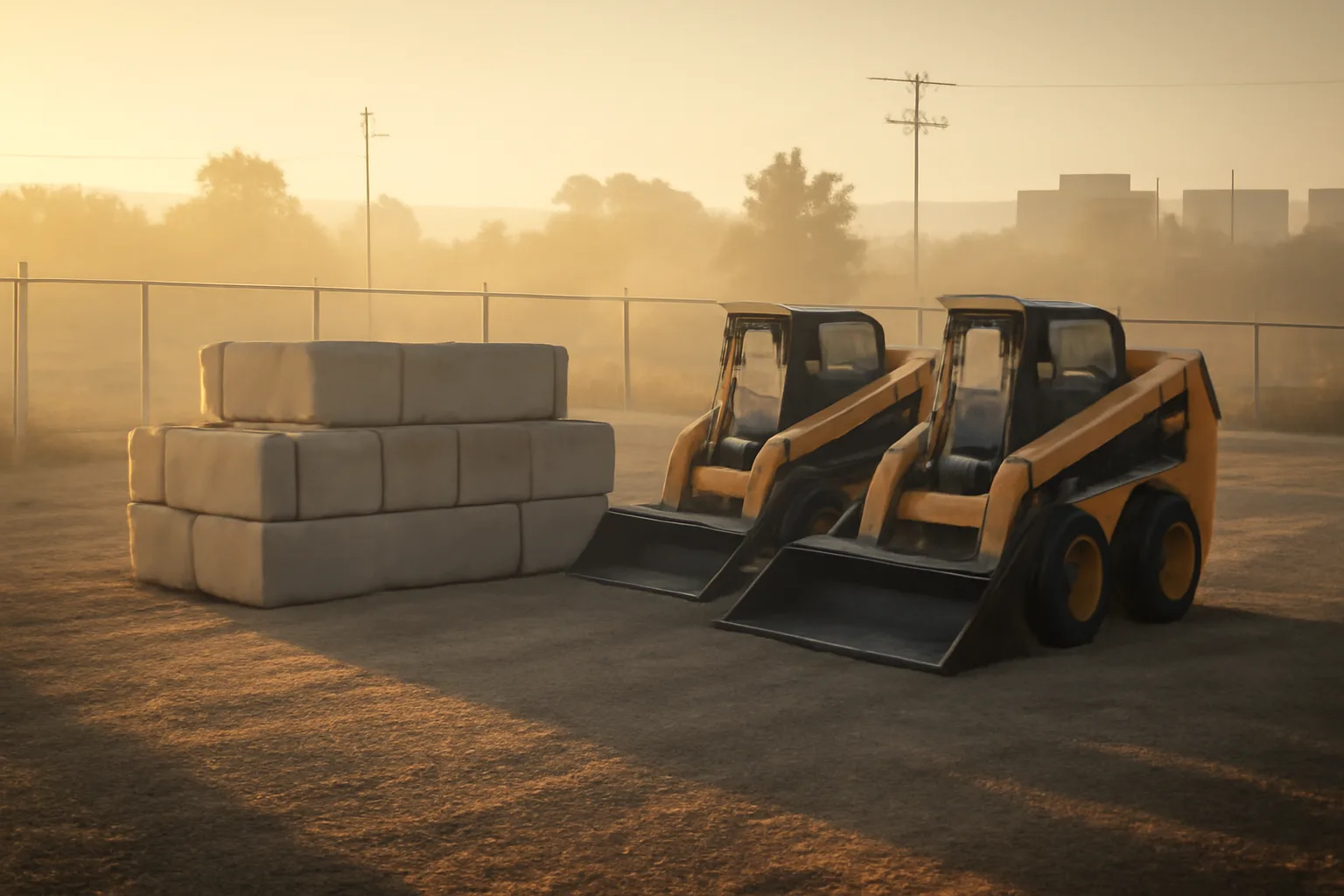
A site services yard is a fenced industrial or heavy-commercial lot where you store, maintain, and dispatch the temporary gear that construction sites and events run on. Typical inventory: roll-off containers, temporary fence panels, portable restrooms, water tanks, light plants, and the trucks that deliver them.
It is an operating pattern, not a federal license class. The Census Bureau groups a lot of the dirt-side work under NAICS 238910, Site Preparation Contractors. [1] Rental-heavy yards sometimes sit closer to construction machinery rental. A dumpster-first yard can look like solid waste collection on a tax form. Your code should follow what you invoice.
People mix this up with a general contractor shop. A GC shop builds. A site services yard feeds sites. You might still hold a contractor license, but the yard itself is land plus dispatch. Store only your own iron and never bid construction, and your paper stack stays short. Rent, haul, and set gear on active jobs, and it grows fast.
I treat the phrase as a land-use and insurance problem first. Planners and underwriters hear contractor's storage yard or equipment yard. Use those words at the counter. Site services sounds like marketing to a zoning clerk.
The lot is the product. Gate width, truck turn radius, night lighting, and whether stormwater sheets toward a creek will decide your year more than a logo.
How do you start a site services yard?
You start a site services yard by locking lawful land use first, then forming the company, then adding only the contractor, vehicle, and environmental paper that match what you store and haul. There is no national yard license.
The U.S. Small Business Administration 10-step start guide is a usable skeleton for entity choice, tax IDs, and basic local licenses. [6] It will not tell you whether your gravel lot needs a stormwater notice of intent. That gap is where new yards get surprised.
Here is the order I would actually use. Get zoning confirmation in writing from the city or county before you sign a long lease. Form an LLC or corporation in your state. Get an EIN. The IRS is blunt: "Applying for an EIN is a free service offered by the Internal Revenue Service." [7] Pull the local business tax receipt. Only then map contractor licensing if you bid construction, FMCSA paper if you haul interstate, SPCC if diesel storage is large, and NPDES if you grade an acre or run an industrial activity the stormwater rule covers. [3][4][5]
Buying trucks before zoning is a reliable way to light money on fire. The iron still has payments when planning says the use is not allowed.
Skip the myth that nobody licenses this. Cities license the land. States license contracting and some sanitation or waste trades. EPA and OSHA attach to the activity. Confirm every current form and fee with the board that prints it. I will not invent a processing time.
If you are still weighing this against a nearby W-2 crew, read site services yard vs nearby career.
What licenses does a site services yard actually need?
A site services yard usually needs a local business license plus whatever activity licenses match the work. There is no single yard permit from Washington. Start with city or county occupational tax. Add state contractor paper only if you contract construction. Add waste, sanitation, or hauler credentials if those are the product.
The federal layer is activity-based. It is OSHA if you have employees on the lot. [2] It is EPA if you store oil, generate used oil, or discharge stormwater from an industrial or construction activity. [3][5] It is FMCSA if the trucks meet commercial motor vehicle tests in interstate commerce. [4]
I would make a one-page activity list before I paid any consultant. Write down whether you bid construction, rent equipment, haul waste, pump toilets, store more than a few diesel tanks, wash trucks on site, or cross state lines. Each yes is a different counter.
Portable sanitation and septage are state and county health paper in many places. Roll-off waste can pull in solid waste transporter registration. Those programs change forms. Confirm with the health department and the environmental agency in the state where the yard sits.
A license you do not need is still a waste of money. Do not buy a full general contractor exam course if you will only store your own fence for a related company. Do not skip a hauler credential if the city writes tickets for unregistered roll-offs. Match the paper to the invoice.
What zoning and land use rules apply to a yard?
Zoning is local, and it is the first hard gate. Most site services yards belong in industrial districts or in heavy commercial districts that list contractor's equipment storage as a permitted or conditional use. A house lot, a storefront, and many business parks will not take the trucks.
I would not sign a multi-year lease on a broker's verbal promise. Ask planning for a zoning verification letter that names contractor storage, outdoor equipment, and truck parking. If the use is conditional, budget time for a hearing. I will not quote your city's hearing calendar. Confirm it.
Watch the quiet killers. Overnight parking bans, idling rules, hours of operation, outdoor storage screening, and stack-height limits. Neighbors complain about backup alarms at 5 a.m. That complaint becomes a code case.
If the lot needs new gravel, a driveway apron, or a detention pond, you may trip building and grading permits on top of use approval. That is still local paper. State environmental review can attach if you are near wetlands. Walk the ditch line yourself before you fall in love with a cheap parcel.
Floodplain maps matter. A cheap lot in a flood fringe will flood your boxes and your insurance. Pull the FEMA flood map for the parcel and ask the floodplain administrator whether outdoor storage is restricted. That visit is free and it has saved people from uninsurable yards.
What environmental paper hits a yard in year one?
Year-one environmental paper is mostly stormwater, oil storage, and used oil. EPA's oil spill prevention rule at 40 CFR 112 generally kicks in once a facility's aggregate aboveground oil storage capacity tops 1,320 U.S. gallons, if a discharge could reach navigable waters. [3] Count every diesel tank, tote, and drum that meets the rule's container definitions. Confirm applicability with the text of 40 CFR 112.1 and with your state, because states can be stricter.
Stormwater is the other early hit. 40 CFR 122.26 is the federal NPDES stormwater regulation. Construction activity that disturbs one acre or more (including a smaller site in a common plan) needs construction stormwater coverage. [5] Industrial stormwater coverage depends on your industrial category and what you do on the pavement. Truck washing, fueling, and exposed scrap can pull a lot into a multi-sector general permit even when the office is quiet.
I would not skip a site walk with someone who can read a drainage path. If the lot sheets into a creek, assume an inspector can see it too.
Used oil from equipment service has its own federal part at 40 CFR 279. [14] Keep it in closed containers, label it, and use a legitimate collector. Mixing solvents into used oil is how a small shop becomes a hazardous waste story.
SWPPP binders that nobody updates are a waste of money. A short plan that matches the actual lot, with dated inspection notes, beats a long template you never open. Confirm the current notice of intent process with your state water board. I will not invent a filing fee.
Do you need a contractor license to run the yard?
You need a contractor license when you contract construction work that your state treats as contracting, not merely because you own a yard. Storage is land use. Contracting is a bid and a scope.
California is the clean example people copy in conversation. Business and Professions Code section 7028 makes it a misdemeanor to act in the capacity of a contractor without a license. [8] General engineering work is defined in section 7056 and includes fixed works that need specialized engineering knowledge and skill, which is where a lot of heavy site work lives. [13] Confirm the current dollar threshold and classification with CSLB before you bid. I will not print a fee or a test date.
Florida requires certification or registration to engage in contracting under Chapter 489. Section 489.113 is the core prohibition. [10] Confirm the classification with DBPR and any local competency board.
Texas does not run a California-style statewide general building license. Cities still register contractors, and TDLR still licenses specific trades. Confirm with the city of the job and with TDLR for the trade.
| Jurisdiction | Contracting paper | Confirm with |
|---|---|---|
| California | CSLB license when you act as a contractor | CSLB classification and current threshold |
| Florida | Chapter 489 certified or registered contractor | DBPR plus local competency |
| Many Texas jobs | City registration, state paper for licensed trades | City and TDLR |
| Federal | No contractor license | OSHA, EPA, FMCSA overlays |
Lease space to other contractors and never bid, and your risk shifts to landlord-tenant and land use, not CSLB. Install fence or set boxes as part of a construction contract, and you are in contractor territory. Read a deeper split of yard versus GC paper in site services yard guide 18.
Do yard trucks need a USDOT number?
FMCSA requires a USDOT number for interstate commercial motor vehicles with a GVWR of 10,001 pounds or more, and for other listed CMV categories. [4] A single 26-foot box truck can trip it. A pickup under the weight line, used only in one state, may not. Confirm with the FMCSA Do I Need a USDOT Number page and with your state DOT, because many states issue state DOT numbers for intrastate fleets.
Interstate is not a vibe. Haul a load from a yard in one state to a job in another, and you are in FMCSA territory. Intrastate-only fleets still face state safety rules, CDL thresholds, and insurance minimums.
I would inventory GVWR from the door sticker, not from memory. People guess low. Then they meet a scale.
IRP plates and IFTA fuel tax accounts show up when you run apportioned miles across states. Those are state portal filings on top of the USDOT number. Confirm current credentials with your base-state motor carrier office. Medical cards, ELD rules, and hours of service attach to the driver and the CMV definition, not to your brand name.
Do not buy a compliance subscription in month one if you have one straight truck that never leaves the county. Do not run a fleet of 26,000-pound GVWR trucks interstate with a laminated business card as your authority file.
What OSHA rules apply inside the yard?
OSHA applies when you have employees, and the construction standards in 29 CFR 1926 apply when the work is construction. Material storage is not a free-for-all. 29 CFR 1926.250(a)(1) says, "All materials stored in tiers shall be stacked, racked, blocked, interlocked, or otherwise secured to prevent sliding, falling or collapse." [2] Fence panels, trench plates, and box piles fail that sentence every week.
Hazard communication still applies to diesel, solvents, welding rods, and concrete form oil. 29 CFR 1910.1200 requires classified hazards, labels, and safety data sheets for employees. [11] A milk crate of mystery spray cans is an easy citation.
If the yard is just storage and shop work, parts of general industry 1910 may fit better than construction 1926. Powered industrial trucks, welding, and spray finishing have their own sections. I would pick the standard that matches the task, then train to that, not to a generic safety video.
Recordkeeping under 29 CFR 1904 depends on company size and industry. Confirm whether you must keep OSHA 300 logs. I would keep injury notes anyway. Memories fade before an inspection.
PPE theater is a waste. If people unload steel in sneakers, fix that before you order embroidered hoodies.
How much does it cost to open a site services yard?
Nobody has an honest national price tag. Industrial land lease, gravel, and used iron move with the metro and with scrap steel. Any blog that prints one startup number for the whole country is selling certainty it does not have.
What I would budget for, without fake totals: several months of rent and deposit, liability and auto insurance down payments, workers' comp if you have staff, utility hookups, basic stormwater controls, and enough cash to float customer payment terms. Construction customers pay slow. A yard that is busy on paper can still bounce payroll.
I would buy used, inspectable iron first. A new office trailer is a vanity buy. A used conex with a lock and a camera does the same job. I would not finance decorative gates.
If you need help forcing shared-lot math onto one page (rent split, idle days, haul cost per drop), SiteServicesPath sells a $249 one-time Shared-Yard Economics Kit. You do not need it to follow the paper path on this page.
For more on how operators split costs, see site services yard guide 24 and site services yard guide 30. Confirm actual vendor quotes yourself.
What insurance and workers' comp do you need?
You need liability insurance that matches loading in the street, auto liability on every CMV, and workers' compensation wherever your state requires it. California Labor Code section 3700 requires every employer except the state to secure the payment of workers' compensation. [9] Other states differ. Texas lets many private employers go without a traditional policy, which is not the same as going without risk. Confirm with your state workers' comp agency.
I would not shop a general liability quote on premium alone. Ask what the form does with loading and unloading, with rented equipment in someone else's care, and with pollution from a spilled tank. Those exclusions are where yard claims go to die.
Inland marine or an equipment floater matters once the iron leaves the lot. A GL policy is not a substitute for scheduled equipment coverage. Cargo coverage is a different question again if you haul customer property.
Certificate theater wastes time. If a GC wants to be additional insured on a specific job, your broker should know the endorsement names. If you cannot explain the endorsement, you do not have it.
Hired and non-owned auto shows up when employees run errands in personal trucks. It is cheap relative to the claim. Ask for it. I would raise umbrella limits when you start dropping boxes along public right of way, not when a lender nags you.
What records should you keep from day one?
Keep the records an inspector can ask for without drama: entity papers, the IRS EIN confirmation (often Form CP 575), lease and zoning letter, insurance policies and certificates, SDS file, driver qualification files if you have CMVs, scale tickets and waste manifests if you haul refuse, used-oil pickup receipts, and stormwater inspection notes if you have a permit. [7][14]
I would keep a simple lot log. Date, who was on site, what left the gate, what came back damaged. That log settles more customer fights than a polished invoice.
Training records should name the person, the topic, and the date. A signed handbook acknowledgment is not powered-industrial-truck training.
Digital photos of stack condition and of every outgoing load sound fussy. They win arguments about damage that supposedly happened on your lot.
Do not build a giant compliance spreadsheet you will abandon in March. A banker's box plus a shared drive folder named by year is enough if you actually put paper in it. For a longer records checklist see site services yard guide 36.
How is a site services yard different from a nearby career job?
A nearby career job pays you to show up. A site services yard pays you after the customer pays, after the truck is legal, and after the lot still has a use permit. The skill overlap with a foreman or dispatcher job is real. The paper and the cash gap are the difference.
BLS notes that construction laborers and helpers typically need no formal educational credential and get short-term on-the-job training. [12] That is the labor pool you will hire from, and it is also the job many owners just left. Leaving it does not make the OSHA rules vanish. You become the employer named on the citation.
I would keep a six-month cash buffer before I quit a steady crew job to open a yard. Idle iron is a bill, not an asset. Crew overtime is someone else's problem until the day it is yours under the FLSA overtime rules you now have to follow.
Read the direct comparison at site services yard vs nearby career and the adjacent guide site services yard guide 42 if you are still on the fence.
What first-year mistakes waste money?
The expensive mistakes are predictable. Signing a lease before zoning is in writing. Buying new iron to look busy. Skipping SPCC math on a row of diesel tanks. Letting unlicensed contracting work walk in because it is just fence. Running interstate without checking GVWR. Training nobody, then hoping posters count.
I would rather open small on a lawful lot with three revenue-producing assets than open loud on a pretty lot with a thin file. Inspectors do not grade your website.
Confirm every fee, quota, and timeline with the board that owns the form. This publication is not a law firm and not a service company. SiteServicesPath is an independent publisher. If you want the Shared-Yard Economics Kit after you have the paper map, it is at /start.
Frequently asked questions
What is a site services yard?
A site services yard is a fenced industrial lot that stores and dispatches temporary job-site gear such as roll-offs, fence, toilets, water, and lights. It is a land-use and logistics pattern, not a federal license. Your tax code often lands near NAICS 238910 if you do site work, or nearer rental or waste codes if that is what you invoice. Confirm zoning language with the local planner.
How do you start a site services yard?
Lock zoning in writing, form an entity, get a free IRS EIN, then add only the contractor, stormwater, oil, and USDOT paper that match your activity list. Buy iron after the land is lawful. Confirm every current fee with the issuing board. There is no national yard card and no honest one-week timeline that fits every city.
Can I run a site services yard from my house?
Usually no. Overnight trucks, outdoor storage, and customer pickups break residential zoning. Some rural counties allow a limited home occupation for a single work truck. That is not a yard. Ask planning in writing. A code complaint from a neighbor can shut a driveway operation faster than any state board.
Do I need a contractor license just to store equipment?
Storage alone is a zoning and fire-code problem, not automatically a contractor-license problem. You cross into contractor licensing when you bid or perform construction work your state defines as contracting. California treats unlicensed contracting as a misdemeanor under B&P 7028. Confirm the line with your state board before you bid fence or site work.
What stormwater permit does a yard need?
It depends. Grading an acre or more generally needs construction stormwater coverage under the federal NPDES framework in 40 CFR 122.26. Day-to-day industrial coverage depends on your category and whether you expose pollutants, fuel, or wash water. Confirm with your state NPDES authority. Do not copy another yard's permit number.
When does SPCC apply to diesel tanks?
EPA's SPCC rule at 40 CFR 112 generally applies when aggregate aboveground oil storage capacity tops 1,320 U.S. gallons and a discharge could reach navigable waters. Count qualifying tanks and drums. States can be stricter. Read 40 CFR 112.1 and confirm with your state. I will not design your SPCC plan in a FAQ.
Do I need a USDOT number for local haul only?
Interstate commercial motor vehicles at 10,001 pounds GVWR or more need a USDOT number. Purely intrastate fleets often need a state DOT number instead, and sometimes still a USDOT number under state adoption. Confirm with FMCSA's USDOT guidance and your state carrier desk. Weigh the door-sticker GVWR, not your guess.
Is workers' comp required in every state?
No. California Labor Code 3700 requires employers to secure compensation. Several other states have different structures, and Texas allows many private employers to operate without a traditional policy. That is not zero risk. Confirm with the workers' comp agency in each state where you have employees.
How do I get an EIN for the yard company?
Apply on the IRS EIN online application. The IRS says applying is a free service and warns about sites that charge for it. You need the entity formed first in most cases. Save the CP 575 confirmation letter in your year-one file. Confirm current identity requirements on the IRS page, not on a random blog.
What OSHA rules apply if nobody is building on the lot?
You still have employer duties. Material storage, hazard communication, powered industrial trucks, and injury recordkeeping can all apply to a quiet yard with employees. 29 CFR 1926.250 covers stacked materials. 29 CFR 1910.1200 covers chemicals. Confirm which part matches the task.
What zoning is typical for a contractor yard?
Industrial districts, and some heavy commercial districts that list outdoor contractor storage or equipment yards. Conditional use permits are common when the lot sits near houses. Confirm permitted uses on the official zoning map and get a verification letter. Do not trust a listing photo that shows other trucks.
How much cash should I hold for the first year?
Hold enough to cover several months of rent, insurance, payroll, and slow-pay customers without selling iron under stress. I will not invent a national dollar target. Construction invoices lag. A yard can look busy and still miss payroll. Confirm your own lease and premium quotes, then add a buffer you can actually live on.
Can I skip a written SWPPP if the lot is paved?
Paved does not mean exempt. Industrial stormwater turns on activity and exposure, not on whether you like gravel. A paved lot that drains wash water to a gutter can still need coverage. Confirm with the state water board. If you have a permit, a current SWPPP that matches the site is the document inspectors ask to see.
What records do inspectors ask for first?
In practice they ask for the permit or license you claimed, proof of training, SDS sheets, and the last inspection log. Driver files come first in a roadside or DOT audit. Zoning letters come first in a neighborhood complaint. Keep those packets complete. Fancy binders without dates do not help.
Sources
- U.S. Census Bureau, NAICS 238910 Site Preparation Contractors (2022): Site preparation contractors are classified under NAICS 238910
- OSHA, 29 CFR 1926.250 General requirements for storage: Materials stored in tiers must be stacked, racked, blocked, interlocked, or otherwise secured to prevent sliding, falling or collapse
- U.S. EPA, 40 CFR 112.1 SPCC general applicability: SPCC oil spill prevention rules generally do not apply to facilities with aggregate aboveground oil storage capacity of 1,320 U.S. gallons or less, among other conditions
- FMCSA, Do I Need a USDOT Number?: A USDOT number is required for interstate commercial motor vehicles with a GVWR of 10,001 pounds or more and other listed CMV categories
- U.S. EPA, 40 CFR 122.26 Storm water discharges: NPDES stormwater rules cover construction activity that disturbs one acre or more and listed categories of industrial activity
- U.S. Small Business Administration, 10 steps to start your business: SBA outlines forming a business, obtaining tax IDs, and securing licenses as core startup steps
- IRS, Apply for an Employer Identification Number (EIN) online: Applying for an EIN is a free service offered by the Internal Revenue Service
- California Business and Professions Code section 7028: Acting in the capacity of a contractor in California without a license is a misdemeanor
- California Labor Code section 3700: California employers except the state must secure the payment of workers' compensation
- Florida Statutes section 489.113 (2023): Florida prohibits engaging in the business of contracting without required certification or registration under chapter 489
- OSHA, 29 CFR 1910.1200 Hazard communication: Employers must classify chemical hazards and provide labels and safety data sheets to employees
- U.S. Bureau of Labor Statistics, Occupational Outlook Handbook: Construction Laborers and Helpers: Construction laborers and helpers typically need no formal educational credential and receive short-term on-the-job training
- California Business and Professions Code section 7056: A general engineering contractor's principal business is fixed works requiring specialized engineering knowledge and skill
- U.S. EPA, 40 CFR Part 279 Standards for the Management of Used Oil: Federal used oil management standards apply to generators and other handlers of used oil