Last updated 2026-08-20
TL;DR
A site services yard is the fenced lot where you stage portable toilets, roll-off boxes, fence panels, tanks, and the trucks that move them. You start by locking zoned land, forming an entity, and getting a free IRS EIN, then adding only the licenses your work actually triggers. Confirm every local fee with the issuing board. Do not buy a new truck before the lease and zoning letter exist.
What is a site services yard?
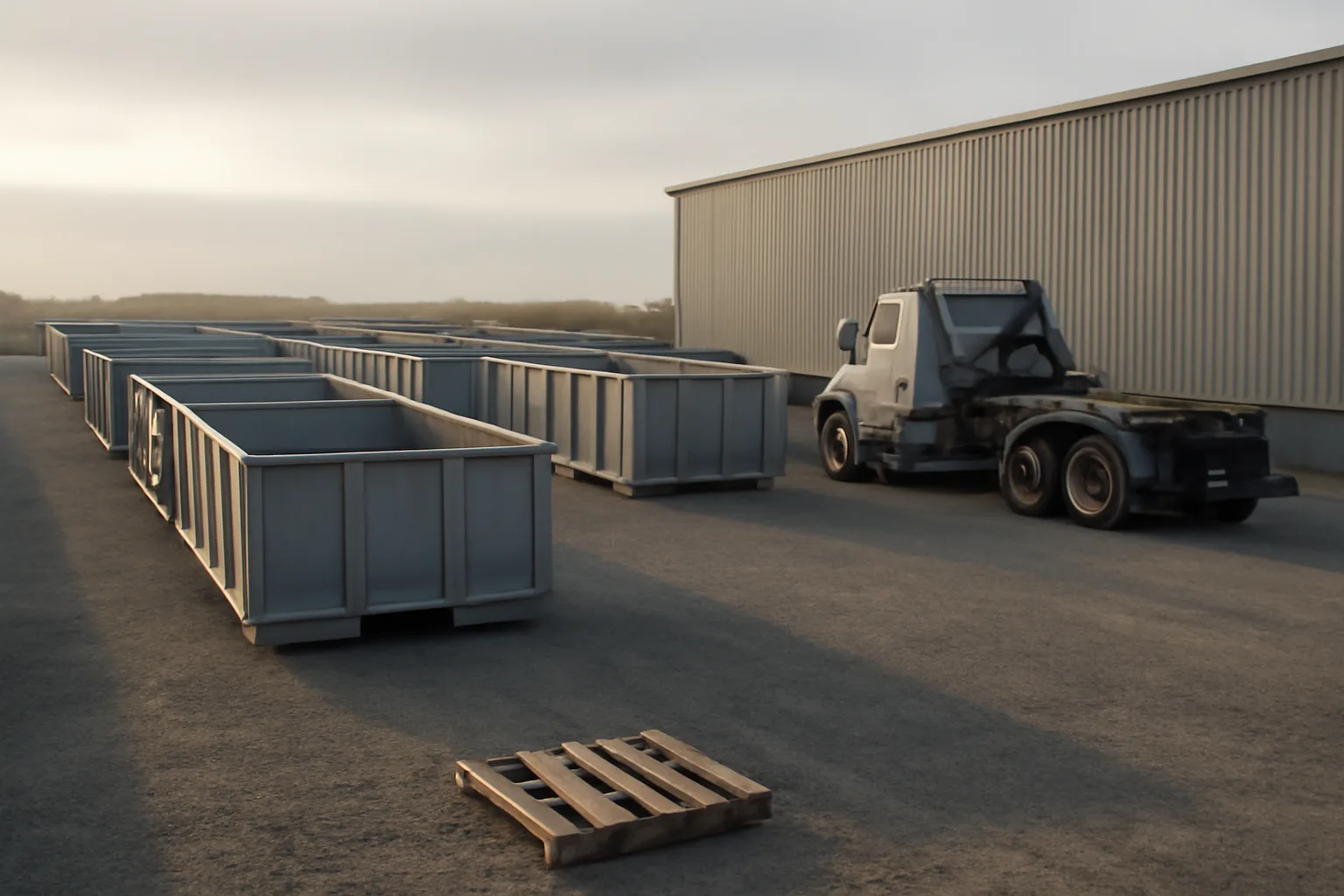
A site services yard is the land base for a business that stores, maintains, and dispatches the temporary gear that construction sites and events run on. Portable toilets live there. So do roll-off boxes, fence panels, storage containers, and water tanks. The yard is not the jobsite. It is the lot you come back to after the last job.
Most operators run it as outdoor storage plus light maintenance. You park fleet. You stage empty boxes and clean units. You might wash tanks, weld gates, or sort bent fence. That mix is why cities, insurers, and water boards treat the address as an industrial use even when your invoices read like simple rentals.
NAICS mapping follows the revenue, not the nickname on the gate. Site preparation work sits in 238910. Solid waste collection sits in 562111. Support services can land in 561990. Construction and transportation equipment rental can land in 532412. Pick the code that matches what customers actually pay you for. [11]
People confuse the yard with a general contractor shop. A GC shop builds. A site services yard feeds other people's sites. If you also grade or install utilities, you stacked two businesses. Keep two sets of books even if they share one gate. Shared tools are fine. Shared tax stories are not.
The yard is a compliance object too. Neighbors see trucks at dawn. Stormwater sees oil. Cities see outdoor storage of waste containers. That is why the paper path matters more than a logo wrap. If the lot is illegal, the route does not matter.
How do you start a site services yard?
You start by controlling land that already allows outdoor storage and commercial fleet, then forming a legal entity, then collecting only the licenses your services trigger. The order matters. Equipment is not step one. A truck payment on land you cannot legally use is how people burn a year.
Here is the path I would actually walk. First, get a zoning verification letter or a written zoning interpretation for the exact address. A broker saying it should be fine is not a document. Second, form the entity with your secretary of state and write an operating agreement even if you are the only member. Third, apply for a free IRS EIN. The IRS says an EIN "is used to identify a business entity." [2] You can apply online at no cost. [1] Fourth, open a dedicated bank account. Fifth, bind insurance before the first unit leaves the lot. Sixth, add USDOT, stormwater, waste, or hauler credentials only if the work and the vehicles trip those rules.
SBA is blunt about structure: "The business structure you choose influences everything from day-to-day operations, to taxes, to how much of your personal assets are at risk." [3] For a single yard I would form an LLC in the state where the lot sits, then talk to a CPA about an S corp election after payroll is real. I would not form a C corporation on day one for this trade.
Do not skip the local business license. SBA notes that licenses and permits depend on your activity and location, and that you apply with the city, county, and state that have jurisdiction. [4] Confirm every fee with that board. Nobody can honestly quote your city's current charge from a national article.
I would not hire a driver until the truck class and the license class match. I would not paint the truck until the lease is signed. Those two delays feel unprofessional. They cost less than a rebrand on a lot you had to leave.
What licenses and permits does a site services yard need?
A site services yard needs the local business license, land use approval for outdoor storage, and then a stack that follows the work. There is no single federal site services yard license. Anyone selling you one is selling stationery.
Haul refuse or construction debris for a fee, and many states require a solid waste transporter, franchise hauler, or similar credential. That is a state environmental or utilities board problem. Confirm with that board. If you only rent fence and never touch waste, do not buy a hauler permit you do not need.
Place toilets, and some counties want a septage pumper or portable sanitation registration. Health departments vary hard. I have watched operators waste money filing the wrong bureau's form because a Facebook group posted another state's packet.
Vehicle credentials sit on the truck, not the brand name. Interstate commercial motor vehicles at 10,001 pounds or more generally need a USDOT number. [5] Drivers of vehicles at 26,001 pounds GVWR or more generally need a CDL. [6] Intrastate-only fleets still often need a state DOT number. Confirm with your state patrol or DMV motor carrier desk.
Contractor licensing is the trap. Renting and delivering equipment is not always contracting. Installing silt fence or doing grading often is. If your invoice says install, assume a contractor board will want a word. Confirm. Do not take a forum's word for it.
| Credential | Typical trigger | Who confirms |
|---|---|---|
| EIN | New entity, hiring, or a bank that requires one | IRS |
| USDOT number | Interstate CMV at 10,001 lb or more | FMCSA |
| CDL | GVWR 26,001 lb or more, plus other CMV classes | State driver license agency |
| SPCC plan | Over 1,320 gal aboveground oil | EPA or authorized state |
| Industrial stormwater | Industrial activity plus a discharge | State water board or EPA |
| HW generator ID | Above VSQG limits or stricter state rules | EPA or state environmental agency |
Do you need a USDOT number or a CDL for the yard trucks?
You need a USDOT number when your vehicle use matches FMCSA's interstate commercial motor vehicle tests, including a 10,001 pound weight trigger. You need a CDL when the vehicle class hits the 26,001 pound GVWR line or another CMV category. Plenty of first trucks sit right on those lines. Weigh the actual truck. Do not guess from a listing photo.
FMCSA says you must register for a USDOT number if you have a vehicle used in interstate commerce that "Has a gross vehicle weight rating or gross combination weight rating, or gross vehicle weight or gross combination weight, of 10,001 pounds or more," among other independent triggers such as certain hazardous materials. [5] That sentence is the one I would print and tape inside the shop.
A hooklift with a loaded 20 yard box will blow past 26,001 pounds. Plan the CDL path before you hire your cousin. The medical card, the skills test, and the state driver file are not weekend errands. [6]
Stay inside one state, and you may still need a state USDOT-style number and a cab card. IFTA fuel tax credentials show up once you cross state lines with qualified motor vehicles. Confirm with your state department of transportation. I would not run interstate just this once on a pickup plate and hope.
FMCSA uses a 10,001 pound weight trigger for many interstate USDOT registrations. That number is not a rumor. It is the agency's published line. [5]
What zoning and land rules apply to a site services yard?
A site services yard lives or dies on zoning and the lease. You need a parcel that allows outdoor storage, commercial vehicle parking, and the specific nuisance items you will keep. Empty waste containers count. So do toilets and fuel. If the use table lists a contractor's yard or equipment storage as a conditional use, budget time for a hearing. I would not close on land until that paper exists.
Check floodplain status on FEMA maps before you grade a pad. A floodplain lot can still work. It changes fill permits, insurance, and where you store oil. Confirm with the local floodplain administrator, not with a topographic vibe from the driveway.
Neighbors will call about backup beepers at 5 a.m. Hours of operation, screening, and a dust plan often matter more than the use classification. A tall wood screen costs less than a fight. I would put the wash rack and the dumpsters at the back, not along the road.
Home occupation rules almost never allow a row of roll-off boxes. Do not build the business on a residential driveway and plan to move later. Moving later means you buy the fence twice.
Lease language should name outdoor storage, after-hours dispatch if you need it, and who owns stormwater improvements. Get that in writing. A handshake about the back acre is how you lose the acre.
What environmental paper hits a site services yard in year one?
Environmental paper shows up when you store oil, wash equipment, or let industrial stormwater leave the lot. EPA's SPCC rule is built around preventing oil discharges to navigable waters. Facilities with more than 1,320 gallons of aggregate aboveground oil storage capacity generally fall in scope if a discharge to waters could reasonably be expected. [7] Count drums plus tanks plus the diesel cube. Do not count only the pretty tank you labeled.
EPA sets the SPCC aboveground oil storage threshold at 1,320 gallons. [7] Trip it, and you need a plan. A professional engineer must certify many of those plans. I would count every container 55 gallons and up before I told myself I was too small.
Industrial stormwater is a separate pile. EPA's Multi-Sector General Permit covers stormwater discharges associated with industrial activity in areas where EPA is the permitting authority. [9] Most states run their own NPDES industrial program. Vehicle maintenance on site is a classic trigger. Confirm with the state water board. A SWPPP is not a poster. It is a site map, a control list, and an inspection habit.
Wash water from toilets and trucks is wastewater, not stormwater. Do not put it in the ditch. Talk to the sewer utility about a sand-oil interceptor and a discharge approval. If you store waste oil, solvents, or batteries, EPA generator categories start at 100 kilograms per month for the very small quantity generator line. [8]
I would spend money on containment pallets before I spent a dime on a sculpture at the gate. Spills are how quiet yards become famous.
How much does it cost to open a site services yard?
Nobody publishes a clean national average for what a site services yard costs to open. Dirt work, gravel depth, drainage, and the first used truck swing the number far more than business cards do. State filing fees are the only line that is truly board-priced, and they are not the big line.
California's secretary of state publishes LLC articles of organization at $70 on its filing fee schedule. Confirm that figure on the current fee page before you write a check, because boards change schedules. [12] Other states price formation differently. If you want state-shaped notes instead of a fake national total, start with site services yard cost in Alabama, what you'll actually spend in Alaska, Arizona, Arkansas, California, and Colorado.
I would budget first for a security deposit and early months on industrial land, fence and rock, a used truck that already matches your license class, a starter set of rentable units, an insurance down payment, and a lawyer plus CPA for formation. I would not budget first for a custom paint job or a full dispatch platform.
Want a worksheet that forces shared-yard math (what you can stage per acre, what sits idle)? SiteServicesPath sells a $249 one-time Shared-Yard Economics Kit. The public path in this article still works if you never buy it.
Do not treat Section 179 as free money. IRS Publication 946 explains how to depreciate property and how the Section 179 expense election works, including annual limits that change. Confirm the current cap in that publication. [15]
What insurance does a site services yard actually need?
A site services yard needs commercial auto on every power unit, general liability for off-site placement, and inland marine or floater coverage on the toilets, boxes, and fence that live on other people's dirt. If you have employees, workers compensation is not optional in most states. Pollution coverage matters once you haul waste or run a wash rack.
I will not quote premiums. Anyone who publishes a single national general liability price for this trade is guessing. Your loss history, radius, and whether you haul municipal solid waste change the number. Sit with a licensed agent who already writes dumpster or sanitation accounts. Bring the vehicle schedule and the radius.
Certificates of insurance will show up in every general contractor onboarding pack. Additional insured and waiver of subrogation wording is a contract fight, not a product you invent at 9 p.m. Read the subcontract before you deliver the first box.
Skip the cheap policy you cannot explain. One unpaid claim ends the yard. I would rather start with fewer units and a real admitted carrier than a pretty fleet on paper that will not defend a jobsite injury.
What equipment belongs in a first-year yard?
Buy a used truck that your driver can legally operate, then buy the units that turn weekly. That is the whole first-year equipment plan. A 20 yard box that rents beats a new service body you polish.
I would start with one hooklift or roll-off, or a small toilet route, only if that market is already calling you. Two half businesses means two half routes and one exhausted owner. Pick the revenue line you can sell this month.
Forklifts and skid steers show up fast. OSHA's powered industrial truck rule says the employer shall ensure each operator is competent, "as demonstrated by the successful completion of the training and evaluation specified in this paragraph (l)." [10] Keep the evaluation on paper. A laminated card from a guy at the auction is not a file.
Waste of money: a monument sign, a brand new class 8 when a decent class 7 exists, and routing software before you have repeating stops. A shared spreadsheet is ugly and it works.
Yard improvements that pay: rock that keeps you out of the mud, a lockable connex for tools, lighting that points down, and a camera that actually records plates. Mud is not a vibe. Mud is lost days and angry neighbors.
How do you set up the entity, EIN, and bank path?
Set up the entity in the state where the yard sits, get the EIN the same week, and open the bank account before the first customer check arrives. That sequence keeps your personal name off the wrong tax forms.
An IRS EIN can be obtained online at no cost. [1] Third party sites that charge you for the same government form are a waste. Keep the CP 575 notice in a folder you can find. Banks and insurers will ask for it. [2]
An operating agreement is not decoration. It says who owns what, how capital calls work, and what happens if a partner stops showing up. I would pay a business attorney for a plain agreement and skip the cheap template that conflicts with your state act.
Sales tax permits, reseller certificates, and employer withholding accounts come next if you have taxable rentals or payroll. Confirm with your state department of revenue. IFTA and IRP show up with interstate qualified vehicles. Do not mix IFTA in the same week as formation unless you already have the truck titled and plated.
Hire someone, and federal wage and hour rules under the Fair Labor Standards Act apply to most employers. [13] Overtime and time records are not construction culture. They are statute. Confirm details with DOL if you are close to an exemption you do not understand. I would run payroll through a real service once the second person is on site. Handwritten envelopes hide mistakes until they become back wages.
What first-year operations paperwork should you keep?
Keep a boring file that would survive a bad week. Formation documents, EIN letter, lease, zoning letter, insurance policies, vehicle titles, driver qualification files if you use CDL drivers, training records, scale tickets, waste manifests, and every invoice.
With more than 10 employees, OSHA injury and illness logs generally apply. 29 CFR 1904.1 says if your company had ten or fewer employees at all times during the last calendar year, you do not need to keep those records unless OSHA or BLS informs you in writing. [14] Count people. Do not count full time equivalents you feel like counting.
Inspection logs for fire extinguishers, weekly stormwater walks if you have a SWPPP, and SPCC monthly visual checks if you have a plan all belong in the same cabinet. Digital is fine if you can export it next Tuesday, not after a restore from a dead laptop.
I would reconcile the bank and any IFTA account quarterly, not in a panic in January. I would not keep customer checks in the glove box. I would not deduct a cost I cannot explain as ordinary for a yard just because a podcast host deducted a boat.
What should you confirm with the board before you spend money?
Confirm four things in writing before you spend on iron. One, the zoning use for that address. Two, whether your services need a state hauler, septage, or contractor license. Three, whether the sewer utility will take wash water. Four, the current formation and tax fees on the secretary of state and tax department sites.
Boards change forms. A PDF you found in 2022 is not a filing. Never invent a current fee, quota, or processing time from memory. Render those as confirm with the relevant board.
SiteServicesPath is an independent publisher, not a law firm and not a service company. Nothing here is an approval, a timeline, or legal advice. If you want a paid worksheet after you have done the free public checks, the kit lives at /start.
State cost pages on this site exist so you can see how the paper priced out in places like Florida and Georgia. Use them as a map. Then call the board that actually cashes the check.
Frequently asked questions
What is site services yard?
A site services yard is the fenced operations lot for a company that stores and dispatches site-support gear such as portable toilets, roll-off boxes, temporary fence, and tanks. It is not the construction jobsite. It is where fleet parks, units get staged or washed, and dispatch starts. Zoning, stormwater, and vehicle rules attach to that lot.
How do you start site services yard?
Lock land that already allows outdoor storage and commercial trucks, form an entity, get a free IRS EIN, open a business bank account, and bind insurance. Add USDOT, CDL drivers, hauler, or stormwater paper only if your trucks and services trip those rules. Confirm every local fee with the issuing board before you pay a filer.
Do I need a contractor license just to store and deliver rentals?
Often no if you only drop and pick equipment and the customer installs nothing through you. Yes if your invoice includes installation, grading, or other contracting. The line is fact-specific. Confirm with the state contractor board for the exact services on your price list. Do not copy another state's answer.
Can I run a site services yard from my house?
Almost never if you mean boxes, toilets, and commercial trucks. Home occupation rules usually ban outdoor storage of that scale. Neighbors and code officers will find you. Lease industrial or heavy commercial land first. A farm parcel can still be zoned in a way that forbids a contractor yard. Read the use table.
What NAICS code do site services yards use?
There is not one code. Site preparation contractors are 238910. Solid waste collection is 562111. All other support services can be 561990. Construction equipment rental is 532412. Code the activity that produces the revenue. Banks and insurers will ask. Census publishes the current definitions for each code.
Do portable toilet wash racks need a sewer permit?
Usually you need written approval from the sanitary sewer utility before you discharge wash water. Do not drain to a storm inlet. Many utilities want a sand-oil interceptor and a sample point. If you are on a septic system, do not assume it can take that load. Confirm with the utility and the health department.
When does stormwater permitting apply to the lot?
It applies when you have stormwater discharges associated with industrial activity, which often includes on-site vehicle maintenance. EPA's MSGP is the federal template. Most states issue their own industrial general permit. Confirm with the state water board for your actual activities. A clean lot with no maintenance can still need local grading permits.
Is an LLC required to open a yard?
No. You can operate as a sole proprietor. I would still form an LLC in the lot's state because the personal asset risk on trucks and jobsites is real. SBA explains that structure changes taxes and liability. Pay a local attorney for formation that matches your state act. Confirm current filing fees with the secretary of state.
How many trucks do I need to start?
One legal truck is enough if it matches the product you can already sell. Two trucks before you have a route is how people finance paint. I would rather have one reliable hooklift and ten rentable boxes than a matching fleet and empty land. Add a second unit when the first is fully booked on weekdays, not when you are bored.
Do I need workers compensation if I am solo?
Many states do not require workers compensation for a true owner-only shop with no employees. The moment you hire, or you use labor that looks like employment, the answer changes. Some general contractors will still demand a policy or a waiver on the certificate. Confirm with your state workers compensation agency and the contracts you sign.
What records does OSHA want for a forklift?
You need proof each operator completed training and an evaluation under 29 CFR 1910.178(l). Keep the name, date, trainer, and the evaluation of driving skill. Refresher training is required after incidents, unsafe operation, or workplace changes. A wallet card without a file will not help you after an injury.
What is the first document I should get?
A written zoning verification for the specific address, naming outdoor storage and commercial vehicle parking. Everything else can wait a week. A truck cannot. If the use needs a conditional permit, you just learned the real calendar. I would not pay a nonrefundable deposit until that letter exists.
Does interstate work change the paper stack?
Yes. Interstate commercial motor vehicles at 10,001 pounds or more generally need a USDOT number. Qualified motor vehicles that cross state lines bring IFTA and often IRP plates. Driver qualification files get more formal. Staying inside one state does not erase state motor carrier numbers. Map the lanes before you take the out-of-state order.
Can I share a yard with another operator?
Yes, and it can be smart if the lease and insurance name both uses. Write who owns the stormwater plan, who reports a spill, and how gate codes work. Shared yards fail on waste oil and customer boxes that get mixed. Put unit numbers and a simple inventory rule in the sublease. Confirm the landlord allows subtenants in writing.
Sources
- IRS, Employer ID Numbers: An EIN is used to identify a business entity
- U.S. Small Business Administration, Choose a business structure: Business structure influences operations, taxes, and personal asset risk
- FMCSA, Do I Need a USDOT Number: Interstate CMVs at 10,001 pounds GVWR/GCWR/GVW/GCW or more generally require a USDOT number
- FMCSA, Commercial Driver's License: A CDL is required to operate commercial motor vehicles at 26,001 pounds GVWR or more and other listed CMV classes
- U.S. EPA, Categories of Hazardous Waste Generators: Very small quantity generators are generally those generating 100 kilograms or less of hazardous waste per month
- U.S. EPA, Stormwater Discharges from Industrial Activities (2021 MSGP): EPA's Multi-Sector General Permit covers stormwater discharges associated with industrial activity where EPA is the permitting authority
- OSHA, 29 CFR 1910.178 Powered industrial trucks: Employers must ensure each powered industrial truck operator is competent as demonstrated by specified training and evaluation
- U.S. Census Bureau, 2022 NAICS definition 238910 Site Preparation Contractors: NAICS 238910 is the Census classification for site preparation contractors
- U.S. Department of Labor, Fair Labor Standards Act: The Fair Labor Standards Act sets federal minimum wage, overtime, and recordkeeping rules for most employers
- OSHA, 29 CFR 1904.1 Partial exemption for employers with 10 or fewer employees: Employers with ten or fewer employees at all times during the last calendar year generally do not keep OSHA injury and illness records unless notified in writing
- IRS, Publication 946 How To Depreciate Property: Publication 946 explains depreciation and the Section 179 expense election, including annual dollar limits that IRS updates