Last updated 2026-08-21
TL;DR
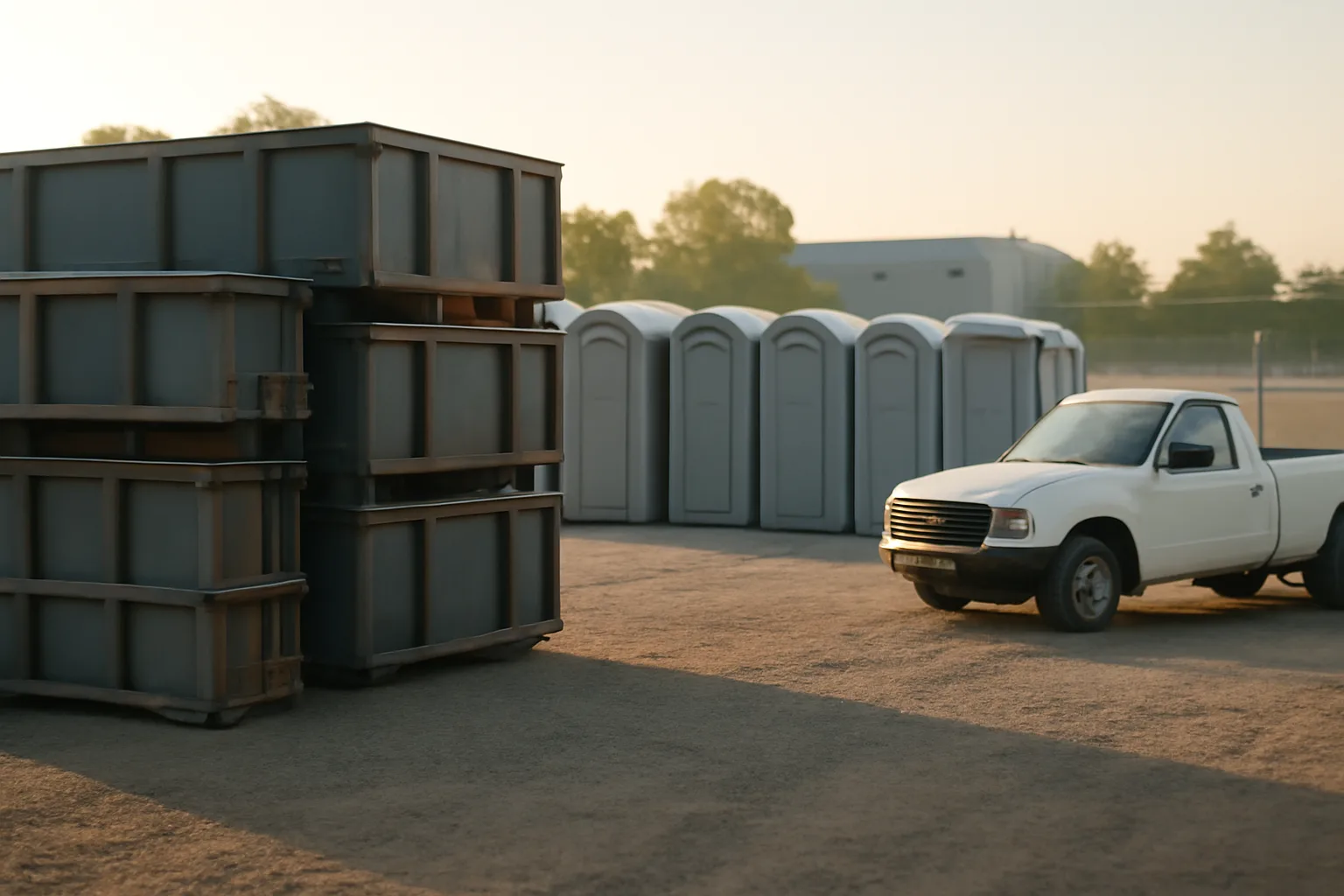
A site services yard is the fenced lot where you stage portable toilets, dumpsters, temporary fence, tanks, and the trucks that move them. You start by locking land use first, then entity paper, then only the fleet that matches your first route. There is no federal yard license. Confirm zoning, waste, and stormwater with your local board before you buy steel.
What is a site services yard?
A site services yard is the fenced depot that holds and turns the units a construction support company sends to jobs. Portable toilets, wash stations, roll-off boxes, temporary fence, storage boxes, light towers, water tanks, plus the trucks and the shop that keep them moving. It is a land business first.
The public sees a messy lot. You should see three cost centers. Land and its permits. Fleet and drivers. Units in the field that get dirty, stolen, or delayed. Let one go sloppy and the other two cannot save you.
I do not treat a site services yard as a single licensed trade. There is no one state card. Some pieces look like solid waste collection. Some look like equipment rental. Some look like septage hauling. Your mix decides your paper. A fence-only yard and a toilet-pumping yard are not the same company, even when they share a gate.
People also confuse the yard with the job. OSHA sanitation rules attach to the construction employer on the site, not automatically to you as a rental vendor. Still, your units are how that employer meets 29 CFR 1926.51, which says, "An adequate supply of potable water shall be provided in all places of employment." [1] Sell the toilet and the water and you are inside that system. You are not the OSHA duty holder unless you are also the contractor. Read the contract.
Census NAICS will not hand you a perfect box. Many operators land in 532490 (other commercial equipment rental), 562111 (solid waste collection), 238990 (all other specialty trade contractors), or a waste code that matches septage. Pick the code that matches what you actually invoice. Your insurer and your county business license will ask. Guessing "construction" because it sounds serious is how you get the wrong workers-comp class.
Here is the working definition I use. If steel sits on your gravel, gets washed or repaired there, then earns rent on someone else's dirt, you are running a site services yard. If you want a side-by-side with taking a nearby W-2 instead, read site services yard vs nearby career. The yard wins only if route density is real.
How do you start a site services yard?
You start a site services yard by proving the land is legal for outdoor storage and washing, forming a state entity, getting a free EIN, then adding only the local hauler, health, and stormwater paper your first service line actually needs. Buy steel last. Confirm every permit with the board that issues it.
Nobody can promise you a timeline. Here is the order I would use. I have watched people invert it and eat the deposit.
First, sit with planning and zoning. Ask about outdoor storage, tractor-trailer circulation, hours, screening, and whether washing units counts as an industrial process. Ask if a conditional use permit is required. If you will dump or transfer toilet waste, ask environmental health the same week. A lot that reads industrial on a zoning map can still ban septage. Get the answer in writing.
Second, form the entity the way your state wants it. The U.S. Small Business Administration walks through registration, state tax IDs, and local licenses on its Register your business page. [6] Then get an Employer Identification Number from the IRS online. That application is free. [7] Do not pay a reseller for an EIN.
Third, decide the first service line with brutal honesty. Portable toilets need a legal waste destination and a service truck. Roll-offs need a legal disposal site and, in many cities, a collector permit or a franchise you cannot break. Fence and storage boxes need space and a forklift or boom, and they need less health paper. I would start with the line whose disposal or dump path I already have in writing.
Fourth, only then price trucks and inventory. A pretty fleet on illegal land is scrap.
Fifth, stand up the people paper if you will hire anyone. Use Form I-9 for identity and work authorization. [8] Follow wage and hour rules under the Fair Labor Standards Act. The federal minimum wage listed by the Wage and Hour Division is $7.25 an hour, and many states set a higher rate, so confirm the current WHD figure and your state poster before you hire. [9] Ask your state about workers compensation class codes. Do not let a buddy help out off the books. That is how you buy a claim you cannot pay.
No approval or timing guarantees exist in this path. Processing is local. Confirm with the relevant board.
What licenses and paper does a site services yard need?
A site services yard needs state entity papers, a local business license, land-use approval, and then activity licenses that match what you haul or store. There is no national yard card. Waste, septage, and over-the-road trucks each add their own file. Confirm names and fees with the issuer. Fees change.
I keep a folder labeled gate and a folder labeled road. Gate is zoning, occupancy, fire, stormwater, and fuel. Road is USDOT or state DOT, CDL drivers, oversize if you haul long fence racks, and any solid waste collector permit. Mix the folders and renewals get missed.
Run a commercial motor vehicle in interstate commerce at 10,001 pounds GVWR or more and FMCSA says you need a USDOT number. [5] Intrastate-only fleets often still need a state number. Confirm with your state DOT, not a Facebook group. I would not take a customer's word that everyone around here just goes.
Hazard communication still applies in the shop. OSHA's 1910.1200 rule is the SDS and labeling rule for chemicals you use to clean toilets, degrease parts, or treat waste. [10] If a 55-gallon drum of anything carries a pictogram, you need the program. This is boring paper. It is also the binder a fire inspector understands.
Generate hazardous waste (spent solvents, some aerosols, certain shop wastes) and your EPA generator category depends on monthly quantity. Very small quantity generators sit at 100 kilograms or less per month. The next rung is more than 100 kilograms up to 1,000 kilograms. [4] Weigh it. Do not guess.
For a longer paper walkthrough in this same series, site services yard guide 12 sits next to this one.
| Paper | Who usually issues it | What trips it |
|---|---|---|
| Entity and EIN | State plus IRS | Any real company [6][7] |
| Zoning or CUP | City or county planning | Outdoor storage, washing, truck traffic |
| Solid waste collector | City, county, or state | Roll-off or dumpster routes |
| Septage or wastewater | County health or state | Toilet pumping and dump |
| USDOT or state DOT | FMCSA or state | CMV weight and commerce [5] |
| Stormwater | EPA or authorized state | Disturbed acres or industrial exposure [2][11] |
| SPCC | EPA, sometimes with a PE | Oil storage over 1,320 gallons [3] |
Confirm every row. I have seen two adjacent counties split septage and solid waste differently.
What land and zoning does a site services yard need?
You need land that already allows outdoor storage of equipment and, if you wash or pump, the industrial-style activity that comes with it. A cheap acre with the wrong use table is not cheap. Confirm the use with planning before you sign a lease.
I would not close on a contractor yard listing until I have the zoning code section in my hand and a planner has said, out loud, whether portable toilets and roll-offs count as outdoor storage, a waste facility, or a prohibited use. Those three answers lead to three different lives.
Ask about screening, setbacks, overnight idling, and whether you can store units higher than the fence. Ask where wash water is allowed to go. If the answer is the ditch, walk. Wash water off toilets and stained boxes is not a casual discharge. Stormwater rules sit underneath that whole conversation. [11]
Driveway geometry matters more than office paint. Can a truck and trailer turn in without blocking the county road? Can a fire apparatus reach the fuel? The fire marshal will ask. I would spend money on gravel section and drainage before I spend a dollar on a break room.
Sharing a yard can be rational. Sharing without a written license that names who holds the stormwater plan and who holds the fuel is not. If you want a comparison of operating models, site services yard guide 18 is the next read.
What equipment should you buy first for the yard?
Buy the smallest set of units that can finish a week of routes you already have in writing, plus the truck that legally moves them. Everything else can wait. A half-empty lot of new plastic is a storage bill.
I would not buy a new vacuum truck in month one unless toilet service is the only product and I have dump rights. Vacuum trucks are expensive to sit. A used service body on a chassis that is legal for your driver pool is the better first bet for toilets. For fence, a flatbed and a deep inventory of panels beats a fancy truck. For roll-offs, the truck is the business and the boxes are the float. Do not under-buy boxes. You will strand a truck.
Skip the machine shop. Skip the customer lounge. Skip wrap on every unit before you have a route. Branding does not pull permits.
If you need a forklift, budget training and a spot that is not a mud hole. If you store diesel in totes, read the SPCC threshold before the third tote arrives. EPA sets the SPCC aboveground oil threshold at 1,320 gallons in 40 CFR part 112 for containers of 55 gallons or more, when the facility could reasonably discharge to waters of the United States. [3] That number sneaks up on people who just added another tote.
Theft is an equipment problem. Fence yards bleed panels. Containers walk when you do not track serials. Cameras help. A written checkout sheet helps more.
How much does a first-year site services yard cost?
Nobody publishes a clean national first-year cost for a site services yard. Local land, franchise rules, and steel prices move too fast. What you can budget with receipts is paper, deposits, insurance down payments, and the first truck. Treat online startup cost listicles as fiction.
Land is the swing factor. A shared industrial lot with a written license can be rational. Owning eight acres for later is how people run out of cash before the first route densifies. If you want a structured way to compare shared land versus owned land, the Shared-Yard Economics Kit is a $249 one-time worksheet pack. Use it or a spreadsheet you already trust. Either way, do the land math before the equipment math.
Insurance is a real check you write, and I will not invent a premium. Ask a licensed agent for quotes on general liability, commercial auto, inland marine (the units off your lot), pollution or sewage-related coverage if you pump, and workers comp. Bring your actual NAICS and your actual radius. Wrong class codes waste money twice.
Disposal and dump fees will dwarf coffee and software. Get the gate rate in writing from the landfill or the wastewater plant. If the plant will not take your septage, you do not have a toilet company.
Cash cycle is ugly. Contractors pay slow. Your fuel vendor will not. I would keep more cash than feels dignified.
For state-by-state friction, the hardest states for a site services yard right now is the comparison piece.
What environmental rules hit a site services yard on day one?
The environmental rules that hit first are stormwater, wash-water disposal, oil storage, and any hazardous waste your shop makes. Disturb one or more acres while you build the lot and EPA's 2022 Construction General Permit (or your state's authorized stand-in) is in play for that construction activity. [2] Confirm with the water board. Do not assume a gravel pad is not construction.
EPA's industrial stormwater program covers certain industrial activities with material exposure to rain. [11] A yard that parks oily equipment and dumps wash water on the ground is begging for a notice. I would keep oils under roof and wash on a pad that drains to a legal tank, not to the catch basin.
SPCC is the oil plan. The 1,320-gallon aboveground aggregate in 40 CFR part 112 is the tripwire people miss, and it only counts containers of 55 gallons or larger. [3] Secondary containment is not decoration. One tipped tote can close a lot for a week.
Handle toilet waste and you are in septage rules, which are state and county. That is not RCRA hazardous waste in the normal case, but your shop chemicals might be. EPA's generator categories start mattering at 100 kilograms in a month. [4] Keep the streams separate. Mix a little solvent into a septage load and you can lose dump privileges.
I would hire a local environmental consultant for one site walk, not a national binder mill. One afternoon with someone who knows your county is enough for a first punch list.
What insurance does a site services yard actually carry?
A site services yard typically carries commercial auto, general liability, property or inland marine on the units, and workers compensation once you have employees. Pollution or sewage coverage is the one people skip and then regret. Required coverages and limits are set by state law, your landlord, and your customers' vendor packets, not by a blog. Confirm with a licensed agent.
I would not start without auto and GL quotes in hand. Customers will send you a vendor packet that asks for additional insured status and sometimes a waiver of subrogation. Fail the packet and you cannot take the work. Read the packet before you bid.
Inland marine (or an equivalent floater) is how you insure toilets and panels that live on someone else's site. Lot-only property insurance will not follow them. Ask the agent that exact question.
Workers comp class codes for yard labor, drivers, and construction carry different prices. Code the work you actually do. Mis-classing to save a quarter is a gift to the auditor.
I will not quote premiums. They move with losses, radius, and driver records. Anyone giving you a national average is selling something.
More model comparisons live in site services yard guide 30.
How do construction sites use a site services yard?
Jobs use a site services yard as a just-in-time closet. They call when the headcount jumps, when a dumpster fills, or when the GC's vendor packet says toilets must appear before mobilization. Your route density is the product. The unit is just the SKU.
OSHA's construction sanitation table is why toilets get ordered at all. For 20 or fewer employees the table calls for 1 facility. At 20 or more it is 1 toilet seat and 1 urinal per 40 workers. [1] Superintendents will still under-order. Put the table in your quote. It saves a fight later.
Water sits in the same standard. That potable water sentence is not poetry. In heat, it is the call you get at 6 a.m.
Roll-off customers care about haul time and overweight fees. Fence customers care about panels that match and stands that are not bent. Container customers care about delivery windows. None of them care about your brand story.
I price delivery and service separately from the monthly rent. Bundled unlimited flips is how you work for free.
Still comparing this life to a nearby paycheck? Site services yard vs nearby career for first-year pay is the honest version of that argument.
What records should you keep from week one?
Keep land-use approvals, dump authorizations, scale tickets, service tickets, SDS sheets, I-9s, driver files, and a simple injury file even if you think you are too small. The first inspector will ask for the thing you thought was optional. Paper that is dated beats a speech.
OSHA injury recordkeeping has a small-employer off-ramp. 29 CFR 1904.1 says, "If your company had ten (10) or fewer employees at all times during the last calendar year, you do not need to keep OSHA injury and illness records unless OSHA or the BLS informs you in writing that you must keep records under § 1904.41 or § 1904.42." [12] Severe-injury reporting is a different duty. Confirm current reporting triggers on OSHA's site. I would still keep a private incident file. Memories rot.
Scale tickets and waste manifests are how you prove you did not dump in a field. Keep them longer than you want to. Your landfill or wastewater plant will tell you their retention expectation. Confirm it.
Driver files: CDL, medical card, MVR, training. Under FMCSA, the driver-qualification file has a set list. [5] If you are not under FMCSA, keep the same file anyway. It is cheap discipline.
HazCom SDS must be available to workers. [10] A binder in a locked office at 2 a.m. is not available. I-9s have their own retention rules. Follow the USCIS instructions, not a meme. [8]
What first-year site services yard mistakes waste money?
The expensive mistakes are illegal land, exclusive-franchise dumpster dreams, over-buying units before routes exist, and treating fuel storage as a hardware-store problem. Training and software are not the usual killers. Dirt and disposal are.
I would not sign a national territory pitch. This work is local politics plus trucks. A PDF of a map is not a moat.
I would not build a wash rack that drains to a storm drain until we get busy. That sentence has closed yards.
I would not hire a family member as the only driver without a backup. One medical card lapse parks the company.
I would not ignore vendor packets until you win the bid. Winning a bid you cannot insure is a loss.
I would not assume a home driveway is a starter yard. Overnight commercial storage, truck traffic, and wash water are how neighbors and code officers find you. Confirm home-occupation and outdoor-storage rules first. Most residential lots fail that test.
Compare operating notes across this series if you like checklists. Site services yard guide 36 and site services yard guide 42 cover adjacent cuts of the same problem.
How do you confirm site services yard facts with the local board?
You confirm facts by asking the issuer for the form name, the current fee, and the statute or ordinance number, then writing down the person's name and the date. If they will not put the use in an email, it is not confirmed. No article can hold your county's fee table still.
Call planning, environmental health, the solid waste division, the fire marshal, and the water board as five separate conversations. They do not share a brain. I lead with a plain sentence. I want to store and dispatch portable toilets and roll-off boxes from this parcel, and I may wash units on a pad. What use is that, and what applications do I file? Then I shut up.
Running CMVs? Add FMCSA or your state DOT. [5] Hiring? Add your state labor agency and remember federal wage and I-9 rules still apply. [8][9]
I do not offer approval or timing guarantees. Anyone who does is not the person who stamps the permit.
Want the shared-land worksheets after you have the board answers? They are at /start. That is optional. The board answers are not.
Frequently asked questions
What is a site services yard?
A site services yard is the fenced depot behind a construction support company. You store, wash, repair, and dispatch portable toilets, dumpsters, temporary fence, tanks, and related units, plus the trucks that move them. It is a land-and-logistics business, not a single state license. Your mix of services decides the real paper.
How do you start a site services yard?
Lock land use first with planning and, if you wash or pump, environmental health. Form a state entity, get a free IRS EIN, then add only the hauler, health, stormwater, and fleet paper your first service line needs. Buy steel last. Confirm every fee and form with the board that issues it. Nobody can promise timing.
Do I need a CDL to run a site services yard?
Only if the truck you actually drive meets your state's CDL weight, combination, or hazmat triggers. A light service truck may not. A roll-off or loaded combo often will. Confirm GVWR, GCWR, and cargo with your state driver license agency before you buy the chassis. Do not take a seller's word on it.
Is a residential driveway legal for a site services yard?
Usually no. Overnight commercial storage, customer trucks, and wash water trip zoning and nuisance rules on most residential lots. Home-occupation clauses rarely cover a toilet or dumpster fleet. Ask planning in writing before the first unit sits there. A cheap driveway that gets a stop-work order is not a starter plan.
What NAICS code should a site services yard use?
There is no single perfect code. Operators often use 532490 for equipment rental, 562111 for solid waste collection, or 238990 for specialty trade work, depending on what they invoice. Match the code to the real revenue line. Insurers and business licenses will ask. Confirm with Census NAICS tools and your agent.
Can I start with only portable toilets?
Yes, and it is often cleaner paper than dumpsters in franchise cities, if you already have a legal dump point for septage. You still need land use, a service truck, health or hauler credentials where required, and a place that will accept the waste. Without dump rights in writing, you do not have a toilet company.
Do diesel totes trigger an SPCC plan?
They can. EPA's 40 CFR part 112 uses a 1,320-gallon aboveground aggregate for oil in containers of 55 gallons or more, if a discharge to waters of the United States is reasonably expected. A few 275-gallon totes add up fast. Confirm applicability and any PE-certification need with someone who reads part 112, not a tote vendor.
How many toilets does OSHA require on a construction job?
OSHA 29 CFR 1926.51 Table D-1 calls for 1 facility at 20 or fewer employees. At 20 or more it is 1 toilet seat and 1 urinal per 40 workers. That duty sits on the construction employer. If you supply the units, put the table in the quote so the order matches the headcount.
Do local-only trucks need a USDOT number?
Interstate commerce in a CMV of 10,001 pounds GVWR or more is the classic FMCSA USDOT trigger. Intrastate-only fleets often still need a state DOT number. Crossing a state line to a landfill or a vendor can change the answer. Confirm with FMCSA's "Do I need a USDOT number" page and your state DOT.
What insurance is required to open a site services yard?
State law, your landlord, and customer vendor packets set the real list. Plan on commercial auto and general liability at a minimum, plus workers comp once you have employees, and inland marine for units off the lot. Pollution or sewage coverage matters if you pump. Confirm limits with a licensed agent. I will not invent premiums.
Can two operators share one site services yard?
Yes, if zoning allows it and a written license assigns who holds stormwater, fuel, fire access, and insurance. Handshake sharing is how spills and audits become everyone's problem. Spell out who may store waste, who may wash, and who calls the fire marshal. Shared land can be smart. Shared liability without paper is not.
How long does zoning take for a yard?
I will not invent a processing time. Conditional use hearings, staff comments, and neighbor notices vary by city and by whether washing or waste is involved. Ask planning for the current application name and calendar. Get any use determination in writing. Anyone who guarantees a stamp date is not the person who stamps it.
Where can portable toilet waste be dumped?
Only where the wastewater authority or licensed septage facility says you may. That is usually a treatment plant or an approved receiving station, under a hauler credential your county or state issues. Field dumping is how you lose the company. Get acceptance in writing before you buy tanks or book the first service stop.
Do I need a stormwater permit to lay gravel for the yard?
If construction disturbs one or more acres, or is part of a larger common plan that will, NPDES construction coverage (EPA's 2022 CGP or the state equivalent) is the usual tripwire. Industrial stormwater can also apply once the yard operates with exposed materials. Confirm both questions with the water board for that parcel.
Sources
- OSHA 29 CFR 1926.51 Sanitation: Construction employers must provide potable water and toilets per Table D-1 (1 facility at 20 or fewer employees; 1 seat and 1 urinal per 40 workers at 20 or more).
- EPA 2022 Construction General Permit (CGP): Construction activity that disturbs one or more acres generally needs NPDES stormwater permit coverage under the CGP or an authorized state permit.
- eCFR 40 CFR Part 112 SPCC: SPCC applicability includes aggregate aboveground oil storage greater than 1,320 gallons in containers 55 gallons or larger, with a reasonable expectation of discharge to waters of the United States.
- EPA Categories of Hazardous Waste Generators: Hazardous waste generator category is based on monthly quantity, including a very small quantity generator cutoff at 100 kilograms or less per month.
- FMCSA Do I Need a USDOT Number: A USDOT number is required for interstate commerce in a commercial motor vehicle, including vehicles with a GVWR of 10,001 pounds or more.
- U.S. Small Business Administration Register your business: New businesses register with the state and obtain required state tax IDs and local licenses as part of launch.
- IRS Apply for an Employer Identification Number (EIN) online: Businesses can apply for an EIN online through IRS, and the IRS application itself is free.
- USCIS Form I-9: Employers must complete Form I-9 to verify identity and employment authorization for each person hired.
- U.S. Department of Labor Wage and Hour Division minimum wage: The federal FLSA minimum wage listed by WHD is $7.25 an hour, with many states setting a higher rate.
- OSHA 29 CFR 1910.1200 Hazard Communication: Employers must have a hazard communication program, including labels and safety data sheets, for hazardous chemicals in the workplace.
- EPA Stormwater Discharges from Industrial Activities: Certain industrial activities with stormwater exposure need NPDES industrial stormwater permit coverage.
- OSHA 29 CFR 1904.1 Partial exemption for small employers: Employers with 10 or fewer employees in the prior calendar year generally do not need to keep routine OSHA injury and illness records unless OSHA or BLS informs them in writing.