Last updated 2026-08-21
TL;DR
A site services yard is the fenced lot and shop you run construction support from: portable toilets, roll-off bins, temporary fence, water trucks, and the gear that keeps a jobsite legal. You start one by forming an entity, getting an EIN, locking zoning that allows outdoor storage and truck traffic, then stacking only the federal and state paper your actual activities trip. There is no single national license. Confirm every fee and form with the board that issues it.
What is a site services yard?
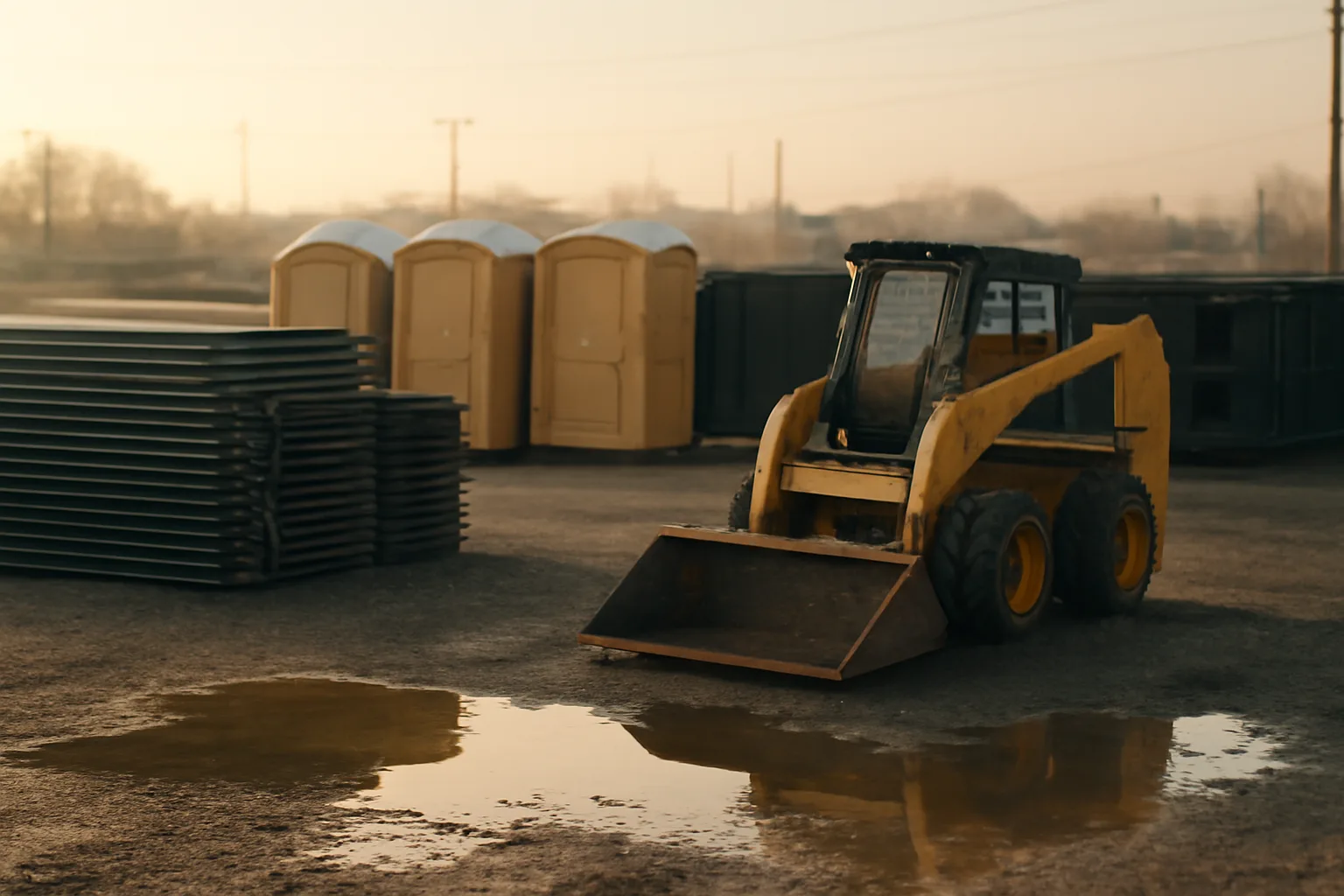
A site services yard is the fenced lot, shop, and staging area a contractor uses to store and dispatch jobsite support gear. Portable toilets, temporary fence, roll-off containers, water tanks, light towers, compact equipment, and the trucks that haul them all live there. It is an operating base, not a showroom and not the construction site itself.
If you invoice for keeping a jobsite legal and moving, you are in site services even if the card on the truck says something else. Some shops only rent fence. Some pump toilets. Some do both plus water and traffic control. The yard is what those shops share: outdoor storage, truck circulation, a wash area, and a place to lock up after dark.
Census NAICS 238910 (site preparation contractors) covers a lot of the dirt work next to this trade, including excavation, grading, and equipment use on site [1]. Your sales-tax desk and license board will not grade your NAICS poetry. They care what you store and what leaves the gate. Waste collection, septic, and specialty trade codes show up too. Pick the code that matches the invoices, then leave it alone.
I treat a true yard as a land-use problem first. Gravel. Stacked product. Backup alarms at 5:30 a.m. Mud on the public road. That is why planning staff get involved. A garage with two post-hole diggers is not a yard. A leased corner of someone else's lot is not a yard if you have no written right to be there.
Customers rarely visit. Drivers, mechanics, and the city inspector do. Design the place for them. Wide turns. A place to stage dirty units away from the neighbor's fence. A lock that two people can work at dawn without a speech.
People search "site services yard" hoping there is a national category with one form. There is not. The phrase is trade slang for the depot behind the work. The paper follows the land, the tanks, the trucks, and the heads on payroll.
How do you start a site services yard?
You start a site services yard by locking a legal land use, forming a business entity in your state, getting a free IRS EIN, then adding only the permits your trucks, tanks, waste, and employees actually trigger. There is no federal yard license. Do not buy iron until zoning is in writing.
The U.S. Small Business Administration lays out a plain sequence in its 10-step start guide: write a simple plan, pick a structure, register the business, get tax IDs, and apply for the licenses your activity needs [2]. I would swap one thing. Do the land-use check before you print cards. A planner who says a contractor's yard is not allowed in that district ends the project cheaper than a new roll-off truck does.
Get the EIN yourself on IRS.gov. The Service says, "Applying for an EIN is a free service offered by the Internal Revenue Service" [3]. Anyone charging you for that number is selling you a form you can file in minutes. Open a bank account in the entity name the same week. Track yard cost from day one. IRS Publication 583 is the starter tax map for records and first filings [4].
Hire later than you think. The day you have staff you add I-9s, wage-and-hour rules, and usually workers compensation. Confirm the WC trigger with your state board. It is not the same in every state. Some states start at the first employee. Some wait. I will not invent your state's number.
My actual order: option on the lot, zoning letter, entity, EIN, insurance binder, then the first truck. Everything else can wait a month. If the lot dies in planning, you still have an entity you can park. You do not have a truck payment on a use that never existed.
What licenses and permits does a site services yard need?
A site services yard needs local land-use approval, a city or county business tax certificate in most places, state tax registration if you sell or lease tangible goods, and then activity licenses (hauler, septage, contractor, overweight) only if you do those things. SBA is blunt: "The licenses and permits you need depend on your business activities, location, and government rules" [5].
No U.S. agency issues a universal site services yard card. People who tell you otherwise are selling a course.
If you install or erect and your state licenses contractors, you may need that board's classification. Fence rental with install is the usual tripwire. Pure drop-and-go toilet rental often is not contracting. Confirm. I have seen both answers in neighboring counties, which is why a national checklist is a myth.
Septage and portable-toilet pumping is a health and environmental license in a lot of states. The board is usually environmental quality or public health, not the contractor board. Do not guess. Ask for the form number and write it down.
Build a one-page list with the issuing board next to each line. Leave blanks. Call the board. Variable fees change. I will not quote a fee here because I cannot see your county's current schedule, and I will not invent one.
| Activity | Paper you likely need | Who confirms it |
|---|---|---|
| Outdoor storage and truck traffic | Zoning clearance or CUP | City or county planning |
| Selling or leasing goods | Sales and use tax permit | State revenue department |
| Interstate CMV at 10,001 lb or more | USDOT number | FMCSA |
| Pumping toilets or septage | Hauler or septage license | State health or env. board |
| Employees | I-9, payroll tax, often WC | USCIS, IRS, state WC board |
| Oil storage over 1,320 gallons | SPCC plan | EPA or the state desk |
That table is a map, not a permit. If a line does not match what you do, drop it. Extra licenses you do not need still create renewal work.
Do you need a stormwater permit for a contractor yard?
Maybe. A yard that stores materials, fuels equipment, or washes trucks outdoors can fall under industrial stormwater rules. EPA's 2021 Multi-Sector General Permit is the federal template many states copy or replace with their own general permit [6]. Construction stormwater coverage (the CGP) covers earth disturbance on the jobsite. It does not automatically cover the home yard [7].
If stormwater from your lot can carry oil, sediment, or wash water to a ditch or storm drain, assume you need a conversation with the state water board. Some states exempt small facilities. Some do not. Nobody has a clean national headcount of contractor yards that should have filed and did not. The closest honest statement is that exposed industrial activity plus a discharge path is what starts the analysis.
Budget for a simple SWPPP and boring housekeeping before you budget for a fight. Lid the dumpsters. Keep the wash pad from draining to the street. Park the leaky toilet on containment, not on gravel over a storm inlet. That is not optional manners. It is how you stay out of a discharge complaint from the property next door.
Confirm coverage, forms, and any fee with the state NPDES authority. EPA runs the industrial program directly only in a minority of states. Your neighbor's permit number is not yours. Copying their SWPPP without walking your own lot is how people file fiction.
What zoning do you need for a site services yard?
You need a zoning district that allows a contractor's yard, outdoor storage, or a similar industrial use, plus any conditional-use permit the ordinance requires. Home-occupation rules almost never allow stacked toilets, commercial truck traffic, or outdoor storage. Ask planning staff for the use name they will put on the permit. Then read that line in the code.
I would not sign a lease on a handshake that the last guy ran trucks here. Get a zoning verification letter. If the use needs a hearing, price the delay in months, not days. Neighbors show up for backup alarms and odor. Bring a site plan that shows stacking height, hours, and where trucks turn.
Shared lots still need the use to be legal for every operator. A sublease does not wash away the zoning. If the host is legal only as a warehouse with no outdoor storage, your fence panels in the side yard are still a violation.
Access matters as much as the zone. If your trucks cannot turn without jumping the curb, public works will become your most frequent visitor. Count axle loads on the apron. Cheap gravel that ruts in November is not a savings. It is a tow bill and a complaint file.
Rural land is not a free pass. County zoning and septic rules still apply. So does the driveway permit onto the state route. Call that office before you fall in love with a cheap parcel that has no legal access for a loaded truck.
When does a site services yard need a USDOT number?
You need a USDOT number when you operate a commercial motor vehicle in interstate commerce that meets FMCSA's thresholds, including a gross vehicle weight rating or actual weight of 10,001 pounds or more [8]. FMCSA's own registration page states you need the number if the vehicle "Is used interstate and has a gross vehicle weight rating or gross combination weight rating, or gross vehicle weight or gross combination weight, of 10,001 pounds or more."
Intrastate-only fleets often still need a state DOT number. Confirm with your state motor carrier office. Apply before the first loaded interstate trip, not after a roadside inspection. The number is an identity, not a gold star. You still need the inspections, medical cards, and hours rules that match the operation.
CDL rules are separate. Weight, air brakes, and combination type decide that. Your insurance desk will ask for the same numbers the trooper asks for. Keep GVWR from the door sticker in the file. Do not use the empty weight from the bill of sale and hope.
Do not buy a 26,000-pound roll-off and hope it is just a farm truck. It is not. One dump truck used to haul your own gear across a state line is enough to start the federal conversation. Confirm. Then register.
Physical damage and hired-auto questions pile up fast once the number exists. Read Site services yard insurance you actually need to buy before you take a binder that names the wrong vehicles.
How much does it cost to open a site services yard?
Nobody publishes a trustworthy national average for opening a site services yard, because land and used trucks swing the number by a factor of ten. The closest honest inputs are local industrial lease rates, current asking prices on the exact used trucks you will run, and the wage you will pay. BLS reported a median annual wage of $45,300 for construction laborers using May 2023 data in the Occupational Outlook Handbook [9]. That is a laborer median, not a CDL package, and not your burdened cost with taxes and WC.
Skip the custom office, the monument sign, and the full wrap on the first truck. Waste of money in year one. Spend on a legal lot, a truck that starts, and insurance that actually names the gear. A used office trailer that locks is enough. Customers are not coming in for espresso.
Lease the yard before you buy land unless you already understand this market. Twelve months of rent is tuition. Buying the wrong dirt is a career. I would rather overpay a month of rent on a lot that planning already likes than "save" on a parcel that cannot take truck traffic.
Confirm every permit fee with the board that invoices it. Fees move. A blog (this one included) is not a fee schedule. If a salesperson quotes you a package that bundles "all licenses," ask for the form numbers. If they cannot name the board, walk.
Labor will dwarf coffee and software. Price the route work at real wages, not at what you paid yourself last year as a side hustle.
What insurance do you buy before the first dispatch?
Buy commercial auto and general liability before the first dispatch, then add inland marine (the floater) for gear that leaves your lot, and workers compensation when you have employees your state counts. Umbrella comes after the primary limits are real. There is no single national minimum that makes you fully covered.
State minimum auto liability is not enough if you clip a loaded crane. Ask the broker for contractor-yard and trailer-interchange language in writing. If they cannot explain how a rented light tower is covered at a jobsite, keep shopping. Certificates that look pretty and say nothing useful are a hobby in this trade.
Inland marine is the policy people skip and then mourn. The yard policy does not follow the generator down the road unless someone wrote it that way. Auto does not cover the cargo the way you wish it did. Read the form.
Details on forms and the junk riders people upsell live in the insurance guides. Start with Site services yard insurance you actually need to buy and the companion notes in site services yard guide 11. For how a second operator on the same lot wrecks a certificate, see site services yard guide 23.
Confirm state WC with the state board. Some states have a monopolistic fund. Some let you shop. I will not invent your state's employee trigger or the current rate. Call the board. Write down what they say.
What OSHA rules hit a site services yard on day one?
If your people work on construction sites, OSHA's construction standards in 29 CFR 1926 apply to that work. The yard itself often sits under general industry (1910), especially shops and storage. You can have both in one company. Hazard communication applies either way. 29 CFR 1910.1200 requires a written HazCom program, labels, and safety data sheets for hazardous chemicals you keep [10].
If you staff jobsites, sanitation is not a courtesy. 29 CFR 1926.51(c)(1) says, "Toilets shall be provided for employees according to Table D-1 of this section" [11]. Table D-1 starts at one toilet for 20 or fewer employees. That table is why toilet contractors exist. OSHA Table D-1 in 29 CFR 1926.51 requires 1 toilet for 20 or fewer employees on a construction jobsite.
Employers with 10 or fewer employees in the prior year are partly exempt from OSHA injury recordkeeping under 1904.1, with exceptions [12]. Count heads. Do not assume you are exempt from the safety rules themselves. Recordkeeping relief is not a license to skip HazCom or to skip toilets on the job.
Stack materials so they do not fall on someone. Keep shop floors from turning into a slip rink of soap and diesel. Train the new helper on the gate, the PTO, and the chemical cabinet before you hand them keys. Short toolbox talks beat a binder nobody opens.
If a GC sends you a 40-page manual, read the pages that name your work. Sign only what is true. For how those GC insurance demands interact with yard coverage, see site services yard guide 29.
When does yard fuel storage trigger the SPCC rule?
SPCC applies when your facility's aggregate aboveground oil storage capacity is greater than 1,320 gallons and you meet the other location tests in 40 CFR 112 [13]. Count bulk tanks, totes, and many drums. Do not count motive fuel in a truck's own tank the way you count a yard tank. Read the rule. EPA sets the SPCC aboveground oil storage trigger at 1,320 gallons in 40 CFR 112. EPA's SPCC overview repeats that 1,320-gallon aboveground trigger [14].
40 CFR 112.1 states that the part "establishes procedures, methods, equipment, and other requirements to prevent the discharge of oil from non-transportation-related onshore and offshore facilities into or upon the navigable waters of the United States."
Map every tank and drum before you add a 500-gallon cube for now. Two cubes and a couple of drums is how quiet yards trip the rule. If you are in, you need a plan that matches the rule, not a binder of SDS sheets and a hopeful smile. Secondary containment is not a kiddie pool from the hardware store.
Used oil from the shop counts as oil. Hydraulic oil counts. Diesel in a yard tank counts. The math is capacity, not how full you keep the tank on Tuesdays.
Confirm with EPA or the state agency that implements SPCC locally. I am not certifying your plan. If a consultant will not walk the lot, do not hire the consultant.
What records should you keep in the first year?
Keep the entity documents, EIN letter, zoning verification, leases, insurance binders, I-9s, payroll registers, driver files if you have CDL work, scale tickets, and any stormwater or waste records. USCIS requires Form I-9 for each employee [15]. Do it on day one of work, not on payday three weeks later.
Hazardous waste from solvents, aerosols, and shop drips can still make you a generator. EPA's very small quantity generator category is for sites that generate 100 kilograms or less of hazardous waste in a month (and meet the other limits) [16]. Weigh it. Do not guess you are too small to count. A drum of mixed solvent is how a tidy shop becomes a file.
If you have more than 10 employees, assume OSHA 300 logs unless you fall in an exempt industry list. Confirm on 1904.1 and the current appendix. Partial recordkeeping relief is a headcount rule, not a vibe.
I keep a single folder with the current permit PDF and the expiration date in the filename. Fancy software is optional. Lost PDFs are how people miss renewals. Put the insurance renewal on the same calendar as the registration renewals. One missed auto policy on a roll-off is a bad morning.
Invoice files matter when a GC pays slow and you need to prove delivery. Photos of the unit on site with a date beat a shouting match. For certificate and additional-insured paper that GCs will demand, see site services yard guide 35.
Should you share a yard or lease your own lot?
Share if you need legal outdoor storage and you cannot carry a full lease yet. Lease your own if you will fight over the wash pad and the gate code by month two. Shared yards fail on insurance additional-insured wording and on who files the stormwater plan. Get those two items in the sublease before you stack a single panel.
SiteServicesPath publishes a $249 one-time Shared-Yard Economics Kit for people who want a structured way to split rent, utilities, and compliance cost. You can also build the same split in a spreadsheet. The kit is optional. The written split is not.
If you share, you still need your own entity, EIN, and auto policy. You are not an employee of the host just because you park there. You are not covered by their GL just because your toilets sit on their gravel. Ask for the endorsement. If they stall, that is your answer.
Hours and odor will test the friendship. Portable toilets coming back Friday night next to someone else's clean rental fleet is how shared yards end. Write the dirty-unit zone into the deal. Write who plows snow. Write who talks to the inspector.
A cheap shared lot with illegal outdoor storage is not cheap. It is a joint problem with your name on the unit. For how multi-operator certificates go sideways, stay in site services yard guide 29 and site services yard guide 41.
What first-year mistakes waste the most money?
Buying trucks before zoning. Paying a website for an EIN. Treating the house lot as a yard. Washing trucks to the street. Skipping inland marine and then losing a generator. Hiring a friend full time without WC. Signing a five-year industrial lease on a lot with no truck turn.
I would rather look slow for 90 days than unwind a bad lease. The used-truck market will still be there. A planner's no is a gift if you get it before the down payment.
Another money pit is a full rebrand before you have a dispatch rhythm. Paint is cheap compared to a lawyer. A lawyer is cheap compared to a use that was never allowed. Skip the launch party. Run the route.
Copying another operator's permit set is a quiet way to file the wrong thing. Their septage license does not cover your fence installs. Their stormwater sector may not be yours. Read your own activities onto the form.
Saying yes to every GC insurance exhibit is how you buy coverage you cannot use and still miss the one endorsement they will audit. Read site services yard guide 35 before you take a demand you do not understand, then compare the messy ones in site services yard guide 47.
What should you confirm with the board before you spend?
Confirm the use name and any hearing with planning. Confirm stormwater coverage with the state NPDES desk. Confirm motor carrier registration with FMCSA and your state. Confirm contractor or septage licensing with those boards. Confirm WC with the state fund or board. Confirm sales tax with the state revenue department. Confirm every current fee on the board's fee page. Do not use a blog number, including this one, as your payable amount.
Write the person's name, the date, and the form number they gave you. Boards change portals. Verbal "you are fine" dies when staff rotates. A verification letter beats a memory.
If two boards disagree, get both answers in writing and do not start pouring gravel until they agree on the use. I have no approval timeline to sell you. Processing time is local and it moves. Anyone who guarantees a date is guessing with your money.
SiteServicesPath is an independent publisher, not a law firm and not a service company. If you want the worksheet kit after you have done the board calls, it lives at /start. The calls come first. The lot comes first. The truck comes after the letter.
Frequently asked questions
What is a site services yard?
A site services yard is the fenced lot and shop a contractor uses to store and dispatch jobsite support gear such as portable toilets, temporary fence, roll-offs, water tanks, and trucks. It is the depot, not the construction site. Zoning, stormwater, and vehicle rules attach to that land use even if customers never walk in.
How do you start a site services yard?
Lock zoning for outdoor storage and trucks first, then form a state entity, get a free IRS EIN, open a bank account, bind auto and liability insurance, and add only the activity licenses you actually trip. There is no federal yard license. Confirm each form and fee with the board that issues it before you buy iron.
Is there a federal license for a site services yard?
No. The United States does not issue a site services yard license. SBA states that licenses depend on your activities, location, and government rules. You may still need local zoning, state tax registration, a USDOT number, a septage or contractor license, or an industrial stormwater permit if those activities apply.
Can I run a site services yard from my house?
Almost never, if you mean stacked units, commercial trucks, and outdoor storage. Home-occupation rules usually ban those. A driveway full of toilets is how neighbors and planning staff get involved. Get a zoning verification letter for any address before you park the first unit. Rural land still has county rules.
Do portable toilet businesses need a contractor license?
Often no if you only drop and service units, and often yes if you install related work your state treats as contracting. Fence install is the more common contractor-board trip. Pumping and septage sit with health or environmental boards in many states. Confirm with both boards. Neighboring counties disagree.
How many toilets does OSHA require on a construction site?
29 CFR 1926.51 sends employers to Table D-1. That table starts at one toilet for 20 or fewer employees. Counts rise with headcount, and urinals change the math in some rows. The duty sits on the employer at the jobsite. Your rental contract does not erase their duty, and it does not erase yours if you are the employer.
What is the SPCC 1,320-gallon rule for a yard?
40 CFR 112 pulls in many facilities whose aggregate aboveground oil storage capacity is greater than 1,320 gallons, if the other location tests are met. Count tanks, totes, and many drums by capacity, not by how full they are on a given day. Motive fuel in a truck tank is not the same as a yard tank. Read the rule and confirm.
Do I need a USDOT number for one dump truck?
You can. FMCSA requires a USDOT number for interstate CMVs that meet its tests, including 10,001 pounds GVWR or actual weight. One truck is enough. Intrastate-only operations often still need a state number. Confirm with FMCSA and your state motor carrier office before the first loaded interstate trip.
How do I get an EIN for the yard company?
Apply on IRS.gov after the entity exists. IRS says applying for an EIN is a free service. Beware of sites that charge for that free filing. Use the legal name that matches your state formation papers. You need the EIN for the bank account, payroll, and many license forms.
Does a contractor yard need a stormwater permit?
It might. Outdoor storage, fueling, and truck wash can be industrial activity that needs a state or EPA industrial stormwater permit and a SWPPP. The construction general permit covers jobsite earthwork and does not automatically cover the home yard. Confirm with the state NPDES authority. Do not copy a neighbor's paperwork.
What insurance do I need before the first dispatch?
Commercial auto and general liability first. Add inland marine for gear that leaves the lot. Add workers compensation when your state counts your people as employees. State minimum auto limits are rarely enough around construction. Get yard and trailer language in writing. Confirm WC with the state board, not a blog.
Are shared site services yards legal?
They can be, if zoning allows the use for every operator and the host's permits actually cover outdoor storage and truck traffic. You still need your own entity, EIN, and auto policy. Put stormwater responsibility and additional-insured wording in the sublease before you stack product. A cheap illegal lot is not a savings.
What NAICS code do site services yards use?
Many dirt-adjacent shops use 238910 (site preparation contractors) per Census NAICS. Toilet, waste, and pure rental shops may sit in other codes. Boards care more about the activity than the poetry of the number. Pick the definition that matches what you invoice, then use it consistently on tax and license forms.
When do I need workers compensation?
When your state says you do. Many states start at the first employee. Some have different triggers for construction. Owners and LLC members are treated differently by state. Confirm with the state WC board or monopolistic fund. I will not invent your state's headcount or the current rate. Write down the form they name.
Sources
- U.S. Census Bureau, 2022 NAICS definition 238910 Site Preparation Contractors: NAICS 238910 covers site preparation contractors, including excavation, grading, and related site work.
- U.S. Small Business Administration, 10 steps to start your business: SBA's start sequence includes planning, structure, registration, tax IDs, and activity-based licenses.
- Internal Revenue Service, Apply for an Employer Identification Number (EIN) online: IRS states that applying for an EIN is a free service offered by the Internal Revenue Service.
- Internal Revenue Service, Publication 583 Starting a Business and Keeping Records: IRS Publication 583 is the starter guide for small-business records and first tax filings.
- U.S. Small Business Administration, Apply for licenses and permits: SBA states the licenses and permits you need depend on your business activities, location, and government rules.
- U.S. EPA, 2021 Multi-Sector General Permit (MSGP) for Industrial Stormwater: EPA's 2021 Multi-Sector General Permit is the federal template for industrial stormwater that many states copy or replace.
- U.S. EPA, Stormwater discharges from construction activities: EPA's construction stormwater program covers construction earth disturbance, not automatically a home contractor yard.
- FMCSA, Do I need a USDOT number: FMCSA requires a USDOT number for interstate CMVs at 10,001 pounds GVWR/GCWR or actual weight, among other tests.
- U.S. Bureau of Labor Statistics, Occupational Outlook Handbook: Construction laborers and helpers: BLS reported a median annual wage of $45,300 for construction laborers using May 2023 data.
- OSHA, 29 CFR 1910.1200 Hazard communication: OSHA HazCom requires a written program, labels, and safety data sheets for hazardous chemicals.
- OSHA, 29 CFR 1926.51 Sanitation: 29 CFR 1926.51(c)(1) requires toilets according to Table D-1, starting at 1 toilet for 20 or fewer employees.
- OSHA, 29 CFR 1904.1 Partial exemption for employers with 10 or fewer employees: Employers with 10 or fewer employees in the prior year are partly exempt from OSHA injury recordkeeping, with exceptions.
- eCFR, 40 CFR 112.1 General applicability (SPCC): 40 CFR 112 sets oil-discharge prevention requirements and includes the greater-than-1,320-gallon aboveground storage capacity trigger.
- U.S. EPA, Spill Prevention, Control, and Countermeasure (SPCC) overview: EPA's SPCC overview repeats the 1,320-gallon aboveground oil storage trigger.
- U.S. Citizenship and Immigration Services, Form I-9: USCIS requires Form I-9 to verify identity and employment authorization for each employee.
- U.S. EPA, Categories of hazardous waste generators: Very small quantity generators are those that generate 100 kilograms or less of hazardous waste per month, with other limits.