Last updated 2026-08-21
TL;DR
A site services yard is the outdoor lot where you store and dispatch toilets, dumpsters, fence, and trucks. You start with an entity, an EIN, zoning, and the state permits that match what you haul. Stormwater and oil rules apply to most outdoor yards. Truck rules apply once you cross FMCSA weight triggers. Confirm every form and fee with the issuing board.
What is a site services yard?
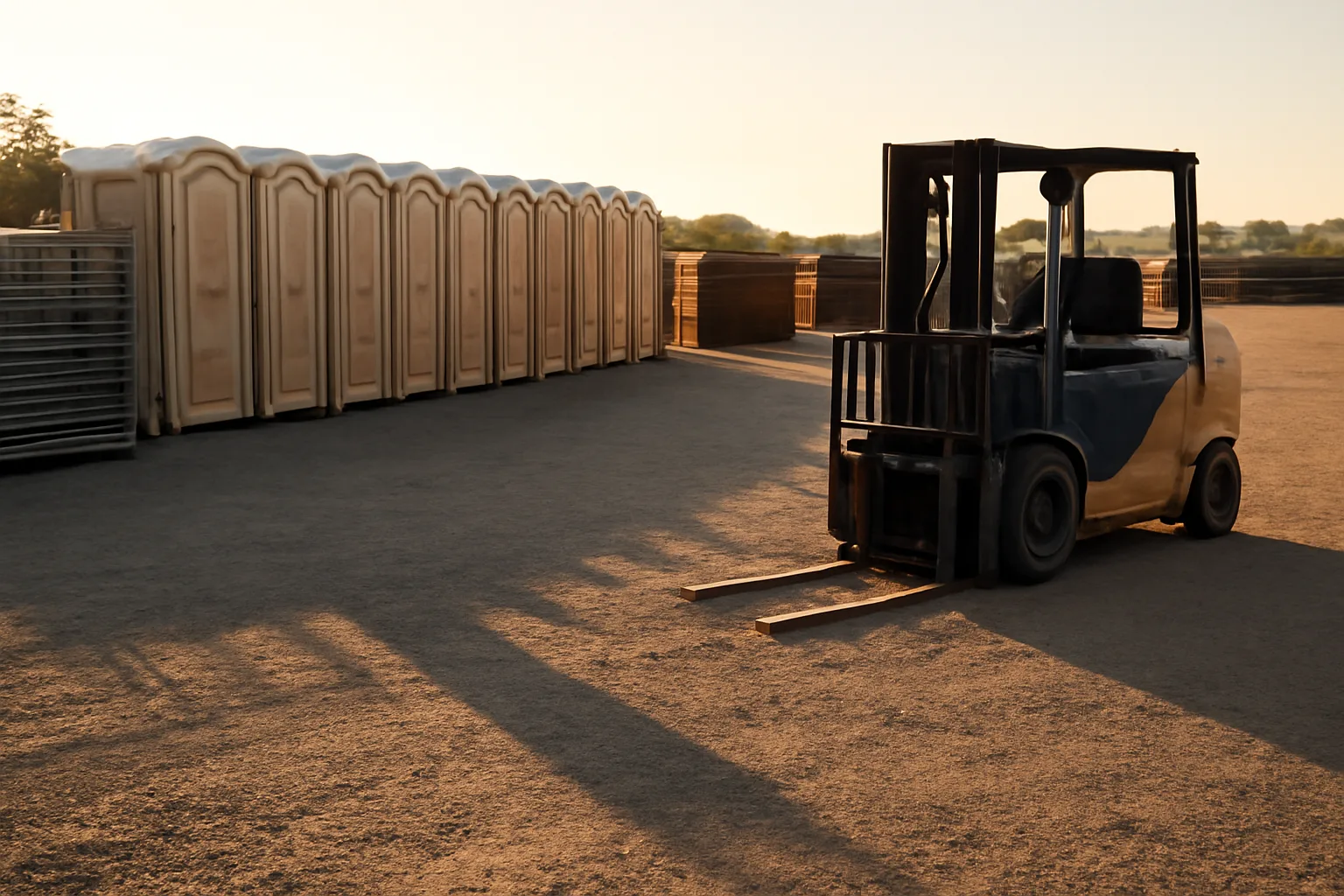
A site services yard is the fenced outdoor base where you store, service, and dispatch the gear construction sites rent. Portable toilets sit there between jobs. Roll-off dumpsters sit there too if that is your line. Fence panels and a lift often share the same gravel. It is a contractor-style lot. It is not a storefront. It is not a landfill.
Census NAICS 562991 (septic tank and related services) is where much of the portable sanitation trade is filed.[15] Dumpster-heavy shops sometimes sit closer to solid waste collection. Fence-heavy shops sometimes sit with construction equipment rental. Use the code that matches what you invoice. Your bank will ask.
People look for a national site services license. I have not found one. The paper is local, and it follows the activity. Pump toilets and you are talking to a state septage or liquid-waste desk. Place dumpsters in a franchise city and you are talking to solid waste staff. Bolt fence into the ground for a fee and a contractor board may want a filing. Confirm each of those with the board that would issue the card.
The reason contractors call you is often OSHA, not marketing. 29 CFR 1926.51 says, "An adequate supply of potable water shall be provided in all places of employment."[1] The same section sets toilet counts on construction jobsites.
| Employees on the jobsite | Minimum facilities under 29 CFR 1926.51 |
|---|---|
| 20 or less | 1 toilet |
| More than 20, fewer than 200 | 1 toilet seat and 1 urinal per 40 workers |
| 200 or more | 1 toilet seat and 1 urinal per 50 workers |
That table governs the jobsite you serve. It does not license your yard. Yard rules are zoning, stormwater, oil storage, truck registration, and whatever waste you actually touch. OSHA 29 CFR 1926.51 requires 1 toilet for 20 or fewer employees on a construction jobsite.
How do you start a site services yard?
You start a site services yard by making the lot legal, then filing entity paper, then adding only the permits that match what you will haul. Do not buy a fleet in week one. That is how cash disappears.
Form an LLC or corporation with your state. Get an EIN from the IRS online. The IRS does not charge for that number.[9] The SBA start guide is the dull sequence that works: pick a structure, get tax IDs, then apply for the licenses your city and state actually list.[10][11] Take a simple site plan to the zoning counter. Show outdoor storage, truck turns, and where wash water goes. If the zone does not allow a contractor or industrial yard, walk away.
Open a business bank account. Price insurance before you price toilets. I cannot give you an honest national premium. Anyone who can, without your address and loss history, is guessing.
Then buy a small unit count and one truck you can keep reliable. Sharing a fenced lot cuts the land bill if the lease and the city both allow it. Read what a site services yard actually costs in year one before you sign a long industrial lease.
If the truck crosses FMCSA's commercial motor vehicle line in interstate work, get the USDOT number before the first loaded trip.[8] If you pump toilets, call the state environmental agency about transporter registration and how 40 CFR 503 applies if anyone land-applies the waste.[13] Confirm forms and fees with that board. I will not invent a processing time.
What licenses does a site services yard actually need?
A site services yard needs a local business license, zoning approval for outdoor storage, and then only the activity permits that match the work. There is no single federal yard license.
The SBA states that licenses come from your city, county, and state, and that the mix depends on what you do.[10] I would walk in this order. City or county business tax certificate. Zoning verification letter, or a conditional use if the code requires it. State environmental transporter credentials if you pump toilets or haul regulated waste. Solid waste franchise or hauler registration if you place dumpsters in a city that still runs exclusive hauling. An FMCSA USDOT number (and a motor carrier number if you haul other people's goods for hire across state lines). A sales tax permit if you rent or sell tangible goods.
| Activity | Paper to ask about | Who confirms |
|---|---|---|
| Toilet pump-out | Septage or liquid-waste transporter | State environmental agency |
| Dumpsters in a franchise city | Hauler agreement or registration | City or county solid waste |
| Fence install for a fee | Contractor license (sometimes) | State contractor board |
| Interstate truck over 10,001 lb | USDOT number | FMCSA |
| Outdoor wash and maintenance | Industrial stormwater NOI | EPA or state NPDES |
| Oil storage over 1,320 gallons | SPCC plan | EPA under 40 CFR 112 |
Do not collect a contractor license just in case unless your state board says delivery-plus-install is contracting. Boards differ. Confirm with the board. California is not Florida. If you already operate and you are heading into a renewal year, start with the state page that matches you, such as site services yard renewal in California or site services yard renewal in Florida.
I would skip paid license expediters until you have the checklist from the agency website. Most of the early paper is forms you can file yourself.
Do you need zoning before you lease the land?
Yes. Get zoning in writing before you pay a deposit on the lot. Outdoor storage of toilets, dumpsters, and trucks is often limited to industrial or heavy commercial districts. Some towns also ban it on arterial frontage.
Ask planning for the zone district, whether outdoor storage is permitted or conditional, setback and screening rules, and whether a site plan review is required. Get the answer on letterhead or in an email from staff. A landlord saying other guys parked trucks here is not an approval.
Wash water and storm drains matter at this visit. If you wash toilets or trucks, the city may want that water in a sanitary sewer with a pretreatment OK, not in the gutter. That single plumbing fact has killed more yard deals than rent.
Parking count, hours, and noise get attached as conditions. Live with them or pick another parcel. Fighting a neighbor war in year one is a waste of money. I would rather spend a month on a second site tour than spend a year defending a cheap lot that was never legal.
If the parcel sits in a floodplain or over a wellhead protection area, ask that question out loud. Outdoor waste handling and fuel tanks get extra review there. Confirm with planning and with the local sewer district, not with the listing broker.
What stormwater and oil rules hit an outdoor yard?
Most outdoor yards with vehicle maintenance, equipment cleaning, or exposed material storage need industrial stormwater coverage under EPA's Multi-Sector General Permit or the state NPDES permit that replaced it.[5] Coverage is not optional because the lot only stores empties. If rain can touch drips, wash water, or oily parts, the permit writer will treat you as industrial.
EPA's 2021 MSGP is the federal template. Many states run their own industrial general permit. File the notice of intent with the agency that has NPDES authority where the yard sits. Confirm the form with that agency. I will not invent a fee.
Oil is the other early trap. 40 CFR 112.1 says this part does not apply when "the aggregate aboveground storage capacity of the facility is 1,320 U.S. gallons or less of oil."[4] Cross that line and you generally need an SPCC plan.[3] Count diesel ASTs, used-oil tanks, and containers 55 gallons or larger. Hydraulic reservoirs on some equipment can count. EPA 40 CFR 112.1 applies an SPCC plan when aggregate aboveground oil storage capacity exceeds 1,320 U.S. gallons.
Used oil from truck service belongs under 40 CFR 279, not in the dirt and not in the dumpster.[6] EPA's used-oil FAQ is the plain-language start. Label the drums. Use a registered collector. Keep the pickup receipts.
If you generate hazardous waste (spent solvent, certain aerosols), EPA's generator categories start at 100 kilograms per month for very small quantity generator status.[7] Stay honest about volume. Crossing a category changes the paper a lot.
When does a site services yard need a USDOT number?
You need a USDOT number when you operate a commercial motor vehicle in interstate commerce that meets FMCSA's definition, including many trucks with a GVWR of 10,001 pounds or more.[8][14] Check the FMCSA page and 49 CFR 390.5 against the actual door sticker weight of your truck, not the sales brochure.
49 CFR 390.5 defines a commercial motor vehicle, in part, as a vehicle used on a highway in interstate commerce to transport passengers or property when it "has a gross vehicle weight rating or gross combination weight rating, or gross vehicle weight or gross combination weight, of 4,536 kg (10,001 pounds) or more, whichever is greater."[14] That sentence is the one I would print and keep in the cab file. 49 CFR 390.5 sets the commercial motor vehicle weight line at 10,001 pounds.
Intrastate-only trucks can still need a state DOT number. Confirm with your state patrol or DMV motor carrier desk. Some roll-off trucks also trip CDL rules based on weight and air brakes. CDL is about the driver. USDOT is about the carrier. Both can apply.
If you haul waste or septage, you may need both transporter credentials and truck credentials. They do not cancel each other. I would not take a loaded interstate trip while the number is pending. That is how you buy a roadside fine.
What does first-year paper actually look like?
First-year paper is a folder set, not a branded binder. Entity docs. EIN letter. Lease and zoning letter. Business license. Insurance certificates. Vehicle titles, cab cards, and a USDOT printout if you have one. A stormwater SWPPP if you are a permittee. An SPCC plan if you crossed 1,320 gallons. Used-oil logs. Septage manifests if you pump. Employee forklift evaluations under 29 CFR 1910.178 if you run a lift.[12] OSHA 1926.250 is the construction storage rule your crews should know when they stage material on someone else's site.[2]
Keep a separate folder for each city you place dumpsters in. Franchise towns will ask for it during a stop.
I like a wall calendar with renewal months, because yard paper dies on anniversary dates, not on your memory. Alabama is not Alaska. Use the state renewal writeups when you get there, including site services yard renewal in Alabama and site services yard renewal in Arizona, then confirm dates with the board. Nobody here can promise a processing time.
Digital scans plus one fire-resistant box. That is enough. Fancy compliance software in year one is usually a waste of money. The habit that matters is putting the pickup receipt in the folder the same day the truck returns.
How much does a site services yard cost in year one?
Year-one cost is land plus units plus trucks plus insurance plus the unglamorous paper. I will not invent a national total. Rents for industrial yards swing hard by metro. A toilet costs a different number in a used auction than it does from a factory. Fuel is a weekly bill, not a line you guess once.
What I can tell you is the shape. Land and screening eat cash first if you do not share. Units come next. A truck with a title loan is how yards go broke in month eight. Read the year-one cost breakdown at what a site services yard actually costs in year one. For a New England example of how local fees stack, see site services yard cost in Connecticut.
Shared lots change the math. If you split fence, gravel, and a gate with another operator, the fixed bill drops. SiteServicesPath sells a $249 one-time Shared-Yard Economics Kit for that worksheet, and the public explainer is at the shared-yard bill a site services yard actually pays. You can build the same sheet yourself in an afternoon.
Do not finance wash equipment until you have a sewer connection that the city already accepted. A shiny pressure washer that dumps to the creek is a violation, not an asset. Hold a cash reserve for gravel, screening slats, and the first insurance audit. Those three bills arrive before the first fat rental month.
What insurance do yards usually carry?
Yards usually carry commercial general liability, commercial auto, inland marine on the units, and workers' comp once you have employees. Umbrella gets added when a GC contract demands it.
I do not have a clean national premium study I trust. Anyone quoting you a single monthly number without your loss runs, radius, and commodity is selling, not advising. Ask three independent agents who already write waste, sanitation, or equipment rental. Make them price the same limits.
Contract insurance is a different pile. Primes often name additional insured, waiver of subrogation, and a per-occurrence CGL limit written in the subcontract. Read that exhibit before you bid. If you cannot buy the limit, do not bid the job.
Auto is where sanitation and roll-off accounts get expensive. Dumpster trucks and wet lines change underwriting. Tell the truth about radius and about whether you pump. A cheap policy that excludes pollution or that misstates your commodity will not be there when a hose fails over a storm drain.
Pollution liability is worth a quote if you handle septage or sit over a catch basin. It is not automatically included in a small business package policy. Get that answer in writing from the agent before you park tanks.
Should you start with toilets, dumpsters, or fence?
Start with one commodity you can service with one truck and one skill. I would start with portable toilets if I already understand pump-out rules. I would start with fence panels if I want to stay out of waste paper. I would not start with every line at once.
Toilets have recurring weekly service revenue and a clear OSHA demand on the jobsite.[1] They also drag you into septage rules and wash-water plumbing. Dumpsters have weight tickets, overloaded boxes, and city franchise fights. Fence has theft, delivery labor, and possible contractor-license questions.
Mixing every line in month one multiplies permits and idle inventory. Earn the right to add a product after you have 90 days of on-time pickups. Events are seasonal. Construction is lumpy. A small municipal or GC blanket in writing beats a stack of one-day festival dreams.
If a customer asks you to add dumpsters because you already drop toilets, pause. That is a new paper path in a lot of cities. Price the franchise call and the extra truck before you say yes.
What equipment should you buy first?
Buy a reliable used service truck or flatbed, a forklift you can train on under 29 CFR 1910.178, and only as many revenue units as you can place in 60 days.[12] Everything else waits.
A new restroom trailer as your first asset is usually a waste of money. High ticket, high damage, slow rental velocity unless you already have event accounts. Same for a brand-new roll-off truck if you have four boxes.
I like used toilets from a known fleet, a simple fence inventory in one panel size, and hand tools you can lock up. Cameras on the lot, yes. A custom paint scheme, no.
If you share a yard, agree in writing who owns the forklift and who pays when someone forks a tank. That argument will happen.
Shop equipment that leaks oil will push you toward SPCC and stormwater faster. Factor that. A 1,000 gallon diesel AST plus two 55 gallon used-oil drums plus a 300 gallon waste-oil tank is how quiet yards suddenly need a plan.[4] Keep tanks labeled and keep the spill kit where a night driver can find it.
How do state renewals work after year one?
Renewals are agency-specific. Your city business license, your state transporter credential, your stormwater NOI, and your FMCSA MCS-150 update do not share a birthday. Put each one on a calendar with a 60-day reminder.
I will not quote a renewal fee or a processing time. Those change, and they are not national. Confirm with the board that issued the credential. Use a state guide only as a map to the form names, then open the live agency page. Site services yard renewal in Colorado is an example of that map.
Missed FMCSA biennial updates and lapsed waste transporter cards are the quiet killers. They show up at a roadside stop or when a GC's vendor portal refreshes.
If you add a commodity mid-year (you started in fence, now you pump toilets), treat it as a new permit, not a renewal.
SiteServicesPath is an independent publisher, not a law firm and not a service company. If you want the paid worksheet, it lives at /start. The rest of this page stands without it.
What facts can a licensing board actually confirm?
A board can confirm whether your activity needs their credential, what form to use, what they currently charge, and whether your filing is complete. They will not confirm your zoning. They will not bless your business model.
Bring them a one-paragraph description of what you do. Example: we store empty portable toilets and a service truck at 100 Industrial Way and we pump units on construction sites inside this county. Vague pitches get vague answers.
Write down the person's name, the date, and the form number they cite. Follow up in email so you have a record. If two agencies disagree, make them talk to each other. You should not guess in the gap.
Federal numbers you can cite without a phone call include the OSHA toilet table in 1926.51, the 10,001 pound CMV line in 49 CFR 390.5, the 1,320 gallon SPCC line in 40 CFR 112.1, and the 100 kg VSQG line on EPA's generator page.[1][14][4][7] Everything with a dollar sign or a due date gets confirmed locally.
If a salesperson hands you a national checklist with fees already filled in, throw it out. Boards change forms. Your file should name the statute or the form number, not a blog.
Frequently asked questions
What is a site services yard?
A site services yard is the fenced outdoor base where an operator stores, maintains, and dispatches jobsite support units and the trucks that move them. Portable toilets and dumpsters are the usual inventory. Fence panels show up if that is your line. It is not a landfill and it is not a retail store. The paper follows the land, the fleet, and whatever you haul or install.
How do you start a site services yard?
Lock zoning on an industrial or contractor lot, form an entity, and get a free IRS EIN. Add the city business license and only the state permits that match your work, such as a septage transporter card or a USDOT number. Buy insurance next, then a small set of units and one truck. Confirm every fee with the issuing board. Do not order a fleet before the land is legal.
Do I need a contractor license to deliver portable toilets?
Often no, if you only deliver, service, and pick up units. Installation of fence, erosion controls, or plumbing can flip you into contractor-board territory. States split this differently. Ask the contractor board in the state where the work happens, with a written description of the exact tasks. Do not buy a license you cannot use, and do not skip one the board says you need.
Can I run a site services yard from my house?
Almost never, if you mean stacked toilets, dumpsters, or nightly truck traffic. Residential zoning usually bans outdoor contractor storage. A home office for dispatch can be fine. The inventory still needs a legal lot. Get the zoning answer in writing before you park the first unit at home. Neighbor complaints are how these home yards die.
What is the SPCC 1,320 gallon trigger?
Under 40 CFR 112.1, a facility with aggregate aboveground oil storage greater than 1,320 U.S. gallons generally needs an SPCC plan. Count diesel tanks, used-oil tanks, and containers 55 gallons or larger. The 1,320 gallon line is an exemption ceiling, not a goal. Confirm how your tanks are counted with someone who can stamp the plan if you are close.
Do I need industrial stormwater coverage for empty toilets?
You might. EPA's industrial stormwater program (the 2021 MSGP or your state version) looks at exposed industrial activity, vehicle maintenance, and equipment cleaning, not at whether the toilets are empty. Wash water and oily drips are what trigger reviewers. Ask the state NPDES authority. File only the form they name. I will not invent a fee or a wait time.
Do my drivers need a CDL?
They need a CDL when the vehicle and the cargo meet state and federal CDL tests, usually tied to weight, air brakes, or combination class. A light service pickup may stay non-CDL. A loaded roll-off or a heavy pump truck often does not. Check the door-rated GVWR and your state DMV CDL manual. USDOT registration is a separate question from the driver's license class.
What NAICS code does a site services yard use?
Use the code that matches revenue. Census NAICS 562991 (septic tank and related services) is the usual home for portable toilet rental and pump-out. Solid waste collection or construction equipment rental may fit dumpsters or fence better. Banks and insurers will ask. Pick one primary code and stay consistent on tax and application forms.
Is septage hauling a separate permit from the business license?
Yes. A city business license does not replace state septage or liquid-waste transporter credentials, and it does not replace 40 CFR 503 questions if you land-apply. Call the state environmental agency and ask for the transporter form by name. Keep manifests. Confirm disposal site acceptance in writing. The business license only lets you exist as a local taxpayer.
How long does licensing take?
Nobody honest can give you a national timeline. Zoning hearings, transporter cards, and USDOT activations move on different clocks, and those clocks change. Ask each issuing board for its current instructions. Build slack into your lease start date. Ignore anyone who sells you a promised approval date. Confirm fees and forms with the board that issues them.
Can I share a yard with another operator?
Yes, if zoning allows multiple occupants and the lease says so. Write down who owns the lift, who files stormwater paper, and who pays for a spill. Shared gates fail when those items stay verbal. A simple cost-split sheet is enough. Confirm the landlord and the city both accept a shared occupancy before you move units in.
What insurance do general contractors usually ask for?
Many GC contracts name commercial general liability with additional-insured wording, commercial auto, and workers' comp. Dollar limits live in the subcontract exhibit, not in a national rule I can cite. If you cannot buy the limit, skip the bid. Have an agent who already writes sanitation or waste read the exhibit before you sign.
Do I need an EIN if I am a single-member LLC?
Get one anyway. The IRS issues EINs online at no charge, and banks, carriers, and vendor portals will ask for it. Using your Social Security number for a yard that stores waste and runs trucks is a mess. The IRS page is the only filing path I would use. Beware sites that charge for the same form.
Sources
- OSHA 29 CFR 1926.51 Sanitation: Requires potable water at places of employment and sets construction-jobsite toilet counts, including 1 toilet for 20 or fewer employees.
- OSHA 29 CFR 1926.250 General requirements for storage: Sets construction material storage rules that apply when crews stage gear on jobsites.
- U.S. EPA Spill Prevention, Control, and Countermeasure (SPCC) Rule Overview: Facilities above the applicability thresholds must prepare and implement an SPCC plan.
- eCFR 40 CFR 112.1 General applicability: Exempts facilities whose aggregate aboveground oil storage capacity is 1,320 U.S. gallons or less, which is why plans apply above that number; also addresses 55-gallon countable containers and the 42,000 gallon buried-capacity figure.
- U.S. EPA 2021 Multi-Sector General Permit (MSGP): Federal industrial stormwater permit template covering outdoor industrial activity, including vehicle maintenance and equipment cleaning.
- U.S. EPA Managing Used Oil: Answers to Frequent Questions for Businesses: Used oil from vehicle and equipment service is managed under the used-oil rules, not dumped on the ground or in ordinary trash.
- U.S. EPA Categories of Hazardous Waste Generators: Very small quantity generator status begins at 100 kilograms or less of hazardous waste per month.
- FMCSA Do I Need a USDOT Number?: States when a motor carrier must obtain a USDOT number for commercial motor vehicles in interstate commerce.
- IRS Apply for an Employer Identification Number (EIN) Online: Businesses can apply for an EIN online directly with the IRS at no charge.
- U.S. Small Business Administration Apply for licenses and permits: Business licenses and permits are issued by city, county, and state agencies and depend on the type of business.
- U.S. Small Business Administration 10 steps to start your business: SBA's start sequence covers structure, tax IDs, and then licenses after the entity exists.
- OSHA 29 CFR 1910.178 Powered industrial trucks: Requires training and evaluation before employees operate forklifts and other powered industrial trucks.
- U.S. EPA Biosolids Laws and Regulations: 40 CFR 503 is the federal rule for sewage sludge and related land application, which states use when regulating septage.
- eCFR 49 CFR 390.5 Definitions: Defines a commercial motor vehicle in interstate commerce at a GVWR, GCWR, GVW, or GCW of 10,001 pounds or more.
- U.S. Census Bureau 2022 NAICS 562991 Septic Tank and Related Services: NAICS 562991 is the Census classification for septic tank and related services, the usual home for portable sanitation work.