Last updated 2026-08-18
TL;DR
Connecticut has no single "site services yard board." You assemble three layers instead: a business registration with the Secretary of the State, a local zoning or special permit from your town, and, depending on what you store or handle, an environmental permit from DEEP. State fees run a few hundred to a few thousand dollars. Plan for 90 to 180 days start to finish.
What exactly is a site services yard in Connecticut?
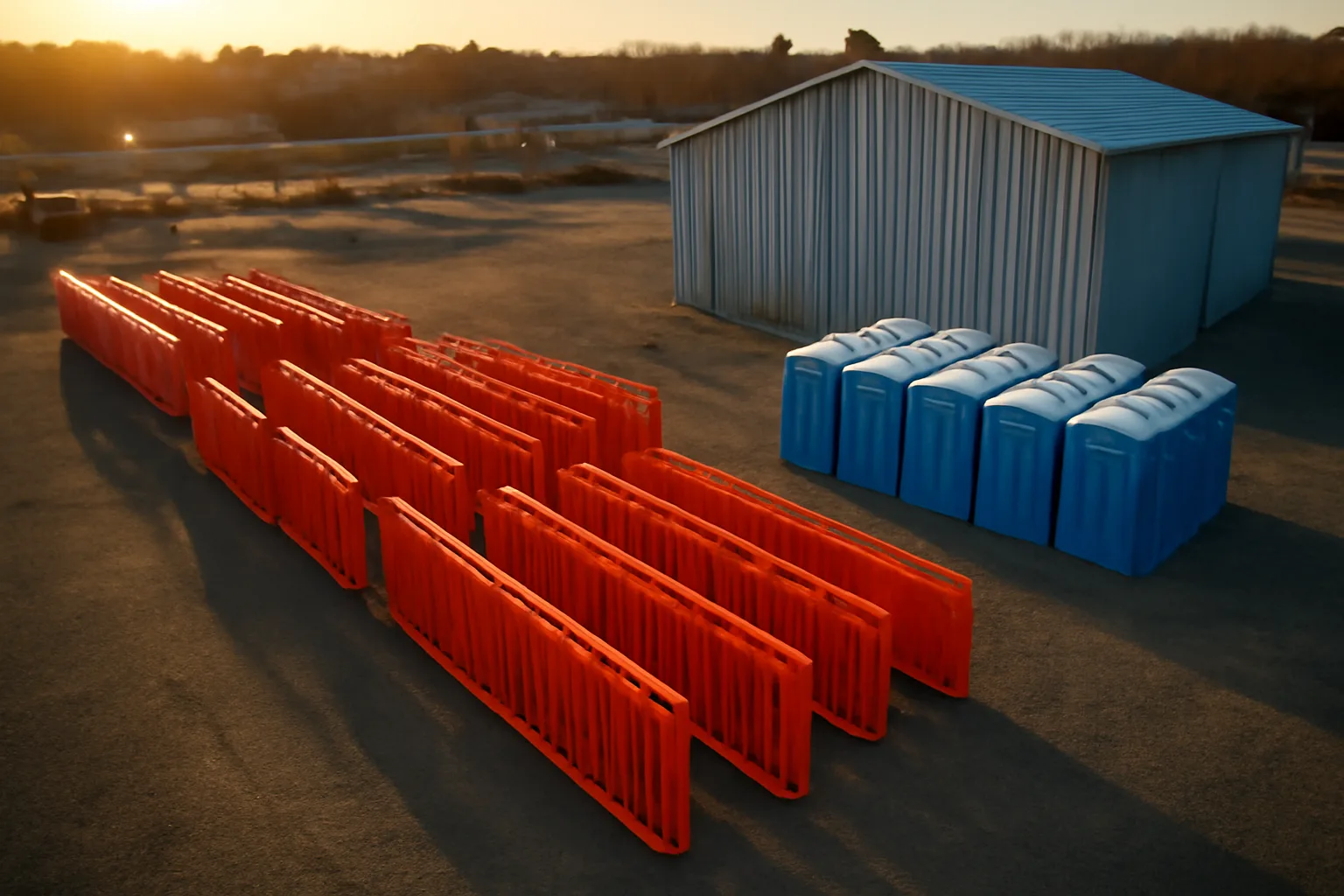
A site services yard is a staging lot where construction gear waits between jobs. Portable toilets, temporary fencing, scaffolding, roll-off containers, generators, and similar equipment. In Connecticut, the term maps to no single licensed trade. The state treats it as a commercial storage or equipment-rental operation, so the regulatory path gets assembled from several agencies instead of handed to you by one board.
That matters on day one. Search the Connecticut licensing portal for a "site services yard license" and you find nothing. What exists are the pieces: a registered business entity, a local land-use permit, and possibly an environmental registration if you handle fuel, waste, or certain materials. Some operators also need a contractor license when they do installation work, more than storage and dispatch.
Connecticut's Department of Consumer Protection (DCP) handles contractor-class licenses [1]. The Secretary of the State's office handles entity registration [2]. The Department of Energy and Environmental Protection (DEEP) handles environmental thresholds [3]. Your local zoning commission handles land use. None of these agencies uses the phrase "site services yard," so you have to know which boxes are yours to check.
Do you need a license for a site services yard in Connecticut?
It depends on what you do, more than what you store. Here's how to reason through it.
Every for-profit business operating in Connecticut registers with the Secretary of the State. That holds for an LLC, a corporation, or a sole proprietor working under a trade name [2]. This is not a license, exactly, but skip it and you create personal liability exposure and can get blocked from pulling permits.
Second piece: if your crews perform construction work at customer sites, like setting up temporary fencing, placing roll-off containers, or installing safety equipment, Connecticut General Statutes Chapter 400 defines who needs a Home Improvement Contractor (HIC) registration under DCP [1]. Commercial construction work is regulated differently from residential, but certain installation tasks can still pull you in. Confirm with DCP which category your work falls into before you assume you're exempt.
Third piece, and this catches new operators off guard: if your yard stores petroleum products, engine fluids, or you wash and maintain equipment on-site, DEEP may require stormwater general permit coverage. Connecticut's General Permit for the Discharge of Stormwater Associated with Industrial Activity covers SIC classifications that include equipment rental and repair [3].
Fourth piece, and the one that controls everything: your local zoning designation decides whether you can run a yard on that lot at all. Many Connecticut towns bar outdoor storage of heavy equipment in commercial zones without a special permit. Some require site plan review that pulls in state-level environmental review too.
Plainly: yes, you need licenses and permits, and they come from at least three different places.
How much does a site services yard cost to set up in Connecticut?
Costs split into two buckets. State fees are predictable. Local fees swing so hard that any single number would mislead you.
Here are the state fees you can confirm directly:
| Item | Fee range | Source |
|---|---|---|
| LLC formation (SOTS) | $120 | CT Secretary of the State [2] |
| Trade name registration | $10 per name | CT Secretary of the State [2] |
| DCP contractor registration (HIC) | about $220 per two-year cycle (confirm current) | CT DCP [1] |
| DEEP stormwater industrial permit | $525 to $2,625 by acreage (confirm current) | CT DEEP [3] |
| Local zoning application | $50 to $5,000+ | Varies by municipality |
| Site plan review (if required) | $200 to $15,000+ | Varies; some towns bill outside engineers |
The DCP Home Improvement Contractor registration was roughly $220 for a two-year cycle on the most recent published schedule, but Connecticut adjusts these periodically. Confirm with DCP before you budget [1].
The DEEP stormwater industrial general permit ties fees to facility acreage. Published amounts have ranged from $525 for the smallest covered facilities up to $2,625 for larger ones. Cross certain thresholds or store regulated materials and you may need an individual permit, which costs more and moves slower [3].
Local costs are the wild card. A simple zoning approval in a rural Connecticut town might cost under $200. A special permit in a denser town, with a public hearing, a traffic study, and engineering review, can run $5,000 to $15,000 in application and professional fees before you break ground. Call the zoning office in your target town before you sign a lease.
Total first-year state-level spend for a typical new operator lands around $900 to $3,500 in permits and registrations, before professional fees. Add local costs and you're realistically at $1,500 to $20,000 depending on the site and the municipality.
How long does a site services yard take to get approved in Connecticut?
State business registration is quick. Filing an LLC online with the Secretary of the State takes minutes and processes in one to two business days [2]. That is not your bottleneck.
DCP contractor registration, if you need it, takes two to four weeks from a complete application. Incomplete applications get returned, which restarts the clock. Their site lists processing targets but doesn't guarantee them; confirm current timelines with DCP [1].
DEEP stormwater coverage starts with a Notice of Intent (NOI). DEEP reviews the NOI and issues an authorization letter, typically 30 to 60 days from a complete submission. If DEEP decides your activity doesn't qualify for the general permit and needs an individual permit, you're looking at six months to over a year [3].
Local zoning is where timelines get genuinely unpredictable. Connecticut Planning and Zoning Commissions meet on schedules that vary by town, usually monthly. Miss the deadline for one meeting and you wait for the next. A special permit that requires a public hearing adds statutory notice periods on top. An uncontested application in a supportive town can move in 60 to 90 days. A contested one, or one in a town with a long calendar, can take six months or more.
Plan for 90 to 180 days from first application to operating authorization if everything goes smoothly. One snag at zoning stretches that window. Most experienced operators here say six months is the safe number, and they start the local zoning conversation before touching anything else.
What does Connecticut's zoning process actually look like for a yard?
Connecticut hands zoning authority to individual towns, not the state, under Connecticut General Statutes Section 8-2 [4]. Every town writes its own zoning regulations, its own special permit criteria, and its own site plan rules. There is no statewide template.
For a site services yard, four hurdles show up over and over.
Use classification comes first. Confirm whether outdoor equipment storage is permitted, allowed by special permit, or prohibited in your target zone. In many Connecticut towns, heavy equipment storage is legal only in industrial zones. Some allow it in general commercial zones with a special permit. A few rural towns run looser.
Site plan requirements come next. Most towns want a plan showing lot dimensions, setbacks, drainage, stormwater controls, truck access, and often lighting and screening. You'll likely need a licensed engineer to prepare it.
The public hearing is third. Special permits almost always require one in Connecticut. Neighbors can speak. Objections about noise, traffic, and appearance surface here. Solid documentation of your hours, your operations, and your traffic patterns helps you answer them.
Conditions are fourth. Even an approved special permit arrives with strings: fencing, hours of operation, limits on what stays outdoors, drainage improvements. Read these before you sign a lease or close on a property, because they run with the land-use approval, not with you personally.
A pre-application meeting with the local zoning officer is free in most towns and saves weeks of guesswork. When in doubt, take it.
What environmental permits does DEEP require for a Connecticut site services yard?
This is where operators get surprised most often. DEEP permitting can reach your yard even when you think you're only parking equipment.
Stormwater is the main trigger. If your yard falls under an industrial SIC code and has any outdoor industrial activity, including equipment storage, washing, or maintenance, you likely need coverage under DEEP's General Permit for the Discharge of Stormwater Associated with Industrial Activity. That means a Notice of Intent, a stormwater pollution prevention plan (SWPPP), and annual reporting [3].
Above-ground petroleum storage is the second trigger. Store diesel or other petroleum products in above-ground tanks over a regulated aggregate threshold and Connecticut's storage rules apply. Thresholds have shifted across regulatory cycles, so confirm the current number with DEEP before you install tanks.
Hazardous waste is the third. If equipment cleaning or maintenance generates waste solvents, oils, or other regulated materials, you may count as a small or large quantity generator under DEEP's hazardous waste program, which follows federal RCRA rules [6].
DEEP's online eFiling system handles most applications, though some still require paper. Processing times for stormwater NOIs have historically run 30 to 60 days for complete submissions, but staff capacity moves the actual number. Confirm the current process on DEEP's stormwater permit page before you start [3].
Do you need a contractor license if you deliver and set up equipment?
Maybe. This is a genuinely gray area in Connecticut, and the answer turns on what you do at the customer's site.
Connecticut General Statutes Chapter 400 governs home improvement contractors [1]. If your work is purely commercial, meaning you deliver portable toilets to a commercial construction site rather than a residence, HIC registration generally doesn't apply.
But send crews to residential properties, or let the line between "delivery" and "installation" blur, and DCP's HIC rules can pull you in. The statute defines a home improvement contractor broadly, and enforcement has reached equipment companies that performed setup work at homes.
For commercial-only yards, the sharper licensing questions usually sit with your employees. Do any drivers operate vehicles over 26,001 pounds gross weight? That's a federal CDL requirement administered through Connecticut DMV, not DCP [8]. Do any technicians perform electrical work on generators or lighting? That may require an electrical contractor license under the State Electrical Work Licensing Board [7].
Short version: purely commercial, purely storage and delivery, no construction installation, and you probably don't need a DCP contractor registration. Do anything that looks like construction work at any site, and you should call DCP and describe your specific operations before assuming you're clear.
How do you actually register your site services yard business in Connecticut?
Start at the Secretary of the State's online portal, the Business One Stop. LLC formation costs $120 and processes in one to two business days when filed online [2]. You'll need a registered agent with a Connecticut address, a principal office address, and the names of your members or managers.
Operating under a name different from your LLC? Register that trade name (a DBA) separately for $10 per name through the same portal.
Once the entity exists, get your Federal Employer Identification Number from the IRS. It's free and issued instantly online at IRS.gov [9]. You need it for your state tax registrations.
Register next with the Connecticut Department of Revenue Services for sales and use tax if you'll sell or rent taxable goods or services. Equipment rental is generally subject to Connecticut sales tax [10]. DRS registration is free.
Then layer in the permits above: local zoning, DEEP if triggered, DCP if your operations include contractor work. The Business One Stop portal is a fine starting point for state-level requirements, but it won't stand in for a conversation with your local zoning office or DEEP [2].
If you want to map the full paper path before paying anyone, the SiteServicesPath Shared-Yard Economics Kit at /start walks the sequence in one place for $249 one-time. Every step above is publicly available, though, and this article covers the real sequence for free.
How does Connecticut compare to nearby states for site services yard setup?
Connecticut runs more layered than several neighbors, for concrete reasons. It has 169 municipalities, each with independent zoning authority, which creates more variability than states with county-level zoning. Its DEEP is among the more active state environmental agencies in New England, so stormwater and storage rules carry real teeth.
Against site services yard board in Florida, Connecticut generally costs more and takes longer because most special permit processes build in a public hearing. Florida centralizes state permitting for some business types.
Against site services yard board in Delaware, Connecticut carries more local zoning complexity. Delaware's county-level zoning means fewer jurisdictions to work through.
Against site services yard board in Georgia, Connecticut's environmental requirements, stormwater especially, are stricter in practice.
Here's the honest caveat. If you're already in Connecticut and your customers are here, the comparison doesn't buy you much. Local zoning variability is the factor that actually moves your timeline, and there's no shortcut around it. The operators who move fastest are the ones who call the local zoning office before they sign a lease.
What insurance does a Connecticut site services yard need?
Connecticut sets no single insurance package for site services yards by statute, but your zoning board, your DEEP permit conditions, and your commercial lease each bring their own requirements.
General liability insurance is effectively universal. Most zoning boards and landlords want at least $1 million per occurrence and $2 million aggregate for a commercial operation like this. Confirm the exact figure in your zoning approval conditions.
Commercial auto insurance is required by Connecticut law for any vehicle you run on public roads. Trucks you own or lease for equipment delivery need commercial auto coverage. CDL-class vehicles carry higher minimums under federal Motor Carrier Safety Administration rules [8].
Workers' compensation is required in Connecticut for any business with one or more employees. Not optional. The Connecticut Workers' Compensation Commission enforces it, and penalties for going without run high [11].
Equipment floater or inland marine coverage isn't legally required, but it's practically necessary once you're moving $200,000 or more in portable equipment between sites. One theft or one fire at the yard can end a small operation without it.
Environmental liability insurance is worth pricing if your yard stores fuel or generates regulated waste. Standard general liability policies typically exclude pollution claims. This coverage is specialty and costs more, but DEEP enforcement actions can create real cleanup liability.
What are the most common reasons applications get delayed or denied in Connecticut?
Local zoning denials almost always trace to one of three things: the proposed use isn't permitted in that zone, the site plan doesn't handle stormwater or drainage well enough, or neighbors showed up at the hearing with enough objections to make the commission nervous.
Incomplete applications cause the most delay at every level. DCP returns incomplete contractor registrations. DEEP returns NOIs missing required SWPPP elements. Zoning boards table applications missing plans or engineer certifications. Each return costs at least a month, often two.
Another frequent trap: operators sign a lease, pour money into site improvements, then learn the zoning doesn't allow their use. Connecticut has no general variance path for use prohibitions, only for dimensional requirements. If outdoor equipment storage is banned in your zone, you generally can't get a variance. You'd need a zone change, which is a political process with no guaranteed outcome.
Meeting-cycle timing is a real operational factor too. Submit an application deemed complete two days after the deadline for the next meeting, and you wait a full month. In a town with a crowded calendar, those slips compound.
The single most useful move: call the local zoning administrator before you submit anything, describe your operation in plain terms, and ask whether the proposed use is likely approvable in your target zone. Most will tell you straight.
Frequently asked questions
Do you need a license for a site services yard in Connecticut?
Yes, but there's no single "site services yard license." You need a registered business entity from the Secretary of the State, a local zoning or special permit from your municipality, and potentially a DCP contractor registration and a DEEP stormwater permit depending on your operations. The exact combination depends on what you store, what your crews do at customer sites, and your yard's acreage and drainage. Confirm your specific requirements with each agency.
How much does a site services yard cost to start in Connecticut?
State-level registration and permit fees typically run $900 to $3,500 for a new operator, including LLC formation ($120), DCP registration if required (around $220 for two years), and a DEEP stormwater permit ($525 to $2,625 by acreage). Local zoning application fees add $50 to $5,000 or more, and site plan preparation by a licensed engineer can add $2,000 to $15,000. Total first-year regulatory spend is realistically $1,500 to $20,000 depending on site and municipality.
How long does it take to get approved to open a site services yard in Connecticut?
Plan for 90 to 180 days minimum. State business registration takes one to two business days. DCP contractor registration takes two to four weeks. DEEP stormwater NOI authorization takes 30 to 60 days for complete submissions. Local zoning is the longest and least predictable piece: an uncontested special permit in a cooperative town can close in 60 to 90 days, while a contested application or a missed meeting cycle can push it to six months or more.
Which Connecticut state agency handles site services yard permits?
No single agency handles all of it. The Secretary of the State handles entity registration. The Department of Consumer Protection handles contractor-class licenses. DEEP handles environmental permits including stormwater coverage for industrial activities. Your local Planning and Zoning Commission handles the land-use special permit. Most operators deal with at least three of these four before they're fully authorized.
Does Connecticut DEEP require a permit for a site services yard?
It depends on your operations. If your yard has outdoor industrial activity, including equipment storage, washing, or maintenance, and falls under a covered SIC code, you likely need coverage under DEEP's General Permit for the Discharge of Stormwater Associated with Industrial Activity. That requires a Notice of Intent and a stormwater pollution prevention plan. Confirm whether your specific SIC code is covered by reviewing DEEP's industrial stormwater permit program directly.
Can you run a site services yard out of a commercially-zoned property in Connecticut?
It depends on the town's zoning regulations. Some Connecticut towns permit outdoor equipment storage in general commercial zones with a special permit. Others restrict it to industrial zones only. A few prohibit it in both. Because Connecticut's 169 municipalities each write their own rules, there's no statewide answer. Call the local zoning administrator for your target town and describe your operations before committing to a lease or purchase.
Do CDL drivers at a Connecticut site services yard need any special licensing?
Yes, federally. Any vehicle with a gross vehicle weight rating over 26,001 pounds requires a Commercial Driver's License under federal rules administered through Connecticut DMV. If you haul equipment on trailers that push the combination weight past that threshold, your drivers need the right CDL class. This is a federal requirement under Federal Motor Carrier Safety Administration regulations, separate from any state business licensing.
Is workers' compensation required for a site services yard in Connecticut?
Yes. Connecticut requires workers' compensation coverage for any employer with one or more employees. There are no industry exemptions for site services yards. Coverage must be in place before employees begin work. The Connecticut Workers' Compensation Commission enforces this, and operating without required coverage can bring significant civil penalties and personal liability for the owner.
What is a stormwater pollution prevention plan (SWPPP) and do I need one?
A SWPPP is a written plan documenting how your facility identifies and controls pollutants in stormwater runoff from the site. If DEEP's stormwater industrial general permit covers your yard, you're required to prepare a SWPPP, put its controls in place, and update it when conditions change. DEEP publishes SWPPP content requirements through its industrial stormwater program. Most operators hire a licensed environmental consultant to prepare the initial plan.
Can a sole proprietor operate a site services yard in Connecticut without forming an LLC?
Technically yes, but it's not advisable. A sole proprietor operating under their own name doesn't have to register the entity with the Secretary of the State, though a trade name registration ($10) is required if you use a different business name. The problem is personal liability: as a sole proprietor, your personal assets are directly exposed to business claims, equipment accidents, and environmental enforcement. An LLC provides a liability shield for modest annual cost.
What SIC code applies to a site services yard in Connecticut?
Most site services yards fall under SIC 7359 (Equipment Rental and Leasing, Not Elsewhere Classified) or, when the primary activity involves construction equipment, SIC 1731 through 1799 (Construction Specialty Trades). The code matters because DEEP's stormwater industrial general permit covers specific SIC codes. Choosing the wrong one on a DEEP application can create compliance gaps. Confirm your primary activity description with your accountant or a licensed engineer before filing.
How do Connecticut's site services yard requirements compare to neighboring states?
Connecticut is more complex than most neighbors, mainly because of its 169 independent municipal zoning authorities and DEEP's active enforcement of stormwater and storage rules. States with county-level zoning, like Delaware, have fewer jurisdictional variables. Connecticut's setup costs and timelines generally run higher than southeastern states like Georgia or Florida, though the regulatory rigor gives you cleaner operating certainty once permitted. Local zoning variability is the biggest practical difference.
What happens if you operate a site services yard in Connecticut without the required permits?
Consequences range from cease-and-desist orders and fines to personal liability for cleanup costs. Operating without local zoning approval exposes you to enforcement by the municipal zoning enforcement officer, including daily fines and orders to vacate. Operating without DEEP stormwater coverage can trigger enforcement actions with civil penalties. Operating without a required DCP contractor registration risks fines and an inability to collect payment on contracts. Connecticut agencies do enforce these.
Sources
- Connecticut Secretary of the State, Business Services: LLC formation in Connecticut costs $120 and processes in one to two business days when filed online; trade name registration costs $10 per name
- Connecticut DEEP, Stormwater General Permits: DEEP's industrial stormwater general permit requires a Notice of Intent and SWPPP for covered industrial activities including equipment storage and rental; permit fees range from $525 to $2,625 depending on acreage
- Connecticut Office of Policy and Management: Connecticut's regional planning bodies publish guidance that affects how many towns approach industrial and commercial land uses
- Connecticut DEEP, Hazardous Waste: Connecticut DEEP administers hazardous waste generator requirements aligned with federal RCRA rules; generators of waste solvents and oils from equipment maintenance may be classified as small or large quantity generators
- Federal Motor Carrier Safety Administration, Commercial Driver's License: Federal law requires a Commercial Driver's License for any vehicle with a gross vehicle weight rating over 26,001 pounds, administered through state DMVs
- IRS, Apply for an Employer Identification Number (EIN) Online: Federal Employer Identification Numbers are issued free and instantly through the IRS online application
- Connecticut Department of Revenue Services, Informational Publications: Equipment rental is generally subject to Connecticut sales and use tax; businesses must register with DRS before collecting
- Connecticut Workers' Compensation Commission: Connecticut requires workers' compensation coverage for any employer with one or more employees; the Workers' Compensation Commission enforces this requirement